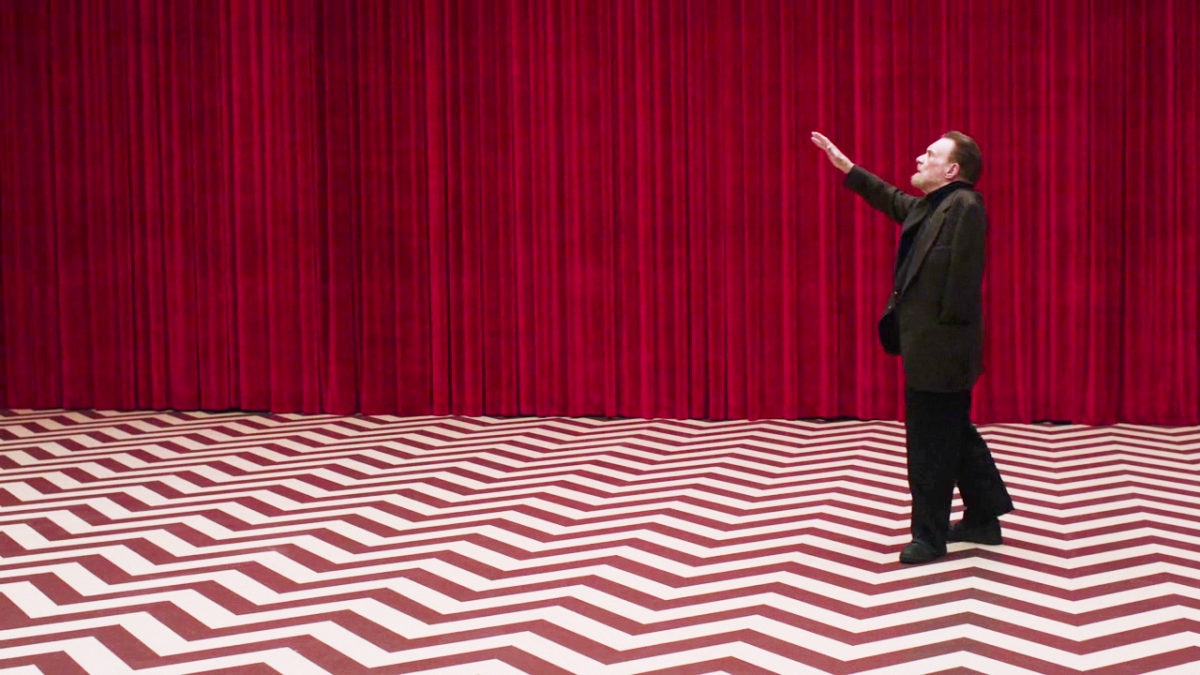
Return(s) to Troy

What is Twin Peaks: The Return all about? Is there a way to synthesise the whole season in a few words – not so much the narrative, but its underlying aims?

It seems to me that season 3 is fundamentally concerned with the return of the soul to the One (“from multiplicity, to duality, to unity“, to quote the Maharishi Mahesh Yogi). Contrary to what was at stake in the original opening credits of Twin Peaks in the 1990s – which described the process of division, from the original unity of the Cosmic Tree (the axis mundi) to the various elements that constitute our universe (earth, fire, air, water) – season 3 appears concerned with an idea not unlike that of the Big Crunch in cosmology, the final contraction of all things into one point – lights out!

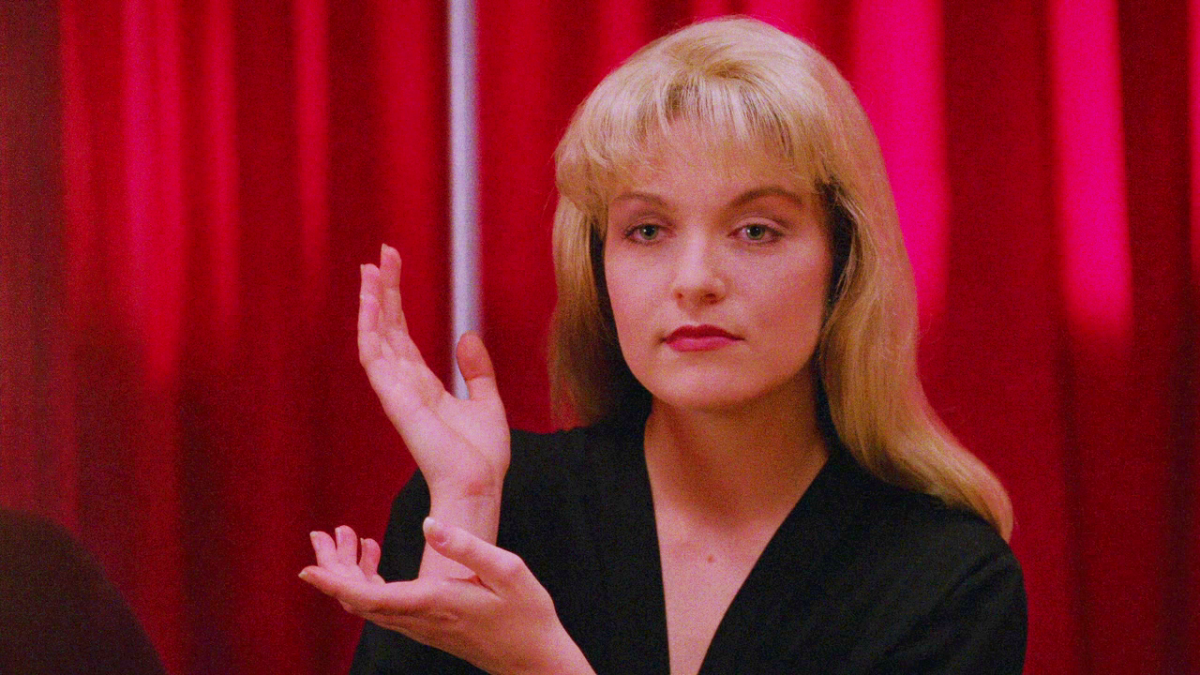
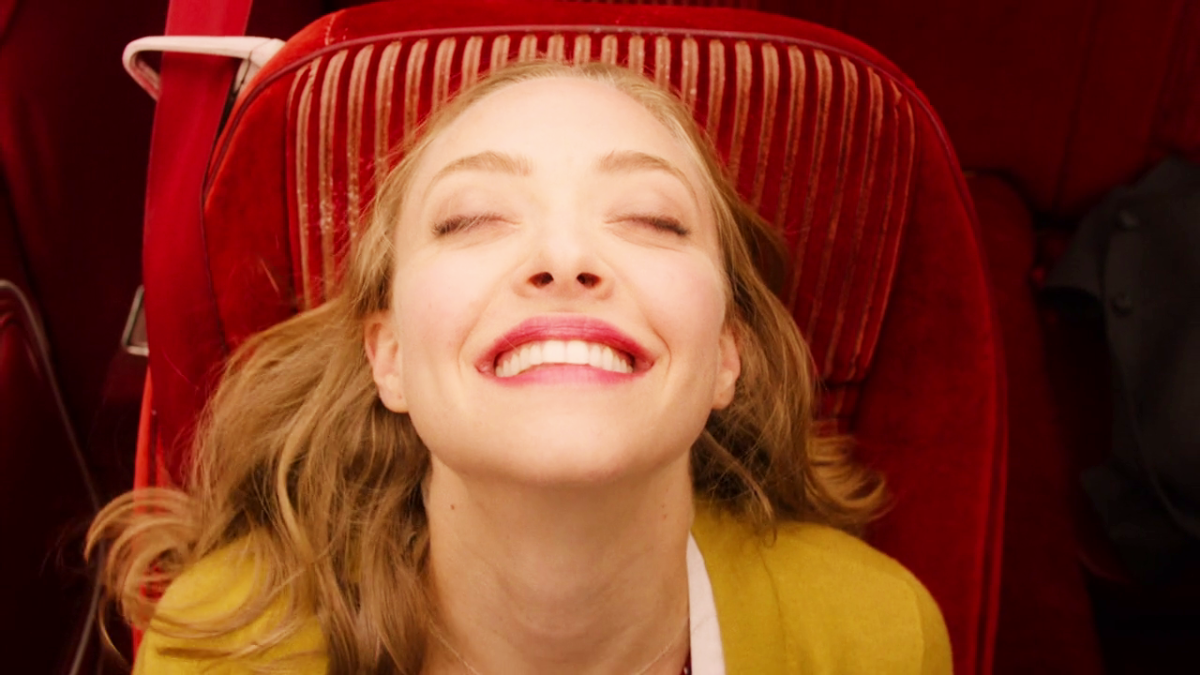
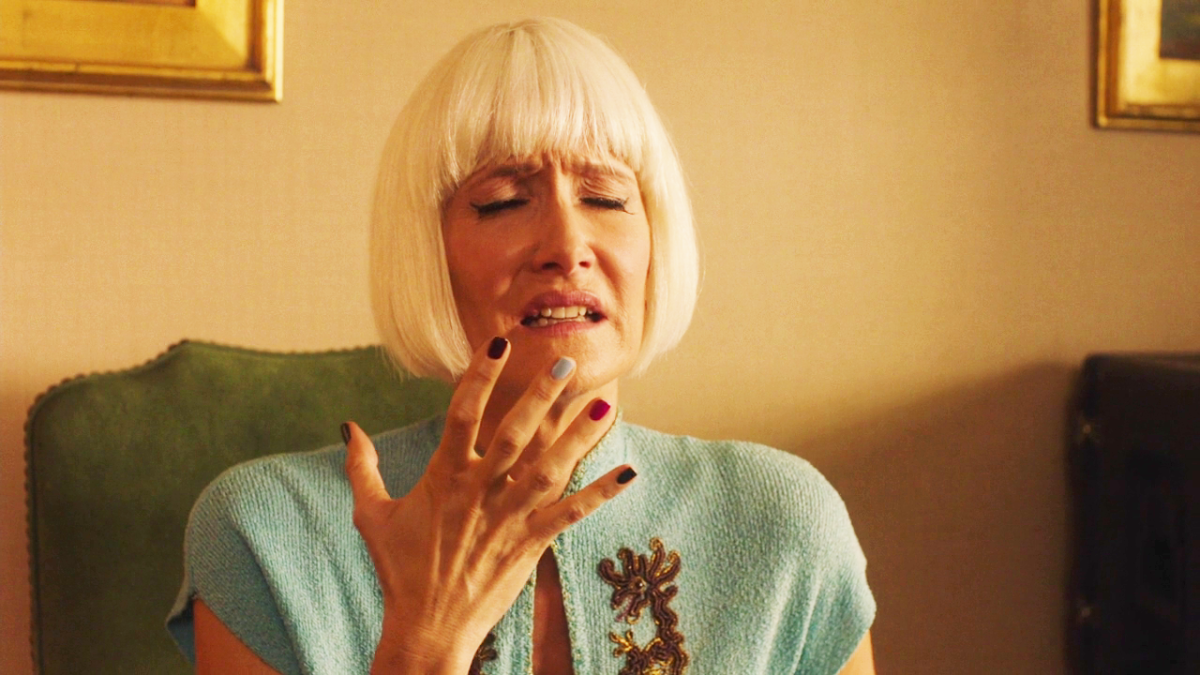
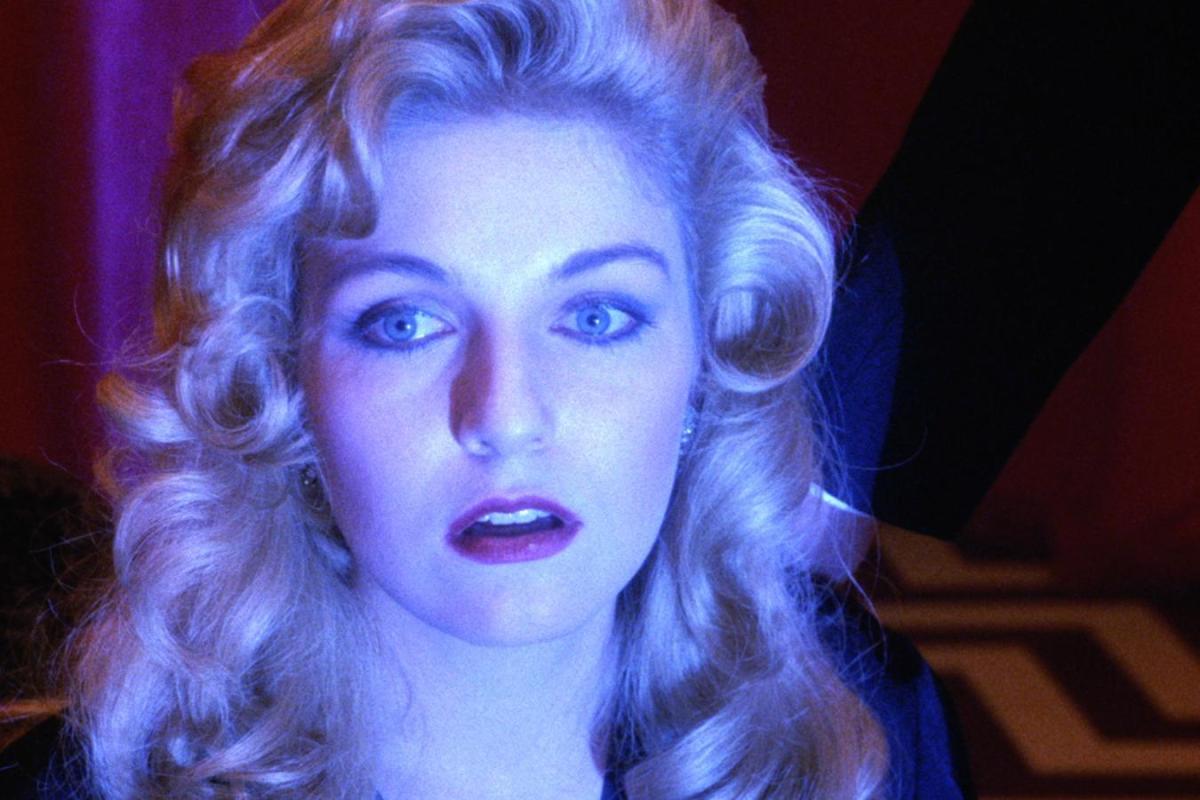
So Twin Peaks: The Return is a return of and to Twin Peaks, but it is also a closing of the book of life, as symbolised by the appearance of its last Page (Carrie) in episode 18, whose trip to the bottom of the dark night alongside Richard/Cooper leads to the extinction of all fires. Everything starts and ends with Laura Palmer in Twin Peaks – she is truly “the One”. “The Alchemist postulates as his first principle the existence of a certain Universal Solvent in the homogeneous substance from which the elements were evolved… there is but one element in the universe” (Helena Blavatsky, The Key to Theosophy).
Laura.jpg
Laura is “the One”

Here is another quote from the same book which tells us more about the aims of Theosophy, of central importance in gaining a clear understanding of Twin Peaks: “Theosophy considers humanity as an emanation from divinity on its return path thereto”. Blavatsky goes on in the following statement: “Every thought, desire, or action affects in some measure the equilibrium of the universe. Once its harmony has been disturbed, the universe seeks to return to balance; the process of seeking to restore equilibrium is what we call karma“. The balance of the universe has been disrupted by the atomic blast of episode 8 and by Cooper’s actions in episode 17, which changed the flow of Time. As a result, a new balance needs to be found that necessitates a “reset” and “reboot” of the whole cosmos.

As always with Twin Peaks, it is possible to read the same facts from several angles. It is never “either/or” in this universe on which preside two creators (Lynch and Frost), it is rather “and/and”. The Theosophical interpretation can easily be doubled by one inherited from Hinduism and the Vedas. The idea that the universe evolved/emanated from the One in Theosophy (in synch with the teachings of the neoplatonists – “For Plotinus, the first principle of reality is “the One”, an utterly simple, ineffable, unknowable subsistence which is both the creative source and the teleological end of all existing things“) resonates well with the creation myths of Hinduism.

Shesha, for instance, the king of all nagas (deities taking the form of very great snakes), is a cosmic serpent that floats coiled in space or on the ocean of bliss, a symbol of time, and one of the primal beings of creation. White like the moon, it holds the cosmic egg in its grasp. Such a description fits rather well with the entity seen in episode 8, the one that gives birth to a multitude of eggs while floating in space.

In the book Mystic Universe, we learn that “The water at the bottom of the universe is a primordial state of the material universe (undifferentiated) which denotes all the things that can occur in the past, present, and future“. Once again, we have this notion of the original chaos leading towards differentiation (division) and order. This is probably the water which the fallen angel/woodsman from episode 8 is talking about, the one to be found at the bottom of the well.

The cycle of water – which, as just noted, does not necessary mean H2O in this context, but rather primordial matter – plays an important role in this world view. Here is what Helena Blavatsky had to say about the subject: “The ‘Waters’ is another name of the ‘Great Deep’, the primordial Waters of space or Chaos, and also means ‘Mother’, Amba, meaning Aditi and Akâsa, the Celestial Virgin-Mother of the visible universe“. One also finds the following quote in Mystic Universe : “transmigration of the soul depends on the cycle of water… the water of the Karana Ocean flows in through a hole at the top of the universe… then rains on top of the Sumeru Mountain… eventually reaching the bhuloka (Earth’s sphere)“. This circuit is highly reminiscent of the one followed by Dale Cooper during his reincarnation process from the Red Room to Las Vegas: his fall through the ocean floor of the Lodges to New York, then to the purple peak (mount Meru), and finally to Las Vegas via an electrical device.

Such a fall can also be linked to the concept of the Fourth Dimension, about which one can learn more in the following book: Theosophy and the Fourth Dimension. This spatiotemporal notion – which I already discussed at great length in my pre-Twin Peaks: The Return book (here) – definitely came to the fore during season 3. Here, for example, is a quote from the book mentioned above that should help one understand what is meant by Fourth Dimension in relationship with the opening credits of the first two seasons of Twin Peaks: “A 2-dimensional being can have no conception of birds and bird-men, except when they alight upon his 2-dimensional space – they would appear as a ‘vision’ coming out of nowhere… the 4th Dimension is at right angles to all 3 physical dimensions“. Just like a two-dimensional being can not really understand what a three-dimensional bird is, the inhabitants of Twin Peaks have difficulties grasping who or what the four-dimensional entities of the Lodges truly are.

The same is true in the following example: “The surface of a table would appear a ‘real’ thing to (a two-dimensional caterpillar), yet we know the table to be an infinitely more complete thing than our caterpillar can ever know it“. One only needs to convert this example from 2D/3D to 3D/4D in order to understand our relationship to four-dimensional entities such as The Arm or BOB. These parasites/vampires from a higher dimensional realm escape our limited senses: “Do you understand the parasite? It attaches itself to a life form and feeds” (MIKE). Dion Fortune also wrote about this subject in Psychic Self-Defense, a book regularly mentioned by Mark Frost as one of the main sources of inspiration for Twin Peaks: “There was an outbreak among us of exceedingly bad ‘mosquito’ bites… He expressed the opinion that it was vampire’s work… usually mistaken for insect bites“.

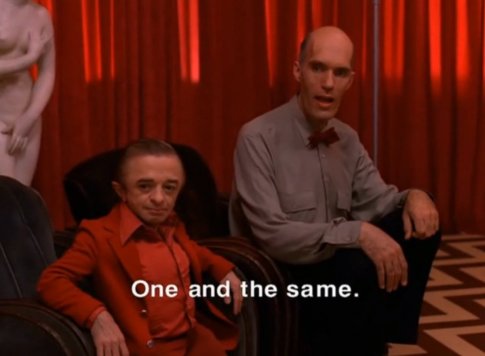
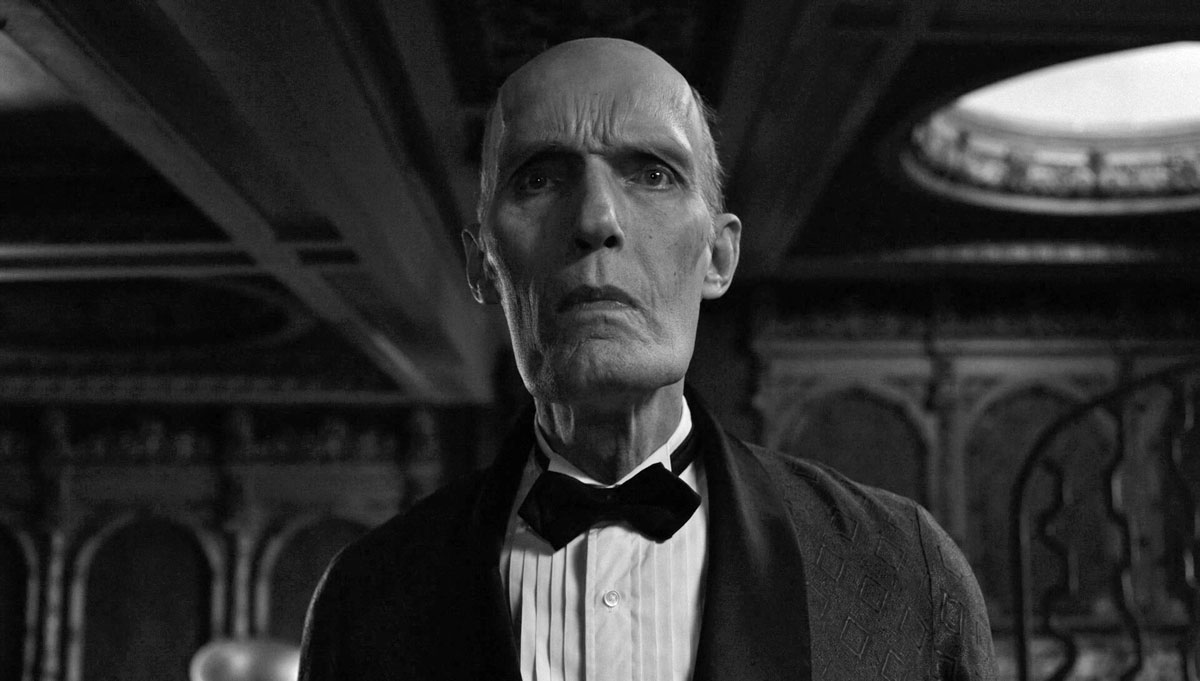
Kronos (Saturn) stands for endless, and hence immovable Duration“, and “to a Being outside of the plane of Time“, as one would be in the Fourth Dimension, “the past, present, and future would be simultaneously visible as the ever-existing present – the One Reality“. From this, it follows that the passing of reality through a plane of consciousness would be akin to “a passing panorama across the plane of time of something which, beyond Time, is ever one and the same“. This is the viewpoint form the Red Room, otherwise known as “the waiting room”, a place one probably needs to link to the notion of Devachan in Theosophy, the “dwelling of the gods”, a temporary, intermediate state of being before the soul’s eventual rebirth into the physical world.
One

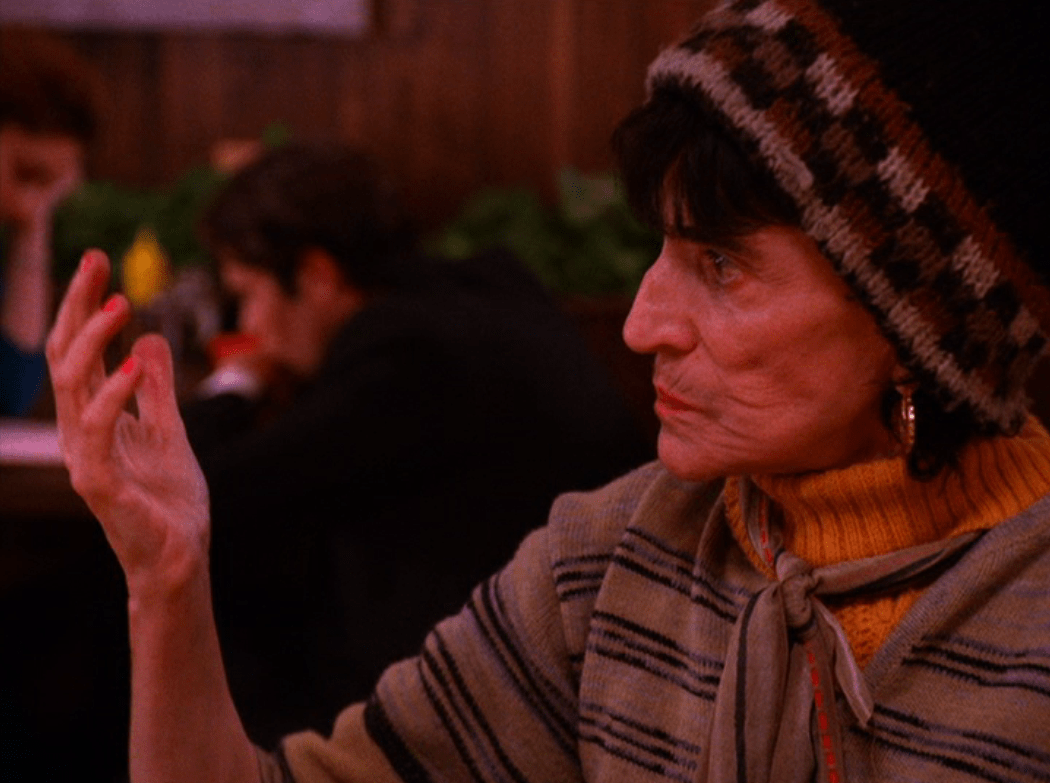
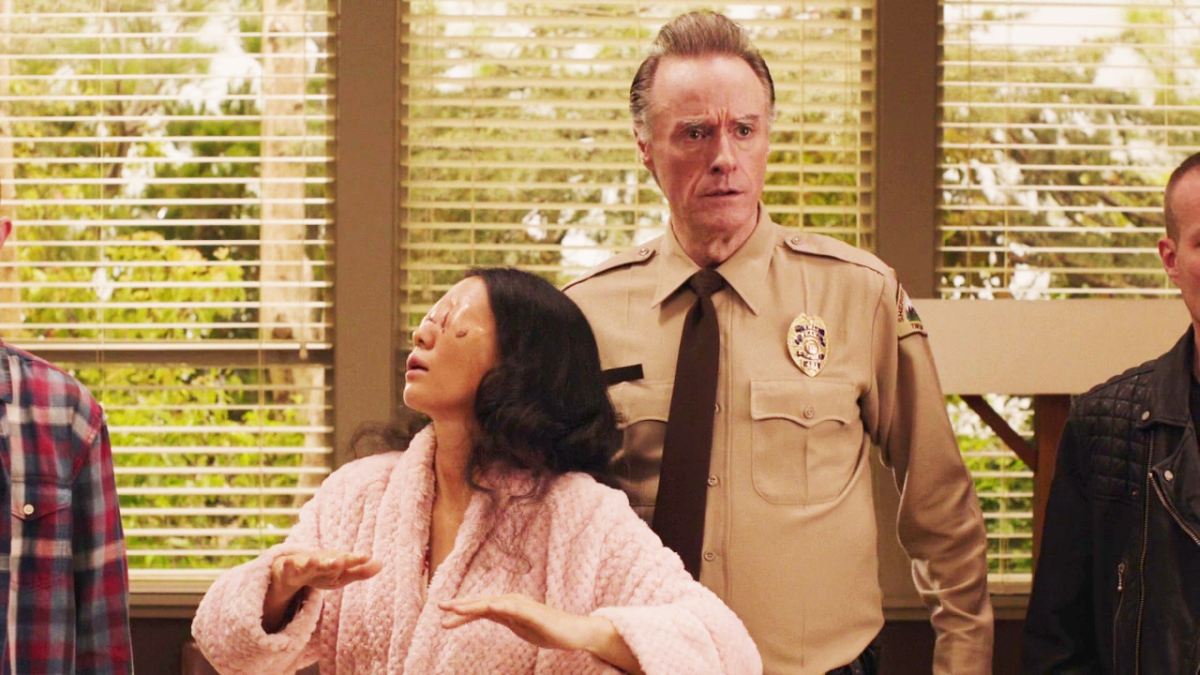
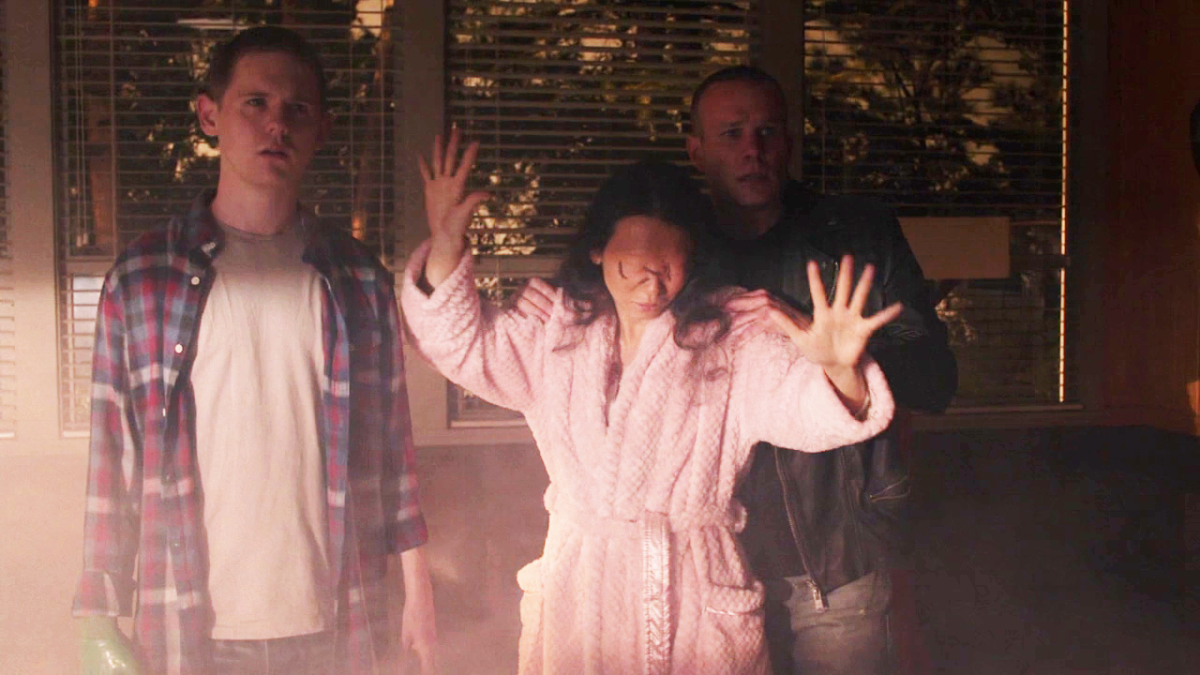
It is worth noting here that “because of the translucency of astral (4D) objects, everything is transparent… and a person who has not yet had much experience in its use, is apt to receive topsy-turvy impressions… frequent reversal of any number… 139 as 931, and so on“. This example should be connected to the 119 mother from Rancho Rosa, who might have access to this fourth dimensional realm because of the altered state of consciousness (Aldous Huxley’s Antipodes of the Mind) she has achieved thanks to the many drugs she takes.

119

In relationship with the idea of motherhood, let us mention here the following element, taken from the book The Masters and their Retreats (linked to Theosophy): “After Atlantis the Mother of the World veiled Her Face… She was often depicted with her eyes covered or veiled by a blue veil, signifying certain mysteries of the universe not yet to be revealed to man“. Nicolas Roerich, an adept of Theosophy, painted the image below in 1924.

Now, in reference to Rancho Rosa (a nod towards the “Rancho Rosa” housing project in the 1981 movie True Confessions by Ulu Grosbard), several things are worth mentioning.

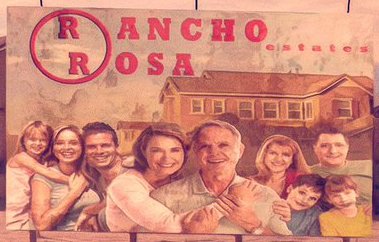
First, the poster for the housing development is definitely “full of secrets”. I have already pointed out, in a former blog post (here), its connection with the “Welcome to Twin Peaks” poster from the opening credits. It now appears that another layer of mystery can be found beneath its design, as it seems that the various groups of people on the poster have been positioned according to occult möbius signs masked by the faces present in that advertisement.

Beyond this reference to infinity in relationship to the closed circle of Rancho Rosa – a nest of sorts, open to the great beyond – this place can also be understood as an egg (circle), a seed that only needs electrical fire in order to create a Tulpa such as Dougie. If one studies the Rancho Rose Production logo that opens up every episode of The Return, one notices a dot in the centre of the circle. This central point is “the spirit of Fire, which stirs up, fructifies, and develops into concrete form everything… the Universe evolving from the central Sun, the POINT, the ever-concealed germ. The navel of Vishnu in the Mundane Egg” (Blavatsky).

Still in relationship to the Rancho Rosa logo, it seems that there might be a connection between the various Rancho Rosa Intros for Twin Peaks: The Return and the colour chart designed by Charles Leadbeater and Annie Besant for their book Thought-Forms. Each colour choice sets the tone for the episode – for instance, the grey of black and white episode 8 – the one with the atomic blast and the creature that contaminates Sarah – reflects the feelings of fear and depression with which it is associated in the following colour chart; and the black of episode 18, which follows Dale/Richard and Laura/Carrie till the end of the night of the Kali Yuga, definitely resonates with the idea of malice (Joudy) associated to this colour in the chart. A systematic rewatch of all the episodes will be necessary to assess the emotion or feeling chosen to depict each segment.

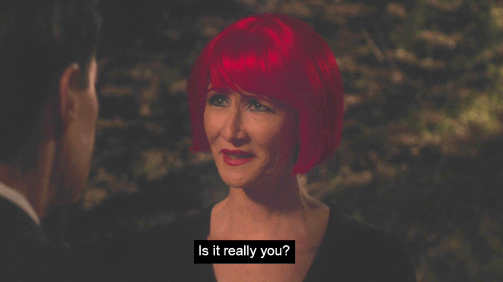
But let us now go back to the idea of “return” with which this blog post started. The end of episode 18 makes it clear that the two characters who are the most closely associated to this concept are Dale Cooper and Laura Palmer. The Return closes with their drive back to Twin Peaks, after a trip that took them beyond death, dimensional tears and spacetime rips.

The last episode plays a lot with the notion of personality. The reason for this concern is to be found in the many births/deaths endured by the various characters: “The personality is ever changing with every new birth. It is only the part played by the actor (the true Ego) for one night. This is why we preserve no memory on the physical plane of our past lives, though the real ‘Ego’ knows them all… Believing as we do in a series of births for the same Ego… we say that this ‘Ego’ plays, like an actor, many parts on the stage of life… he finally retires form the stage as ‘Prospero’, the magician” (Blavatsky). The magician longs to see the continuity of individuality beyond the variation of personalities linked to each new birth. This is perhaps one of the possible readings of the chevron motif in the Lodges: “The one line of life along which (each birth) is strung runs unbroken… an individual vital undulation… the life-undulation = individuality, ; each of its series of natal manifestations = a separate personality“.

Who are Dale and Laura really, beyond their many incarnations during the course of the three seasons (Dale/Mr. C/Dougie/Richard & Laura/Madeleine/Carrie)? What is the true individuality that lies behind their many personalities? As often in Twin Peaks, the answer can be found in Hinduism and the Vedas.
You

One of the two major epics in India, besides the Mahabhrata, is the story of the Ramayana. It is an epic poem which narrates the struggle of the divine prince Rama to rescue his wife Sita from Ravana, the Rakshasa (demon) king of Lanka, overlord of all Asuras (demons), who wished to overpower the Devas (gods). The Ramayana follows Rama’s fourteen-year exile to the forest from the kingdom, and his eventual return to Ayodhya. Rama is Vishnu’s seventh avatar. According to the teachings of Hinduism, whenever the forces of darkness get the upper hand on earth, Vishnu comes to the aid of humanity by taking incarnation as avatar. It is important to remember that in the Vedas (the oldest layer of Sanskrit literature and the oldest scriptures of Hinduism), Vishnu was not yet the major deity he now is in Hinduism (part of the Trimurti, the trinity of supreme divinity in Hinduism, alongside Brahma and Shiva) – back then, Indra was the king of the gods, and his role was equivalent to the Fireman’s in this third season.

Dale Cooper too had to go through a prolonged exile in the Lodges, a forest of sorts (with an entrance in the Glastonbury Grove). His “wife” Diane was taken from him and he only gets her back in episode 17, after she has been raped by his main opponent, Mr. C/BOB, Twin Peaks‘ equivalent of Ravana. Just like Ravana (which means roaring, and Mr. C/BOB is kept in a cage like an animal when he goes to the Fireman’s Palace) who ruled over Swarnalanka (Golden Lanka), Mr.C/BOB appears to control New York (where he runs the experiment), depicted in The Return as a City of Gold.

Ravana is depicted as having ten heads and he is said to have possessed the nectar of immortality (Garmonbozia?), which was stored inside his belly. BOB’s flying head in The Return is highly reminiscent of the extra heads of Ravana as is his relationship to Garmonbozia (which he stole from the Devas).

Ravana’s brother is Kubera, the Lord of Wealth (Garmonbozia?) in Hindu mythology, and his equivalent in Twin Peaks might very well be The Arm. Regent of the North (the Northwest Passage?), he is generally depicted as a dwarf. He once ruled Lanka, but was overthrown by Ravana. His city is usually called Alaka and has a grove called Caitraratha – the Lodges and Glastonbury Grove?

There might actually be (at least) two versions of Dale Cooper (interesting fact: COOPER Industries is an American worldwide electrical products manufacturer headquartered in Houston, Texas): Cooper/Vishnu who dreams up universes on the ocean of being (the chevron motif in the Lodges transforms the floor into an ocean of waves, and Venus is the Western equivalent of Lakshmi, Vishnu’s wife); and Cooper/Rama, his avatar on Earth, who fights Ravana/BOB.

Concerning Laura Palmer’s true individuality, now, dead but alive, similar references to Hinduism should be made, as well as to Greek mythology. It is possible that the two explanations for who she truly is overlap, according to the and/and principle discussed above.

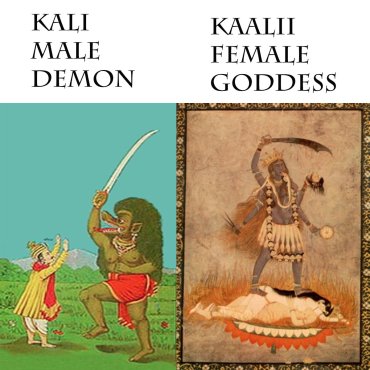
First, it is possible to read Carrie Page as Kalki (their names – Carrie/Kalki – are actually very similar), the tenth avatar of Vishnu. This avatar is supposed to end the Kali Yuga, the age of Demon Kali (who should not be mistaken for goddess Kali) which we are currently experiencing (David Lynch regularly talks about the Kali Yuga in his interviews). It is very likely that the Kali Yuga results from the atomic blast in episode 8 and that Demon Kali can be identified as Joudy.
Kali

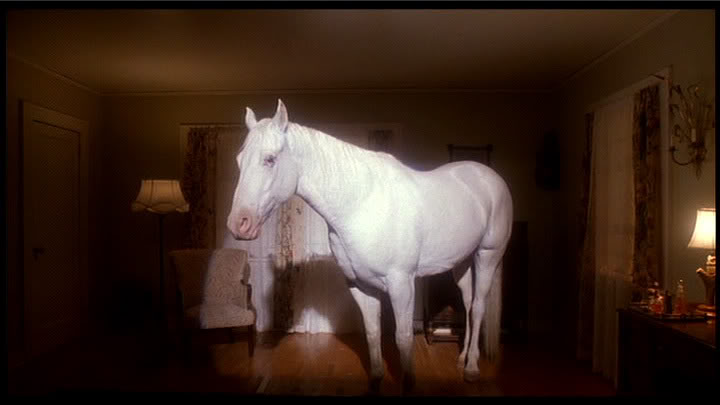
Kalki is the harbinger of the end time in Hindu eschatology and is supposed to fight Kali atop a white horse. The white horse imagery is of course a recurring one in Twin Peaks, and Carrie is clearly associated to it in episode 18 with the little white horse on her chimney in Odessa and the horse shoe pendant around her neck.

She travels all the way to the fort of her archenemy in the closing episode, right to the house where Kali/Joudy/Sarah lives, and blows out the electrical flame that symbolises its power with her scream.

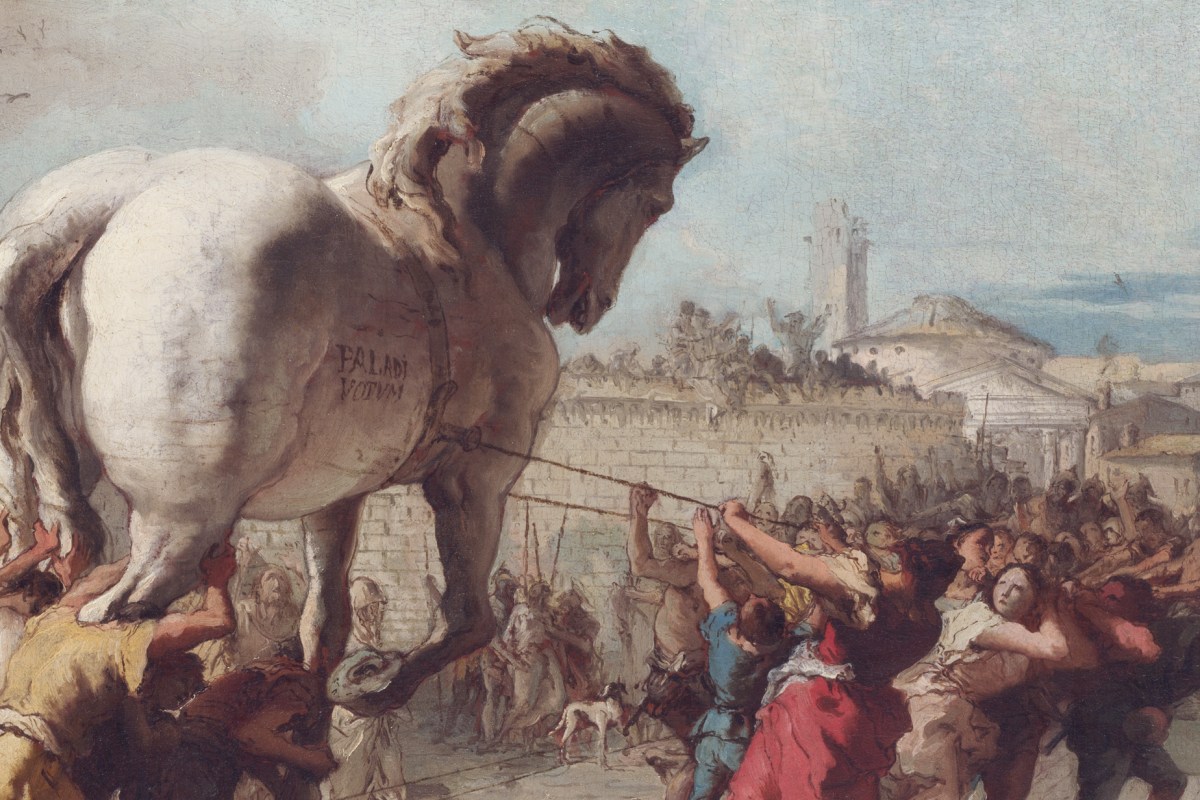
But besides Kalki riding his white horse, it might very well be that Carrie is herself the horse in question. Indeed, it is important to remember that Laura’s horse, when she was young, was named Troy. It has already been noted elsewhere that The Return follows Dale Cooper’s odyssey (to Odessa?) back home, from his exile in the Red Room to Twin Peaks. This journey mimics the one undergone by Ulysses in Homer’s Odyssey, after he has been exiled on his way back from Troy. Ulysses was the one who had the idea of the Trojan Horse at the end of the siege of the city, a subterfuge that the Greeks used to enter the independent city of and win the war (see The Iliad).

Though it is not Cooper who had the idea to replicate this move in order to defeat Joudy , after having eliminated BOB (two birds with one stone?), he is nevertheless the one who drives Carrie right to the heart of the enemy’s territory – Twin Peaks, and more specifically, the Palmer house. Though she does not manage to actually enter the house/fortress, the trap functions: when she hears Sarah pronounce her name, she suddenly wakes up/opens up, and the hidden forces inside her spurt with her shriek, which powerful vibrations blow out the electrical flame inside the house and win the war. Indeed, it had already been made clear in the Lodges that she was nothing but a shell, similar to a mannequin, replete with light, ready to illuminate the Dark Age with her hidden powers.

Of course, one may wonder if the price for this victory was worth paying. It is very likely that by ending the Kali Yuga, the very reality of Twin Peaks as we know it might have also disappeared. Vishnu will have to dream a new world, out of the dust of what is left behind.

So, is this a happy ending?

Please define “happy”.

Follow Unwrapping the Plastic: https://www.facebook.com/unwrappingtheplastic/

Mystic Geography

In a style that is highly reminiscent of what Alan Moore did with London in From Hell, (a masterful comic book about Jack the Ripper), under the surface of its geography, the town of Twin Peaks hides a complex series of mystical links that connects elements of the story that would otherwise remain separate.

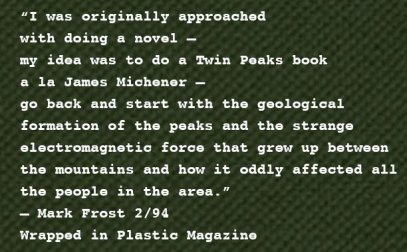
The importance devoted to geography in the series can be linked to the following quote from Mark Frost:

Mark Frost geological.jpg

Geology (caves, mines, etc.) and Hollow Earth Theories (here’s the article I wrote on the subject in April last year: link) play an important role in Frost’s book The Secret History of Twin Peaks. It is as if the Earth itself plays a role in the story. Inhabited by aliens from underground (as opposed to aliens form outer-space), the planet becomes symbolic of the minds of the characters, haunted by their unconscious. This can also be linked to the famous subterranean realm of Agartha in Tibet (we already know the importance of Tibet in Twin Peaks mythology):

The word “Agharta” is of Buddhist origin. It refers to the Subterranean World or Empire in whose existence all true Buddhists fervently believe. They also believe that this Subterranean World has millions of inhabitants and many cities, all under the supreme domination of the subterranean world capital, Shamballah, where dwells the Supreme Ruler of this Empire, known in the Orient as the King of the World. It is believed that he gave his orders to the Dalai Lama of Tibet, who was his terrestrial representative, his messages being transmitted through certain secret tunnels connecting the Subterranean World with Tibet.

The idea of subterranean tunnels running across the world certainly makes sense in Twin Peaks. They might not all be tunnels carved in stone, but this world is full of electromagnetic shortcuts that seem to align with important geological features and cities.

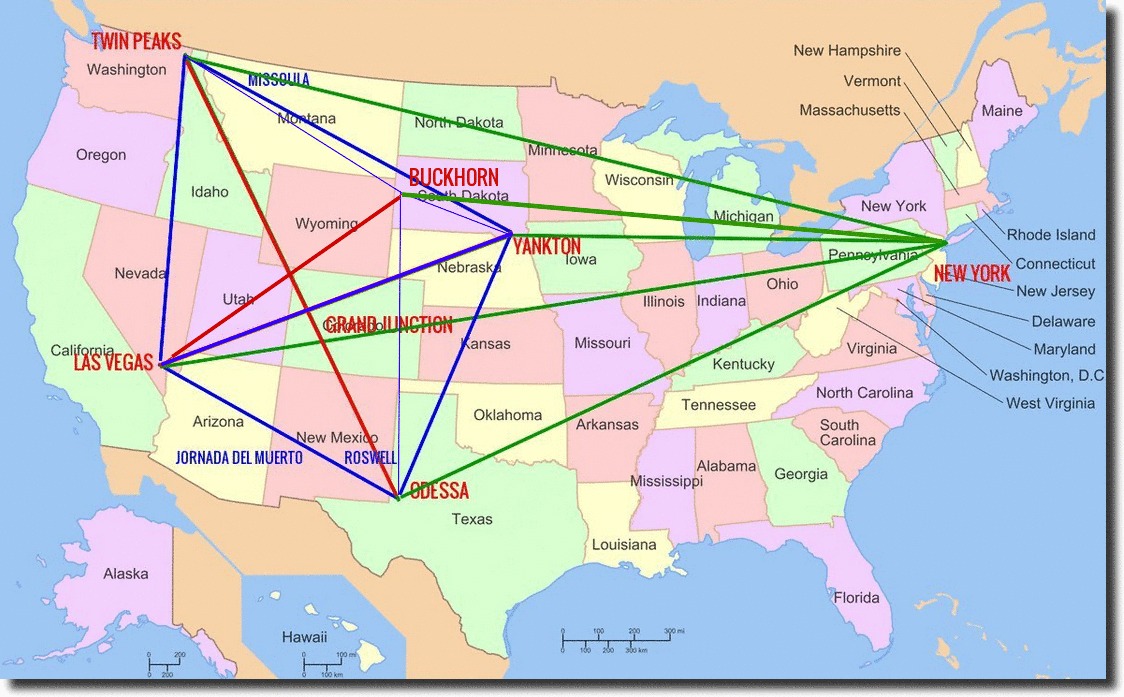
I have already analyzed in a former blog post the startling pattern that emerges on a map of the USA when tracing the various trips made during The Return by Cooper’s avatars. These lines draw a 3D pyramid in the west of the country which appears to point towards New York (in 4D, as in the Fourth Dimension of Theosophy?).

imageedit_96_4907168574.jpg

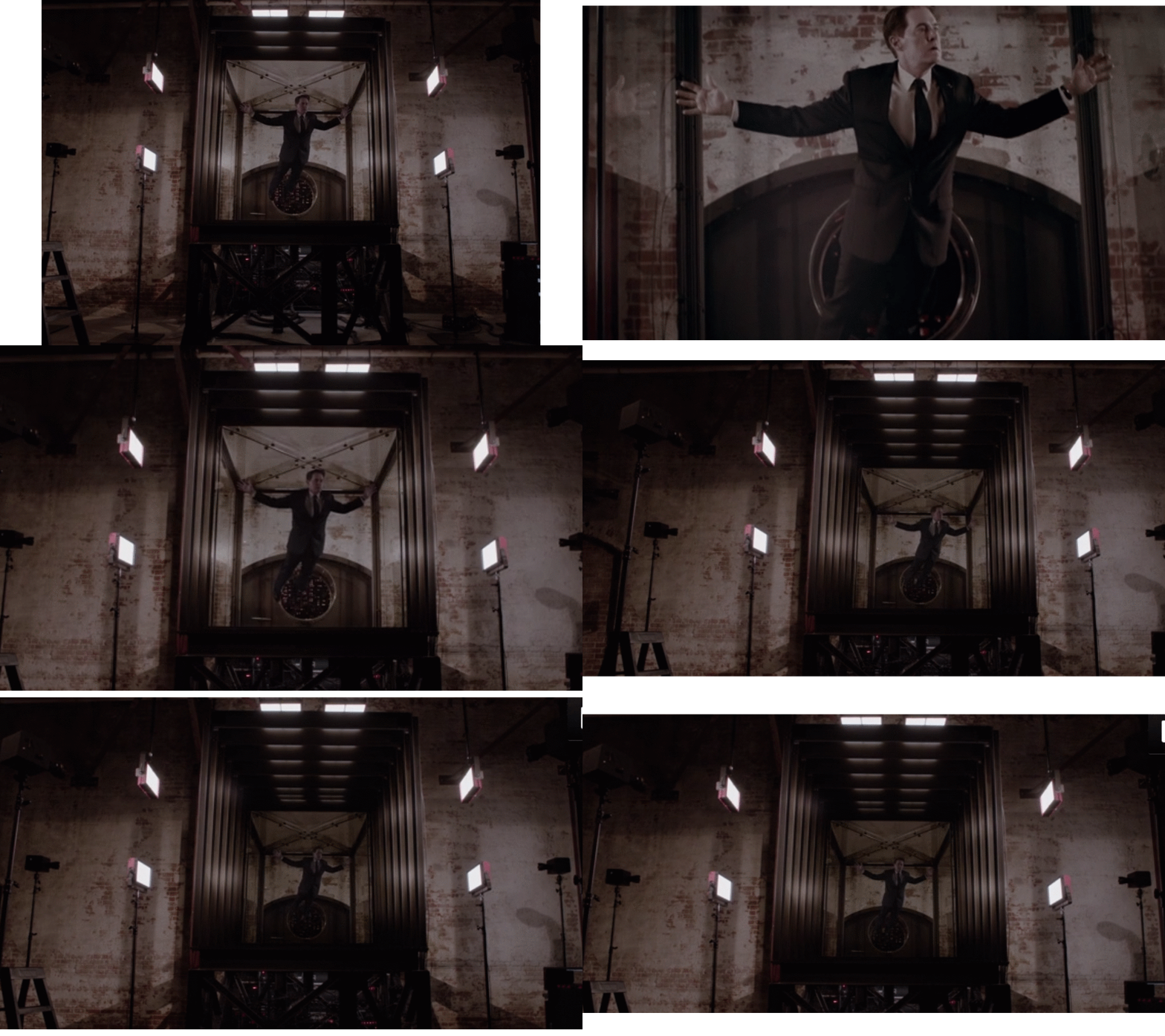
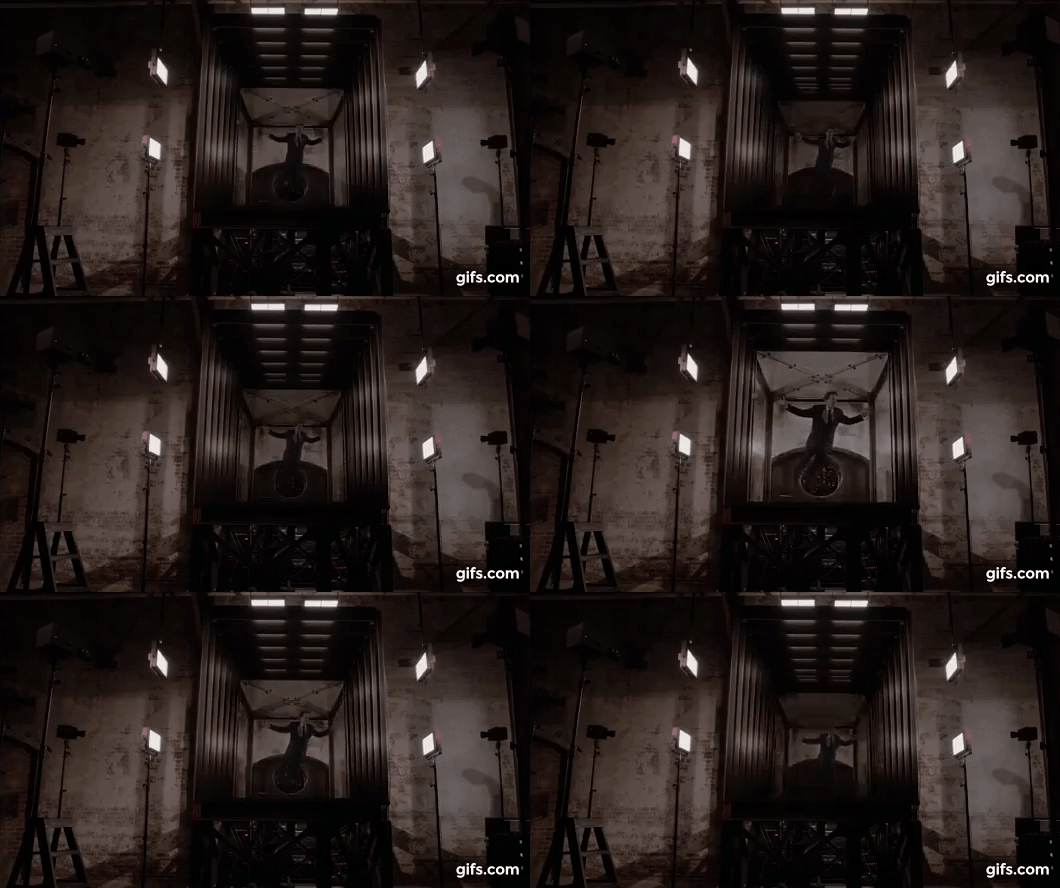
Should this be linked to the usual symbol for the Illuminati, the esoteric society that plays such a major (evil) role in Mark Frost’s The Secret History of Twin Peaks? This would make a lot of sense when one remembers that their most famous symbol is the one of the All-Seing Eye, found notably on dollar bills atop… a pyramid! The Return is replete with references to surveillance, and perhaps the most obvious of these is found in New York, with the glass cube experiment that is constantly watched and videotaped. It seems impossible to evade the All-Seing Eye in The Return. But the question is of course, to figure out who is behind this eye.

Beyond the USA, one can also broaden the scope and study the way in which geography, alignments, and symmetry play a role on a continental level. Alignments have always played a central role in the mythology of the series, at least from a cosmological point of view with the Great Conjunction of Jupiter and Saturn, which is supposed to open the doors to the Lodges on a cyclical basis. It is possible to find such alignments on the surface of the Earth as I will explain below.

First, the link needs to be made between North and South America. This is achieved when one notices that the lines drawn between Las Vegas and Buenos Aires, and those between Yankton and Rio de Janeiro, are parallel. A third line actually runs parallel to those, the one between Twin Peaks and Odessa (crossing through Grand Junction). Two parallel lines could possibly be due to chance (even though they both lead to cities that play a major role in the story), but three makes it almost impossible. South-America appears to play the role of a mirror image to that of North-America.

It is possible to continue this search for lines of force across the Americas. For instance, note that the line Yankton / Buenos Aires runs parallel to the one between New York and Rio de Janeiro:

imageedit_76_7743626348.jpg

 Here is the (complex) map of such links that I have traced so far: Twin Peaks / Hawaii (Doctor Jacoby) seems to run parallel to Buenos Aires / Rio de Janeiro, while Anchorage (Carl Rodd lived in Alaska, as well as in Yellowknife – the line between Grand Junction and Jornada del Muerto passes close to that city & Fred Crisman discovered a Lemurian frozen cave in Alaska) / Yankton follows the same directions as Hawaii / Buenos Aires, etc.

imageedit_103_6880411088.jpg

There is no overarching theory to explain all these lines except for the fact that underground connections appear to link elements that might superficially appear disconnected. The presences of Phillip Jeffries in Buenos Aires on the one hand and of Mr. C in Rio de Janeiro on the other make  more sense as a result. They were just following the lines of force between the two continents, traveling to important nodes of electromagnetic energy, places where currents cross.

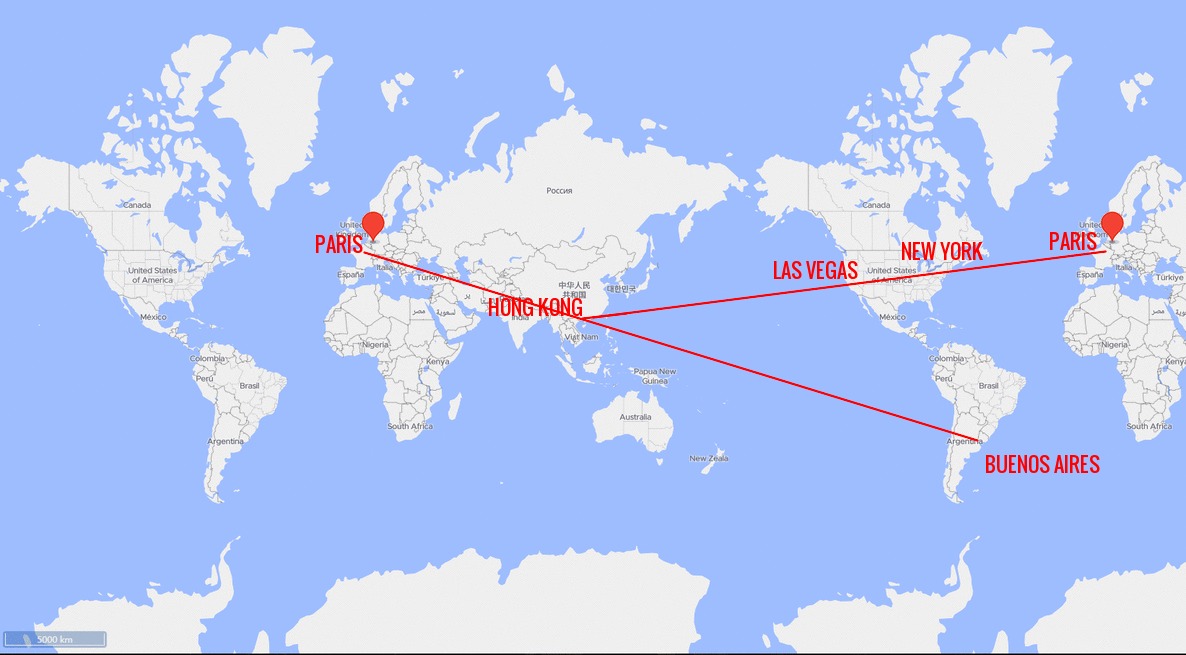
If we broaden our scope once again and look at the connections between America and Europe, it becomes apparent that Las Vegas, New York and Paris and linked by an invisible line. Even more startling, this same line continues westward towards Hong Kong! Josie Packard was the first character to appear on screen in the Twin Peaks’ pilot – is it possible that these lines were already drawn in the early 90s?

So, once again, not 2 or 3 cities on the same line, but 4 – pure chance should probably be ruled out in such an alignment, as with the new alignment that connects Buenos Aires, Hong Kong and Paris.

imageedit_14_3861315928

Then, continuing along the Buenos Aires / Hong Kong / Paris line further west and crossing line that runs through Buenos Aires and Las Vegas, note a point at the northwestern top of the Americas – could this be the famous Northwest Passage, the maritime route that almost gave its title to Twin Peaks? One linked to Hong Kong, note a beautiful parallelogram centered on Las Vegas, with two giant triangles on the West coast of the continent (the Pacific Ocean) and on its East coast (the Atlantic). The fact that the lines between Hong Kong and this Northwest Passage and the line between Buenos Aires and Paris run parallel once again indicates that this map is not the result of pure chance but of design.

imageedit_18_7546222474.jpg

Now, let’s connect the dots between Buenos Aires and Hong Kong and between Hong Kong and Las Vegas. We get a similar box centered on the Canary Islands, close to the coast of Africa. What one needs to know is that some believe the islands to be remnants of the sunken continent of Atlantis. As David Lynch and Mark Frost were also working on a script about the lost continent of Lemuria just prior to beginning the filming of Twin Peaks (additionally, several mentions of Lemuria are made in The Secret History of Twin Peaks), it is possible to think of these two sides of the American continent shown in the giant triangles mentioned above as linked to these lost worlds (and their ongoing subterranean influences).

imageedit_66_2846394851.jpg

If we draw a horizontal line and the level of the Northwest Passage and one through Buenos Aires (which should probably be understood as the Southwest Passage, as proven by the disappearance of Phillip Jeffries there and also by the fact that the Lodge Entities declare, in Fire Walk With Me, that “from pure air we have descended, from pure air” – Buenos Aires means “good air” in Spanish), we can then continue the various lines already started on the map and make them rebound through the various important nodes already present. This is the result:

imageedit_100_8300025396.jpg

The chevron bandwidth reminiscent of the motif on the floor of the Lodges seems to draw two giant peaks across the map – are these the Twin Peaks that gave their name to the series? And what of the role of the two American Passages, the northern one and the southern one? Could they possibly be connected to the ongoing motif of the mirror image found throughout the episodes? Could they somehow be connected to the owl motif found in the Owl Cave in Twin Peaks and on the jade ring? Does the upward or downward direction faced by the symbol lead to the Northwest or to the Southeast Passages (to the Fourth Dimension)?

No definitive answer for the time being, just new paths to follow. The more we dig up under the surface narrative of Twin Peaks, the more surprising associations come up (BOB up?) to the surface. The search for the mythological meaning of the show began more than 25 years ago and it appears that most of the path is still ahead of us!

Follow Unwrapping the Plastic: https://www.facebook.com/unwrappingtheplastic/

The Big Rip

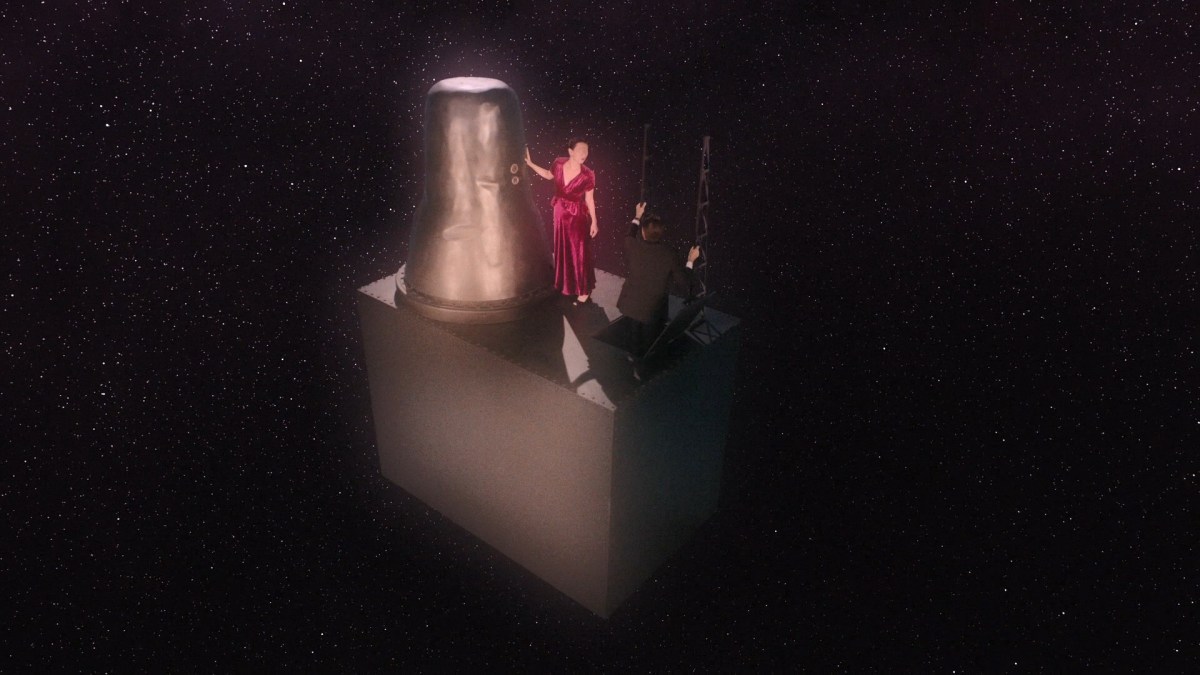
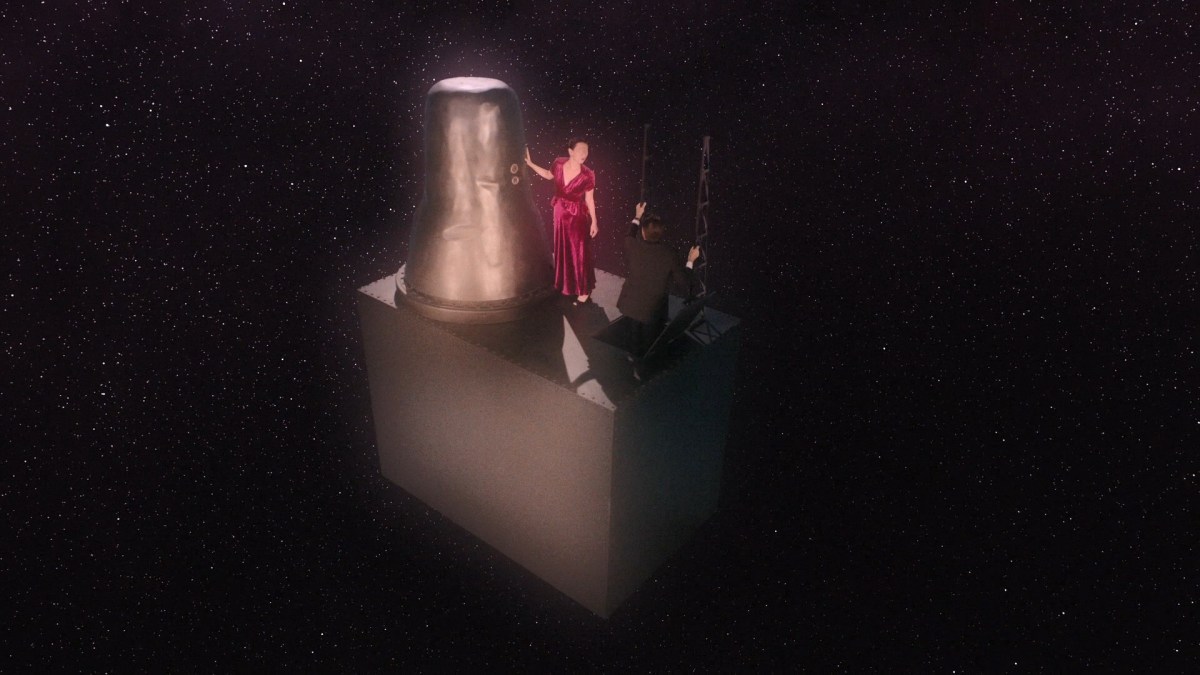
Much has been written about the role of time in Twin Peaks and the show is replete with references to temporal coordinates of all sorts: “I’ll see you again in 25 years”, “Time and time again”, “What year is this?”… Nevertheless, one should not underestimate the importance of space in this universe – both literally (as in episode 2, when Dale Cooper, until then a psychonaut, suddenly becomes an astronaut in outer space, on the platform at the top of Naido’s ladder) and metaphorically too.

Space.jpg

In the new season, both time and space appear to be “out of joint”. The atomic blast of episode 8 has created a hole in the empty canvas of the desert (to quote Jack Parsons in The Secret History of Twin Peaks), tears and superimpositions of all sorts are everywhere. The enormous electromagnetic thimbles we notice over the course of several episodes appear unable to correctly sew back together the various dimensional membranes  – the cosmological “Big Rip” seems to win at the end of the series.

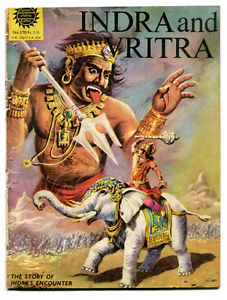
The Fireman (who I linked to Indra in a former post) tries to fight such dimensional tears, an attitude coherent with what one learns in the book Vedic Physics: “The main force of expansion in the Vedic cosmology is Indra, and his chief adversary, the main force of contraction, is Vritra… Indra will be identified here as electric force… The electric repulsion force must be stronger than the surface tension force in order for the universe to expand. This is the grand cosmic battle of Indra and Vritra… outcome of this battle determines whether there will be a universe or not” (p. 57-62).

Indra.jpg

In such a Space, in which tears and holes multiply, points that appear distant from each other might actually coincide on a different level, and superior dimensions suddenly become accessible. The various fourth dimensional entities from the Lodges have been able, more than ever, to visit our reality, and the walls between realms are getting thinner.

For instance, when the Fireman hears the alarm signal from the big thimble in his Jupiter-like living room, his first reaction is not to check the fictional world in which Twin Peaks takes place, but rather our reality via the interface of our television screens. Through the looking glass of these devices (Fire Walk With Me actually opens with the “snow” of a television screen), he breaks the fourth wall and examines our reality to make sure that the dimensional tear signaled by the electromagnetic thimble device is not its point of origin. The traditional hierarchy between the dimensions of the real and of the fictional suddenly becomes obsolete – are we living in the real world or is the real world that of people we took for characters? When Gordon Cole has a dream about having coffee with Monica Bellucci in Paris, is he actually dreaming our reality? It would indeed make more sense for David Lynch to meet such an actress than for FBI agent Gordon Cole.

Who is the actor and who is the character in this indefinite space?

Fireman

Here, there and everywhere – the point of departure is also the point of arrival in such a “Return”. When one moves in a non-euclidean sort of space-time, it becomes possible to travel without moving. “You are far away”, says the Fireman to Dale Cooper seated in front of him. But the words are enough to make him disappear, to teleport him to another realm which opens up wherever, like the Red Room and its many openings (to South Dakota, to Las Vegas, to Twin Peaks…). The dissolution of spaces into each other, the way they fold into one another, includes the mental space of the characters, whose dreams and thoughts take them places, on psychedelic “trips”, different in style to the work of the Surrealists in the 1920s and 1930s (a time more reminiscent of the Fireman’s costume and of the general atmosphere in his Palace).

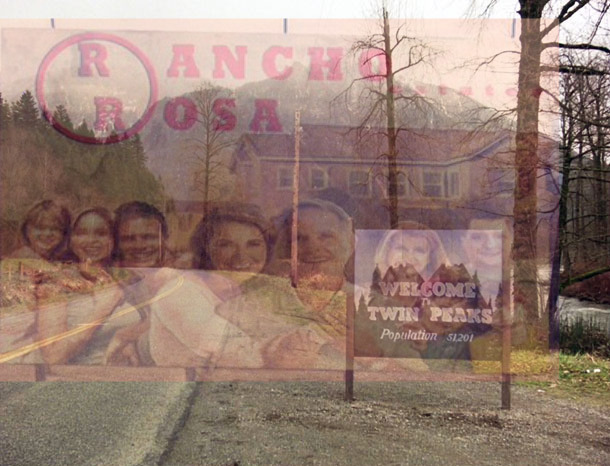
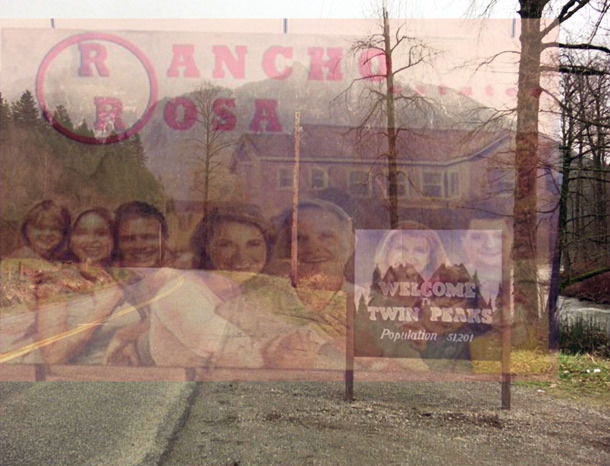
The interconnection of different locations is made apparent when one realizes that the Rancho Rosa poster (notice the visual “noise” on the image, the various white lines and black spots without apparent rhyme or reason) can actually be superimposed on-top of the “Welcome to Twin Peaks” image from the opening credits of the series.

When then 3rd and 4th poles of the Rancho Rosa poster are correctly aligned with the two of the sign at the entrance of Twin Peaks, the superimposition becomes evident (see the blue shirt of the man on the top-right for instance, which matches perfectly the curve of the river). Both posters, when positioned as this, exactly end at the same point on the left hand side of the images. These perfect matches between the shirt and the water, the two poles, the left of the image… but also with the positioning of the (spooky) house on-top of the mountain lead one to the conclusion that Rancho Rosa and Twin Peaks are truly one, or at the very least, one leads to the other.

RR

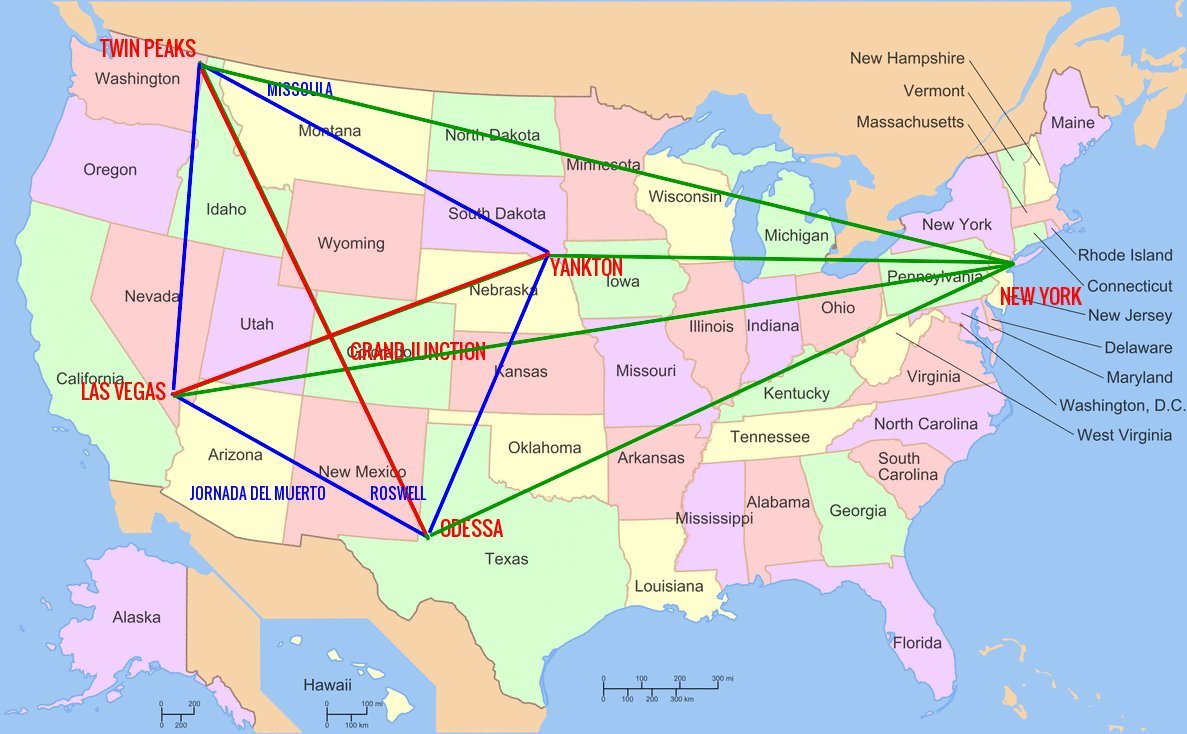
Rancho Rosa is the place where Dougie ends up. There is something ghostly about this place where no one lives. It is a prison of sorts, but a colorful one, as opposed to the prison in Yankton where Mr. C goes. This symbolic geometry is easily explained when one examines the way the various Coopers travel across a map of the US. The five points of importance for the different versions of the FBI agent are: Twin Peaks, Las Vegas, Yankton, Odessa and New York. This is the pattern they draw on the map:

The pentagram of sorts which appears as a pyramid in the image, with New York at its top, could also be read as a vast trap (the red X in the middle of the blue trap/ezoid) with a source in the Big Apple. The glass hyper cube in the loft, with a similar X shaped target on-top of it, might very well be the center towards which everything caught within the blue lines is directed/sucked.


It is important to know that Jornada del Muerto, the place where the explosion in episode 8 takes place, is situated at precisely 430 km from Las Vegas – Dale and Diane probably drove between these two spots in episode 18, before “crossing over” to another dimension through the hole the bomb made in the desert (and through the electromagnetic web made apparent in the following image).

Web.jpg

The straight line between Las Vegas and Jornada del Muerto continues to Odessa, where Dale/Richard finally meets Carrie Page. Interestingly, one finds the Post 430 of the American Legion in Odessa.

When one draws the lines between Twin Peaks and Odessa and between Las Vegas and Yankton, they cross at a right angle (while also crossing the Roswell area, while the blue line between Twin Peaks and Yankton goes through Missoula, Montana -i.e. the town where David Lynch was born). The point where the red lines meet is none other than Grand Junction, which of course makes perfect sense. A kind of symmetry suddenly appears between Twin Peaks and Odessa, the places where Laura and the anti-Laura (Carrie) live, as well as between Las Vegas (Dougie) and Yankton (Mr. C). This pattern can be described as something between magic, land art and geomancy, mixed with the technology at work in the New York loft (the borders between science and the supernatural also crumble in this world).

Why should the red lines meet in Grand Junction? Perhaps because according to theosophy, the Cathedral of the Violet Flame is placed in the heart of the Rocky Mountains. Perhaps Grand Junction is the place where one can find the Fireman and the other Fourth Dimensional entities. After his brief appearance in the New York hyper cube, Dale Cooper actually falls to the balcony of the Fireman’s Palace – the connection appears to be direct between the two locations. This might have something to do with the following theosophical quote: “The geomancer therefore conceives of the World as a four-sided multi-dimensional structure… At the Center is the World Tree, the Central Pillar that supports the Heavens”.


This slideshow requires JavaScript.

In episode 18, when Carrie Page shrieks, when she suddenly wakes up, the vibrations thus produced tear apart the thin veil of the dimensional membrane in which she lived for so long. Electricity goes off and the giant thimbles cannot mend reality anymore, which brings Laura and Dale back to square one: the Red Room.

From a shriek to a whisper…


This slideshow requires JavaScript.

In my book Twin Peaks: Unwrapping the Plastic, published a few months before The Return, I insisted on the importance Max Ernst’s collages in order to better understand Twin Peaks, particularly his artist’s book, A Week of Kindness.  The new season has multiplied collages of all sorts and its recurring use of superimpositions is to be linked to what Gene Youngblood had to say on the subject in his book Expanded Cinema (1970). Layer over layer of reality are to be found in Twin Peaks for those ready to excavate. Akin to the Lost Dutchman’s Gold Mine, one only needs to persevere in order to reach the auriferous vein so that the grand junction might take place.

Follow Unwrapping the Plastic: https://www.facebook.com/unwrappingtheplastic/

Indra and Mount Meru

It has taken me a little over 25 years, but I now think I’m beginning to get a good grasp about who and what some of the most mysterious elements of the Twin Peaks universe might be. The extreme difficulty to decipher what lies beneath the surface of the show’s narrative, the metaphysical mysteries it “occults”, is really to be credited to the powerful imagination and talent of both David Lynch and Mark Frost. Together, they have created a multilayered universe in which one can dig forever, it seems, layer after layer of meaning – there is always something more to find underneath.

My personal quest has lead me through many different grids of interpretation, not necessarily exclusive of each other: surrealism, psychoanalysis, philosophy, mythology, spirituality, etc. Theosophy definitely played an important part in this process, thanks to Mark Frost’s input, just like the writing of Tuesday Lobsang Rampa (discussed elsewhere on this blog: link).

But in the end, nothing appears more central to Twin Peaks than Hinduism (and Theosophy, of course, owes a great deal to Hinduism).

In my 2016 book Twin Peaks: Unwrapping the Plastic, I had already analyzed much of the first two seasons and the film using elements from the Upanishads, the Rigveda, the Puranas… I already knew about David Lynch’s strong interest in Transcendental Meditation and his recurring use of quotes from the Upanishads in his book Catching the Big Fish. I had also read Martha Nochimson’s excellent book David Lynch Swerves, which lays the emphasis on the importance of Indian spirituality in his work (but which mostly focused on his post Fire Walk With Me films).

Twin Peaks: The Return has opened up new perspectives for my analysis which I have been working on during the past year. It has also enabled me to dig further into some of my previous research so as to come to more satisfactory answers to some of the most cryptic parts of the show.

Let’s start with Mount Meru.

In episode 3 of the new season, Dale Cooper literally falls on the balcony of a building on top of a peak surrounded by a mauve ocean. This is the result of a long trans-dimensional fall that started in the Lodges, continued through the mysterious glass cube in New York – the fall would finally continue though an electrical device so as to reach Las Vegas, down here on planet Earth.

It then appears in episode 8 that this peak is crowned by a castle of sorts in which the Fireman and Senorita Dido live. The rocky peak and its surrounding ocean are contained within a golden ball which appears on our screens after the atomic explosion on July 16th, 1945.

What is this place? The answer lies of course in Hinduism.

Mount Meru, a golden mountain, is considered to be the center of all the physical, metaphysical and spiritual universes. It is the most sacred object in the universe because it supports the heavens and the gods. Geographically, it is said to exist at the center of the universe in the waters of life, surrounded by seven concentric seas, each diminishing in size from the center. The Sun along with all the planets circle the mountain. The Suryasiddhanta (a Sanskrit treatise in Indian astronomy from late 4th-century or early 5th-century CE) mentions that Mt. Meru lies in ‘the middle of the Earth’ (“bhurva-madhya”) in the land of the Jambunad (Northern Hemisphere of the earth as opposed to  the Southern hemisphere, referred to as Patala).

Obviously, even though Mount Meru is very high, the Lodges must be even higher up because it’s from the sky that Dale Cooper lands/crashes on the balcony of the fortress. As explained above, Mount Meru supports the heavens. There are fourteen worlds all in all, seven higher ones (Vyahrtis) and seven lower ones (Patalas), with planet Earth in-between.

map lokas.jpg

Svargaloka is a set of heavenly worlds (some Puranic references equate it to the Solar System) where the righteous live in paradise before their next incarnation. Svarga is seen as a transitory place for righteous souls who have performed good deeds in their lives but are not yet ready to attain moksha, or elevation to Vaikunta, the abode of Lord Vishnu, the Supreme Abode (or to Goloka, the eternal supreme abode of Lord Krishna and Radha – the terms “Goloka” and “Vaikunta” are often synonymously used; all the Vaikuntha planets are said to be like petals of a lotus flower, and the principal part of that lotus, Goloka Vrndāvana, is the center of all the Vaikunthas). The capital of Svarga is Amaravati and its entrance is guarded by Airavata (a mythological white elephant).

Because of his fall to Mount Meru, it is reasonable to believe that the Lodges are situated somewhere in the Svargaloka, “above” the purple peak.

Fall.jpg

The link between Mount Meru and the heavens is made evident when Cooper follows Naido up the ladder she climbs to reach a metallic “raft” lost in space. This simple climb enables them to cross physical dimensions from the “earthly” realm of Mount Meru to the cosmic heavens of Svargaloka.

Space.jpg

Interestingly, Indra, the lord of the heavens and leader of the Devas, lives on the top of Mount Meru and presides over Svargaloka. He is the god of the heavens, lightning, thunder, storms, rains and river flows – in other words, he is the god of electricity. His mythologies and powers are similar to those of Indo-European deities such as Zeus, Jupiter or Thor. He is the most referred to deity in the Rigveda and he is the one who kills the great symbolic evil (Asura) named Vritra (a serpent or dragon, the personification of drought that obstructs human prosperity and happiness). He destroys Vritra and his “deceiving forces”, and thereby brings rains and the sunshine as the friend of mankind.

I believe that this description fits perfectly with the Fireman as we meet him in The Return: a force for good who intervenes to help mankind and who lives perched on-top of the purple peak in a citadel with his wife (Senorita Dido/Indrani).

Indrani, also known as Shashi, is one of the seven Matrikas (mother goddesses). She has a significance in Vedic in developing the idea of Shakti which denotes power, the feminine personified might. According to the Rig Veda, Shachi is considered a most fortunate female for Indra granted her immortality. It is said that he chose her over all of the other goddesses because of her magnetic attractions. is a goddess who, even though from a father of demonish origin, is pure, the most beautiful, kind and the one who was a wonder to many eyes.

A brilliant article written by Croatian scholar Karla Lončar that I will soon publish in the upcoming Fall/Winter special issue dedicated to Twin Peaks of the Supernatural Studies Journal insists (among other mind-bending associations with astrology and discussions about the role of Saturn in relationship to Twin Peaks) on the links between the Fireman and Jupiter, based notably on the motif that appears on the floor in his fortress, which resembles the atmosphere of the Solar System’s giant.

The above mentioned links between Indra and Zeus/Jupiter make a lot of sense in relationship to this imagery. His connection to Thor also appears to be of importance since it is the Giant who presides overs Freddie Sykes’ metamorphosis into a person gifted with the strength of a demi-god, thanks to the green garden glove that he leads him to (“Both Indra and Thor are storm gods, with powers over lightning and thunder, both carry hammer or equivalent, for both the weapon returns to their hand after they hurl it, both are associated with bulls in the earliest layer of respective texts, both use thunder as a battle-cry, both are heroic leaders, both protectors of mankind, both are described with legends about “milking the cloud-cows”, both are benevolent giants, gods of strength, of life, of marriage and the healing gods, both are worshiped in respective texts on mountains and in forests”). This glove functions similarly to Thor’s hammer Mjölnir, a weapon that functions with the power of a thunderbolt, a weapon he uses to subdue BOB-the-snake/dragon, the equivalent in Twin Peaks to Indra’s fight against Vritra with Vajra. (“The Rigveda states that the weapon was made for Indra by Tvastar, the maker of divine instruments. The associated story describes Indra using the vajra, which he held in his hand, to slay the asura Vritra who took the form of a serpent”).

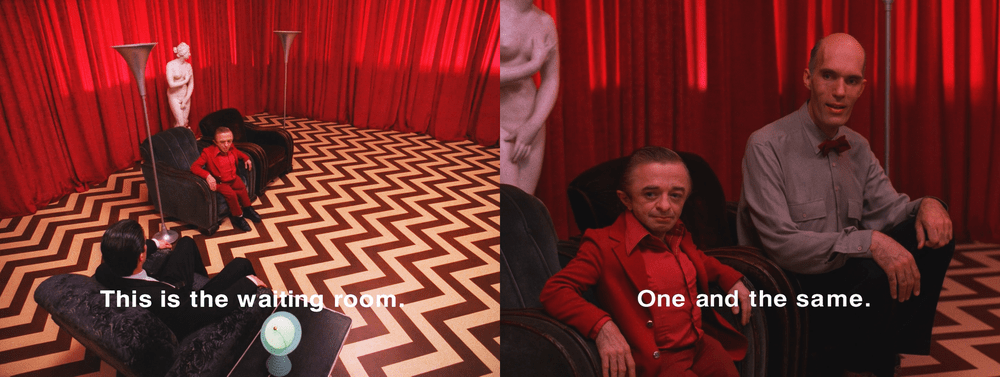
Returning to the idea that Svarga is a transitory place for righteous souls not yet ready to attain moksha (freedom from samsara, the cycle of death and rebirth), one needs to remember an important quote from the original series:

waiting room

The Red Room (or is it the Lodges as a whole?) is such a transitory place, a waiting room on the path to rebirth (down to Earth) or spiritual elevation to a superior Loka. And as in Hinduism, though deities appear to be distinct from each other and constitute a vast pantheon, in the end they are all essentially One: the transcendental Brahman, the highest Universal Principle, the Ultimate Reality in the universe. “Brahman pervades the whole universe. All forms and aspects of Brahman are Brahman only”.

“In sections 4.5–6 of the Maitri Upanishad, students ask their Vedic Guru (teacher) about which god is best among gods they name, a list that includes Agni. The Guru replies that they are all supreme, all merely forms of the Brahman, the whole world is Brahman. So pick anyone, suggests the Upanishad, meditate and adore that one, then meditate over them all, then deny and discard the individuality of every one of these gods including of Agni, thus journey unto the universal, for a communion with the Purusha, the Atman”.

“Some Sanskrit mystics locate seven planes of being, the seven spiritual lokas or worlds within the body of Kala Hamsa, the Swan out of Time and Space… (The Voice of the Silence by H. P. Blavatsky). Within the Hindu faith and its symbolism, the Swan or Hamsa represents the Supreme Spirit or Ultimate Reality; that is, the metaphysical creative and cosmic principles known as Brahman. In Western terms, the hamsa represents the God in the Hindu pantheon. At the same time it was a genderless or androgynous figure which united the fundamental forces of Shiva and Shakti and all dualities, including the intake and release of the breath. (link)

I have regularly argued about the importance of eggs, swans and geese in Twin Peaks, and in particular in relationship to The Return. You may read more about my thoughts on the subject of ducks/swans/geese here: link.

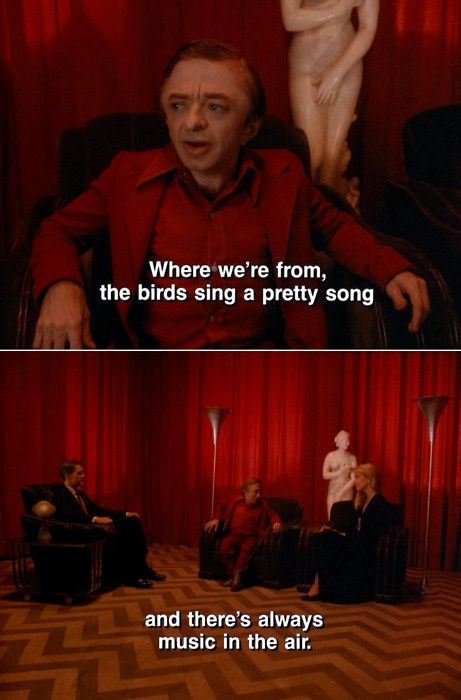
In my book, I described the Red Room as a secret garden, a hortus conclusus hidden in a (Glastonbury) grove where human can meet deities, as in the Temenos of classical Greece. One of the things that led me to this conclusion, besides the omnipresence of statues of Venus (the goddess of garden), was the famous quote from The Arm about birds and music (followed by a dance).

Where we're from

Now, if we follow the line of reasoning concerning Mount Meru, Indra and Svargaloka, we come to a description of his gardens. We learn that the heaven of Lord Indra is a region for the virtuous alone with celestial gardens called Nandana planted with sacred trees and sweet-scented flowers. The fragrant groves are occupied by Apsaras. Low sweet music plays. Indra’s abode is eight hundred miles in circumference and forty miles in height. The inhabitants of Amaravati (the capital of Svarga, built by Lord Vishwakarma, the architect of the gods) are entertained by music, dancing and every sort of festivity.

One last short thought concerning the role of the gods in Twin Peaks (in relationship to the way they act in the Vedas). When Andy gets teleported to the Fireman’s fortress after his visit at Jack Rabbit’s Palace, this is highly reminiscent of how Indian deities used to summon human beings:  “When a great god thinks of anyone, that person immediately appears before him, summoned and transported by telekinesis“.

Andy-Black-Lodge.jpg

This is all for the moment. I will come back soon with more reflections concerning similar themes… as well as ideas about the role of the Pleiades in the world of Twin Peaks.

Follow Unwrapping the Plastic: https://www.facebook.com/unwrappingtheplastic/
Planet Goloka

Thanks to David Lynch’s active involvement in the Transcendental Meditation movement initiated by the now deceased Maharishi Mahesh Yogi, it is now clear that Twin Peaks owes a great deal to Vedic mythology. I underlined this fact in my 2016 book Twin Peaks: Unwrapping the Plastic and I strongly feel that The Return only confirms this idea. I believe that several of the central mysteries at the heart of the series and film can be “solved” using this key and that the metaphysical structure of this world is built using elements taken from this religious tradition.

Who is the dreamer? What is the white horse? What is the mysterious ocean with a peak in its middle, crowned by a castle of sorts? These are some of the questions which might be answered by studying Hindu myths closely.

First of all, let’s note that a central element of this mythology is Vishnu, the “preserver” in the Hindu trinity (Trimurti) that includes Brahma and Shiva. He lies in a dream-like state on the serpent Adisesha Ananta who is Time, without beginning or end. As if he is seeing a dream, Vishnu watches Brahma create the Universe. By the act of watching his dream, Vishnu sustains the Universe.

vlcsnap-2018-03-09-11h49m21s912.png

There is a strong probability that this myth is to be connected to the scene when Gordon Cole meets Monica Belluci in Paris. Since the stability of the Universe is about to collapse because of the conflict between various time lines, remembering that Vishnu is the one whose role it is to keep the integrity of the multiverse appears appropriate.

Vishnu is known to ride on the Garuda, a legendary bird. In Hinduism, Garuda is a divine eagle-like sun bird and the king of birds. Garuda’s links to Vishnu – the Hindu god who fights injustice and destroys evil in his various avatars to preserve dharma – has made him an iconic symbol of a king’s duty and power. Interestingly, it is possible to notice the same infinity/Ouroboros sign drawn by Phillip Jeffries as a machine on the image below, where Vishnu and Lakshmi fly atop Garuda in a sea of stars.

Also, the thunderbird we see on Steven’s car is similar to Gardua. The logo on his hood resembles much the one found on many flags, such as the Indonesian one below.

Garuda

vlcsnap-2017-09-05-09h46m26s916

When Vishnu wakes from his dream, one cycle of Creation ends. In Hinduism, the world goes through four stages (or ages or yugas) as part of a ‘cycle of yugas’ described in the Sanskrit scriptures. David Lynch regularly talks about the present time, the Kali Yuga (the Dark Age), supposed to last 432,000 years. For instance, for those who can read French, one can find Lynch discussing the Kali Yuga in the following issue of Cahiers du Cinéma (link).

vlcsnap-2018-03-09-15h25m19s027.png

It is interesting to note that the Kali Yuga will end with the arrival of Kalki (the destroyer of filth), nemesis of demon Kali (worshipped as the Divine Mother, Mother of the Universe) and 10th avatar of Vishnu.

The Purana scriptures foretell that Kalki will be atop a white horse with a drawn blazing sword. He is the harbinger of the end time in Hindu eschatology, after which he will usher in Satya Yuga” (the Age of Truth, when humanity is governed by gods, sometimes referred to as the “Golden Age”).

Who will ride the white horse in Twin Peaks?

To return to Vishnu dreaming the Universe on the serpent Adisesha Ananta, one should note that they float for all eternity on the waters of the Ksheer Sagar (otherwise known as the ocean of Cosmic Consciousness). This is of course reminiscent of what Lynch wrote about Transcendental Meditation in his book Catching the Big Fish. This ocean in Hindu cosmology is the Ocean of milk, the fifth from the center of the seven oceans. Difficult not to make a link to the ocean first seen in episode 3 of The Return. The connection is ever more obvious when one finds out that some relationships between the milk ocean and Goloka, the planet of Krishna, may be found. Krishna is the same as Vishnu, who lives in a white castle on the ocean of milk and on other hand, Krishna is the same as Vishnu, but He lives on Goloka, a planet of cows.

Here is an image of Vishnu dreaming worlds next to the Fireman invoking Laura Palmer’s orb:

Humans not only live on Earth with a salt water ocean, but there are other oceans like the sweet water ocean among these 7 oceans that humans may aspire to live in. The material world is compared to the ocean of fault, especially in Kali-Yuga, so a way to go out of this matter is to enter the ocean of bliss – in the eternal world of Vaikuntha (the celestial abode of Vishnu, the preserver – a sort of Fireman… Vaikuntha is an abode exclusive to him, his consort the goddess Lakshmi – senorita Dido? – and other liberated souls. They are blessed with pure bliss and happiness in the company of the supreme being for all eternity).

The supreme planet in that ocean of Truth is Goloka, though only a few persons out of thousands and thousands may come to the conclusion of Absolute Truth and may subsequently live on this planet of cows (the most sacred animal for Hindus, a symbol of good nature, purity, motherhood and prosperity), where the milk ocean exists. Vaikuntha is like a job place of Krishna, but Goloka is like a home of Krishna.

As will become apparent below, the way Goloka is traditionally depicted resembles the drawing seen above Sonny Jim’s bed, the one of a pink planet next to a much smaller blue one.

As for the link with cows, one remembers when David Lynch Used a live cow in 2006 to campaign for Laura Dern’s Oscar nomination, for her leading role in Inland Empire to be acknowledged by the Academy.

The idea of cows and of an ocean of milk should probably be linked to another myth from Hinduism: the one of The Churning of the Ocean, which explains the origin of amrita, the nectar of immortality. The Devas formed an alliance with the Asuras (the good and the bad deities) to jointly churn the ocean for the nectar of immortality and to share it among themselves. However, Vishnu told the Devas that he would arrange for them alone to obtain the nectar. Mount Mandara was used as the churning rod, and Vasuki, a serpent, became the churning rope.

Is it possible that the peak on top of which is located the castle of the Fireman and senorita Dido be Mount Mandara? Did the nuclear explosion of episode 8 function as a sort of second churning of the ocean of milk?

What is certain is the fact that in modern cosmology, the Milky way is similarly depicted as a white spiral cloud. The rotating spiral galaxy structure of the milky way correlates with the ocean of milk being churned, and the Super massive Black hole at its center correlates with the extremely heavy Mount Mandara.

In my book Twin Peaks: Unwrapping the Plastic, I described the Lodges as a secret garden of sorts (a Temenos, to use the jungian term), which one can access via Glastonbury Grove, a liminal place where it is possible to meet the gods. The idea of the Lodges as a hortus conclusus (enclosed garden) came to me for several reasons, which include the now famous words of The Arm: “Where we’re from, the birds sing a pretty song and there’s always music in the air”. I also noted that the chevron motif was a traditional way to depict water, which I linked to the fountains found in most gardens.

It now seems to me that the garden in question might very well be associated to planet Goloka and its ocean of milk. The Lodges might be some sort of antechamber to this edenic planet, Kirsna’s eternal home. Here is a description of Goloka, found in the Srimad-Bhagavatam:

“Goloka is always full of cows. There are many waterfalls, which are always pouring water, and the sound is so sweet that it covers the sound of the crickets. And because water flows all over, the forest always looks very green and beautiful. The inhabitants of Vrindavana are never disturbed by the scorching heat of the sun or high summer temperatures. The lakes of Vrindavana are surrounded by green grasses, and various kinds of lotus flowers bloom there. The air blowing in Vrindavana carries the aromatic pollen of those lotus flowers. When the particles of water from the waves of the Yamuna River, the lakes, and the waterfalls touch the bodies of the inhabitants of Vrindavana, they automatically feel a cooling effect. Vrindavana is such a nice place. Flowers are always blooming, and there are even various kinds of decorated deer. Birds are chirping, peacocks are crowing and dancing, and bees are humming. The cuckoos there sing nicely in five kinds of tunes. Krishna, the reservoir of pleasure, blowing His flute, accompanied by His elder brother Balarama and the other cowherd boys and the cows, enters the beautiful forest of Vrindavana to enjoy the atmosphere. They walk into the midst of newly grown leaves of trees whose flowers resembled peacock feathers. They are garlanded by those flowers and decorated with saffron chalk. Sometimes they are dancing and singing and sometimes wrestling with one another. While Krishna dances, some of the cowherd boys sing and others play on flutes; some bugle on buffalo horns or clap their hands, praising Krishna, ‘Dear brother, You are dancing very nicely.’ ”

Follow Unwrapping the Plastic: https://www.facebook.com/unwrappingtheplastic/
The Language of the Gods

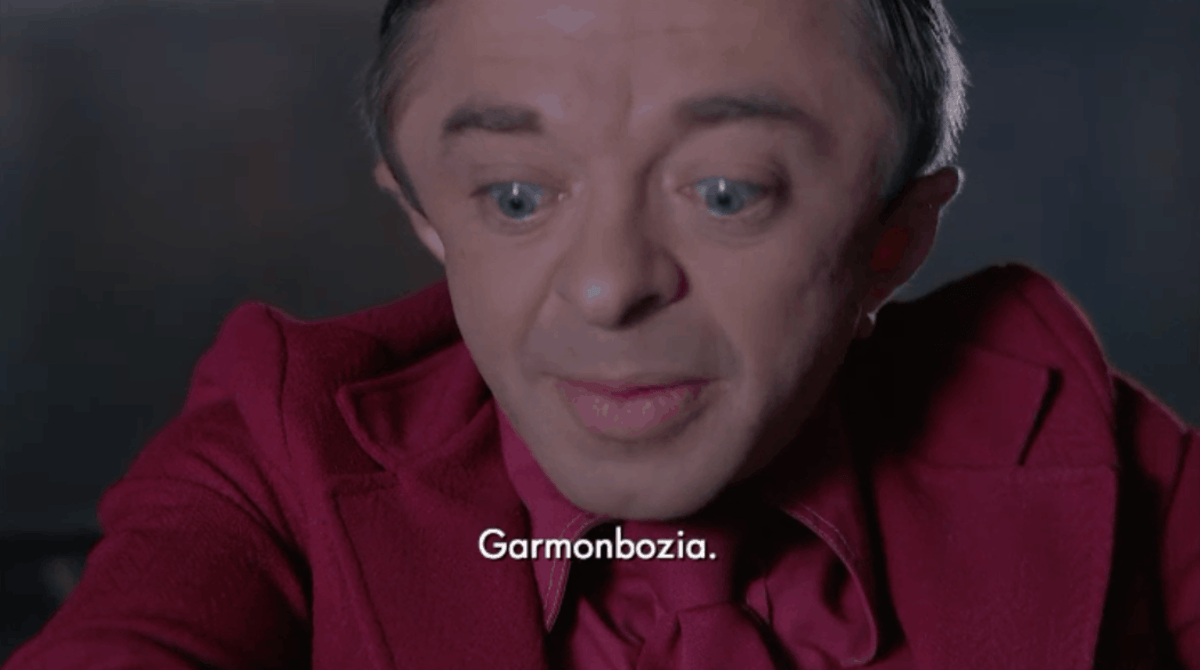
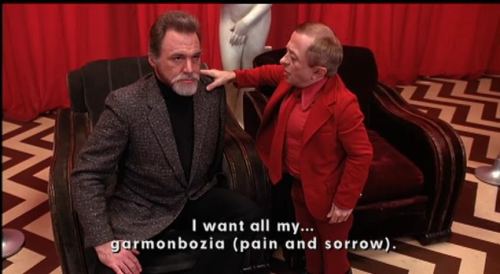
What language do the Lodge entities speak amongst themselves? In Twin Peaks, we hear them use English, but Mark Frost’s The Secret History of Twin Peaks has made it very clear that they preexisted the arrival of Europeans in Northern America by many years (though Time is a complex notion in Twin Peaks). The only non-English word we hear them use is the now famous “Garmonbozia”.

Garmonbozia2

Is this a made up word? I tend to think that David Lynch’s attention to details makes this very unlikely. He definitely enjoys obfuscating the true meaning of his creations, but underneath it all, there’s always an explanation, a way to decipher what it all means.

In the case of Garmonbozia, I would like to suggest Sanskrit: “In Vedic religion, “speech” Vāc, i.e. the language of liturgy, now known as Vedic Sanskrit, was considered the language of the gods”. Lynch opened several chapters from his book Catching the Big Fish with quotes from the Upanishads, and it is now common knowledge that he follows the teachings of the Maharishi Mahesh Yogi, the initiator of Transcendental Meditation. Moreover, the show is replete with elements connected to the Himalayas, Tibet, Nirvana, etc. Sanskrit therefore sounds like a rational choice for “the language of the Gods”.

Garmonbozia 3.jpg

I do not read Sanskrit, so I do not claim that what I have found is firm proof concerning the meaning of “Garmonbozia”, but using various online dictionaries, I definitely found a word combination that appears to make a lot of sense in the context of Twin Peaks. I believe that Garmonbozia might actually be a composite of “gharma” and “bodhya”. Here is the meaning of these two terms:

Gharma: “The Sanskrit “ghr” means “burn” “shine” “moisten” “sprinkle” “ghrna” means “heat” “warmth” “ardour” “sunshine” “ghrni” means “glowing” “ray of light” “flame” “passion” “day” “Sun” and “gharma” means “heat” “warmth” “sunshine”… As mentioned “Ghr” also produces the Sanskrit “gharma” meaning “heat” “warmth” “sunshine” and in the Rig Veda it becomes the “pot” for “boiling” the milk to be offered to the Gods“. I also found this (in French): “घर्म gharma [ghṛ] m. chaleur brûlante, saison chaude; feu intérieur; sueur || gr. θερμος; lat. formus; ang. warm” = burning heat, inner fire.

Bodhya: “बोध्य adj. bodhya to be enlightened or instructed“.

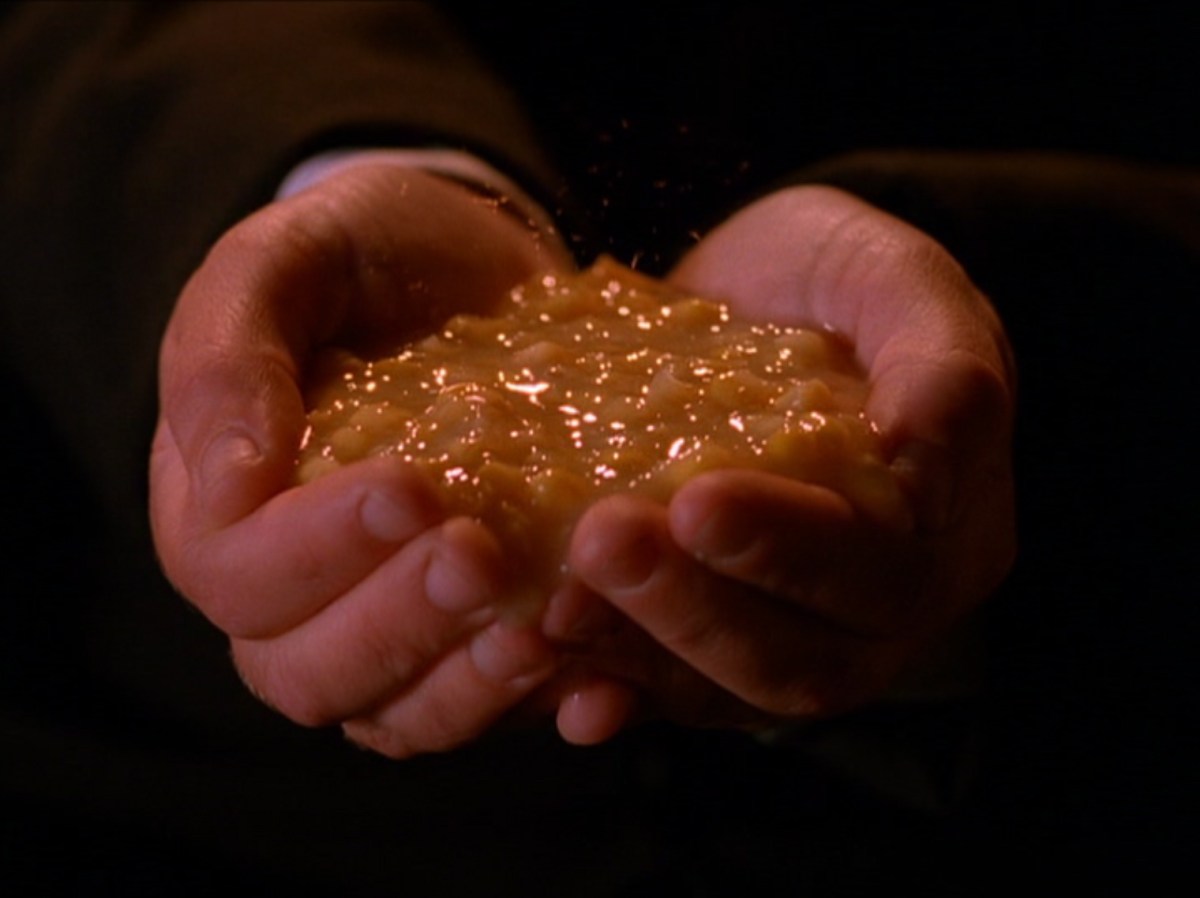
Could Garmonbozia actually mean “to be enlightened by the inner fire“, i.e. the heat produced by the food grown from pain and sorrow? What is certain is the fact that fire walks with those who eat it, the golden fire of enlightenment, from digestive alchemy. The answer to many mysteries found in Twin Peaks might very well lie within the realm of ancient Vedic teachings.

Follow Unwrapping the Plastic: https://www.facebook.com/unwrappingtheplastic/

Pickin’ up good vibrations

It all started with the Beach Boys and their song Good Vibrations

Well, the notion of “good vibes” does comes from the 1960s and their 1966 hit might have played an important role in popularising it. But when it comes to “good vibrations”, on the other hand, the idea can at least be traced back to the 19th Century. In 1893, Frank Earl Ormsby published The Law and the Prophets: A Scientific Work on the Relationship Between Physical Bodies, Vegetable, Animal, Human, and Planetary. In the book, one can find quotes such as “Receive all the good vibrations that spirits can give you, but do something for yourself, if you expect results”.

Vibrations are of the utmost importance in many esoteric teachings – several of which have influenced the universe of Twin Peaks. For instance, one finds the following information in the book Thought-Forms (by theosophists Annie Besant and C.W. Leadbeater, 1905), of clear importance in relationship to Tulpas:

“In cases in which good or evil thoughts are projected at individuals, those thoughts, if they are to directly fulfil their mission, must find, in the aura of the object to whom they are sent, materials capable of responding sympathetically to their vibrations. Any combination of matter can only vibrate within certain definite limits, and if the thought-form be outside all the limits within which the aura is capable of vibrating, it cannot affect that aura at all. It consequently rebounds from it, and that with a force proportionate to the energy with which it impinged upon it”

A bit further on in the book, one also finds:

“These radiating vibrations, like all others in nature, become less powerful in proportion to the distance from their source, though it is probable that the variation is in proportion to the cube of the distance instead of to the square, because of the additional dimension involved. Again, like all other vibrations, these tend to reproduce themselves whenever opportunity is offered to them; and so whenever they strike upon another mental body they tend to provoke in it their own rate of motion. That is—from the point of view of the man whose mental body is touched by these waves—they tend to produce in his mind thoughts of the same type as that which had previously arisen in the mind of the thinker who sent forth the waves”.

diane-tulpa.png

Besides Thought-Forms, another example of the importance of vibrations in the world of hermeticism can be found in the writings of Tuesday Lobsang Rampa, discussed elsewhere on this blog, author of books with paranormal and occult themes which have influenced Twin Peaks. Here, for instance, is what he wrote in The Cave of the Ancients:

Cave2

Everything on this world consists of vibrations; the whole world’s vibrations and everything within the world – may be likened to an octave on a musical scale”.

The Fireman would probably add “Listen to the sounds!” after reading this quote. One might also wonder if the sound heard by Ben Horne in the Great Northern Hotel might not be connected to the fact that this is the place which leads Cooper to Phillip Jeffries, a place that vibrates to the right frequency in order to open the door to such a spacetime shortcut…

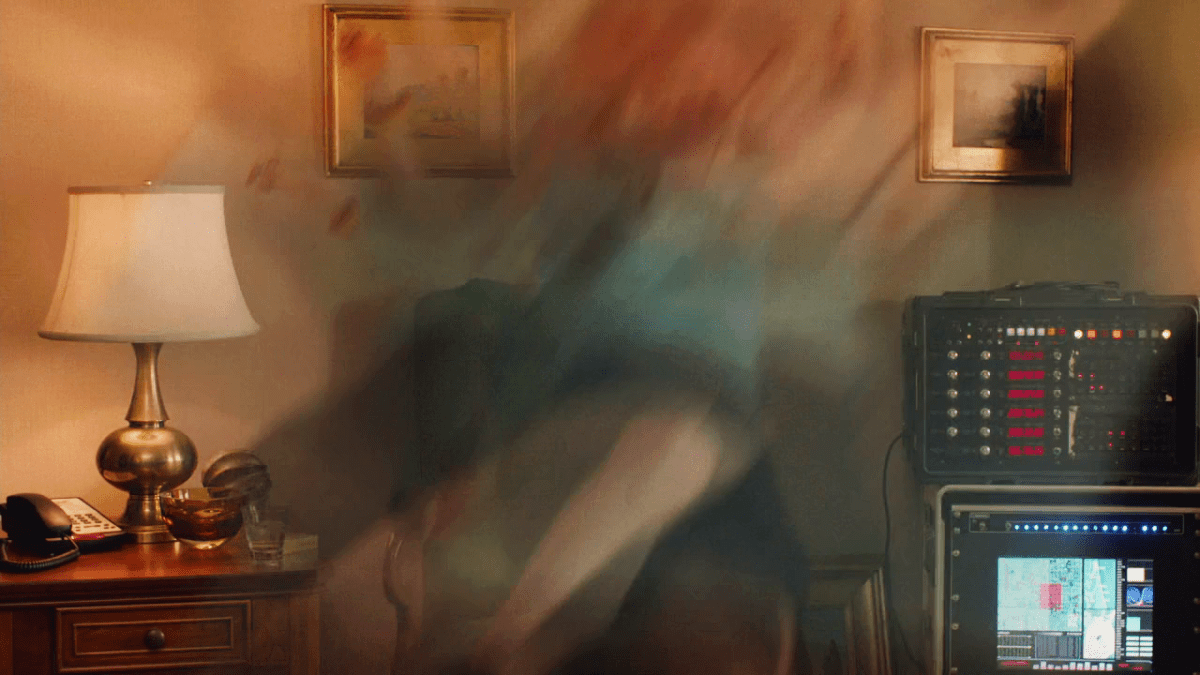
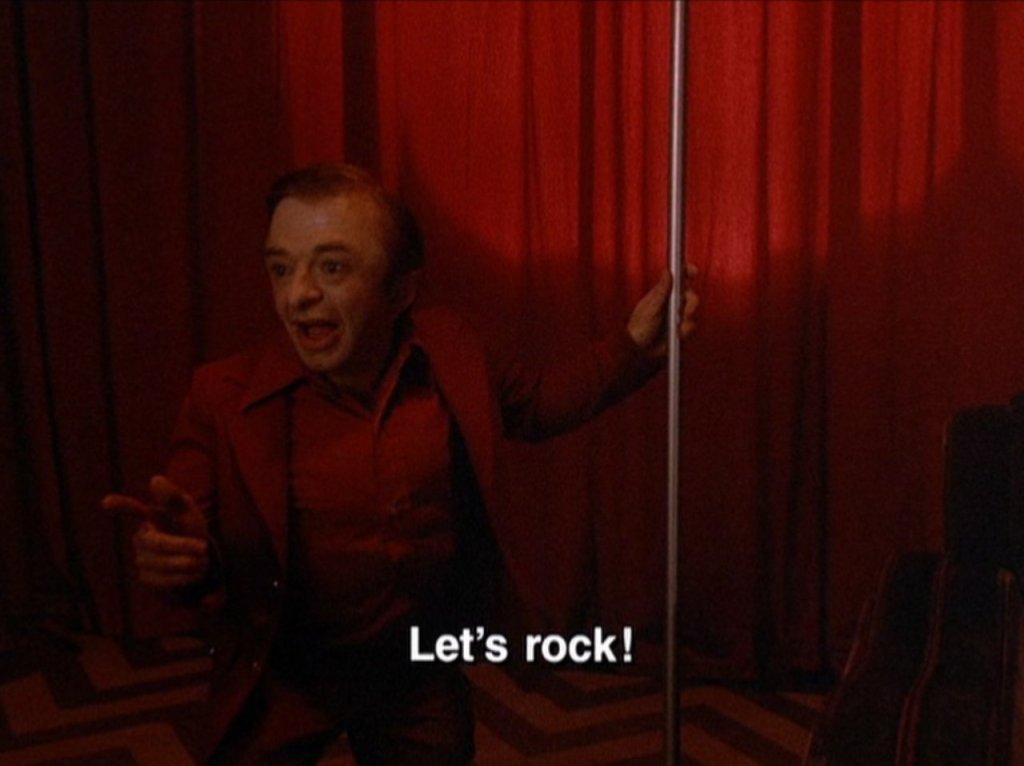
Vibrations have always played a central role in Twin Peaks, right from the first season of the series. The first time we see The Arm, right before he utters the now famous “Let’s rock!” (what’s a rocking motion if not a vibration, an oscillation?), we can see him vibrating with his back to us, as if trying to find the right frequency before speaking to Cooper.

And the floor of the Red Room, with its chevron motif, is of course an ode to vibrations!

Vibes 2

Let’s Rock!

Another example of vibrations can be found in season 2, when various inhabitants of Twin Peaks begin to experience vibrations in their hands, annoucing BOB’s crossing over from the Lodges to our realm via the Ghostwood Forest by such a use of vibrations.

Vibes 3.png

giphy1

Also in season 2, Angelo Badalamenti composed a track named Packard’s Vibration for the series’ soundtrack.

TPS2.jpg

Packard’s Vibration

In The Return an obvious example of the role of vibrations is the moment when Bobby Briggs opens up his father’s  device (that resembles a cigar) by hurling it onto the ground and listening to the ringing tone it produces. As in the Great Northern Hotel, that sound is an indication that it’s possible to open something normally sealed by the power of vibrations.

Vibes 1.jpeg

giphy2

So: what does it all mean? Why such an interest in vibrations? And what are vibrations anyway?

Wikipedia explains that they are “a mechanical phenomenon whereby oscillations occur about an equilibrium point”. There are all sorts of vibrations, from sound vibrations to light vibrations, electromagnetic vibrations. The following book (link), for instance, focuses on “the oscillatory aspects of the electromagnetic field— that is, on the vibrations, waves, radiation, and the interaction of electromagnetic waves with matter”.

electro.jpg

Electromagnetism? Vibrations? Waves? Radiations? WELCOME TO TWIN PEAKS!

In my book Twin Peaks: Unwrapping the Plastic, I explain that “in the world of Twin Peaks at the root of every movement lies a vibration” and I link this to the teachings of the Maharishi Mahesh Yogi, whose influence on David Lynch should never be underestimated: “Through every thought, word, and action we are producing an influence to affect all our surroundings. Physics has revealed that through everything we do we are producing vibrations in the atmosphere.”

Beyond this, I also wrote about the role of the colour extremes of red and blue in the series – I explained that they “are the result of their energetic wavelengths, which place them at near opposite ends of the visible electromagnetic radiation spectrum… once again one is dealing with vibrations, waves or ripples on the surface of the ‘ocean of consciousness’, with most of the currents occurring outside the reach of normal human senses”.

peaks 7.jpg

bob.jpg
Blue BOB in the Red Room

When The Arm explains how he sounds, he plays with the sound properties of vibrations – more precisely, with the Doppler effect, “an increase (or decrease) in the frequency of sound, light, or other waves as the source and observer move towards (or away from) each other. The effect causes the sudden change in pitch noticeable in a passing siren, as well as the red shift seen by astronomers”.

tumblr_lz5apcme3d1rogt97o1_500

I am the Arm and I sound like this!

The real clue concerning the use of vibrations in the series is to be found while reading Bill Hasting’s website The Search for the Zone, especially the page on The Grant Chronicles  called Parallel Universes and Density Shifting.

Screen Shot 2018-02-28 at 21.56.24.png

In my book I discussed the importance of the Fourth dimension (space dimensions) in Twin Peaks, which I associated among others to artists like Marcel Duchamp, to the esoteric tradition and to Theosophy: “it is useful to know that the hermetic tradition gives a special significance to waterfalls… the waterfall becomes a metaphor for the existence of a mysterious Fourth Dimension that interacts with our three-dimensional reality”.

When he discusses the possibility of parallel universes, Bill Hastings basically uses the same idea. He names it the Fifth dimension, which is similar to the one mentioned above except that it also includes vibrations: “The Universe is based on major 5 dimensions, and is unknown except to a select group of mankind! You are familiar with the first three linear axis of ordinary spatial volume related, x, y, and z of standard math. The fourth is time… The fifth dimension involves vibrational frequency. This frequency or vibrational rate is super imposed on matter and energy at the sub atomic level. This would be called its resonant frequency”.

We can also find the following quotes from the site:

“The fifth dimension has many different levels… This is how reports from friendly encounters of being able to pass through solid objects is achieved. Atoms vibrating at different frequencies do not mix; they simply slide past each other… At density level 4 a new Universe appears, less crowded in the number of stars, and in the density of matter itself… Where the vibrational rate of the atomic structure increases, oppositely so does the ambient subatomic field of dark matter thin, thus affecting the perception of time to others outside of the affected area and the particle flow of sub atomic particles related to light, gravity and magnetism.

In a higher dimension, which could be reached by fine tuning the vibrational frequency of the waves of particles, a cube would become a hypercube: “a higher-dimensional being could convey to us the concept of a hypercube by unraveling it until it becomes a series of three-dimensional cubes, called a tesserack… If the edges of a cube are made of sticks, and the cube is hollow, we could shine a light on the cube and have the shadow fall upon a two-dimensional plane”.

output_wlrhzf

This is basically what takes place in New York with the glass cube experiment: it was designed as a five dimensional trap to catch entities from the Lodges / the Zone, vibrating at a higher rate than us. The cube is actually a hypercube capable of holding specimen from this other realm.
giphy

This really should be linked to Robert Heinlein’s (an author of special interest to Bill Hastings) short story ‘—And He Built a Crooked House—’ (1941) about an architect who builds a house shaped liked the unfolded net of a tesseract so as to save money.

This ability to manipulate vibrations also explains why the five dimensional entities from higher realms are able to penetrate the inhabitants of Twin Peaks: “This idea of reaching into a solid object without breaking the outer surface seems absurd to us only because our minds are limited when considering higher dimensions”. They somehow manage to coexist in the same physical space by adopting different vibrational rates.

bob 5.jpg

A lot more could be written about the central role of vibrations in Twin Peaks as a way to move between dimensions and to procur visions beyond the sense of sight. This concept might very well be THE most important in the universe of the series, it explains so much, on so many levels, that it probably deserves several articles. I recently published one such article in POSITIF, a French monthly film magazine (the second oldest French film magazine in publication after CAHIERS DU CINEMA). In this text, I discussed the importance of waves (watery, electromagnetic, etc.) in Twin Peaks. My next step will be to write a more in depth analysis of vibrations, a subject directly connected to the oscillation of waves.

Follow Unwrapping the Plastic: Facebook / Twitter
The First Temptation of Lynch

What if The Return was secretly a musical, a dance film that does not dare say its name? “Listen to the sounds” said the Fireman in episode 1: could he have meant the”sound of music”?

Strangely enough, several aspects of the third season of Twin Peaks point in that direction: its colour code, for instance, highly reminiscent of the costumes worn by actors in the technicolor musicals of the 1950s, Vincente Minnelli style. Also its outdated atmosphere and concerns that owe much to the post-WWII era (atomic fears, diners, flying saucers, etc.); the omnipresence of music in the series, both diegetic and extra diegetic…

During the David Lynch conference that recently took place in Bordeaux last December, Estelle Dalleu, professor of film studies at the University of Strasbourg, reminded us of Bernardo Bertolluci’s claim from the year he was President of the Jury at the Cannes Film Festival (the year Wild at Heart was awarded its top prize, the Palme d’Or). In an interview that one can find on the French DVD edition of the film, he discusses “the temptation of the musical in the films of David Lynch”.

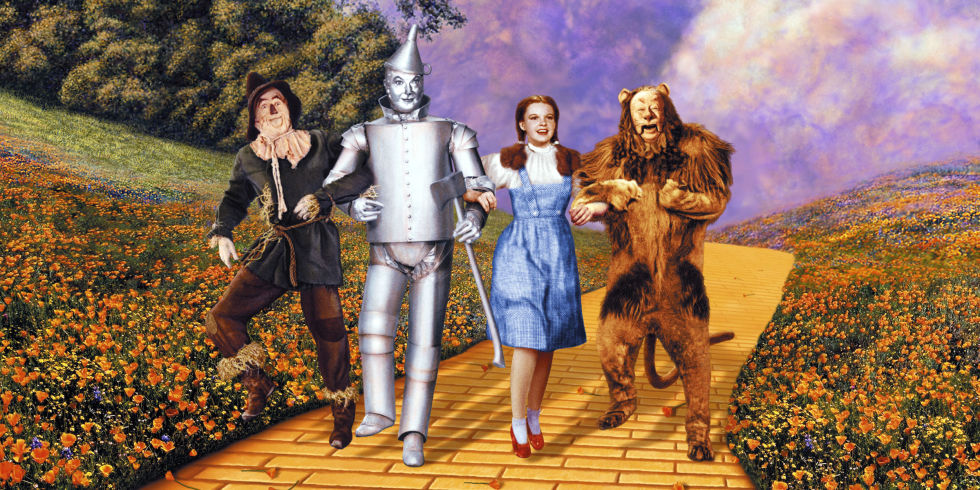
Though Lynch has never truly shot a musical as such, one does indeed have the feeling that this universe of dance and song is always present in the background of his moving images. This might very well be another sign of the influence of The Wizard of Oz on Lynch’s filmmaking (Dougie Jones probably wishes he only had a brain).

OZ 1.jpg

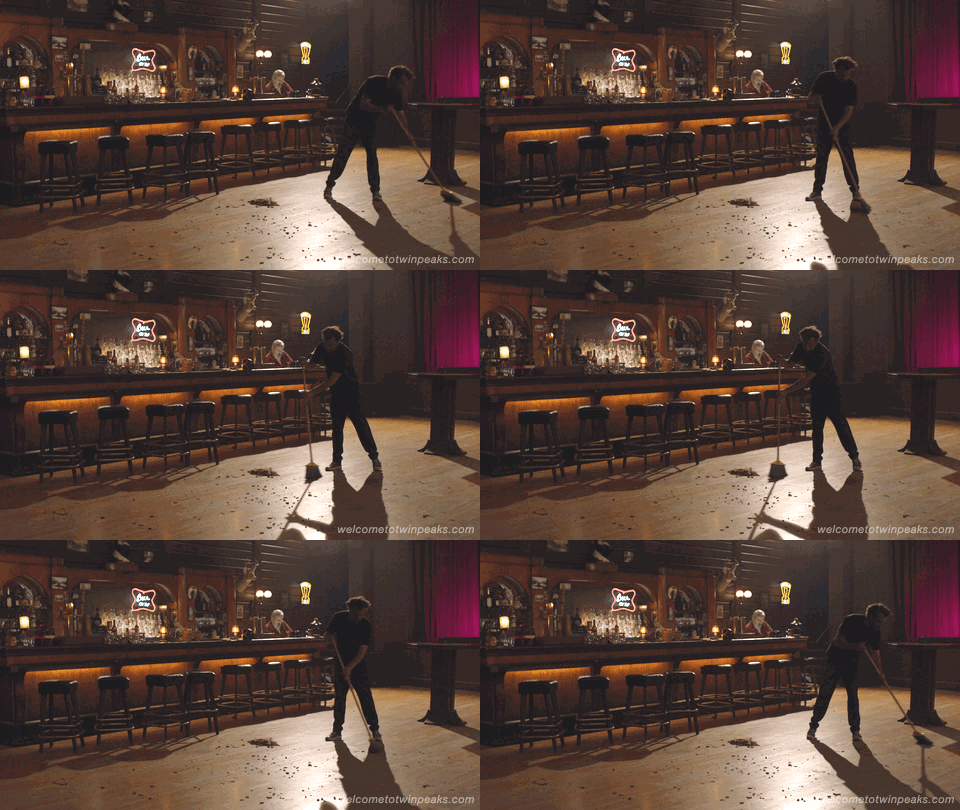
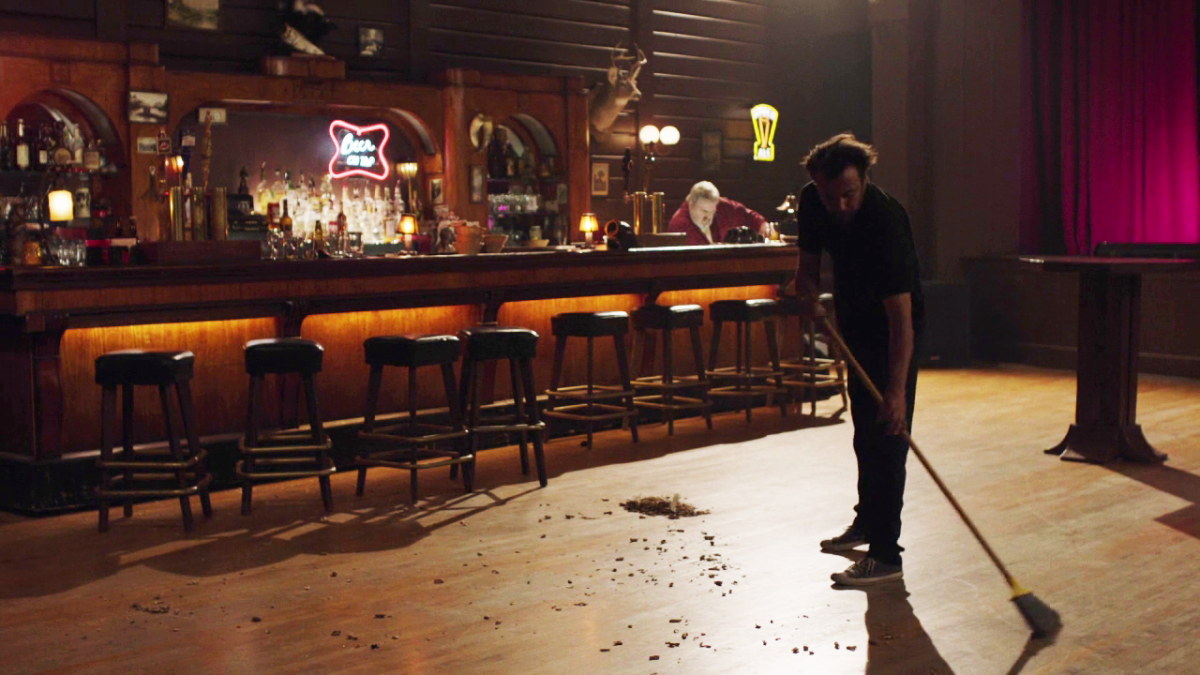
One of the most interesting dance sequence in The Return, in my opinion, is the extended scene during which someone sweeps the floor of the Bang Bang Bar to the music of “Green Onions” by Booker T & the M G ‘s. This is a long and complex choreography for a man and a broom that creates a suspense of its own, based solely on the movements and choices of the cleaner. Simple and powerful, without added movements of the camera or editing.

giphy

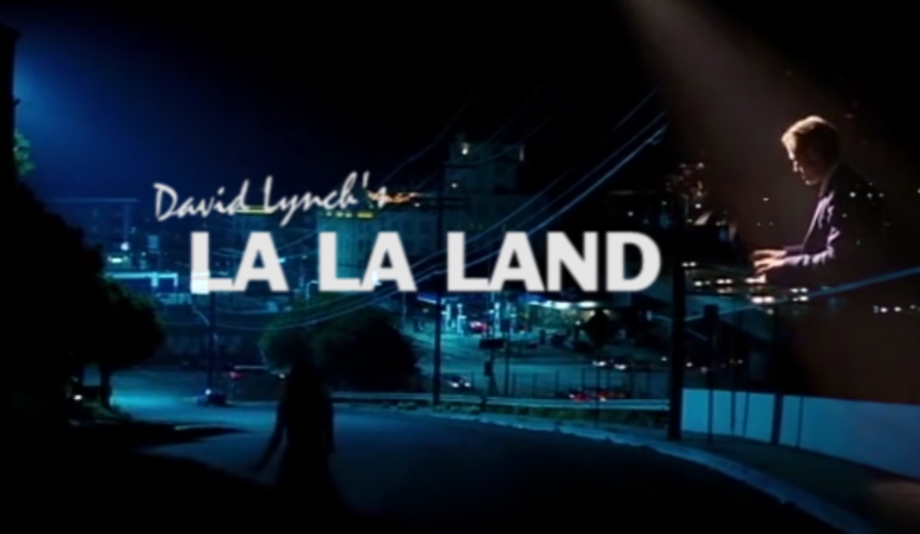
This link between the films of David Lynch and musicals can be felt throughout his filmography (the dance of the radiator girl in Eraserhaed, the Jitterbug scene at the beginning of Mulholland DriveSailor and Lula’s hard rock thrashing, among others). This has also led some people to wonder what a traditional musical would look like filmed by Lynch. Here are two interesting examples of his filmic style applied to Damien Chazelle’s La La Land:

Lynch La La Land.png

LA LA LAND LYNCH CINEFIX

LA LA LAND LYNCH

I will continue to develop this train of thought during a 4 day long conference in Cerisy, Normandy (a celebrated location for conferences in France that intellectual figures like Derrida and Deleuze frequented during their lifetimes), dedicated to screendance. Though not focused solely on Twin Peaks (my talk will focus on Absurda and Ballerina, two short films shot by Lynch in 2007), I will nevertheless use examples from The Return during this presentation. All of this will lead to a book publiation in 2019 about dance in the films of David Lynch, which I am currently working on with Marisa C. Hayes (together we co-direct the Centre de Vidéo Danse de Bourgogne, a center and festival dedicated to the promotion and study of screendance).

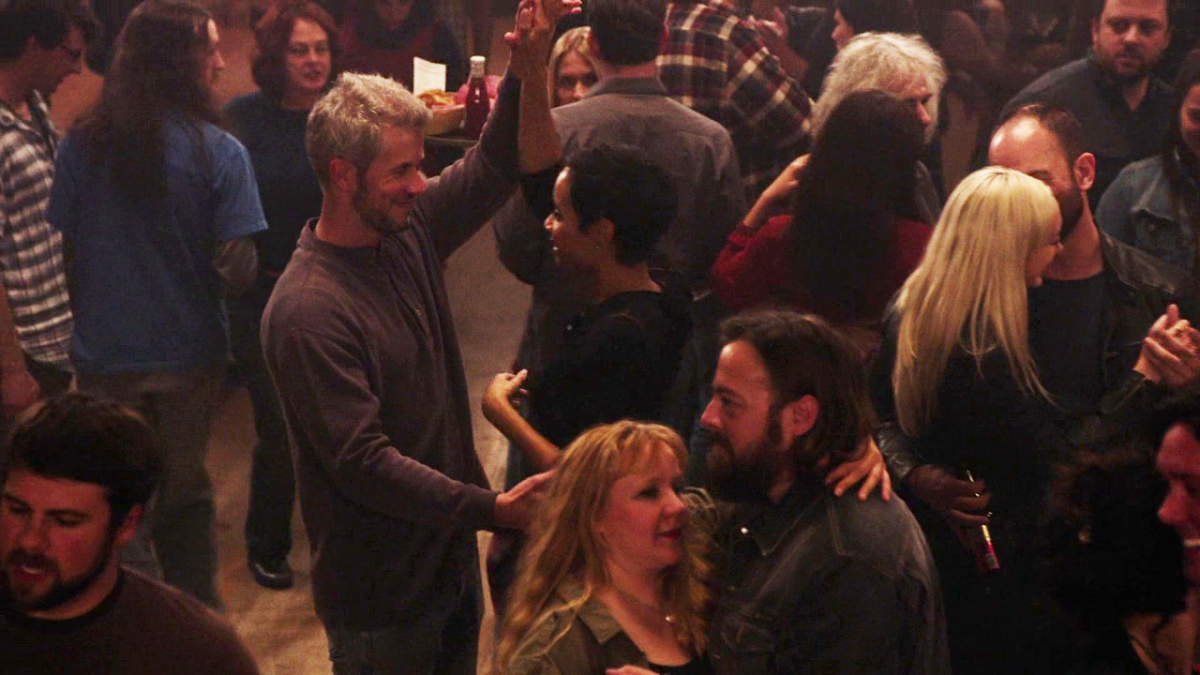
To conclude this (short) article, here’s a gallery of images from The Return that could easily find their place in a musical, or in any other movement oriented film:

SOLOS

vlcsnap-2018-01-19-10h23m32s315vlcsnap-2018-01-19-10h31m15s298vlcsnap-2018-01-19-10h37m48s594vlcsnap-2018-01-19-10h43m27s135vlcsnap-2018-01-19-10h43m53s089vlcsnap-2018-01-19-10h44m38s600vlcsnap-2018-01-19-10h45m12s756vlcsnap-2018-01-19-11h01m32s897vlcsnap-2018-01-19-11h06m44s745vlcsnap-2018-01-19-11h17m10s824vlcsnap-2018-01-19-11h18m22s445vlcsnap-2018-01-19-11h20m26s750vlcsnap-2018-01-19-11h23m01s661vlcsnap-2018-01-19-11h24m13s255vlcsnap-2018-01-19-11h24m53s941vlcsnap-2018-01-19-11h41m05s208vlcsnap-2018-01-19-11h44m49s100vlcsnap-2018-01-19-11h50m40s830vlcsnap-2018-01-19-11h51m10s356vlcsnap-2018-01-19-11h52m48s166vlcsnap-2018-01-19-11h54m53s320

DUOS

vlcsnap-2018-01-19-10h27m28s789vlcsnap-2018-01-19-11h30m14s381vlcsnap-2018-01-19-10h33m26s458Dance 1vlcsnap-2018-01-19-10h38m40s536vlcsnap-2018-01-19-10h40m41s082vlcsnap-2018-01-19-11h06m01s348vlcsnap-2018-01-19-11h30m58s888vlcsnap-2018-01-19-11h39m41s320vlcsnap-2018-01-19-11h55m45s710vlcsnap-2018-01-19-12h00m30s542

TRIOS

vlcsnap-2018-01-19-10h33m11s244vlcsnap-2018-01-19-10h39m31s740vlcsnap-2018-01-19-11h05m24s517vlcsnap-2018-01-19-11h08m30s195vlcsnap-2018-01-19-11h08m38s383vlcsnap-2018-01-19-11h10m28s570vlcsnap-2018-01-19-11h15m46s710vlcsnap-2018-01-19-11h26m06s148vlcsnap-2018-01-19-11h26m36s897vlcsnap-2018-01-19-11h26m53s287vlcsnap-2018-01-19-11h36m32s396vlcsnap-2018-01-19-11h46m25s580vlcsnap-2018-01-19-11h59m26s942

GROUPS & SOCIAL DANCING

vlcsnap-2018-01-19-10h29m10s025vlcsnap-2018-01-19-10h41m17s380vlcsnap-2018-01-19-11h11m10s506vlcsnap-2018-01-19-11h27m28s038vlcsnap-2018-01-19-11h33m06s928vlcsnap-2018-01-19-11h34m26s482vlcsnap-2018-01-19-11h35m37s834vlcsnap-2018-01-19-11h48m11s615vlcsnap-2018-01-19-11h56m23s365

MICROCHOREOGRAPHIES

vlcsnap-2018-01-19-10h09m54s565vlcsnap-2018-01-19-10h16m59s009vlcsnap-2018-01-19-10h31m57s021vlcsnap-2018-01-19-10h40m53s961vlcsnap-2018-01-19-11h00m52s330vlcsnap-2018-01-19-11h14m52s385vlcsnap-2018-01-19-11h25m30s418vlcsnap-2018-01-19-11h29m36s054vlcsnap-2018-01-19-11h50m00s394


Follow Unwrapping the Plastic: Facebook / Twitter

Grand Maître of the Outsider

In the October issue of Cahiers du Cinéma, largely dedicated to Twin Peaks: The Return (link), editor in chief Stéphane Delorme describes David Lynch as a member of the “outsider art” constellation. I agree that this classification makes a lot of sense and this blog post will explore why so.

Outsider art is a category that gravitates somewhere in the vicinity of “naïve art” and “visionary art”. It originated in France with Jean Dubuffet’s term “art brut” (raw/rough art). Outsider artists are generally self-taught and function outside the mainstream art world. Their artistic training is usually very limited. Frequently driven by spiritual quests, their oeuvre is often prolific and multidisciplinary, making use of various materials without regards to traditional disciplinary divisions or material techniques. In this vein, their message driven work often incorporates written texts within the visual works, once again blurring the lines between materials and categories.

Various paintings by David Lynch and Jean Dubuffet

Although David Lynch received formal training in the arts, it is rather obvious that he continues to rebel against many of the traditional rules associated with art making in general and cinema in particular. Many have underlined how the script of The Return, for instance, breaks classical television expectations by adopting a radically personal take on how a story must be told (which led a vast number of viewers to be totally disoriented during the first third of the show). Script writing as it is taught in schools and as it is applied in the vast majority of TV series around the world, feels very academic and “passé” compared to the free form chosen for the 3rd season of Twin Peaks.

 Lynch’s attitude does not appear to be the result of a desire to break away from traditional academic rules as much as it reflects a complete disinterest in them. Lynch’s only concern is to stay true to his own ideas – the rest seems irrelevant. While some viewers were surprised by the low-tech quality of certain special effects in The Return, they offer proof of his disinterest in any sort of expectations one might have from contemporary artists, allowing him to focus solely on his vision – closer to a collage by Max Ernst than to the latest CGI blockbuster.

One of the reasons why a film like Eraserhead, for instance, left such a trace in cinema history was because of its difference, because it did not follow the usual constuction of film stories and its dream logic. It is also crucial to note the obsessive nature of Lynch’s work while making Eraserhead: the film was seven years in the making on abandoned sets (the school stables) of the American Film Institute’s Center for Advanced Film Studies (a course he despised – he would have dropped out if he had not had the chance to shoot his film there). Most filmmakers would have given up the project after the first signs of difficulties whereas Lynch persisted until he was finally able to give birth to this grotesque and horrific child that is Eraserhead. This is typical of the choices an outsider artist would make, so driven by a personal inner world that other considerations have no weight whatsoever.

eraserhead.jpg

Here is what Jean Dubuffet (who created the label “art brut” – outsider art – to describe art created outside the boundaries of recognized culture) had to say about outsider artists: “These works created from solitude and from pure and authentic creative impulses – where the worries of competition, acclaim and social promotion do not interfere – are, due to these very elements, more precious than professional productions. After a certain familiarity with these flourishings of an exalted feverishness, lived so fully and so intensely by their authors, we cannot avoid the feeling that in relation to these works, cultural art in its entirety appears to be the game of a futile society, a fallacious parade“.

In a sense, this describes what Doctor Jacoby is doing in The Return, when he paints his shovels with a layer of gold (he too is a complete outsider, living in the forest, far from the town and its human community). Totally reclusive and eccentric, on the verge of madness (or is it illumination?), he creates gold out of lead, far from the commercial considerations of most creators. His spiritual discourse too, mixed with conspiracy theories and social truths, is not unlike the kind of syncretic intellectual constructions proposed by many outsider artists (including Lynch himself, when he starts discussing Transcendental Meditation’s capacity to bring peace on Earth with its Maharishi Towers of Invincibility).

The link with mental illness appears powerful in relationship to outsider artists. Dubuffet, for instance, used psychiatric hospital patients and all sorts of prisoners, mystics, recluses and children as examples of such artists. He was notably interested in the research of German doctor Hans Prinzhorn, who collected the works of his mentally ill patients in Heidelberg (many of them schizophrenic). The following drawing, for instance, can easily be linked to the importance of electricity and radio waves in The Return. In the Wikipedia entry about Ousider art, we find the following statement: “People with some formal artistic training as well as well-established artists are not immune from mental illness, and may also be institutionalized“. This is not an attempt to claim that David Lynch is mentally ill, but that it’s possible to have been formally trained and categorized as an outsider artist (in Lynch’s case for his visionary capabilities). When it comes to Lynch, there is no denying that a certain amount of mystical and obsessive qualities set him apart from the mainstream.

1922_prinzhorn-artistry-of-the-mentally-ill_c.jpg
From Artistry of the Mentally Ill (Hans Prinzhorn – 1922)

One outsider artist who might have influenced David Lynch during his creative process is Paul Laffoley. This visionary American artist from Boston was diagnosed as autistic when he was a child and given electroshock treatments: “Laffoley began to formulate his unique trans-disciplinary approach to a new discipline combining, philosophy, science, architecture and spirituality to the practice of painting. Laffoley first began to organize his ideas in a format related to eastern mandalas, partially inspired by the late night patterns he watched for Warhol on late night television… Painted on large canvases, the majority of Paul Laffoley’s paintings combine words and imagery to depict a spiritual architecture of explanation, tackling concepts like dimensionality, time travel through hacking relativity, connecting conceptual threads shared by philosophers through the millennia, and theories about the cosmic origins of mankind“.

Kali.jpg
The Kali-Yuga -(Paul Laffoley‘s first painting – 1965)

According to Lynch (see his interview in the December issue of Cahiers du Cinéma, here), we are living in the Kali Yuga (associated with the demon Kali) – the age of strife, that lasts 432, 000 years. This age will end in the destruction of the Universe by fire before a new golden age. Kalki, the tenth avatar of Vishnu, will appear at the end of the Kali Yuga and usher in the Satya Yuga (the age of Truth / the golden age), while riding a white horse with a fiery sword.

Whitehorse
Who’s gonna ride the horse?

Returning to Paul Laffoley, one notes that “from an early age, Laffoley manifested an obsessive interest in UFOs. He had seen the movie The Day the Earth Stood Still 873 times. He explains that his obsessive interest in the film derives partly from a fascination with the architecture of the space ship in the film which, early on in his life, was subconscious. While he was still a child he made a vow to become an architect so that he could design flying saucers, although he did not become a registered architect until he was 50 years of age“. I have pointed out in a former blog post (link) the possible influence of the same film title on The Return (notably, the Firman’s Palace).

i-robur_lafoley_full.jpg

Laffoley was also interested in time travel. Could there be a link between the following painting and the glass box through which Cooper transits on his way to becoming Dougie in Las Vegas?

twin-peaks-season-3-episode-1-cooper-in-the-glass-box

It’s difficult to negate the links that exist between David Lynch and outsider art. While initial and important studies underline how renowned painters and filmmakers (such as Ernst, Bosch, Cocteau, Richter, etc.) have influenced his work, it may now be time to dig further (with our golden shovels?) towards the roots of the outsider art tree, beyond the examples given in this blog post (Dubuffet, Laffoley) to further explore Twin Peaks and Lynch’s other creations. There is likely a vast network of links to be found that will help us better understand David Lynch and his universe.

Follow Unwrapping the Plastic: Facebook / Twitter