Page 1

In my book Twin Peaks: Unwrapping the Plastic, I predicted that Laura Palmer would be resurrected in some form for this new season (or should I say reincarnated?). She had already come back to life as Madeleine Ferguson, and as herself in the Red Room. It made sense that she would do the same in the Return – her return, among several others (in space, in time). The reason for these reincarnations comes from her very name, Laura (laurel) Palmer (palm tree), two symbols of immortality. Now, we also know that she has been sent to Earth by the Fireman as a way to counteract the evil born out of the first nuclear test explosion in New Mexico.

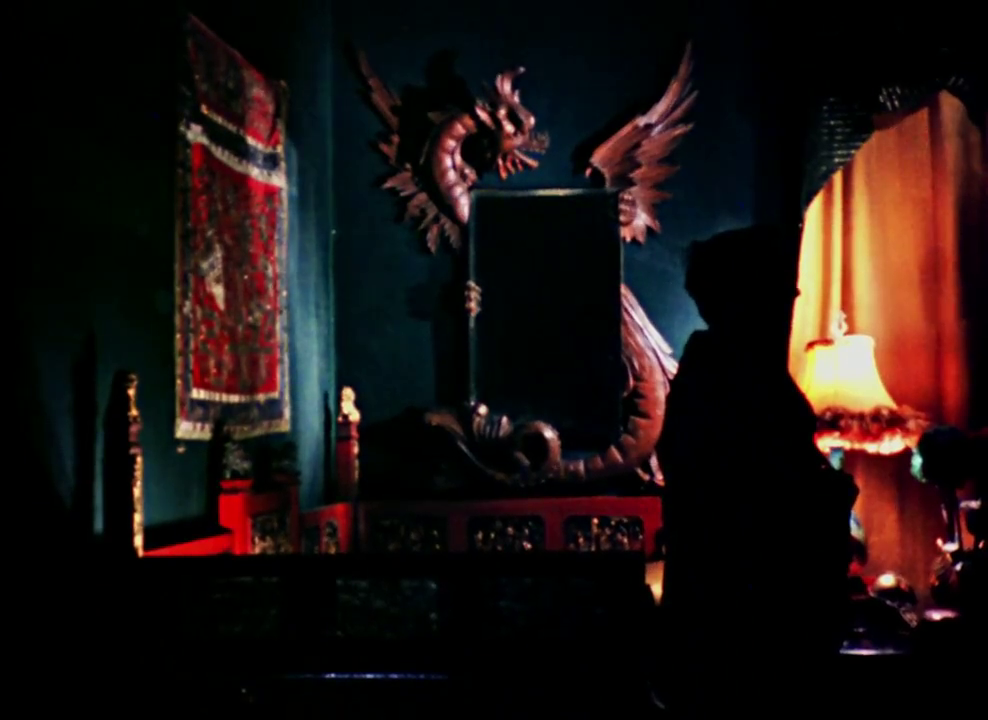
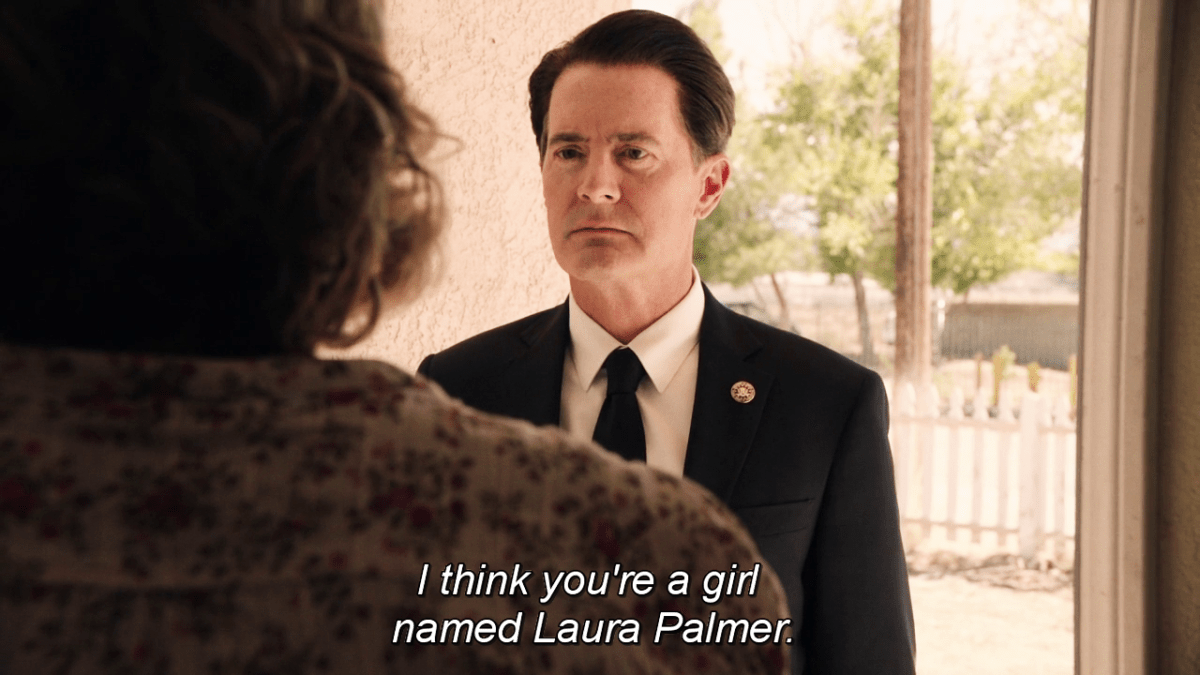
In episode 18, we discover that Laura’s new avatar is named Carrie Page and that she lives in Odessa, Texas.

vlcsnap-2017-09-06-11h32m24s364

Dale gets somehow teleported to Odessa after having accomplished his preplanned Hieros Gamos ritual (sex magick) with Diane and finds Carrie’s house thanks to information he gathers from her coworker at Judy’s. Interestingly, right before getting to the diner, he sees two containers bearing the Maersk emblem. Maersk is a Danish business conglomerate, working primarily within the transportation and energy sectors. Its emblem results from an action by its deeply religious founder who attached a blue banner with a white seven pointed star on both sides of the black chimney on a steamship when his wife recovered from illness.

The steamship in question was the SS Laura.

As always in Twin Peaks, it is worthwhile to explore the etymology of a character’s name in order to better understand who they truly are. Carrie is a pet name for Caroline, the feminine form of Charles, which stands for “full-grown”. As far as Page is concerned, it comes from the Anglo-French and means “youth, youth preparing to be a knight” – it can also be, of course, a sheet of paper.

There are several ways to understand this word combination. Carrie might be a “full-grown youth”, a contradiction. She might also be a “full-grown sheet of paper”, a blank page with no memories regarding who she truly is. She is definitely full-grown, contrary to the Laura Dale had recently lost in the Twin Peaks forest. She is also a sheet of paper, derived from the cosmic tree one finds in her hometown.
vlcsnap-2017-09-06-11h33m43s004

Her horseshoe necklace is a reminder of the Las Vegas casino where Dougie earned so much money and of the Lucky 7 Insurance where he works. It’s also a reminder of the little white horse that stands above her chimney place and of the white horse linked to the Red Room, without forgetting the white horse that stands in front of Judy’s diner. Finally, it’s a reminder of Troy, the poney from her youth (from Laura’s youth, that is), mentioned in The Secret Diary of Laura Palmer.

The thimble that stands next to the horse on the chimney is a strong visual reminder of the electromagnetic devices linked to the Purple Palace. It’s important I belive to remember that thimbles are protective devices for the finger that pushes the needle while sewing. Sewing (from the Red Room) and sewing dreams are activities that play a central role in season 3. It’s all about ripping cloth and sewing universes together.

Here’s an extract from an interview with David Lynch on Deadline.com published on May 19: “You seem to have a very nice life balance, in terms of your art and your hobbies. Is there anything that you haven’t done yet? I would like to learn how to sew. I have a sewing machine, an industrial sewing machine, but I don’t know how to use it, and I would like to learn how to sew. There’s a lot of things like, you know, covers for things, bags to carry things. A lot of these car shows, they have these guys that do the interiors of the car, the seats and the door panels. These people are artists. All the metal workers, and the machinists, and the interior guys, it’s unreal what they do. They can work that sewing machine like nobody’s business, and cut this foam, and different layers of foam, different types of foam, and stretch this leather, and then iron this leather, steam it, and get it perfect. It’s amazing what they can do. Your films are all incredibly stylish. Have you ever thought of going into fashion? I’ve never thought about fashion, but there’s where sewing comes in as well, and getting things shaped just exactly right. They’re artists as well. Total artists.”

Was Carrie Page supposed to sew the universes back together, to repair the tear in the fabric of spacetime? If so, what went (terribly) wrong? Did Dale and Diane’s ritual not only bring him to Laura’s avatar, but also release Babalon in the world? One thing is clear: by the end of the episode, the tear wins, to the point that electricity dies (it can’t even be heard over the Lynch/Frost productions credits). The fire and the warmth are gone from the world and “Jao Déi” (the scream) takes over.

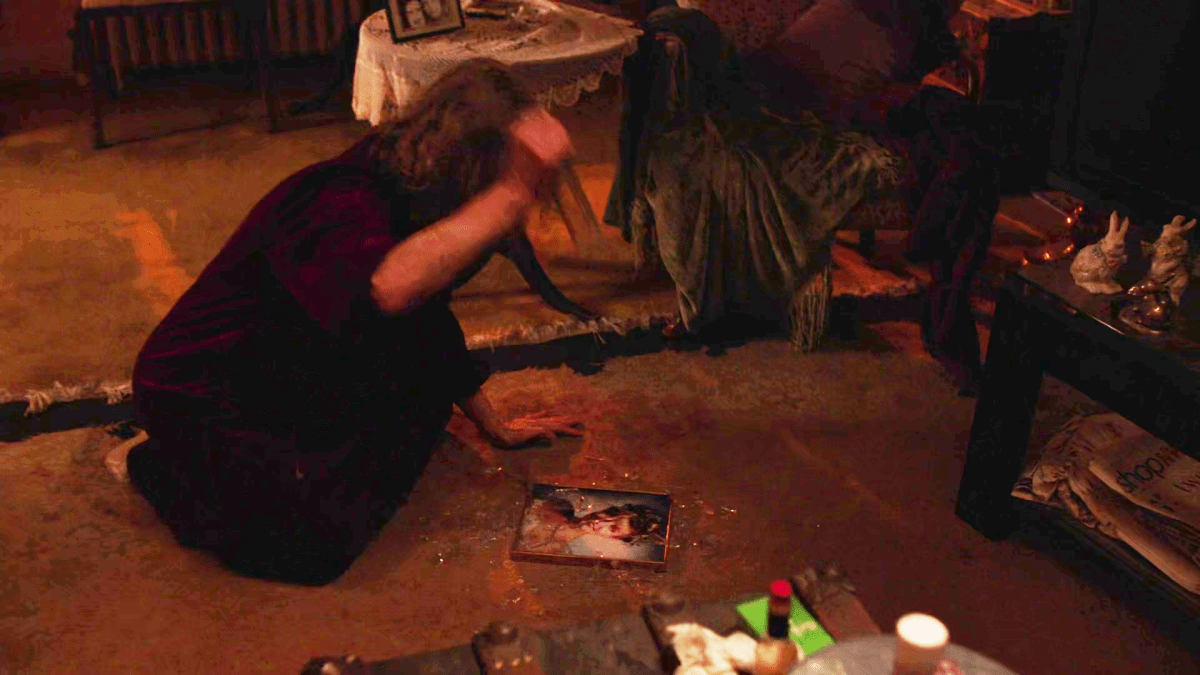
I don’t know if I’m right, but I cannot help but make a connection between the visual riddle of the dead body and other objects left behind in Carrie’s house  (we’ll never learn verbally anything about the murder that took place in her living room) and the clues left behind in the garden of the man accused of having murdered his wife in episode 3 that are examined by Gordon Cole and his team. Carrie could not have left clues in her arid and chaotic yard, so she had to leave them in the same area where the murder took place, the living room.

Could there possibly be a link between the two cases? At the very least, we are asked in both to guess what truly happened based on a simple series of visual (and probably symbolic) elements.

This slideshow requires JavaScript.

Another interesting moment concerns Dale and Carrie’s long drive home from Texas to Washington State. At one point, Dale and Carrie feel they are being followed by another car whose headlights are visible in the windshield. This drive and the presence of a possible follower on their trail is reminiscent of Lolita, one of David Lynch’s favourite films, another story of false identities and child abuse. Of course, Carrie is not a Lolita anymore and the car in the background finally passes them. The sequence seems to say there is no return possible.

In relationship to Carrie and her Texas home, one wonders if all the paintings and motifs of cowboys and deserts, spread throughout season 3 were supposed to be signs of where Laura’s new avatar was truly located?

Dale and Carrie finally reach Twin Peaks, which they enter at night after having crossed a bridge. One has to cross a river to get there, as if entering Hell itself. And it is indeed a form of Hell that awaits them when they find out that Laura’s house is now inhabited by Alice Tremond, who bought it from the Chalfonts. Besides the reference to Lewis Carroll, this revelation suddenly questions the very existence of Laura Palmer since Alice and her husband don’t seem to have any memory of Sarah.

vlcsnap-2017-09-06-11h51m38s286

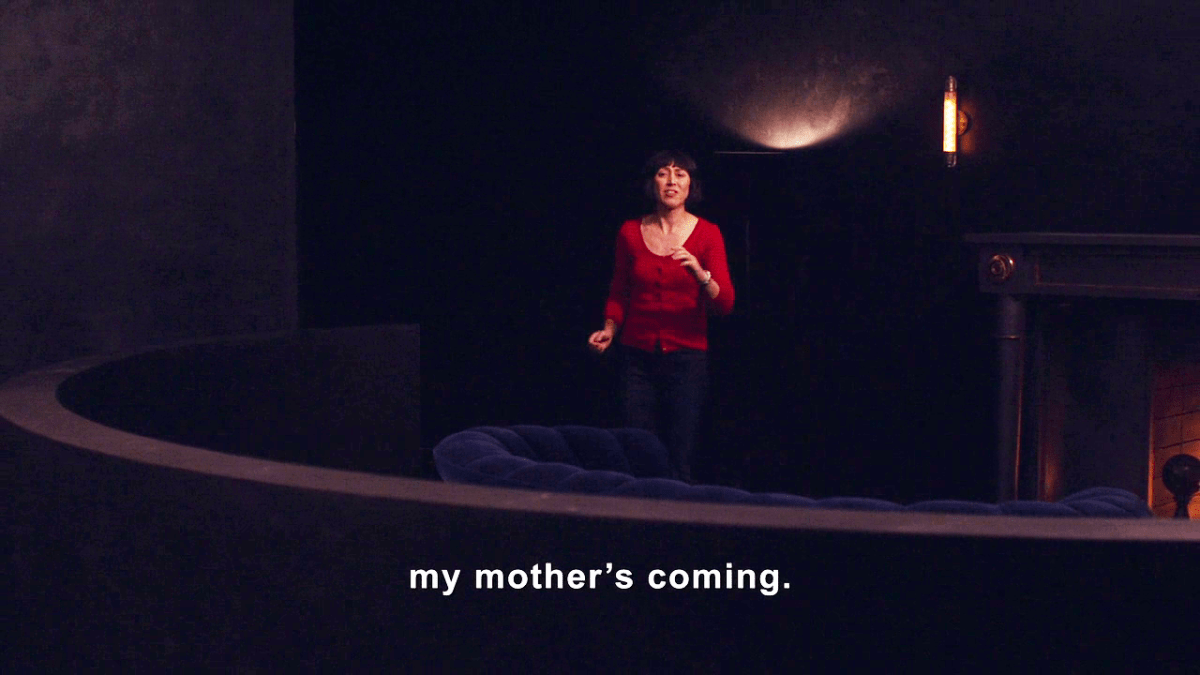
What is one to make of the possible links between Sarah / Mother / the Scarlet Woman / Babalon? If Sarah is Babalon (or possessed by her), could Laura possibly be the Moonchild? And also, if Naido was truly Diane in disguise, is it possible that the other woman Dale met at the beginning of episode 3 – the one who looks like Ronnette Pulaski and who warns Dale to hurry because of her mother’s return – could be a mask for… Laura herself? (Ronnette used to be her double, after all, back in the days).
vlcsnap-2017-09-06-09h55m26s652.png

Episode 18 leaves us with many unanswered questions. It is up to us now to put the pieces of the puzzle back together.

Follow Unwrapping the Plastic: Facebook / Twitter

Sex Magick & the Scarlet Woman

Episode 18 takes us to a new realm entirely, away from the paths covered during the former 17 episodes of season 3. Is it still Twin Peaks? It is, of course – but a Twin Peaks of a different kind, closer perhaps to Mark Frost’s The Secret History of Twin Peaks than to the first two seasons or the film. It’s a Twin Peaks from a parallel dimension, hybridized with elements from other universes – especially, among other influences, the work of Kenneth Anger.

The links between Lynch and Anger predate this episode, of course. One only needs to think of the the latter director’s film Scorpio Rising and its use of the song Blue Velvet to be convinced of this artistic connection. This film is about the myth of the American motorcyclist. Interestingly, Lynch recently declared: “I’m not a film buff, I don’t watch too much stuff, except lately I’ve been watching the news, and some Velocity channel, which is a car channel” (interview for Deadline, May 2017). Cars and motorbikes as a prefiguration of the coming Apocalypse…

One Kenneth Anger film in particular seems to have a lot in common with the Twin Peaks finale: Inauguration of the Pleasure Dome (1954). The film is based on Samuel Coleridge’s poem Kubla Khan. It follows a party that, in its depiction of mind-altering substances and group sexual behaviours, is not unlike the one that takes place at “the Parsonage” in Mark Frost’s The Secret History of Twin Peaks. The Parsonage was Jack Parsons’ mansion in Los Angeles. Parson was a chemist who was instrumental in the development of rocket fuel science. He produced “alchemical elixirs” and was a member of the English mystic Aleister Crowley‘s church/coven “Thelema“.

vlcsnap-2017-09-06-16h45m31s553

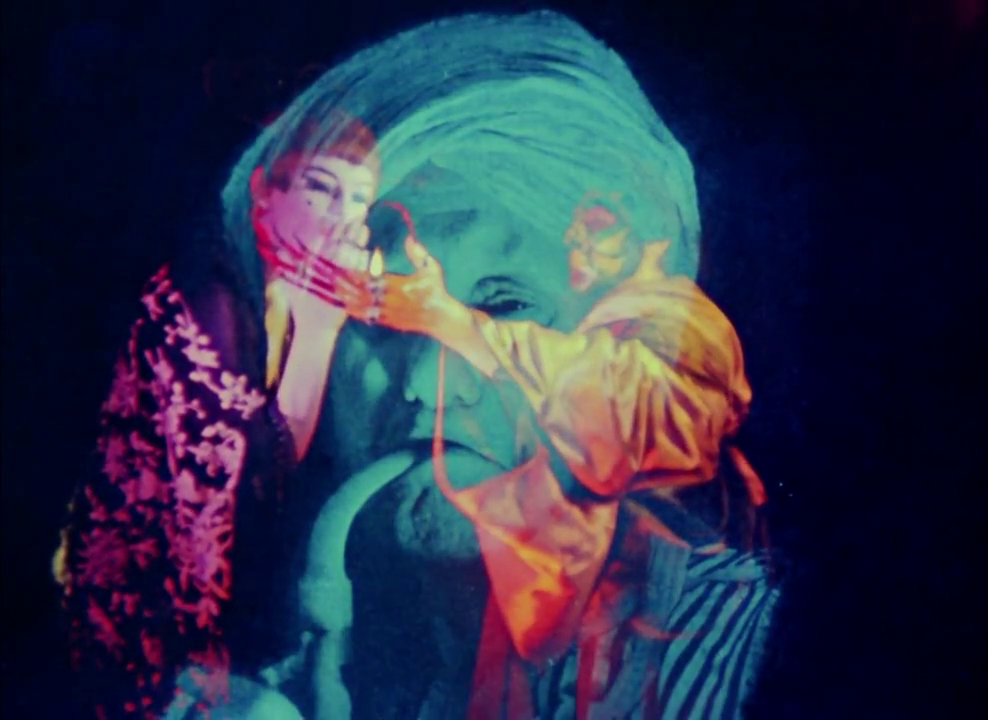
In the film, Shiva adopts different forms to receive the guests invited at the party (various deities, from Aphrodite of Red Room interest, to Astarte and Pan) and gradually induces the loss of individual identities as characters blend into each other via a series of superimpositions. Adorned with alchemical symbols, the films leads to the absorption by Shiva of the essence of his guests by being superimposed over them. In her introduction to episode 8 (1993), the Log Lady once said: “In a dream, are all the characters really you? Different aspects of you?”.

This slideshow requires JavaScript.

When it was revealed in episode 17 that Naido was really Diane in disguise, she came back from the Red Room with a scarlet wig (whereas, until then, her tulpa had been wearing a silvery white one).

vlcsnap-2017-09-06-16h44m57s408
Let’s note here that Diane’s orientalism in season 3 might have something to do with the one found in Inauguration of the Pleasure Dome.

Diane’s red wig is a direct reference to Marjorie Cameron, Jack Parsons red haired second wife, used by Anger in the forementioned film to portray his Scarlet Woman (Babalon, the Whore of Babylon – “the Mother of Abominations”). Marjorie also appears in Mark Frost’s book, as well as Babalon and the various rituals surrounding them. Parsons believed her to be the “elemental” woman that he had invoked in the early stages of a series of sex magic rituals called the Babalon Working.

Sarah.png
Twin Peaks’ Mother of Abominations? (Sarah means “woman of high rank”, “princess”…)

Here’s what we find in Frost’s book: “Parsons first began enacting his bizarre ‘Thelema’ rituals… those rituals were ‘an attempt to summon into human form the spirit of a figure central to the Thelema pantheon, the goddess Babalon… something that sounds like provoking the end of the world… it took two people to enact the ritual… An effort to open a second gate that they’d found in the desert in order to bring across an entity he called ‘the Moonchild‘”. Tamara Preston notes: “He seems to be suggesting that Parsons’s ritual somehow ‘opened a gate’ that resulted in aliens showing up in Roswell“.

vlcsnap-2017-09-06-16h46m06s402
Aleister Crowley

Whether all of this is linked to aliens from outer space or to Lemurians from the Hollow Earth, in line perhaps with the writings of Rampa, does not really matter. The important thing is that it appears to be possible, according to Parsons, to open up gates (Hell Gate?) to another level of reality by enacting magick rituals. Interestingly, Parsons declares in Frost’s book: “Without eros, or agape – love and sex, joined together – ‘will’ is nothing but hollow, patriarchal power without direction or force…”. After they met at the Parsonage, Parsons and Cameron actually took up the practice of sex magic designed to give birth to the Moonchild.

Why is all this important in relationship to episode 18?

vlcsnap-2017-09-06-10h14m36s585

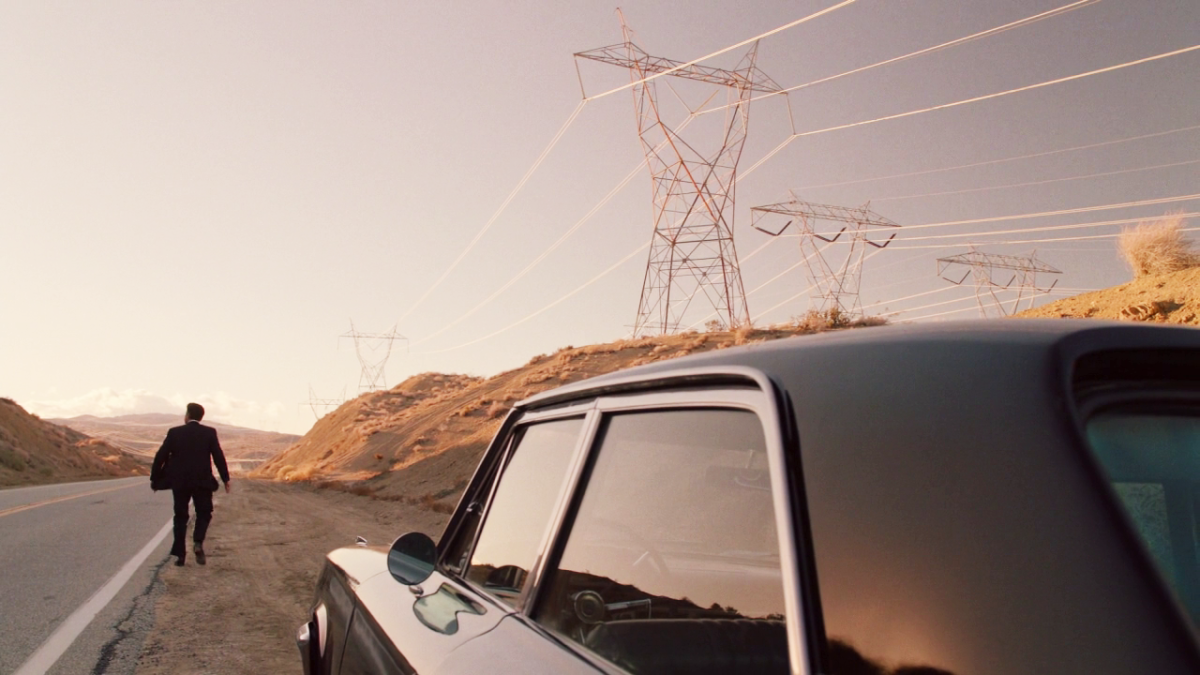
Diane’s red hair is no accident: it visually connects her to Marjorie Cameron / The Scarlet Woman / Babalon (and to Sarah Palmer). After she and Cooper cross over in their car to another dimension, through a breach created by the power of electricity, they stop at a motel where they have sex. Very different from the sex Dougie had with Janey-E, a few episodes back, this moment feels like the enactment of a ritual, with no joy, with closed faces. I believe this is really a moment of sex magick, a way to open a portal.

It is indeed followed by the sudden disappearance of Diane (who had seen her double before entering the motel – was she replaced by Babalon?) and the strange mix-up with their names and Richard & Linda. It also generated a sort of teleportation, the motel from which Cooper exists being different from the one they entered the night before (was it the night before, though?). It’s worth mentioning here that Richard Nixon, who plays a central role in The Secret History of Twin Peaks, was born in a town called Yorba Linda – could there be a link?

After Jack Parson’s death, a science fiction writer friend of his declared (in Mark Frost’s book): “Once a magician stands between two worlds, he’s in danger of not belonging to either one of them“.

Isn’t that what happens to Cooper at the end of episode 18?

vlcsnap-2017-09-06-12h01m36s689

And when you’re trapped, what remains but the possibility to scream? Interestingly, according to a Singaporean friend of mine, this could be said in Chinese: Jao Déi

vlcsnap-2017-09-06-12h02m21s785.png

Follow Unwrapping the Plastic: Facebook / Twitter

Curtain Call

I believe it’s possible to write about episode 17 as the last episode of season 3. Of course, it is followed by episode 18 and once it’s finished, we are still one hour away from the real end of the season. Nevertheless, the various story arcs initiated a few months ago really come to an end (of sorts) with this episode. Episode 18 takes us somewhere/when else entirely. The fact that this conclusion to season 3 was compressed in one episode might explain the frustration felt by some of the viewers. It might have felt a bit rushed, getting rid of all these characters with whom we had started to develop a relationship, especially after having spent so much time in their company during the past 16 episodes. The final battle against BOB also felt slightly unsatisfactory, but perhaps it was meant to feel that way. In a sense, the overall meaning of this episode might have been that it was time to move on to bigger issues. To Judy, for instance.

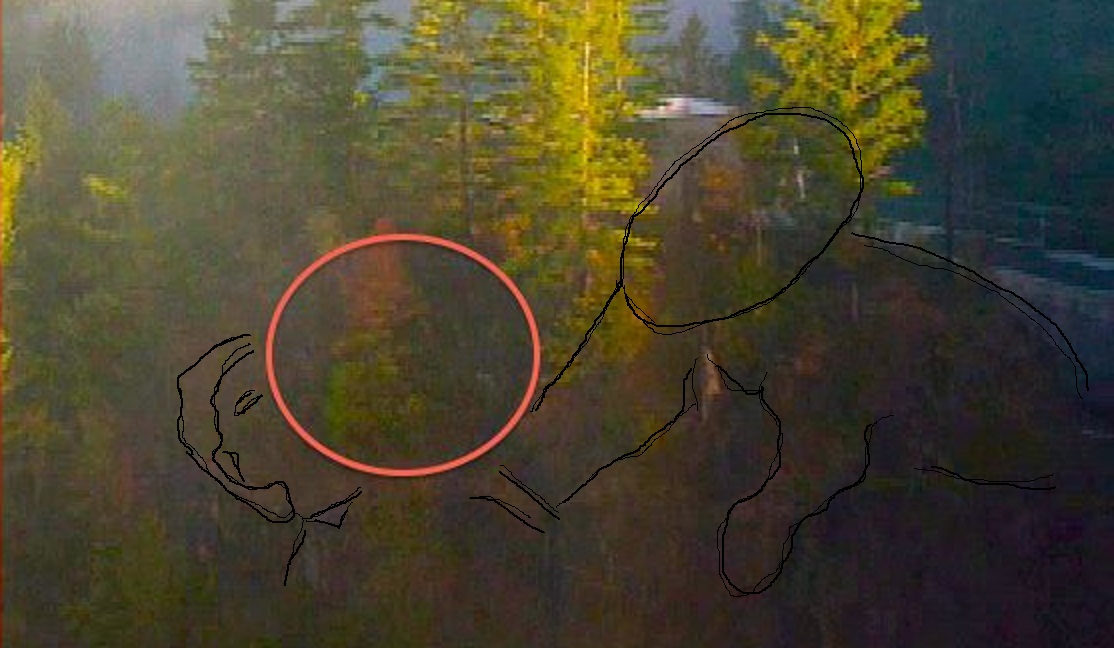
Before moving on to the content of the episode itself, I’d like to come back briefly to the superimpositions in the opening credits that I have been writing about during the past several weeks. I now believe I have found the moment(s) depicted in the rocks/forest seen from a drone during the opening credits and they come from this very episode. It is actually a composite image of the woodsmen massaging Mr. C after he got shot by Lucy and of Cooper walking towards the body of his doppelgänger.

1717-2

It is indeed a central moment in the story of Twin Peaks since it depicts the death of Cooper’s doppelgänger (as well as that of BOB). It makes sense to “engrave” such a moment in the forest surrounding the town, to transform these characters into giants of rock and trees. Such a superimposition confers a mythological feel to Cooper’s victory over his double.

On the other hand, one will note that Cooper’s head is missing, lost in the clouds floating above the forest. Perhaps this victory was not as complete as one might have hoped. In my forthcoming analysis of episode 18 I’ll explore where that head in the clouds might have gone.

Speaking of superimpositions, the most notable in this episode is the one with Dale Cooper’s face that takes place in the Sheriff Station. The superimposition appears right after he’s noted the presence of Naido in the room, which seems to generate a reminiscence for him. All of the sudden, his mood changes and it becomes evident that he is troubled. He realizes the dream-like nature of what is taking place, the fact that levels of reality are in a sense similar to the stuff dreams are made of.

If the past does indeed dictate the future, his effort to change the destiny of Laura Palmer is going to modify this timeline, leading to major changes in the way things are, wiping this reality away as a (mosly) bad dream. But of course, he does not really succeed in saving her, she disappears in the forest as he is about to bring her back to her mother. She does not get killed by her father or wrapped in plastic, but she evaporates into thin air, to a different level of reality where Cooper will travel in the next episode.

The moment when Laura disappears is reminiscent of the one in episode 7 when Jerry Horne appears lost in those same woods. Did he get lost in the same place? Could he somehow feel this thanks to shamanistic powers developed through absorption of various psychedelic drugs? Though he appeared to be totally lost during most of the season, he might have been closer to the truth than a lot of the “normal” residents of Twin Peaks. The psychedelic drugs may have broadened his mind to a higher frequency of consciousness, enabling him to received waves of a stronger nature than the radio ones he was unable to receive via his cell phone.

Never more than in this episode have Mr. C and BOB been depicted as dangerous animals, a werewolf/Big Bad Wolf ready to devour whatever stands in their way. This is the reason why they are trapped in a cage when teleported to the Purple Palace. This is also why Lynch insists so much on the hair of Mr. C, his true face – that of a wild animal.

This slideshow requires JavaScript.

This Purple Palace, as it was already made clear a few episodes again, is reached via a clearing in the forest, as one gains access to the Lodges. The difference is that the pool in the grove in not filled with scorched oil, as in Glastonburry Grove, but with a golden liquid. And contrary to the former and its 12 sycamore trees (12 being a number that indicates the possibility of regeneration towards a higher-consciousness), there is just one here (the primal force), a white one. Unity and gold, the alchemical symbols that have played such a crucial role in season 3.

In the Purple Palace, one can notice on top of one of the doors a motif that resembles the strange ace of spades drawn on Mr. C’s playing card, which I have compared in a previous post to a flying egg.

If I am right and the sound heard at the very beginning of episode 1, played to Cooper by the Fireman with a phonograph, is indeed the sound of a goose, the fact that it is played at the exact moment when Laura’s hand leaves Dale’s in the forest might be the sign that mother goose called back her duckling to stay within the universe-egg. Dale was indeed about to break that shell in order to create a new time line, but in this multiverse, composed of numerous bubble/eggshell worlds, it is not so easy after all to change things.

vlcsnap-2017-09-05-09h54m51s709

One slightly disappointing element of episode 17 for me was the revelation that Naido was in fact Diane under a Red Room disguise. I believe this choice is going to give fuel to the people who claim that Twin Peaks is guilty of “orientalism” because Naido was portrayed by a Japanese actress (and it is a Japanese word), while Diane was consistently depicted during season 3 wearing Chinese clothes and collecting Chinese art in her flat. If this was a choice on the part of Lynch and Frost, it was something of a mistake I think – and if they were not aware of the difference, that is even worse.

Concerning the sequence with Philip Jeffries as a tea-pot (hello Lewis Carroll!), the transformaton of the owl sign into a moebius strip makes perfect sense because of the cyclical nature of Time in Twin Peaks. I discuss this subject at great length in my book Twin Peaks: Unwrapping the Plastic, notably concerning the opening credits of the first two seasons. Twin Peaks appears to exist outside of our world, in a mythological realm where time does not flow the way it does in our universe. Inhabited by various godly deities, connected to Tibet and other mystical realms, it functions according to other laws. Like with Lost Highway, the question “is it the future or is it the past?” does not entirely make sense.

Was this Return a return in Space or a return in Time? Is it possible to disconnect one from the other? What does it mean to go back to Twin Peaks if one does not get there at the right time? Those are, among others, some of the questions asked in episode 18.

vlcsnap-2017-09-05-09h39m54s769.png

Follow Unwrapping the Plastic: Facebook / Twitter

Audrey’s dance

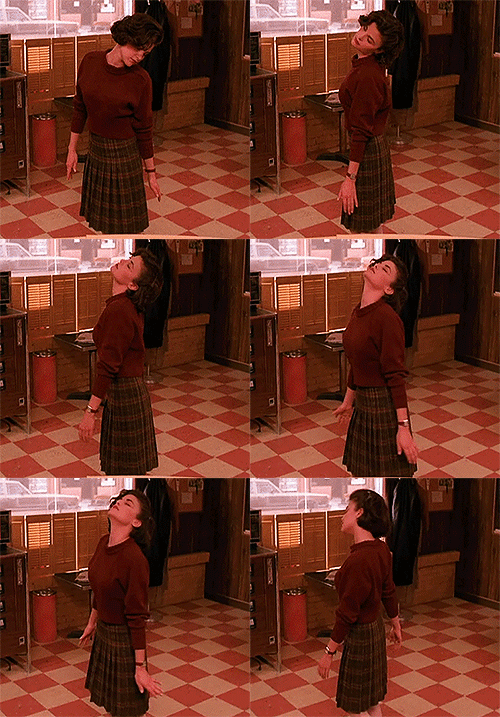
Episode 16 is very much concerned with modified states of consciousness, whether the result of a coma, as in Dougie’s case, or a dance sequence, as with Audrey. In both cases, the result is the same: the sleepers have awakened.

tumblr_lyw534ddt91qghl49o1_r1_500
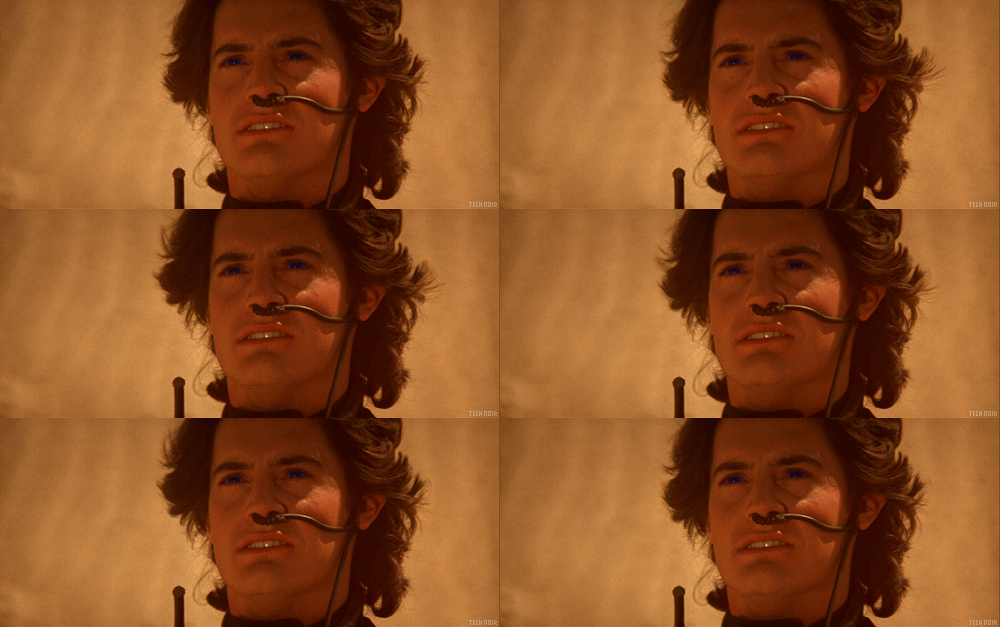
“Father… father, the sleeper has awakened!” (Dune, 1984)

In Dougie’s case, it’s interesting to note that the wave patterns of his EEG are very similar to those he drew on the Lucky 7 Insurance files. Reminiscent of the chevron motif in the Red Room, they are all linked to the flow of electricity.

The Roadhouse dance sequence takes us back 25 years to the RR diner and young Audrey’s first interpretation of her stationary dance. It is not about conquering space, at least not the physical space (she’s not an astronaut) – it’s all about the space within (she’s a psychonaut). The music is so dreamy that she has to dive within towards the ocean of consciousness of Transcendental Meditation, which David Lynch describes in his book Catching the Big Fish. It’s a dance that is really a trance, a meditation synchronized to the audio waves of Badalamenti’s music. As with most of what takes place in Lynch’s universe, the dance results from the vibratory and ondulatory nature of things. Vibrations can take us to other dimensions and dance is one such vehicle, a way to transcend reality.

giphy

But of course, Audrey was already in an altered state of consciousness, without being aware of it. The Sartrean Hell in which she has been trapped now starts to make sense: she has been trapped in the Hell of her own thoughts, unable to leave the artificial reality created for her. Was she “sent” there on Mr. C’s orders as a way to cover up the fact that he probably raped her to beget a son, Richard? Or was this the result of her guilt linked to the conflict with her father? The answer to these questions is unclear for the time being. It seems that her dance triggered something in her, a reminiscence, a transcendence that helped her break ” beyond the wall of sleep”.

The dance takes place right after the live performance by Edward Louis Severson who sings: “And I am who I am, who I was I will never be again… I stare at my reflection to the bone… fearful of dreams, there’ll be no sleep tonight… there’s another us somewhere with much better lives“. The song is a perfect fit for what Audrey is experiencing and it echoes strongly with her words from episode 13.

As for the dance itself, its dreamy nature is underlined by the multiple cuts that split it into slices of a filmed performance. The fact that the audience decides to line up in order to watch it is also a strong indication of its fantasy nature. Before the dance is over and Audrey asks Charlie to get her out, it has become clear that we are witnessing a fanciful mental image. Since she is dancing with closed eyes, it’s clearly all a “vision”.

At one point, she executes a gesture that is highly reminiscent of the one performed by Gordon Cole at the beginning of Fire Walk With Me. In my book Twin Peaks: Unwrapping the Plastic, I compare this gesture to the shape of a cage in which a bird might be trapped. Here, it’s Audrey who is imprisoned in her own mind.

When she wakes up, the position of the shot of Charlie in front of Audrey compared to the shot of her face reflected in a mirror tends to suggest that he might be a creation from her unconscious. His face is really her face reflected – perhaps a portion of a her mind trying to protect her from the truth?

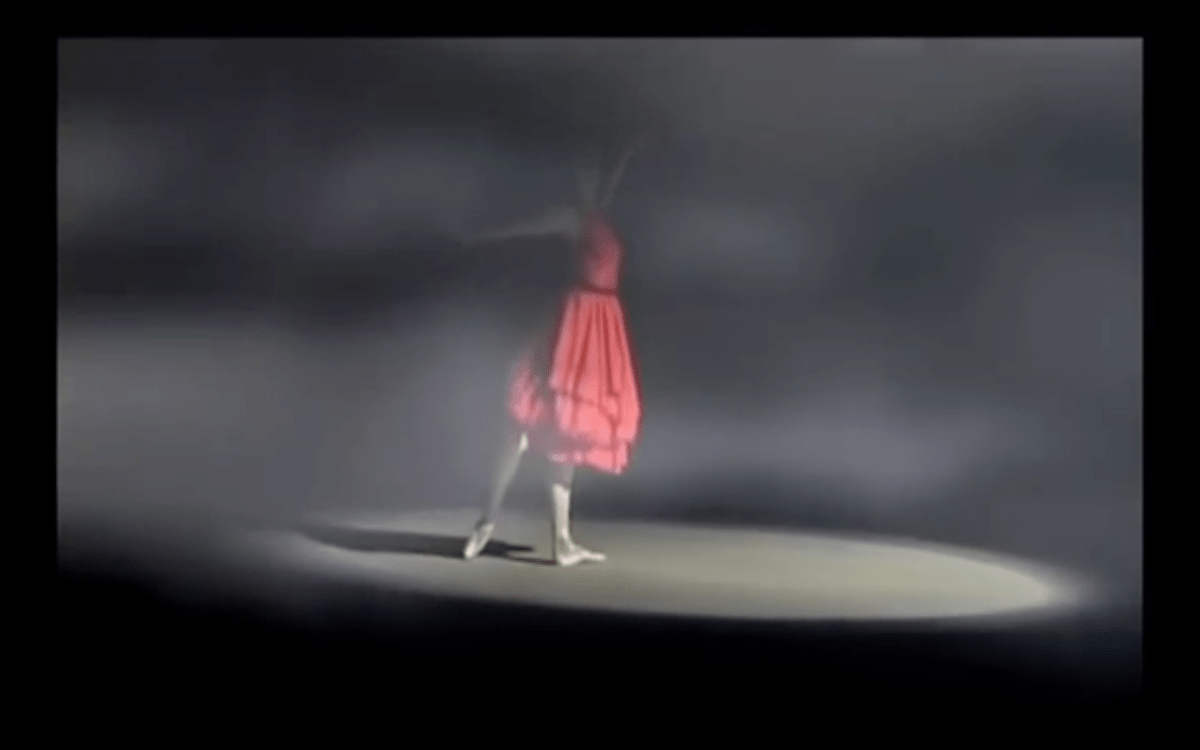
Hopefully, all the answers will come with next week’s double episode finale. Until then, it might be a good idea to revisit the various dance sequences filmed by David Lynch over the years, from the  the Lady in the Radiator ( Eraserhead ) to the Locomotion from Inland Empire. You can also read (in French) the detailed analysis of the opening dance sequence (the Jitterbug) from Mulholland Drive in Kino-Tanz by Dick Tomasovic (who also happens to be my doctoral advisor at the University of Liège ). Finally, note that David Lynch made a dance film several years ago (2007) entitled Ballerina.

Ballerina

Follow Unwrapping the Plastic: Facebook / Twitter

Obstacles

Episode 16 is replete with revelations and strong moments. None of them, of course, are as strong as Dale Cooper’s return to himself from his electricity-induced coma. Dale is finally back, ready for the final showdown that will take place in Twin Peaks. The path seems clear for his flight back to the Pacific Northwest. All the obstacles have been overcome, including the last, which almost cost him his life.

Coma.png

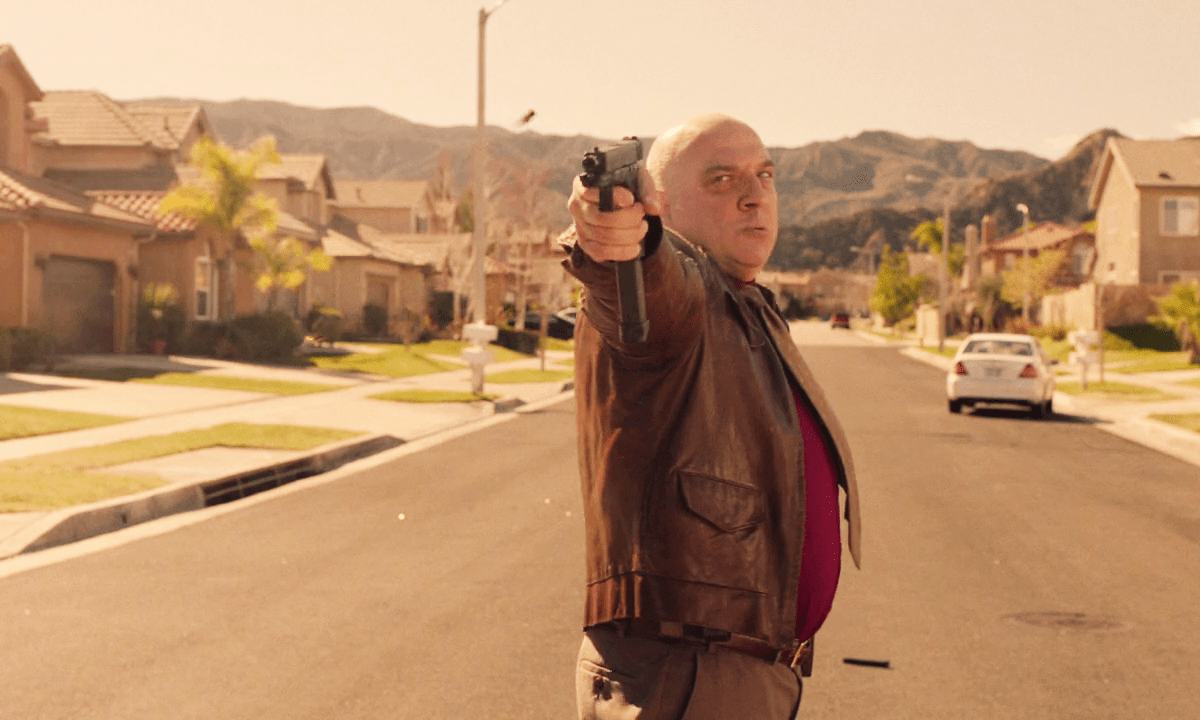
Not everyone shares his luck in this episode, though. The coordinates that Mr. C has been following since the very first episode of the season lead he and Richard to a rock where the latter is disintegrated in the midst of a large electrical bonfire. In Las Vegas, Chantal and Hutch meet a tragicomic end  just when they are about to complete their mission and kill Dougie (an accountant they provoke blasts them away with returned gunfire). It does not take long for Diane’s Tulpa to be shot to death after she suddenly remembers who she is. And although Audrey finally manages to get to the Roadhouse, leaving us to believe for a while that she has overcome her own obstacles, she suddenly realizes that this was all a dream.

Interestingly, the accountant who stops Chantal and Hutch happens to be named Zawaski. Here’s what an etymology site about his name notes: “Zawaski is almost certainly a variant of the name more often spelled Zawadzki or Zawacki. Both those names are pronounced roughly “zah-VOTT-skee.” They come from the noun zawada that means “obstacle, impediment,” and in archaic usage “fortress,” because soldiers often set up fortified positions in places where some natural feature of the land would block the way for enemy armies and make them vulnerable to attack. The surname Zawadzki or Zawacki means “of the zawada,” and thus could refer to a person somehow connected with such an obstacle or fortress“. I believe this applies perfectly to his role in the episode and his presence extends to other segments, from Mr. C to Audrey. The narrative thread suddenly becomes blocked for all these characters who will not flow downstream as easily as before.

This slideshow requires JavaScript.

The revelation that Diane is actually a Tulpa (a “thought-form”), a simple shell for the golden seed placed inside her, is of course a surprise. On the other hand, one could easily notice the dual nature of the character when examining her clothes. In this episode, for instance, the two dragons on her shirt, are symmetricaly positioned on both sides of her chest, just like her nail polish is applied in the same way on her left and right hands. If we go back to the first time we meet her, in episode 6, we notice that her dress was adorned with the symmetrical motif of a flower, placing her character right away under the sign of duality.

The dragon motif on her left side is not unlike the Chinese character for “self” (which, coincidentally, plays a central role in the third season of the Teen Wolf  television series). If the design is indeed intended to represent her character in a stylized manner, this would make sense since Diane/Tulpa was both herself and her own double (her inverted self, as seen in a mirror).

An interesting moment takes place when Dougie, now reincarnated as Dale, says goodbye to Janey-E and Sonny Jim. When the camera travels back, abandoning them in the midst of all the slot machines, we see a beetle on one of the screens in front of an Egyptian sphynx. Here’s what Wikipedia has to say about beetles in Ancient Egypt: “The scarab was of prime significance in the funerary cult of ancient Egypt. The scarab was linked to Khepri, the god of the rising sun, from the supposed resemblance of the rolling of the dung ball by the beetle to the rolling of the sun by the god“. It’s unclear whether this moment is to signify Dale’s return from the land of the dead, or the death of “his” Las Vegas family. In spite of the happy news that constitutes Dale’s return, one can nevertheless feel a sense of loss at this point.

vlcsnap-2017-08-28-15h45m54s345.png

The episode otherwise continues the season’s chain of references to hands and fingers. It also brings several new landscape paintings to us (re-presentations of the world?). The continued links to alchemy and metals are also here.

Once again, as often is the case in Twin Peaks, links to the circus world are established during this episode.

As we are now just one week away from the season’s last episode – which might possibly also be the last of Twin Peaks as a series – I’d like to say that this return has proved to be even more exciting than what I had imagined. I feel compelled to compare it with a thought-provoking book from 1970 entitled Expanded Cinema (by Gene Youngblood). Though the author describes the videosphere in which we now live, it seems to me that Twin Peaks might be the only example I know of “expanded television”. It’s a TV series, of course, but it’s also more than that: a shared experience, a riddle deciphered every week (and for 25 years) by tens of thousands of viewers, a universe into which many scholars continue to dive in search of clues. Let’s hope that next week’s episode(s) will prove as “electrifying” as the last episode of season 2 proved to be!

Audrey's dance.png

Follow Unwrapping the Plastic: Facebook / Twitter

Between Two Worlds

This blog post was liked and retweeted by Mark Frost

Who was Rampa? And why is he significant in relationship to Twin Peaks?

Between Two Worlds.jpg

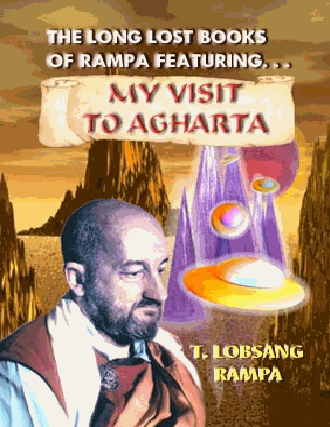
Here’s what Wikipedia has to say about Tuesday Lobsang Rampa: ” Lobsang Rampa is the pen name of an author who wrote books with paranormal and occult themes. His best known work is The Third Eye, published in Britain in 1956. Following the publication of the book, newspapers reported that Rampa was Cyril Henry Hoskin (8 April 1910 – 25 January 1981), a plumber from Plympton in Devon who claimed that his body hosted the spirit of a Tibetan lama going by the name of Tuesday Lobsang Rampa, who is purported to have authored the books. The name Tuesday relates to a claim in The Third Eye that Tibetans are named after the day of the week on which they were born.” He is considered to be a major figure at the root of the New Age movement.

Rampa.gif

The links between the Twin Peaks mythology and the writings of Rampa are numerous. First, of course, there is Tibet (not the real Tibet, though, but a Tibet that owes a great deal to Theosophy) and the mysteries that surround this country (including aliens): “Tibet is the most convenient country of all for flying saucers. It is remote from the bustle of the everyday world, and is peopled by those who place religion and scientific concepts before material gain. Throughout the centuries the people of Tibet have known the truth about flying saucers, what they are, why they are, how they work, and the purpose behind it all. We know of the flying saucer people as the gods in the sky in their fiery chariots. But let me relate an incident which certainly has never been told before in any country outside of Tibet, and which is utterly true“.

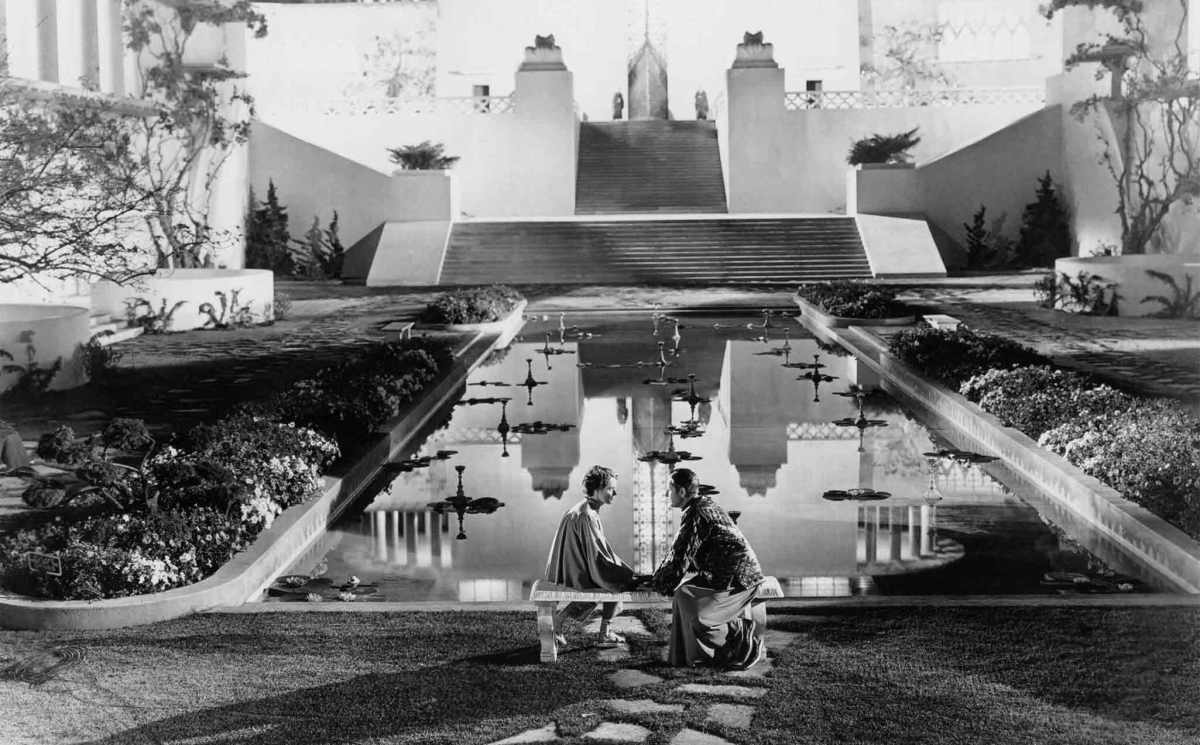
In Tibet, he claims to have traveld several times to Shambala. In Tibetan Buddhist and Indian Hindu/Buddhist traditions, Shambhala is a mythical kingdom hidden somewhere within inner Asia. Shambhala is said to be protected by an ‘akashic veil’ which renders it invisible and impenetrable – as are the Lodges, hidden behind their curtains in Glastonburry Grove. The ruler of Shambhala is ‘ever vigilant in the cause of mankind: he sees all the events of earth in his ‘magic mirror’ and ‘the might of his thought penetrates into far-off lands – this is reminiscent of what the Fireman does in his citadel. The concept of Shangri-La, as first described in James Hilton’s 1933 novel Lost Horizon, is said to have been inspired by the Shambhala myth. Mark Frost’s interest in this book and Frank Capra’s cinematic adaptation of the story are well known (see Frost’s YA trilogy  The Paladin Prophecy, for instance). The Himalayas and the Northwest-Pacific mountain range appear to be, in his mind and David Lynch’s, almost indistinguishable and the town of Twin Peaks is certainly a warm haven in the midst of the wilderness that surrounds it.

Lost Horizon 3.jpg

–> Lost Horizon (trailer)

Here’s what Rampa writes about his first expedition to Shambala in the Himalayas: “Here – nearly thirty thousand feet above the sea, in the Chang Tang Highlands of Tibet, we were toiling upwards, upward… For that night we rested in the warmth and comfort of the Hidden Land. We found ease and relaxation on a soft bed of moss, and in the morning we gratefully bathed in a warm, broad river before setting out on another days march. Here in this land there were pleasant fruits which we took with us for our meal, a satisfactory change indeed from the eternal tsampa… My guide, the Lama Mingyar Dondup, broke our awed silence, saying. ‘This was the home of the Gods half a million years ago. During those days men strove against the Gods, and invented a device to shatter an atom, which wrought disaster on the earth, causing lands to rise and lands to sink, destroying mountains and creating anew. This was a mighty city, the metropolis, and here was once the sea-shore. The convulsion of the earth, which followed, and the explosion – raised this land thousands of feet, and the shock of that explosion altered the rotation of the earth. We shall go closer, and we shall see other parts of the city embedded in the ice of the glacier- -a glacier which, in this hot valley, has gently melted – leaving intact these ancient buildings.’ We listened in fascinated silence, and then, as if by one common impulse, we moved forward. Only as we came close to the buildings, did it become apparent to us that the people who had lived here must have been not less than twelve feet tall. Everything was on a giant scale, and I was forcibly reminded of those huge figures which I had seen deep in the hidden vaults of the Potala“. (link)

Lost Horizon 4.jpg

Interestingly, he was convinced of the existence of “auras”, an “electromagnetic field” surrounding people which he claimed he could see, that revealed to clairvoyants such as himself, the true personality of people. In my book Twin Peaks: Unwrapping the Plastic I write about “Laura’s aura”, and it seems that there might be a bridge between what I discuss in these pages and the teachings of Rampa.

His travels to the mythic underground realm of Agharta, the capitol of the Inner Earth, can also be linked to Mark Frost’s many references to Lemuria and Hollow Earth theories in his latest book, The Secret History of Twin Peaks. Such a network of tunnels and caves could very well be connected to the Owl Cave in Twin Peaks, explaining the presence of the Lodge entities and the telluric alien influence monitored by Major Briggs under the forest. “‘These mountains are far to the north of our own Himalayas’ he told me… We are now deep in a part of Asia that not only is inaccessible by the hazards of the landscape, but also by the local governments and current political situation. This area is forbidden territory as it is said the nearby Pamir plateau was once the garden of Eden“.

This idea of a garden is omnipresent in Twin Peaks. In my book, I  describe the Red Room as a rose garden, a secret garden of sorts, a Temenos where the process of individuation can take place. In Rampa’s book The Hermit, the story begins with a blind old Tibetan hermit imparting his knowledge to “the chosen one”. In his youth he had been abducted by an advanced race that revealed themselves as “the Gardeners of the Earth”: “The Gardeners decided that even though the auras of the human race were faulty, mankind would be given another chance. However, if humans did not heed such warnings and stop polluting their planet with radioactivity, the Gardeners would be forced to intervene at any time in the future. Lobsang Rampa wrote extensively of inhabited, underground caverns, tunnels and cities in Twilight, As it Was and ‘The Subsurface World’ chapter of My Visit to Venus. In Twilight, he introduced the topic of the subterranean realm of Agharta (or Agharti) with its capital city Shamballah (or Shambhala) and omnipotent ruler, ‘the King of the world‘”.

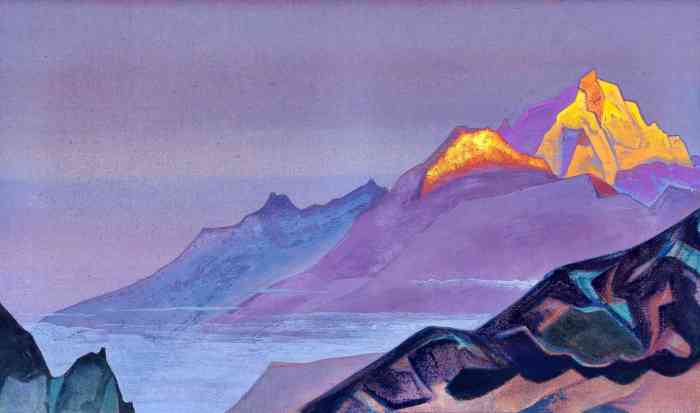
Path to Shambhala (Nicolas Roerich -1933)

One could dedicate much time listing all the possible links between the books of Rampa and Twin Peaks, but here are several pertinent examples to Twin Peaks in general and season 3 in particular. In The Rampa Story (1960), he writes: “For two days and nights I slept, my exhausted body hovering between two worlds“. This of course needs to be compared to the famous mantra from Twin Peaks: “Through the darkness of future past, the magician longs to see, one chants out between two worlds, fire walk with me”.

Rampa 2

More directly connected to season 3 are the following lines, from the same book: “The priests of Egypt had a science which had been lost to the present-day world, the science of creating Thought Forms to do tasks which are beyond the skill of the human body”. In episode 14, Tamara mentions “Tulpas” in relationship to Lois Duffy’s doppelgänger – Tulpas are thoughtforms in Tibetan mythology.

Here’s what Rampa writes about them: “At all times we must speak to the Thought Form which we have created in a firm, positive voice. There must not at any time be any suspicion of negativeness, nor of indecision. We must speak in the simplest possible language and in the most direct manner possible. We must speak to it as we would speak to a very backward child, because this Thought Form has no reason and can accept only a direct command or a simple statement“.

What better description of Dougie Jones could there be?

Dougie Jones.png

Follow Unwrapping the Plastic: Facebook / Twitter

Thresholds & Keys

With episode 15 we approach the final moments of season 3 – and perhaps of Twin Peaks as a whole. There is a feeling that during the next two weeks we are about to complete the heart of the maelstrom, that we are about to cross the line into a realm where all the questions will find their answers, where everything will be decided. This is probably why this episode features so many moments with either thresholds (the one from Sunset Boulevard, for instance) or keys (which can be forks or garden gloves too). Unlike Audrey (still trapped in her own private version of a Sartrean Hell), the series will not get stuck at this point and we will follow Mr C and Dougie to where the narrative will take us – probably back to the town of Twin Peaks itself for a showdown of some sort.

As I have argued elsewhere, the moment to return to unity seems propitious. All the different paths of the story are about to converge towards Twin Peaks, back to unity. This is probably why the Twin Peaks Lodge bears that name, after David Lynch’s obsession with the idea of the “unified field”. This is probably why Norma gives up on all the other RR franchises to focus on the only one that matters. This is also why she finally decides to be with the only one who ever mattered in her life, Big Ed. E pluribus unum. Unity.

This is, of course, also the destiny of Dale Cooper: to return to a state of unity. His split personality will have to cease soon. The process of individuation that started a long time ago in the Red Room – the integration of his unconscious parts – is about to come to an end. It is too soon to say if this is going to kill him, but what is for sure is that some part of him will have to die – let us hope it is his dark side.

This slideshow requires JavaScript.

Mr C just went through the room with the flowers wallpaper that looked so nice on Laura Palmer’s bedroom’s wall 25 years ago. His trip through the secret rose garden led him through a dark room superimposed with images from the forest to the place where the device that Phillip Jeffries has become told him about Judy.

This slideshow requires JavaScript.

Reminiscent somehow of a moka pot (similar to those made of wood seen earlier in the episode, next to Big Ed, on the RR’s counter), this device exhales a flow of smoke that seems partially trapped by an immaterial orb. One can guess that Phillip Jeffries is in the orb, just like Laura was in hers in episode 8.

Which orb will it be that floats on-top of Dale Cooper, if my reading of the superimposed image in the opening credits is correct? Jeffrey’s, Laura’s or a different one? We only have to wait two more weeks to learn the answer!

Drone

Follow Unwrapping the Plastic: Facebook / Twitter

Hands and garden gloves

This is not the first time I stress the possible links that exist between season 3 and Robert Wise’s The Day the Earth stood still (1951). Both fictional universes are built around the fear of the atomic age and include aliens determined to extinguish the fires created by this technology. The connection becomes visually stronger in episode 14 when the Giant describes himself as the Fireman and raises his right hand in a manner reminiscent of Klaatu’s gesture.

Also, the exterior design of his fortress is not unlike Klaatu’s flying saucer in its silvery minimalism.

Another visual connection in this episode and in season 3 as a whole can be found in a slightly forgotten film from 1953 entitled The 5000 Fingers of Dr. T. The yellow hand worn by the young hero of the movie (who looks a bit like Sonny Jim Jones) is very similar to Dr. Amp’s tiny hand puppet worn on his middle finger (shown in episode 5). Dr. Amp is actually a character who would fit perfectly in this film, with his strong conspiracy theories and anti-capitalist discourse. Filmed not long after World War II, The 5000 Fingers of Dr. T develops an anti-authoritarian narrative that would please Dr. Amp. Its colour code is somewhat reminiscent of Diane’s nail polish selection, the boy plays catch and wears a shirt that looks like Sonny Jim’s, and atomic power plays a major role in the film alongside video surveillance, while dreams are omnipresent and a hearing aid is central to the narrative…

Also, the evil autocrat Dr. Terwilliker uses a golden shovel to fill his vault with dollar bills…

Whether or not the film was a source of inspiration for Lynch and Frost, the links noted above are worthwhile in and of themselves for their themes and motifs prevalent in the 1950s, a decade that has always played a central role in Twin Peaks.

Besides the possible connections with the film listed above, it is interesting to focus on the image of the hand in season 3. Hands keep coming back, over and over again. It is not clear yet what role they will play in the last episodes of the season, but it’s very likely that their omnipresence points towards a role they will soon have to play.

In the case of Freddie Sykes (Freddie = peaceful ruler ; Sykes = topographic name for someone who lived by a stream in a marsh or in a hollow), the young English man at the Great Northern Hotel, the glove on his right hand that the Fireman told him to wear is a direct visual link to the one worn by Jean Marais in Jean Cocteau’s Orphée. This is the glove that enables one to travel through the Zone situated on the other side of mirrors. The fact that his glove is of the garden variety makes perfect sense in the context of Twin Peaks. In my book Twin Peaks: Unwrapping the Plastic, I have explained how the Red Room is a secret garden of sorts, a Jungian Temenos dedicated to the process of individuation. What could be more appropriate than a garden glove to open the curtain to such a place? Freddie should therefore play a major role in the coming episodes, perhaps opening the way back to Twin Peaks for Agent Cooper.

donttrytounderstand_justbelieve.jpg

–> Orphée goes to the Zone, through the mirror

Another portal to the Fourth Dimension can be found near Jack Rabbit’s Palace. Interestingly, the Palace happens to be a tree trunk whose shape is highly reminiscent of the purple ocean’s mountain from episode 8 – the place where the Fireman lives. The connection between the two locations is made evident thanks to Andy’s journey, or “briefing” about Naido by the Firmeman. The Palace, according to David Lynch’s terminology, inherited from the Maharishi Mahesh Yogi, is the place where one transcends. Jack Rabbit’s Palace is thus a door towards the purple ocean’s moutain – “as above, so below”, as the saying goes in occultism. Both “Palaces” are lost in the middle of oceans – an ocean of purple water on the one hand, and another of trees on the other.

A drone shot just before the sheriff’s team enters the forest reveals more about the superimposed image found in the opening credits, the one with Dale Cooper lying on his back surrounded by other human shapes (close to an ocean of clouds). Closer to the mountain than the images in the credits, the shot reveals a round shape right on top of Cooper’s face – probably an orb similar to those featured in episode 8. The fact that it floats in front of his mouth leads me to think that it will play a role in the removal of his Garmonbozia.

Drone.jpg

These giants hidden beneath the forest on-top of mountains should probably be linked, somehow, to the pantheon of Greek gods that gathered on Mount Olympus. I don’t believe it’s an accident that Lois Duffy’s arrest took place in  Olympia – the Pacific Northwest appears to be a very propitious place to get in touch with beings that can be associated with gods.

This scene is followed by a strange moment when Gordon Cole appears very disturbed by the sound a window cleaner makes behind the room’s curtain. A few years ago, I wrote a long article about the importance of windows in the films of David Lynch and I believe that this scene comes as an excellent reminder of his obsession with this motif. The fact that we can only see the shadow of the window cleaner also seems to link the moment to one in the Red Room, long ago, when the Man From Another Place conjured the shadow of a bird to fly on the thick drapes above him. In both cases, there seems to be a sort of acousmatic disruption between what we see (shadows) and what we hear. This is almost a neo-platonic vision of the world, the true reality of essences only available to us via their shadows.

Window.png

Then Gordon relates his Monica Belluci dream in Paris and the coffee they had in a place called “Crêperie Plougastel”. I believe that the important element in this choice might be the presence of strawberries on the crêperie’s sign. This dream in black and white feels like something from the underworld, something extracted from the unconscious (the antipodes of the mind). It is worth remembering that in Greek mythology, Persephone (Cora), queen of the underworld (where she was taken by Hades,) was obliged to spend a third of each year there (wintertime) because she had eaten pomegranate seeds before being released. The dead are not supposed to eat the fruits of the living anymore. The strawberries on the sign might be an indicator of such a curse.

Did Gordon eat “strawberries”at some point in his past that led some of his memories to remain trapped in his unconscious?  Is the dream itself the result of such a transgression? “We create our world, and then enter into that world”. Monica Belluci paraphrases the Upanishads (“We are like the dreamer who dreams and then lives inside the dream“), and for those who might like to know more on the subject, I have dedicated a large portion of my book to the links between Indian religion (the Vedas, the Upanishads, etc.) and Twin Peaks.

Strawberry.png

As for the scene with Sarah Palmer, when she removes part of her face to reveal what’s inside of her, this mirrors Laura’s action in the Red Room in episode 2. It is as if Laura and Sarah were just shells, empty inside – but while Laura is full of light, Sarah is full of darkness. Beyond Twin Peaks, this might be another reference to the film Dreams That Money Can Buy by Hans Richter, and more specifically to a portion of the film directed by Fernand Léger entitled The Girl with a prefabricated Heart and its many mannequins.
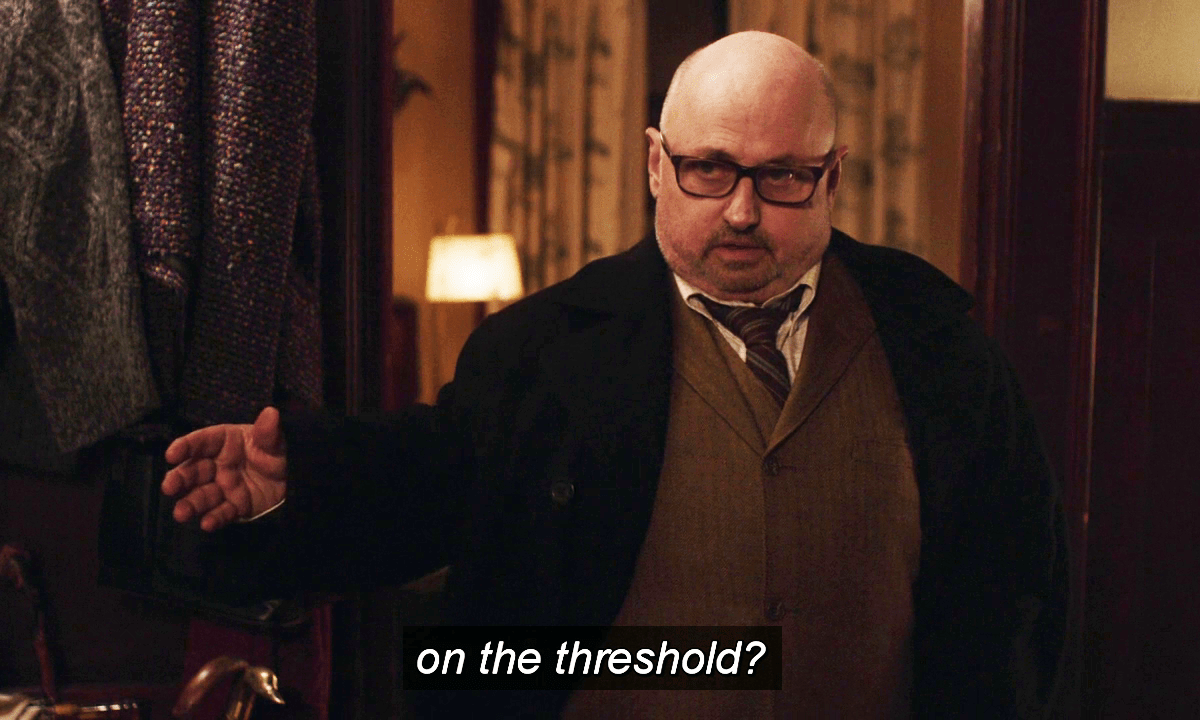
Finally, concerning the sequence in the jail cells between Naido and the other prisoner exchanging strange sounds, it is still unclear to me whether the noises they make are supposed to imitate chimps or geese. It seems that Naido’s link to “Mother” might make the second option more likely, as Mother is obviously oviparous (as seen in episode 8, when she “vomits” her many eggs – including BOB). But monkeys are also important in Twin Peaks. What is certain, though, is the fact that after the scene with Bobby and Mike barking in their cell during season 1, this episode is another proof that in Twin Peaks, prison tends to bring humans back to their animalistic side.

Follow Unwrapping the Plastic: https://www.facebook.com/unwrappingtheplastic/

No Exit

Earlier, in my post about episode 12, I proposed that following Doctor Jacoby’s comment, it feels like Audrey is trapped in a bourgeois version of Hell. In that episode, she appeared unable to move from her standing position in front of the fireplace beneath a landscape painting. In episode 13, the same situation occurs, she just manages to cross the room in which she stands (under another painting) in order to sit in front of Charlie.

vlcsnap-2017-08-02-14h27m40s334

This idea of Hell in a bourgeois setting, coupled with the comment by Charlie about existentialism leads me to believe that she might very well be trapped in the Sartrean version of Hell described in his play No Exit (1944).

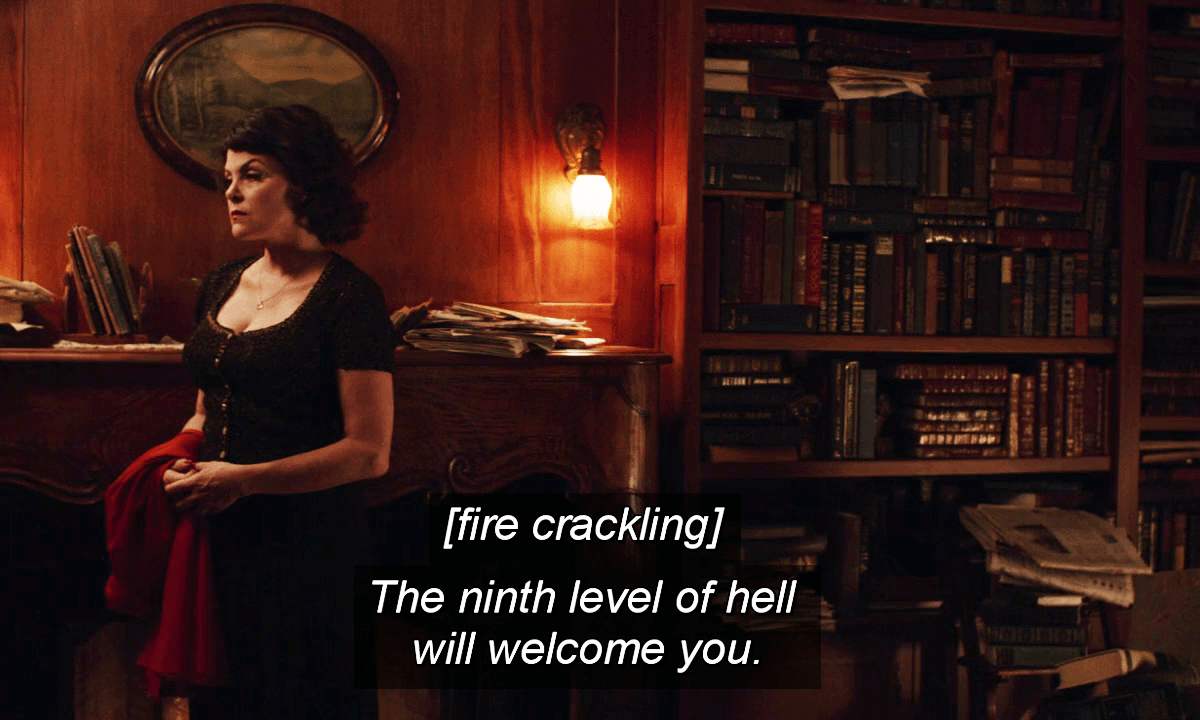
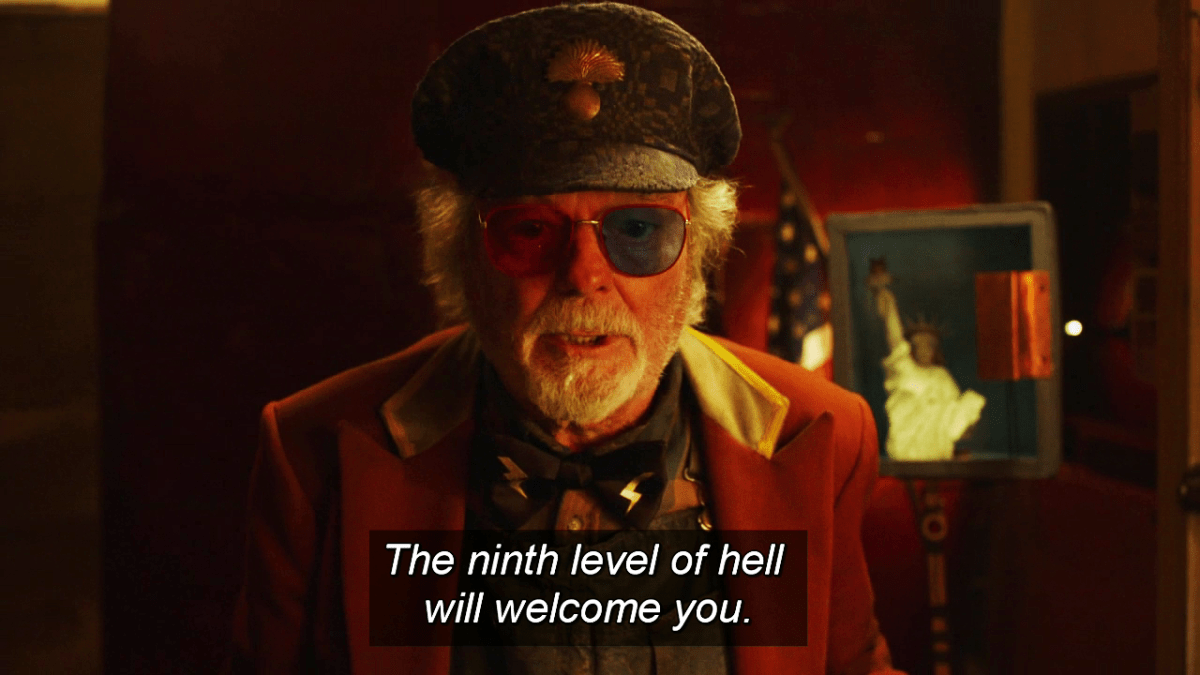
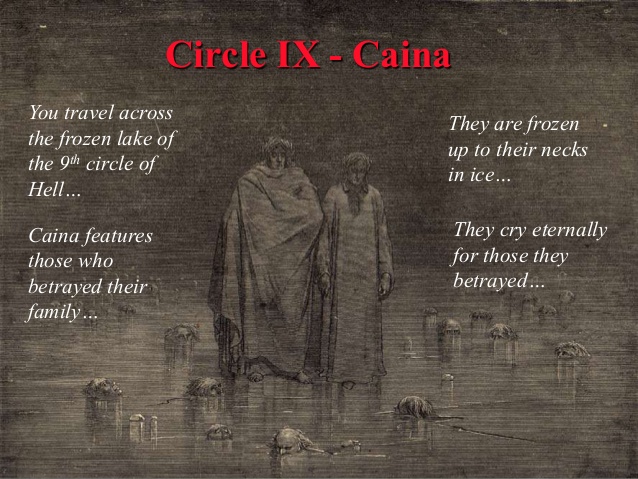
The ninth level and lowest cycle of the underworld in Dante’s Divine Comedy (Inferno) is called Cocytus. It is a frozen lake, home of traitors. Is it possible that Audrey could be imprisoned in such a place because she was a traitor to her family?  This is very much how her father sees her, especially if apply the version of Ben Horne described in Mark Frost’s The Secret History of Twin Peaks.

9th.jpg

No Exit is a play that describes the story of three damned souls (Garcin, Olga & Estelle) brought to the same room, furnished in (French) Second Empire style. Unable to cope with each other, continually annoying each other, they are incapable of leaving the room, and end up agreeing that “hell is other people”.

In Audrey’s version of hell, she’s actually the only one who seems unable to cope with her present state. Charlie appears to be in control, going so far as threatening to “end her story”. It is yet unclear what he means by that, speaking of Audrey as if she were a fictional character, but it is possible to link this to the existentialist idea that “existence precedes essence”. This means that according to Sartre, our actions define who we are, not our “nature”. Audrey cannot really be certain of who she is until she actually does something. But like Garcin in the play (“I shall not go”), when given the chance to exit the room (to go to the Roadhouse) she backs down, she does not act. Frozen in the ninth circle of hell, she appears unable to act and therefore to define who she truly is. In No Exit, the characters are essentially immobile, confined to hell by their own choosing.

Another interesting parallel with Twin Peaks is the fact that in No Exit, time on earth passes at a different speed than in hell. “How quickly the time passes, on earth!” Estelle exclaims.

After Sartre, I’ll conclude with a quote from another giant of 20th Century literature, James Joyce. I believe this quote also applies to the world of Twin Peaks developed by Mark Frost and David Lynch. Joyce commented on deciphering his novel Ulysses (1922), his magnum opus (the story of a return back home, like season 3): “If I gave it all up immediately, I’d lose my immortality. I’ve put in so many enigmas and puzzles that it will keep the professors busy for centuries arguing over what I meant, and that’s the only way of insuring one’s immortality“.

Follow Unwrapping the Plastic: https://www.facebook.com/unwrappingtheplastic/