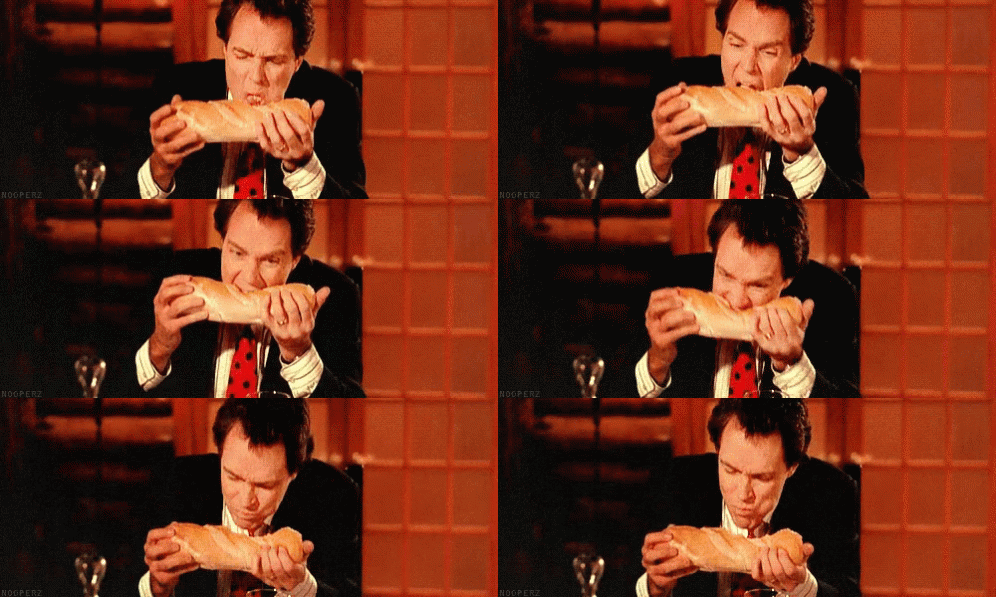
Foods of all sorts play a central role in the world of Twin Peaks, from delicious black coffee to sweet cherry pies, from donuts to tasty French baguettes. Only hospital food serves as a counter example to the endless culinary delights of Twin Peaks. The regressive joy of devouring constitutes one of the main pleasures to be found there – that is, until the devourers find out that they themselves are about to be devoured by someone or by something else. Where there is abundant food, there are also abundant predators. To quote Joseph Campbell: “Life lives on life”.
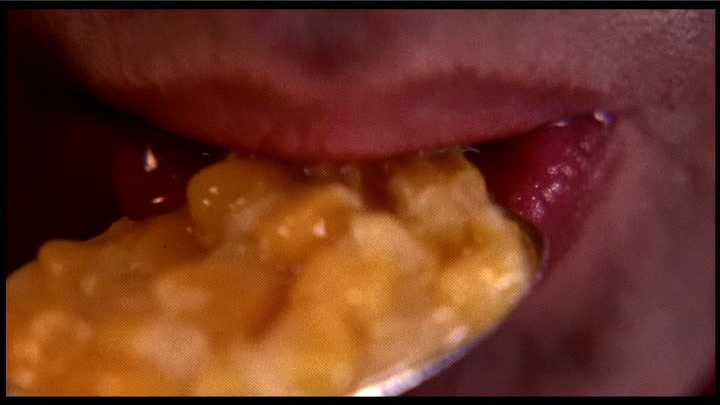
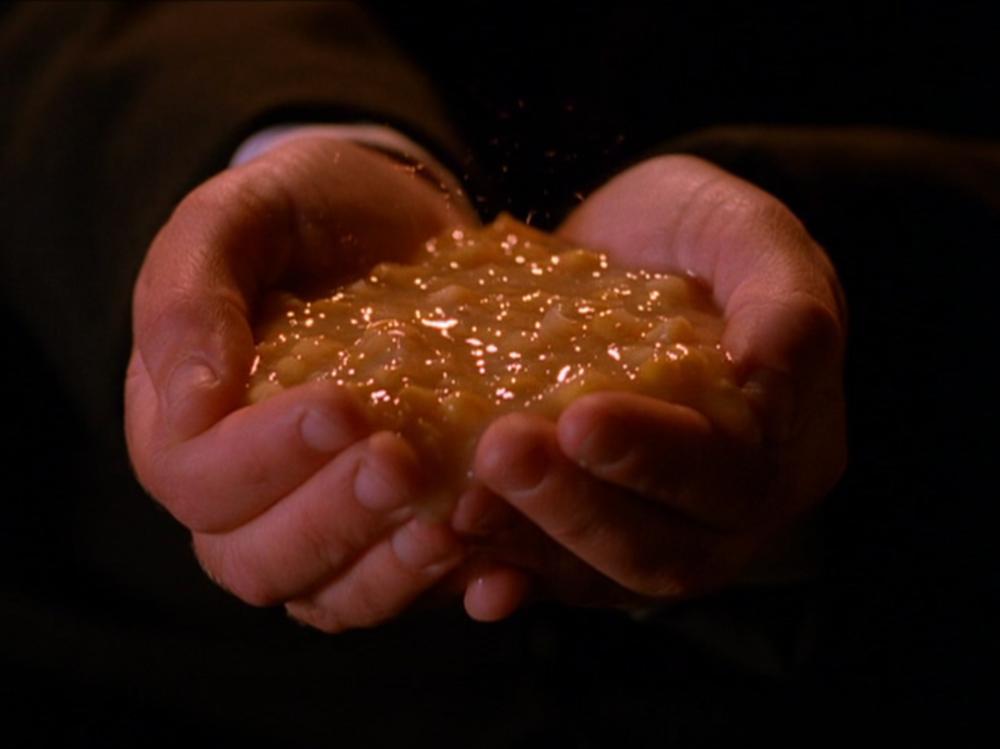
But no other food plays a more crucial role in this universe than (creamed) corn, otherwise known as Garmonbozia. One could even argue that it is what sets the whole story in motion. Without it, Laura Palmer would not have been killed in order to collect her “pain and sorrow”. This harvest is directly responsible for the FBI investigation that follows her murder and for the series itself.
What is so special about Garmonbozia, apart from the fact that it is apparently the only food eaten (sucked) by the Lodge entities? And why is it depicted as (creamed) corn?
In order to answer these questions, recall that “Maize, along with tobacco, pumpkins and succoquatash, was a native of the New World… the Indian grain” (all quotes from articles written by Helen Valbord for HERMES Magazine). I have described the Lodge entities in an earlier post as “the White Indians from Lemuria” and their strong links to Native American imagery on several levels, including that of corn’s symbolism: “To the Indians of the New World, spiritual life and the life of flesh were reflecting counterparts of one another in that midmost place. The breath of Spirit breathed in the corn like the Mayan wife who blows on her kernels before grinding them into meal. Wherever corn grew in the Americas it was held by the people to be the symbol of life and fertility… It was the spirit of the seed of eternal life, and frequently the umbilical cord of a newborn child was cut over an ear of corn“.
Once again, as in alchemy – with the rejuvenating powers of its philosopher’s stone – the concept of immortality comes forth. Besides its ability to produce the elixir of life, this stone is supposed to turn base metals into gold – the colour of corn. Yellow is the colour of gold and of corn, but if we believe the following extract from Zuni Cosmology: “Sky-father… set the semblance of shining yellow corn grains. In the dark of the early word-dawn they gleamed like sparks of fire“.
Garmonbozia’s connection to gold and fire through corn appears clear, as does its link to immortality. Garmonbozia seems to be a sort of Soma (a Vedic ritual drink of historic importance among East Indians). The following quote is taken from the Rigveda: “We have drunk soma and become immortal; we have attained the light the Gods discovered. Now what may foeman’s malice do to harm us? What, O Immortal, mortal man’s deception?“. Perhaps even closer to Garmonbozia then Soma is Armita, referred to in texts as “nectar”, the equivalent of the greco-roman Ambrosia.
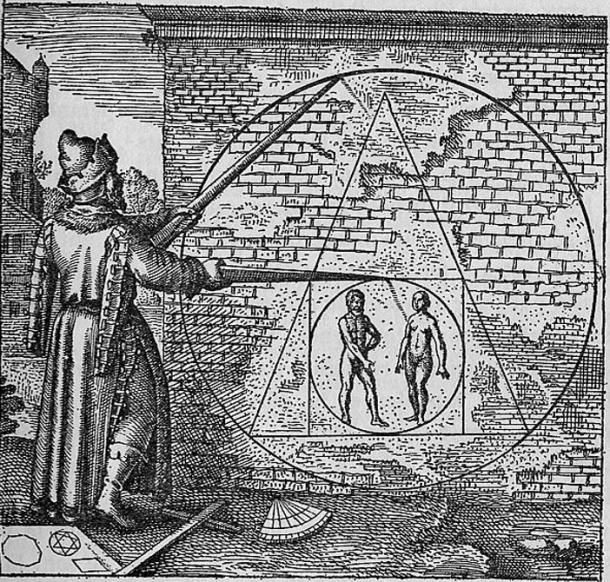
This food is what differentiates the Lodge entities from the rest of humanity. It makes them immortal, it keeps them “above the convenience store” (our reality), as the gods who used to dwell on Mount Olympus in classical Greece. Their ability to travel through the Fourth dimension via electrical fire, their capacity to “square the circle” (to create the Philosopher’s stone), makes them all powerful in our realm.
Philosopher’s stone as pictured in Atalanta Fugiens Emblem 21
This vision of immortality contrasts somehow with the theme of sacrifice which also underlines Twin Peaks in general, and Laura Palmer’s story in particular (in Twin Peaks: Fire Walk With Me, she tells James: “I’m gone. Long gone. Like a turkey in the corn” – she knows that she is soon going to be served as the main dish, a sacrifice to the gods, another clear reference with Thanksgiving – blessing of the harvest – to the links with Native American symbolism).
A Native American deity known as Mondamin is interesting in this context. This god of maize “was dressed in brilliant green, with waving plumes adorning his raven hair… Ojibwa children were taught to dream and they knew the law of sacrifice that governs the manifest world through such legends and through their own strivings when they too would seek a vision. Like the Hindu Purusha, who archetypally sacrificed himself in a thousand pieces so that life in all its fragmented variety might unfold, so Mondanin in a more particularized way sacrificed himself so that men could sustain themselves and flourish“.
Closer to Europe, one can also find a link between deities symbolizing life, fertility and self-sacrifice: “Though personified as Demeter and given its cyclic characterization as her daughter Persephone, corn remained from archaic ages the impersonal yet concrete symbol of the force at the heart of the cosmic and terrestrial evolution. When cornmeal is offered in prayer it is an offering of the flesh. But being a divinely created food, it is also a sign of spiritual thanksgiving“.
This slideshow requires JavaScript.
Interestingly, “Europeans gave the maize to cows, pigs and chicken who thrived on it, and aligned their own appetites with the more refined products of Old World grains“. I have already mentioned in several previous posts how the Lodge entities are associated with birds of all sorts (if only due to Max Ernst’s influence on the visual look of the Lodges) and the fact that their food of predilection is corn makes perfect sense.
In Hinduism, the Gandharvas are male nature spirits. Some are part animal, usually a bird or horse. (Wikipedia)They have superb musical skills. They guarded the Soma and made beautiful music for the gods in their palaces. Gandharvas act as messengers between the gods and humans. They are mentioned extensively in the epic Mahabharata as associated with the Devas (as dancers and singers). (Wikipedia)
Why is it “creamed” corn, though? Probably because everything in Twin Peaks is sugary, producing a regression to a childish state of development in synch with the fairy tale aspects of the show. As in Hansel and Gretel, houses are made of candy in Twin Peaks. Perhaps this is so as to make its inhabitants forget that some of them are going to be eaten by cannibalistic witches/big bad wolves/Lodge entities…
Hänsel and Gretel (Lotte Reiniger – 1955)
The fact that BOB stole their supply of Garmonbozia from the other Lodge entities is also interesting. Once more, this might very well be linked to Hindu mythology and to the competition for power between the demonic Asuras and the more benevolent Devas. This is what we find about them on Wikipedia: “Each Asura and Deva emerges from the same father (Prajapati), share the same residence (Loka), eat together the same food and drinks (Soma), and have innate potential, knowledge and special powers in Hindu mythology; the only thing that distinguishes “Asura who become Deva” from “Asura who remain Asura” is intent, action and choices they make in their mythic lives“.
Before continuing, it is important to note here that it is not as far fetched as it may seem that David Lynch could have had Devas and Asuras in mind when he created the Lodge entities. In her book David Lynch Swerves (2013), Martha Nochimson notes that Lynch told her about his interest in the Hindu demons called Raksashas (also called Maneaters).
Devas and Asuras on either sides of Vishnu
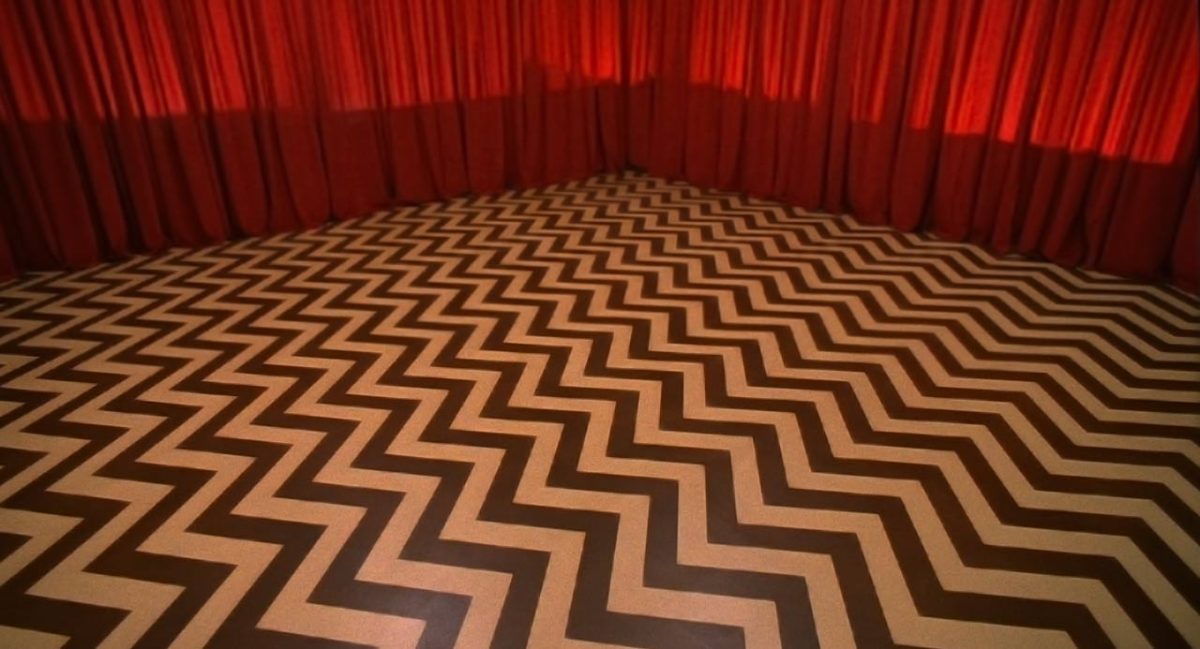
This common living space and shared food between the Devas and Asuras is highly reminiscent of the Lodge entities. It does seem that some of the entities are more benevolent than others (MIKE, the Giant, the waiter), while others obviously have a much darker side (BOB). But not everything is black and white (though Devas symbolize light and Asuras darkness in Hindu mythology). Or if it is, it is similar in a way to the chevron motif on the Lodges’ floor: winding and far from straightforward (at least from a three dimensional perspective).
The definition found on Wikipedia continues: “Asuras who remain Asuras” share the character of powerful beings obsessed with their craving for ill gotten Soma and wealth, ego, anger, unprincipled nature, force and violence. Further, when they lose, miss or don’t get what they want because they were distracted by their cravings, the “Asuras who remain Asuras” question, challenge and attack the “”Asuras who become Devas” to loot and get a share from what Devas have and they don’t, in Hindu mythology. The hostility between the two is the source of extensive legends, tales and literature in Hinduism; however, many texts discuss their hostility in neutral terms and without explicit moral connotations or condemnation“.
One can assume that this is what happened between BOB and the rest of the Lodge entities. Being an “Asura who remained an Asura”, he looted the others so as to get their Garmonbozia. Being ordered to get Laura’s Garmonbozia is probably a way to restore the balance between the two types of deities, “without explicit moral condemnation”. Actually, when the decision is made, neither MIKE nor the Giant or the waiter (the true Devas) are present above the convenience store.
Where are MIKE, the waiter and the Giant…?
“According to Coomaraswamy’s interpretation of Devas and Asuras, both these natures exist in each human being, the tyrant and the angel is within each being, the best and the worst within each person struggles before choices and one’s own nature, and the Hindu formulation of Devas and Asuras is an eternal dance between these within each person“. In Twin Peaks, Laura and Dale both took that dance – and while Laura succeeded in freeing herself from her dark partner, Dale waltzed directly to the Black Lodge, leaving the dance floor to his doppelgänger.
Finally, to return to corn, mirroring the symbolic fight between Asuras and Devas, “corn served as the first staff of life for all the races that made the New World their home. It thus provided a symbolic and biological keynote for the spiritual and physical evolution that has subsequently taken place and that can take place in the future… Let us see within the coarse and overgrown commonness of ourselves or our fellow man the pure breath of sacrifice that nourishes and strengthens and reveals the divine Purusha who is, was and shall ever be“.
The world of Twin Peaks in the Pacific Northwest is generally a cold and damp place. But it is a cold place with a lot of fire – lots of fires, to be precise. Far from being easily contained, this primordial element spreads from place to place and knows several forms in the universe created by David Lynch and Mark Frost. From the sparks that fly off the Packard Sawmill during the opening credits to the flames that consume Laura on the inside; from the forest fire that took the life of the Log Lady’s husband to the fury that burns in the eyes of Leland…
“When this kind of fire starts, it is very hard to put out. The tender boughs of innocence burn first, and the wind rises, and then all goodness is in jeopardy”
Because of its many faces, because of its ability to mutate and devour everything it touches, it is not far-fetched to affirm that Twin Peaks really walks with fire.
Here is what one finds on the subject of fire in the Theosophist literature (all the quotes come from various articles written by Helen Valborg for HERMES magazine in the 1970s and 1980s): Fire eats everything. His three ‘sons’ are Pavaka (Purifier), representing electric or vaidyuta fire, Pavamana (Purifying), or the fire of friction, and Suchi (Purity), the solar fire… His three forms – the sun, lightning and fire – become ‘the structural presences of the cosmos and of the inner life ofmen‘.
From the book “Agni – Way of Fire” (Bruce Lyon)
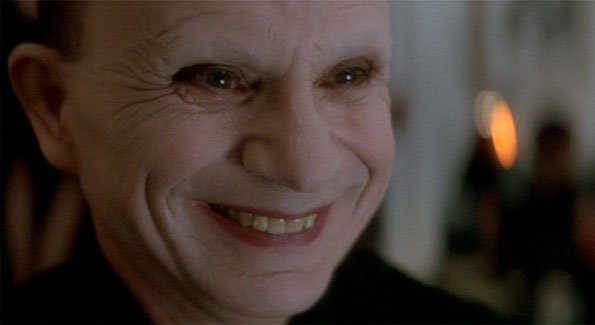
It might be difficult today to remember that electricity (the electric fire), when it was first domesticated by humans in the 19th Century, was seen by some as an occult force. Thanks to its power, it suddenly became possible for humans, though distant by thousands of miles, to speak to each other via a telephone as if they were in the same room. This power (among others) turned the dream of ubiquity into a reality (as in Lost Highway, when the Mystery Man asks Fred Madison to call him at his own house – when he’s actually standing in front of him, at a party, far away from it).
Electricity’s fire is directly connected to that of lightening, a terrifying and instantaneous bridge between two worlds: “the extraordinary mediating role of lightening in its awesome descent from heaven to earth, where it becomes fire as we know it“. The entities from the Lodges definitely walk with fire because of their intimate relationship with electricity (‘we have descended from pure air‘), which in turn connects them to the world of the occult. This is also why their relationship to time is far different from ours, because of the near elimination of the time factor implied by electricity: “it is only through the interruptions of the current (produced by dots and dashes or by voice modulations) that the element of time is made apparent“.
It is important to note the movement implied by lightening/electricity/fire. It is a force that sets things in motion: fire walk with me. “The One Supreme, in three aspects, pervades the universe and vivifies it, yet remains unmanifest… When differentiated, it becomes Fohat which, together with its seven offshoots, is the cause and effect of Cosmic Electricity… the animating principle electrifying every atom into life… the cosmic energy which produces the differentiation of the primordial cosmic matter… All that exists in the universe contains and is electricity… Fohat divides into two parts (male and female) to create the manifested universe… This forms the basis for the world, motion being inseparable from heat, leading to archetypal expansion, the dissociation of relatively homogeneous and ethereal molecules, and their recombinations, producing slightly altered ‘knots’ of energy which whirl and cool according to the fluctuations of Agni’s breath… air is fluidic fire, water is liquid fire and earth is solid fire… “.
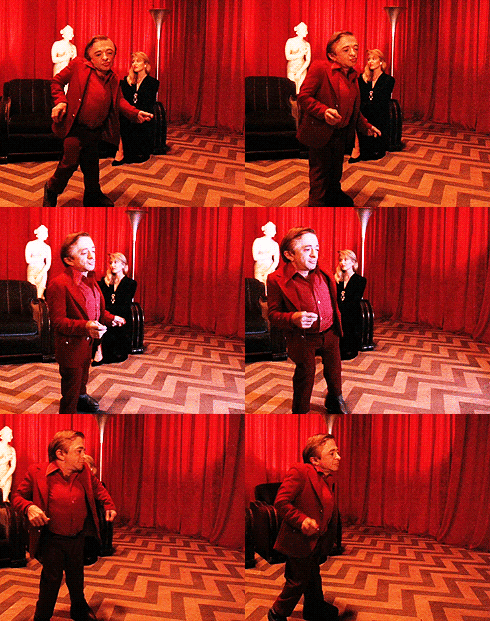
It is no wonder that The Man From Another Place or Leland (when possessed by BOB) dance so much – they are constantly connected to the flow of electricity, the “animating principle” mentioned above. According to Valborg: “The intuitive investigator J.W. Keely called electricity ‘a certain form of atomic vibration‘”. The chevron pattern of the floor of the Lodges is a clear representation of this electrical vibration, of this liquid fire.
Liquid (electrical) fire
In other words, fire is what sets the universe in motion, a motion that generates heat: “All life is in fiery motion producing heat… Electricity and magnetism are, in essence, the differentiated aspects of Universal Motion, and light and heat are but shadows of matter in motion on grosser planes”“. Similar to the saws that cut the Cosmic Tree in the Packard Sawmill, fire divides the original unity of the universe into a plurality. Fire is what gives form to the world. But Valborg adds: “all the wonderful technology men have developed by means of Agni’s heat and electricity are merely shadows of the incalculable enlightenment and development that characterizes the awakened human mind“.
The divinity associated with fire by the Theosophists is the Hindu god Agni, the Vedic fire god. Agni is the Devourer, and he is generally considered to be the mouth of the gods and goddesses. He is the medium that conveys offerings to them. Fire and food, cherry pies and coffee, pain, sorrow and Garmonbozia…
Agni, god of fire, riding a ram
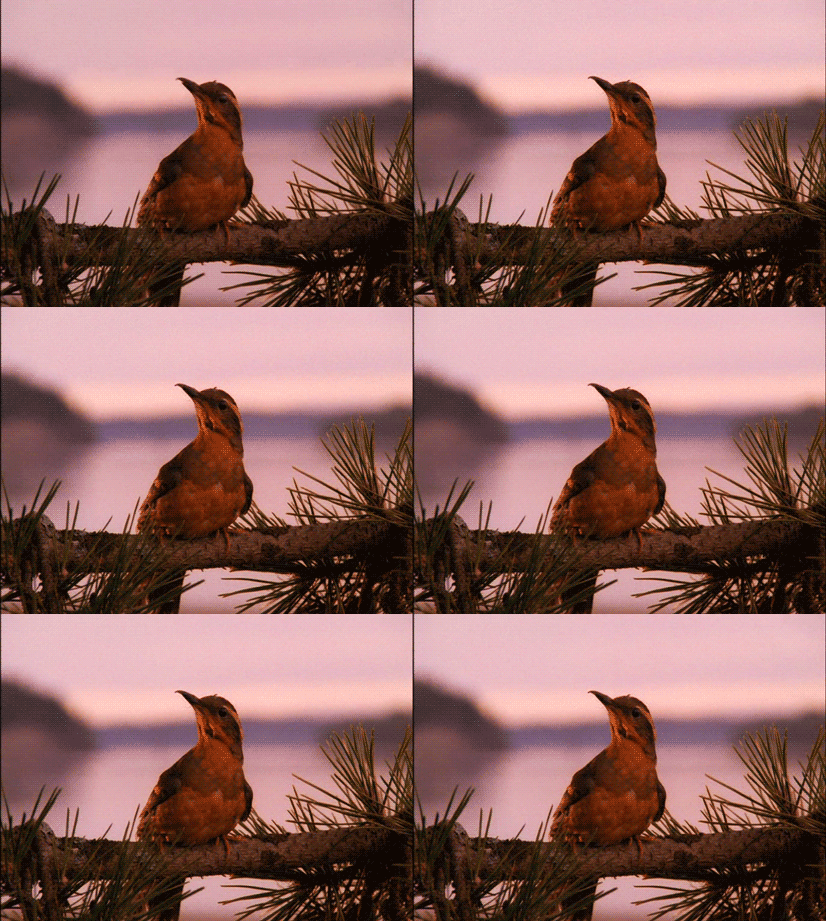
Directly connected to the world of Twin Peaks is the following quote: “Agni may take the form of a bird who then flies down from the realm of the gods to earth. This theme is widespread in the world and often figures in myths about the divine gift of fire to human beings“. This Promethean fire bird might very well be the one that appears at the beginning of every episode of the series. Fire comes from the sky, fire is in the air… or, to quote the title of an album David Lynch recorded in 2007, The Air Is on Fire…
The connection between lightening/electricity/fire and trees/wood is self-evident. The forest fire in which the newly wed Log Lady lost her husband has already been mentioned (for reference: Ronette Pulaski’s name was probably not chosen randomly since the Pulaski is a tool used in wildnerness firefighting…). But let us also remember that the domestication of fire started when humans had the idea to rub two pieces of wood together, the friction thus generated (one of the three ‘sons’ mentioned above) producing fire. “When one makes a resolve or takes a vow, Agni is enlivened and commences the work of burning out the dead wood of constricting thoughts and imprisoning behaviour“. Also remember Pierre Tremond, in the convenience store sequence, when he declares: “fell a tree” to BOB, the one who walks with fire.
Friction
This link between the domestication of fire and the domus (house/home in Latin) is direct. Home is where the hearth is situated, the place where food is cooked and where the family protects itself from the elements. This is what Valborg has to say on the subject: “In ancient societies and in households still preserving a sense of the sacred connection between heaven and the domestic hearth, Agni is kept alive… such fires bring life to a household that cannot be provided by any other thing… In India, through the ashrama stages of life, Agni is carefully fed and reigns at the centre of the human struggle for individual and collective wisdom… All fires are sacred. All burn with the unalterable truth of Agni, and all must be used, fighting fire with fire, to purify the whole nature so that one can stand on the altar of the gods“.
“As the Agnihotra or priest chanted the Rig Veda, he performed Paryagnikriya or circumambulation with fire. Around the altar fire of Agni he created a flaming fire ‘Pass-not’ as the gods proceeded to take possession of that which is sacrificed”
Once fire is domesticated, once humans have understood that they must make sacrifices to the gods through fire, they have to accept the fact that they very well might be the sacrifice in question: “Man lives, his crops grow and his hearth abounds with nourishing food, only to find that he too is food in the great cyclic return that revolves between heaven and earth. At each moment numberless forms of fire devour forms of life which are fuel. The sun itself shines by devouring its own substance… the universe is a constant sacrifice, the transformation of life into life. ‘To live is to devour life’, and on every level of the cosmos all is of the nature of fire and water, Agni and Soma, the Devourer and the Devoured“.
BOB turns Laura’s sacrificial blood into Garmonbozia
This great cycle of sacrifices is universal: “The entire cosmic process is essentially a sacrifice. To grow by giving is the universal law. Self fulfilment can only be achieved through self-immolation… The earth exists chiefly to serve as the place of sacrifice. It is only when this law is recognized and voluntarily followed that the kingdom of death can be traversed and immortality truly attained. The real soma-sacrifice requires the giving of the elemental self to the flames of the higher. The victim of the sacrifice is the sacrificer himself.”
Cooking gloves as a protection from spiritual fire for the uninitiated (once again, the link to food…)
This inner fire of immortality is the ultimate goal to be reached through the external fires: “With effort the meditator identifies the fires and feeds them with the fuel of his own impurities. He learns to practise controlled burning, gaining mastery over his physical and astral temperature only as a byproduct of a deeper process of mental alchemy”.
Laura and Dale are the two main characters in Twin Peaks to have moved on from the external form of sacrifice to an internal one: “The exoteric ritual guarded by external priests is but a shadowy reflection of the fiery offering that must be made within the individual“. The Jungian process of individuation they have followed in the Red Room and elsewhere helped them turn the fires that were consuming them into ones that enlightened them. They moved from exterior to interior sacrifices so as to spiritualize their emotions.
Laura went one step beyond, though: she accepted the final sacrifice in that process when she took the ring, sacrificing her own life to get there. Dale, on the contrary, stopped one step away from the goal. He was not utterly ready to feed the fire with the fuel of his own impurities because of his fear. Laura and Dale’s minds can be seen as fiery devourers, the objects of their thoughts becoming the devoured. On the other hand, Windom Earle’s refusal to sacrifice himself in the process, his desire to sacrifice someone else to get there, could only lead to the complete cremation of his soul. Unwilling to feed the fire with his own impurities, it is his very soul that got burnt instead.
“The soul, which is made up of fire, is thus bound up with all cycles of change taking place in the world as a whole, while at the same time remaining the underlying connection between them”
In the end, Laura is the only character (so far) to have been able to fall through the ring of fire to the other side of the mirror, to the White Lodge, a place where fire does not burn anymore, where it becomes pure light: “Absolute Motion is the eternal dark, invisible fire out of which emanates light, which sets in motion and controls everything in the cosmos. This fiery motion is the alpha and omega of electricity, galvanism, magnetism, moral and physical sensation, thought and life“. In spite of all she has suffered, she managed to stay in motion, to never stop on the path of individuation. The complete integration of the unconscious elements of her personality is what enabled her to move on to the next stage.
“Through the action of fiery truth, he (the sacrificer) will have attained bliss, universal consciousness and essential truth. He will have entered into the luminous realm of the divine flame which flickers not but remains the source of all that was, is and ever shall be”
“And now, facing him bleakly in the hesitant light of dawn loomed the entrance to a cave, the Hall of Initiation that yawned and beckoned… Arriving at the entrance to a dimly lit chamber, his eyes were met by an airy veil of myriad glorious hues which stretched across the width of the room and undulated gently in an imperceptible breeze… He reached out abruptly and drew it aside, fully expecting some revelation to greet him. But only the air stirred and sighed and his eyes were met by the face of another veil” (Helen Valbord – Hermes Magazine – 01/87).
It is no mystery that Mark Frost was highly influenced by Theosophy when he and David Lynch conceived the world of Twin Peaks. This esoteric religion established in New York by Russian émigré Helena Blavatsky (1831-1891) constitutes a recurring motif in his work as a writer and the links with Twin Peaks are numerous. Theosophy claims that its teachings come from an ancient brotherhood of secret adepts known as the Masters, based in Tibet (!) and gifted with paranormal powers.
They constitute a White Lodge that watches over humanity and guides its evolution. One of the seven Root Races of humanity described by Blavatsky is supposed to have lived on the continent of Lemuria, which I have discussed in a recent post.
Personal development is considered by Theosophy to be one of the main goals of human existence, meaning the spiritual emancipation of the soul. Human elements such as the Spiritual Soul and the Spirit, though connected to the body via the Human Soul, can progress through further spiritual planes towards reincarnation. Blavatsky details these ideas in her book Isis Unveiled (1877).
Occultism (the study of Occult practices) is literaly the “knowledge of the hidden”. In the context of Twin Peaks, the esoteric realm par excellence, the one that only a few chosen initiates can enter, is that of the Lodges. But even when one has entered that realm via the Red Room, most of it remains veiled by a maze of red curtains that mask the geography of the space. It is the triumph of maya (“illusion”, in Indian philosophies). The potential space in abstract space that is Aditi (mother of the gods in the Vedas) – to quote another book by Blavatsky (The Secret Doctrine) – is the divine immaculate Mother who can be identified with the most arcane Isis of ancient Egypt.
Once again, I believe that Twin Peaks is fundamentally about the Jungian process of individuation. In other words, the series is mostly concerned with the mental evolution of its characters. Laura Palmer and Dale Cooper are the only two who have access to the Red Room, the athanor (furnace) for this alchemical process of integration of the unconscious elements of their personalities. This space is nothing but a vast (mental) labyrinth of rooms separated from each other by opaque veils (the red curtains). In order for these characters to be reborn as more developed spiritual beings – the veils, linked to Aditi, connect the Red Room to the female womb, the athanor which produces gold from lead – they have to wander through this maze until they reach its core, which is really the core of their own psyche.
But of course, as Dale Cooper finds out at the end of the second season, every labyrinth is inhabited by a Minotaur or a Dragon, protecting its treasure: his own Shadow Self…
“The fiery power of the Heaven-Born must fight its way into the inmost chamber of the heart. Veil after veil may confront him and veil after veil he must cast aside until, like the worn and weary pilgrim, he is well advanced into the Hall of Initiation. But he must not, as did that exhausted pilgrim, despair. For though the final veil eternally remains, he can release its activated Buddhic power within his own being and soar in mind and heart beyond the prison-house of separate existence into the unlimited vastitude of Aditi – divine and boundless Space” (Helen Valbord – Hermes Magazine – 01/1987)
“Any sufficiently advanced technology is indistinguishable from magic” (Arthur C. Clarke)
It is a well documented fact that before the creation of Twin Peaks, Mark Frost and David Lynch were working on a series linked to the mythical continent of Lemuria (see for instance Twin Peaks FAQ by David Bushman and Arthur Smith). One can only guess what this project would have looked like, but it does appear that their ideas for the show might have somehow been transposed to the universe of Twin Peaks, as we will see a bit further down.
But first things first: what is Lemuria?
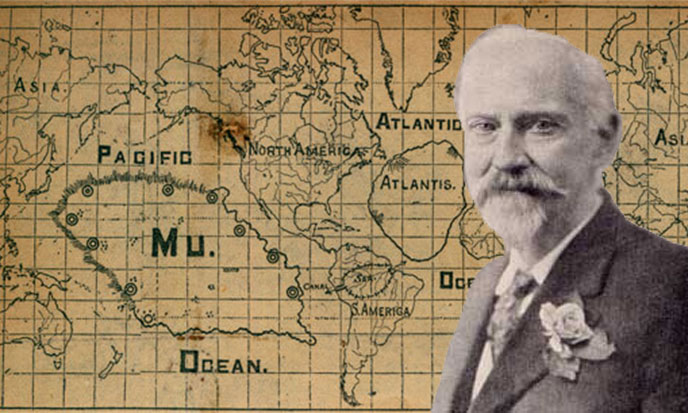
The main proponent of the existence of a Pacific Motherland called Mu (Lemuria) was the Bristish occult writer James Churchward who published The Lost Continent of Mu in 1926. Lemuria was a counterpart to the Atlantic Ocean Atlantis mentioned by Plato in his works Timaeus and Critias. Supposedly based on the information provided by the high priest of a Hindu monastery, the works of Churchward tell us that the continent was inhabited by the light skinned people of the Naacals. The continent spread somewhere in the Pacific Ocean between Hawaii and Easter island. Highly developed spiritually, living in harmony with the planet, the Naacals had also mastered extremely advanced technology. Mu was, according to Churchward, the real Garden of Eden: “The Garden of Eden was not in Asia but on a now sunken continent in the Pacific Ocean. The Biblical story of creation – the epic of the seven days and the seven nights – came first not from the peoples of the Nile or of the Euphrates Valley but from this now submerged continent, Mu – the Motherland of Man“.
James Churchward (1851-1936)
Following his teachings, various authors (such as Frank Joseph in his The Lost Civilization of Lemuria) suggest that the end of the last ice age, with its increase of sea levels, caused the inundation of most of Mu. Then, a comet that passed near the Earth 3000 years B.C. provoked a global catastrophe with most of the continent slipping beneath the sea. The Lemurians fled to various parts of the world, notably to the Himalayas and Tibet where their teachings became the roots of Tibetan Buddhism (in Japan, they served as a basis of Shinto). This is what Joseph wrote about the subject: “The combination of volcanism, meteor falls, mega-tsunamis, and seismic upheaval rippling in earthquake swarms across the Pacific tore the Motherland limb from limb. What remained of her territories was smashed beyond repair or rebuilding, and groups of shell-shocked, struggling Lemurians melted into the foreign populations of Oceania, Asia, and the Americas“. This in turn explains the presence of a variety of mythical statements related to a white race of people in place long before the arrival of Europeans: “The anomalous presence of an otherwise unaccountable Caucasion race in the eastern Pacific can likewise be explained only by the former existence of the lost Motherland, said to have been ruled by a light-skinned elite” (according to The Secret History of Twin Peaks, Jefferson sent Lewis to investigate, among other things, an unknown tribe of “white Indians” – i.e. the Lodges entities).
The syncretism at work in Twin Peaks, which mixes influences from Native American mythology, Theosophy, Transcendental Meditation, Christianity, Tibetan Buddhism, etc. can be explained by the fact that Lemuria (or Mu, since both terms are basically interchangeable) is believed to have been the first global civilization, spread from coastal America (the Kennewick Man) to Oceania and Japan (the Jomon culture), from India to Egypt, and even to Atlantis and Tibet (“Lemurians made their most indelible impact in Asia on Tibet“, according to Joseph). In Ancient Rome, the annual Lemuria festival (in May) is supposed to have been created to propitiate the restless spirits of their ancestors (at the end of the ceremony, small effigies called the lemures representing the deceased were tossed in the Tiber River). To quote Joseph once more: “The Northwest Pacific Coast inhabitants… memorialized the lost Motherland. As Churchward wrote in 1926, ‘These legends and carvings on the totem poles strongly confirm the fact that the forefathers of those Indians came from Mu“.
But concretely, what signs point towards this antediluvian civilization in Twin Peaks? What visual or narrative elements can one find in the series or the film that might be read as hints of a lemurian influence?
First of all, there is the importance of birds.
“We have descended from pure air”
In my book Twin Peaks: Unwrapping the Plastic, I explain that the Lodge entities are clearly associated with birds. First, there is the shadow of a bird in the Red Room summoned by The Man From Another Place. Then there are the masks worn by the entities in the convenience store segment from TP:FWWM, with their long noses reminiscent of beaks. The little jumps executed by Pierre Tremond in that same film, in the scene where Leland Palmer leaves the motel where he has uncovered Laura in a room with Ronette Pulaski (note the phoenixes on the wall behind the bed – connection to Xi Wang Mu, see below), are also highly reminiscent of bird hops. Finally, every episode begins with the image of a bird atop a tree, echoing a statement made by The Man From Another Place in the missing pieces of TP:FWWM: “From pure air we have descended”, before BOB exists the Red Room crouched as a bird.
This slideshow requires JavaScript.
Birds are interesting in relationship to Lemuria because they represent the survivors of the deluge that struck the continent: “After the waters retreated, they followed him back into the world and were guided by the song of a bird. This bird motif recurs in several deluge traditions around the world, not only in Genesis” (Joseph). Their ability to fly links them to the world of the spirits, of the souls. They are not bound by gravity and exist in a vertical dimension of their own, which we cannot share, horizontal beings that we are. Our only way to interact with their celestial realm in the sky is by climbing trees, as our ape ancestors did.
Could this be why Pierre Tremond briefly reveals a monkey face under his mask in TP:FWWM? “Going up and down between the two worlds”? Or perhaps this scene is designed to make us understand that his human appearance is a “masking memory” hiding his real face, with its big eyes reminiscent of the face of ancient astronauts?
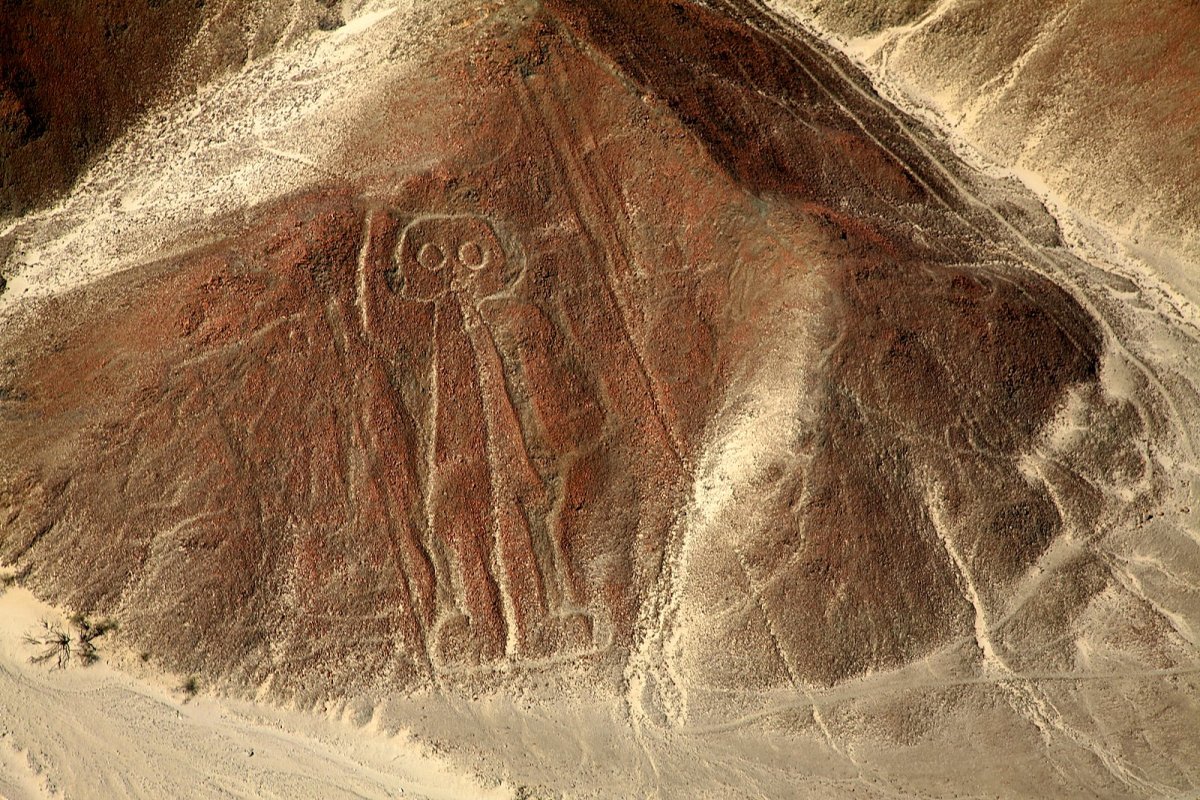
Concerning the big eyes, it might also be interesting to consider this in relationship to the Nazca lines in Chile, which are connected to the Lemurians, according to Joseph: “That was the real meaning, he said, of the desert’s ninety-eight-foot Owl Woman, her one hand raised toward heaven, the other pointed at the Earth. She personalized the perennially magical axiom ‘As above, so below”‘. ‘The owl is a symbol of wisdom for our ancestors, as it still is in the West, and for the same reason… its great eyes allow it to see things in darkness which are hidden to others. The Ancient Ones who drew Owl Woman’s shape and all the other designs not only meditated as they walked them, but danced and sang along the Nazca lines to achieve altered states of consciousness, the only means by which the energies of the universe may be summoned and controlled‘”.
Also, birds tends to like corn… even creamed corn.
Whichever it is, birds appear to be closely connected to the notion of the Tree of Life (or Cosmic Tree). This is what Churchward had to say about the Tree of Life: “Mu was symbolized as a tree, the Tree of Life. One of the names given to Mu was Tree of Life. The sacred writings tell us that Mu was the Tree of Life and that Man was its fruit“. This tree, -this ladder of sorts – connects the underground (with its roots), the surface of the Earth (with its trunk) and the sky (with its branches).
It is on top of such a tree that every episode of Twin Peaks starts, before it gets chopped into logs by the sawmill in the opening credits. Churchward and Joseph insist on the fact that Mu was the original Garden of Eden, the place where the Tree of Life was to be found. This tree became one of the symbols for the lost continent. Joseph: “Both Hawaiian and Maori accounts describe the land in which this tree was venerated as the paradisaical birthplace of mankind, from which humans spread throughout the world… The Tahitian word for island is ‘mu-tu’, apparently derived from the sunken Motherland and memorialized in Moorea, near the northwest coast. Interestingly, its reverse, ‘tu-mu’, means tree, which may again refer to Mu, which was synonymous with the Tree of Life”. A little below, we find this concerning the Maori of New Zealand: “Some of them guessed it belonged to their exterminated predecessors, the fair-complected Moriori, Wai-ta-hanui, or Urukehu, who were known for the possession of special stones like the Pounamu, or ‘green stone’, from the old Motherland”.
Joseph goes on to describe a similar myth from China: “Xi Wang Mu’s (ancient China’s most important deity) chief duty was to tend a peach tree that grew in her garden. Its fruits bestowed eternal life on anyone who ate them. The tree was known as the Jian mu and was regarded as an ‘axis mundi’, the center of the world around which all earthly life revolved“. This legend is of course highly reminiscent of what happens in the Red Room, which is a garden of sorts in which Garmonbozia is “grown”, a food for the Lodge entities which might very well grant eternal life as well. After all, the Lodges’ links to alchemy are strong, and the ultimate aim of alchemy was to gain immortality… Mu Kung, king of the gods, “formed a special group of eight humans, who were given fruits from the Tree of Life. They were know as ‘the immortals’. According to Churchward, the Tree of Life, the embodiment of immortality, was Lemuria’s chief emblem.”
Xi Wang Mu, Spirit Mother of the West / The Jade Maidens, dancers and musicians, gather in a garden on Kunlun as the goddess flies in on a phoenix.
Here is another segment from Joseph’s book which might be of interest when considered within the Twin Peaks universe: “Another Mayan glyph connects with the deer image in Churward’s symbol for the Pacific Motherland… He writes that the hieroglyph was known as U-luumilceh, or the ‘land of deer’… Deer imagery figures prominently and similarly in the spiritual symbolism of the Navajo Indians in the American Southwest”… Several lines from the Boen ‘Rites of the Deer’, an epic poem celebrating the origins of the Tibetan people read, ‘On the Earth the deer walks, the brown deer of the Mu walks. The souls of the king, his minister and vassal took on the guises of the precious cuckoo, deer, and tree‘” He then writes: “Although deer imagery may be found in the religious symbolism or many peoples throughout the world, its appearance among the Maya, Navajo, Japanese, and Tibetans is particularly Lemurian. It combines the concept of rebirth after the disappearance of a former age, usually through the action of a great flood, thereby most closely resembling the significance of the deer in Churchard’s symbol for Mu“.
Now, beyond the bird imagery, there are other elements that connect Twin Peaks to Lemuria. The elements can be found in several locations of the Pacific Ocean, notably Nan Madol, Easter Island, Japan, and Hawaii.
For example, the ruined city of Nan Madol, 1000 miles north of New Guinea, in the Federated States of Micronesia. It consists of a series of small artificial islands linked by a network of canals. It was one of the sites Churchward identified as being part of the lost continent of Mu.
Nan Madol
Local legend claims that the city was built by twin sorcerers who levitated the huge megalithic stones into place. As author Frank Joseph explains in his book about Lemuria, these reports of levitation “may be the folk memory of a lost technology“. Further on, he quotes a physicist from Michigan’s Marquette University: “gravity is really a frequency, part of Einstein’s Unified Field. Crystallized blocks of basalt need only be resonating at the frequency of gravity, 1012 hertz, or the frequency between short radio waves and infrared radiation, and they will lose their weight“. Beyond the fact that David Lynch regularly discusses the Unified Field in his interviews, recall various moments of the series and film when people appear to levitate, as Leland and the angels do in TP:FWWM for instance, freed from the constraints of gravity.
Levitation in Twin Peaks
He then quotes Childress: “The island itself is not usually hit by cyclones, since it is the place where cyclones begin“. Could Pohnpei (the island where Nan Madol is situated) have been deliberately chose by the builders of the city because they somehow appreciated the island’s singular location?, he wonders. The major effect with respect to hurricanes is electromagnetic and it appears that the millions of tons of basalt used to built Nan Madol are strangely magnetized: “It begins with a leading theme repeating itself through Pohnpei’s stark ruins: electricity. At Nan Madol and Insaru, tons of magnetized basalt by the millions were constructed into great enclosures, towers, walls, rooms, and canals. Their artificial lakes were stocked with what appear to have been electric eels… They would have constituted a potent, if irregular, power source that may have somehow interfaced with Pohnpei’s geo-piezoelectricity” “transforming the basalt’s naturally vertical magnetic field into a spiral would amplify the power of any piezoelectric discharge by swinging it around in a narrowing, tightening circuit, then focusing the beam of its concentrated corona discharge skyward“.
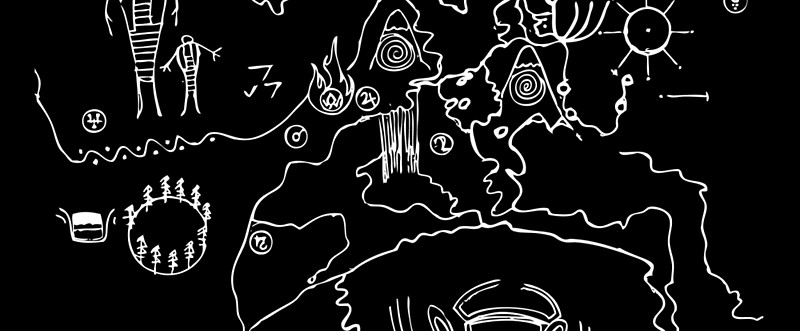
Manipulating the electrical properties in clouds may lead to modification of the weather by man. Nan Madol’s massive towers with their spiral-magnetized basalt connected to artificial pools of electric eels and were energized by tectonic pressure beneath Pohnpei. Joseph stated: “Nan Madol was never a city, certainly not in any ordinary sense of the world, but a power station undoubtedly constructed by the Pohnpeians’ ancestors” “Nan Madol, in tandem with Insaru, was a weather-modification project purposely built to prevent tropical storms from becoming typhoons“. It goes without saying that these references to electricity are highly reminiscent of the Lodge entities. Could it be that Twin Peaks itself is a power station of sorts? This is what I suggested in my book when I wrote about the symbol on the Owl Cave petroglyph representation of the town, especially in relationship to the peaks and the spiral motif drawn on them (a motif that can actually be found throughout David Lynch’s filmography).
This is what one can find in Churchward’s The Sacred Symbols of Mu (1933): “A careful study of the symbol and where and under what circumstances it is found leads me to the belief that:–These hitherto unreadable spiral symbols give the hidden meaning of the hieratic letter N–Mu’s alphabet; that they are intended to depict the continuance of the soul from one cycle to another, from one incarnation to another, eventually ending whence it came. In the New Grange picture which I have shown there are three spirals all running into each other without an end. I take it that the third spiral is meant to indicate the passing of the soul into the world beyond or maybe to some other body in the Universe specially prepared to receive it…
A spiral with an end pointing to the right is an ancient Uighur symbol meaning, “going to somewhere.” It is also found in Mexico and among the North American Indians.”
True Detective (2014) – a series highly influenced by Twin Peaks and its imagery…
Moving on to Easter Island (Rapa Nui): “There was a profusion of rock art in petroglyphs depicting fish, spirals, a variety of geometric designs, and an ubiquitous birdman, a cult figure without parallel in the vast Pacific… the mysteries of Makemake, the bird-man cult from old Hiva” (the Polynesian version of Mu).
Petroglyph of Makemake, the bird-man from the Rapa Nui mythology
Described as “the navel of the world”, Easter Island is reported to be situated at the meeting point of two geological fault lines, according to Joseph: “They recognized Easter Island’s strategic position at the epicenter of a capital T, or flat-topped cross, formed by two connecting fault lines on the bottom of the sea, a configuration they used as the tau emblem of their civilization“. Famous for its collection of giant megalithic “Moai”, Joseph then claims that there are similar reports as in Nan Madol of magically levitated rocks by sorcerers from a sunken civilization who came to the island: “The merest hint of this lost construction art occurs in local legend, which tells how the gigantic statues were made to walk to their assigned positions through the power of ‘mana’, a supernatural or psychic force conjured by priest of the Hanau-eepe“.
Moai – the stone giants from Easter Island (Rapa Nui)
In a process reminiscent of the one occurring at Nan Madol, where the electromagnetic power of the basalt is supposed to prevent typhoons, “Easter Island’s standing colossi transformed the mechanical energy of earthquakes, discharging it into electrical energy, thereby ameliorating the worst effects of seismic upheaval… Together, they formed an anti-earthquake device“.
Also interesting in the context of Twin Peaks is the following quote: “Its energies generate electromagnetic fields that can powerfully influence the electromagnetic circuitry of the brain to induce altered states of consciousness. The harnessed power of our planet was something not only directed to disperse and relieve tectonic stress, but also used in spiritual ways we are only just discovering. For example, it is now understood that granite in large volume produces relatively high levels of radiation, which alter human consciousness by inducing drowsiness and psycho-spiritual experiences, such as a sense of traveling through time and astral projection“.
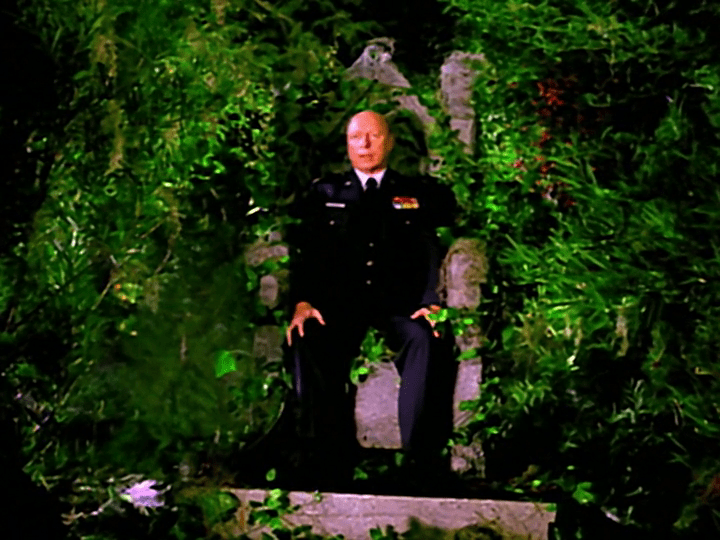
In my book, I insist on the importance of the states of modified consciousness in Twin Peaks, whether from drugs, coffee, sugar, or dreams. Garland Jennings’ “trip” through time and space, after his abduction, might have been the result of such an electromagnetic influence – his brain and body resonating with the frequencies generated by the geological properties of Twin Peaks. Perhaps then was the scene when he sits on a throne lost amidst vegetation a visualization of the lost kingdom of Lemuria?
The last stop on the Pacific Ocean is Japan, which Jomon culture is thought by Joseph to have been greatly influenced by Lemuria. Indeed, besides the ‘citadel’ found eighty feet beneath the surface of the Pacific off Japan’s Yonaguni island, which some describe as proof of the existence of a highly developed race in Earth’s distant past, Swiss author Erich von Däniken, one of the main proponents of the ancient astronauts theory – which claims extraterrestrial influences on early human beings – believes that the Jomon statues depict alien visitors. Very much influenced by H.P. Lovecraft’s Chtulhu Mythos, his ideas have repeatedly been debunked by what he and his followers call the “mainstream scholars” (i.e. basically anyone who disagrees with their tale). Joseph: “The former leaders of Chinese culture migrated once more, this time to Japan. There they intermarried with the resident Caucasians, known as the Jomon, creators of the world’s first pottery, to form the modern Japanese people“. One cannot help but notice a strong resemblance between these figurines and the symbol that appears on the Owl Cave petroglyph…
Owl Cave petroglyph
Clay Figurines from the Jomon Period (Dogus)
The link between Lemurians and extraterrestrial (actually “intraterrestrials”, coming from the Hollow Earth) is made by Richard Sharpe Shaver in the mid 20th century in his series of tales published by Amazing Stories. I will visit his work in a new post soon.
Before closing this post, I’d like to remind readers that several characters from Twin Peaks are directly associated with the Pacific realm, such as Doctor Jacoby (Hawaii) and Carl Rodd (Alaska and war in the Pacific). This is no accident and will probably lead to fascinating developments in the upcoming 3rd season of the series.
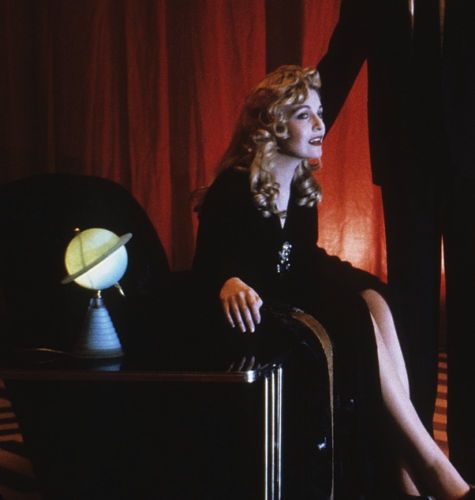
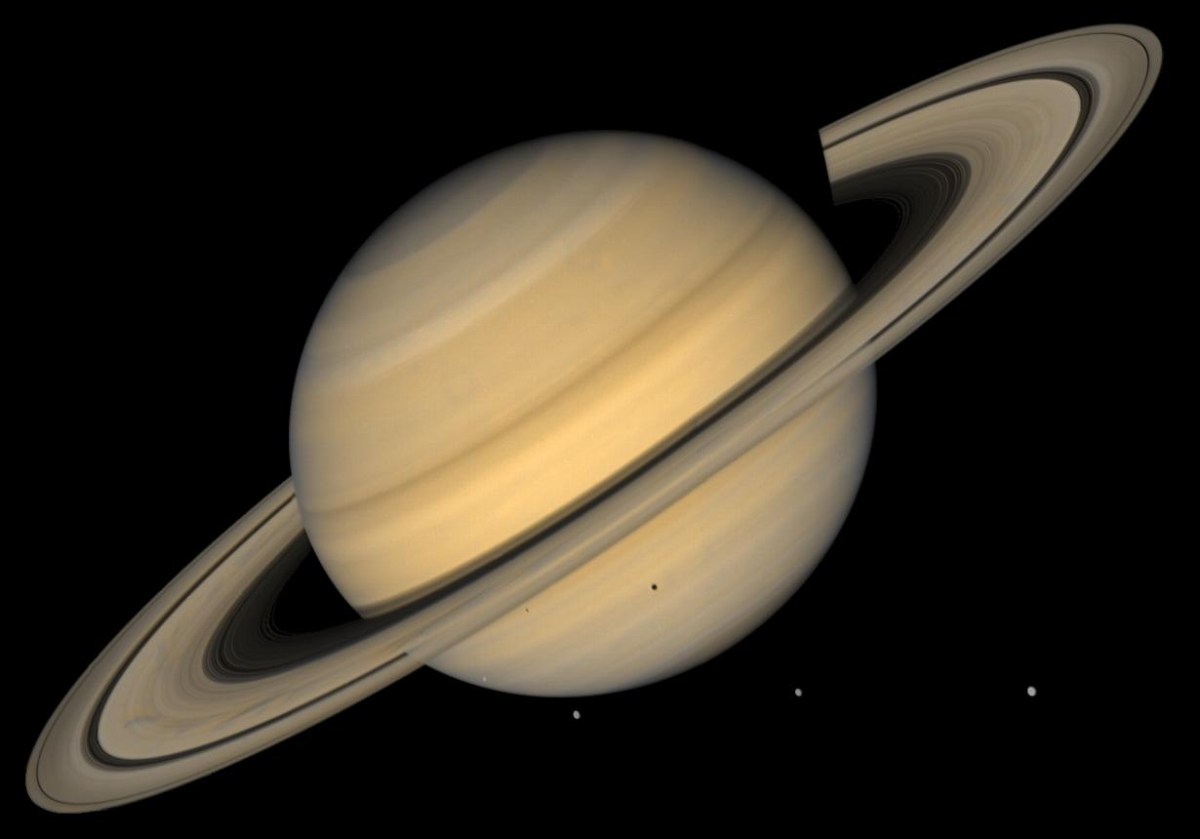
Why is there a lamp in the shape of the planet Saturn in the Red Room next to the armchair in which Dale Cooper (in the series) and Laura Palmer (in the film) sit? What is the meaning of this lamp? Was it chosen because of its rings, as a visual reminder of the jade ring which plays such an important role in the film? Or was it selected for some other, perhaps less obvious, reason?
One way to answer this most important question is to go back to the mythological roots of Saturn. Before it became the name of a planet in our solar system (and the origin of our “Saturdays”), Saturn was a Roman deity, derived from the Greek god Cronus (not to be confused with Chronos, the personification of time). Cronus ruled the world during the Golden Age when humans enjoyed the spontaneous bounty of the earth without laboring for it, in a state of innocence – an equivalent to the Garden of Eden – and was a patron of the harvest. This element of his personality has been transferred to the agricultural deity Saturn, and more precisely to the Saturnalia festival, held every December near the time of the winter solstice.
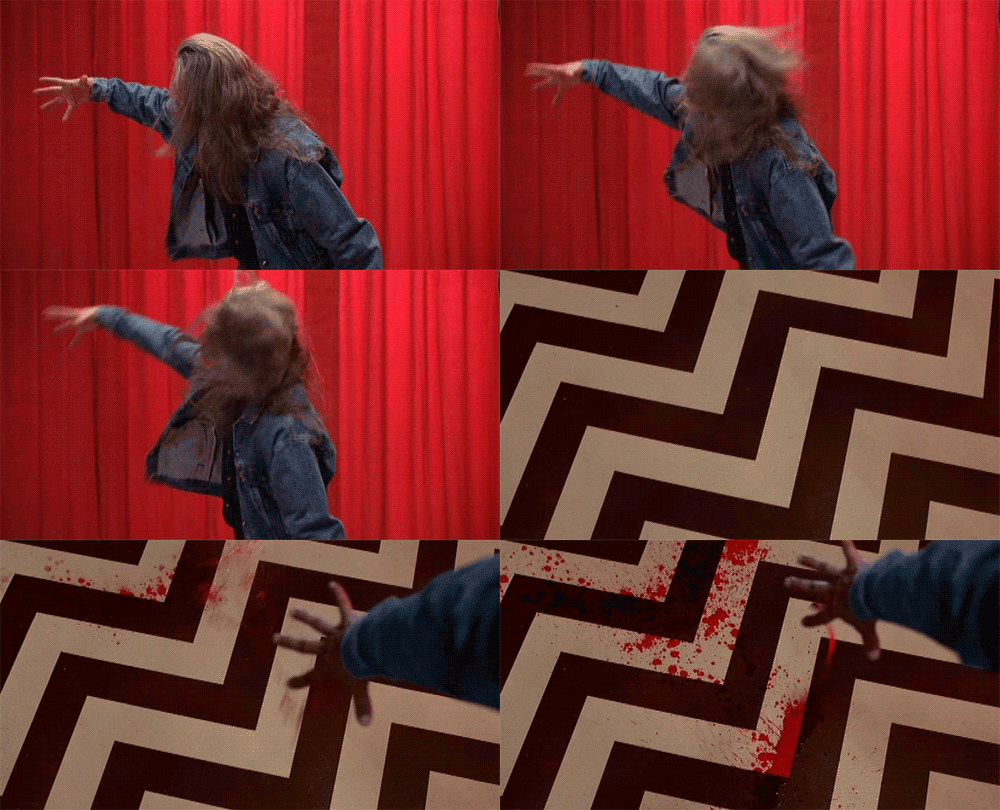
The connection between the Red Room and food is obvious, since it is the place where Garmonbozia is consumed. Moreover, it is also very likely that this is the place where it is actually grown, as exemplified at the end of Fire Walk With Me, when BOB “transmutes” Laura’s blood into Garmonbozia (Saturn is the patron saint of alchemists) by splashing it onto the room’s floor (to be understood as the soil of this secret garden, but also as the water – the chevron motif – necessary to grow crops).
There might also be a link here to the Roman god Mithras (or even to the Vedic Mitra?) whose followers had a complex system of grades of initiation and who met in underground temples (called Mithraea), representing caves, close to springs or streams, with an ante-chamber at the entrance – the iconic depiction of the god sees him slaughtering a bull whose blood, when it touches the ground, turns into wheat…
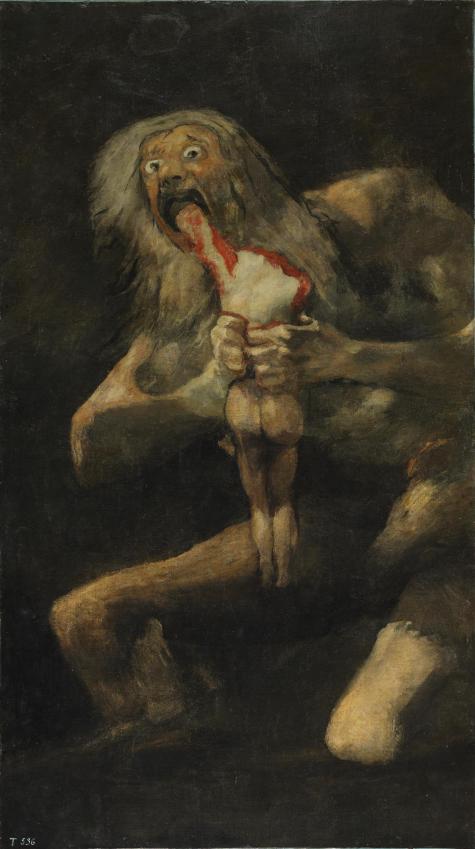
Another crucial element in relationship to Cronus/Saturn is the fact that he devoured his children, the future Olympian gods! He was afraid of being dethroned by them, based on a prophecy revealed to him. Eating them seemed like a good solution to avoid this outcome! Francisco Goya’s famous painting Saturn Devouring His Son (1819-1823) communicates the primal horror one feels when confronted with such an act. From a symbolic point of view, this can be read as a representation of the ravages of time, devouring all things, of the past consuming the future.
Is it possible that this was a clue about the identity of Laura’s killer, that other child devourer BOB/Leland? If so, the answer to the mystery of Laura Palmer’s death appeared early on in the series during the first dream sequence when Dale’s astral body visited the Red Room (and was given the name of the murderer, which he forgot soon afterward).
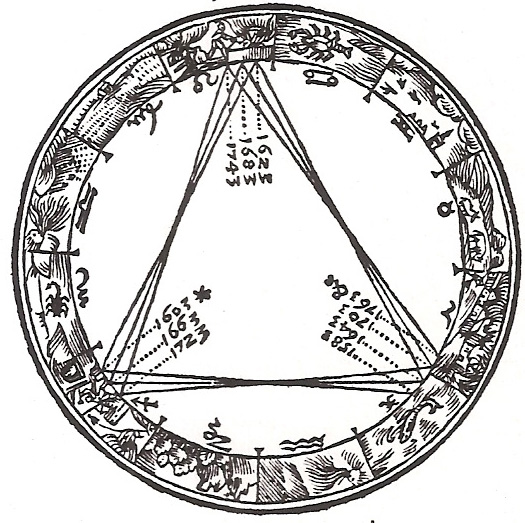
Since Saturn in particular, and planets in general, play such an important role in Twin Peaks, let us have a closer look at this question starting with the Great Conjunction ofJupiter and Saturn (an apparent meeting or passing of two or more celestial bodies) that opens the doors to the Lodges (every 18-20 years). The following drawing, from Keppler’s book De Stella Nova (1606), describes a series of Great Conjunctions and the pattern they draw in the Zodiac (the part of the sky in which the sun travels during its ecliptic journey, through the 12 classical constellations of western astronomy).
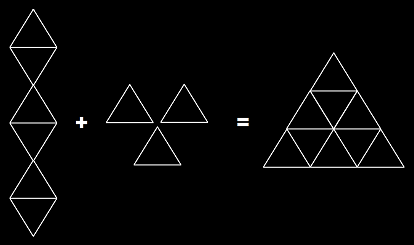
The triangle that results is explained as follows on Wikipedia: “As successive great conjunction occur nearly 120° apart, their appearances form a triangular pattern. In a series every fourth conjunction returns after some 60 years in the vicinity of the first. These returns are observed to be shifted by some 7-8°, so no more than four of them occur in the same zodiacal sign. To each sign astrologers have ascribed one from the series of four elements and thus four triplicities or ‘trigons’ are formed.” Needless to say that the image of the triangle has now become a recurring feature of Twin Peaks, and even more so since Mark Frost’s The Secret History of Twin Peaks has been published.
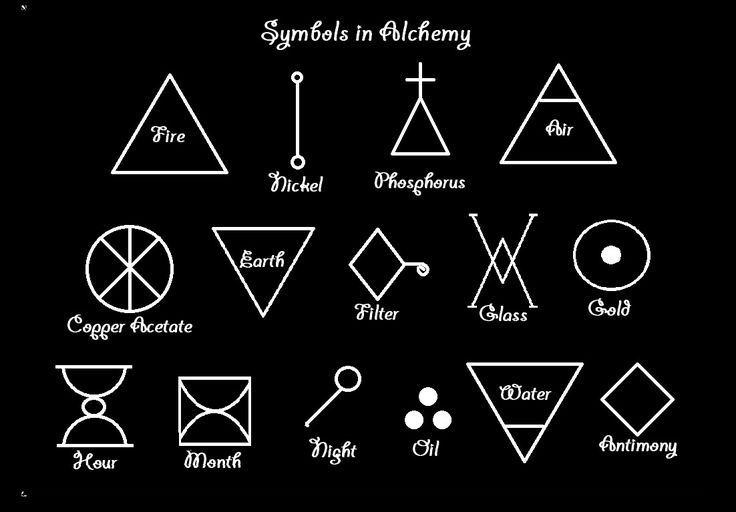
This in turn should be associated with the following image – the four elements mentioned above (and already discussed in a former blog post in relationship to the opening credits of the series), so important to astrologers and occultists, are represented in alchemy as triangles (and alchemy definitely plays a central role in Frost’s new book):
Remember also that the first name of Frost’s Archivist, Major Garland Briggs, means: “‘triangle land’ from Old English gara and land. The surname originally belonged to a person who owned a triangle-shaped piece of land”.
All of this to say that one should not underestimate the (supposed) importance of the planets over the lives of the inhabitants of Twin Peaks. It is made very clear in the show, repeatedly, that the macrocosm influences the microcosm and that what happens “down here” on Earth resonates with what happens “out there”. It seems to make sense to spend a little time studying the possible astrological implications of this fact (regardless of whether one believes in astrology, purely for the purposes of studying Twin Peaks).
Returning to the subject of Saturn, an interesting book was written by Liz Greene in 1976 and is entitled Saturn, A New Look at an Old Devil. As you will soon see, some of the passages found in this book are striking when considered within the Twin Peaks universe.
The book supports the idea that “astrology” can “move from its medieval heritage of predicting events and the external circumstances of life to reveal an understanding of the inner processes of the soul” which in turn can “give one freedom and self-determination” (p.5). Saturn is usually understood as a bad and malefic planet (the greater malefic), but Greene claims that even in its case, there is room for positivity. “
Now things become very interesting: “The psychic process which Saturn symbolizes seems to have something to do with the realization of this inner experience of psychic completeness within the individual. Saturn is connected to the educational value of pain (…) he is the Dweller on the Threshold, the keeper of the keys to the gate, and that is through him alone that we may achieve eventual freedom through self-understanding” (p.10-11).
“In many ways the ancient art of alchemy was dedicated to this end; for the base material of alchemy, in which lay the possibility of gold, was called Saturn, and this base material, as well as having a concrete existence, was also considered to be the alchemist himself” (p.14). When Dale and Laura sit on the armchair next to the Saturn lamp, they are visually associated with the planet and it is implied that they are the base material mentioned above and that their future will greatly depend on how much integration of their personalities they are going to achieve through this painful education. “His pain is, finally and ultimately, part of the growth and evolution of a larger life of which he is part” (p.17). “It is the free will of the individual, contingent upon the degree of his self-knowledge, that decides whether Saturn will be lead or gold or any of the intermediate states” (p.19).
It appears that Laura made it to gold while Dale failed somewhere along the way.
Digging a little deeper: Since we are talking about astrology, why not take a look at the birth dates of Laura and Dale? Laura was born on July 22, 1971 and Dale on April 19, 1954. This means that Laura’s sign is Cancer (born on the last day of the sign) and Dale’s is Aries (also born on the last day of the sign). Cancer is a water sign (hmmm, Laura and water) and Aries is a fire sign (hmmm, Dale and fire). Interestingly, Teresa Banks was also a Cancer and therefore also related to water…
What does the book mentioned above have to say about the presence of Saturn for the water sign of Cancer (Laura)?
“The fourth house, corresponding to Cancer and the Moon, is the domain of childhood, origin, family, and the roots. (…) The fourth house is generally considered to be the indicator of the father and his relationship with the individual. (…) There is also often resentment toward men in general as the father is the first man or symbol of masculinity encountered by the child” (p. 19-21)
These lines could have been written to depict Laura’s relationship with her father and with men in general. The way it describes her situation is uncanny. The conclusion of the section reads: someone “with Saturn placed here who has taken the time to descend into his own emotional depths, as do the heroes of mythology into the underworld, will display that rare integration and serenity which comes from a balancing of the masculine and the feminine sides of the nature“. This is pretty much the story of Fire Walk With Me and Laura’s path summarized in only a few words.
What then of Dale Cooper? What does the presence of Saturn in his fire sign Aries mean about his personality and aims?
“Fire signs tend to possess an innate consciousness of their individuality (…) We may see the expression of this fiery self in a more personal and human way through the urge to explore and conquer as it is displayed by Aries (…) All the world is to the fiery trigon indeed a stage to be explored, acted upon, understood, and loved, and, when necessary, destroyed so that new forms may be built. (…) Saturn in the fiery signs or houses tends to suggest a barrier between the conscious personality and the intuitive perception of the self as it ordinarily is experienced by fire. This often precipitates a loss of the sense of one’s innate purpose and significance in the broader context of life” (p.71-72).
Dale definitely exhibits this urge to explore and make sense of the world, but his passage through the Lodges also brings to light the barrier that exists within himself, between his conscious personality and intuitive perception of the self. He experiences “this struggle between the desire to challenge and experience life to the fullest and the fear of being hurt, dominated, and crushed by the forces of a hostile environment” (p.78).
But there is hope: “Saturn in Aries or in the first house tends first to emphasise the fear of powerlessness because it suggests a clinging to the more superficial features of the personality and a consequent loss of contact with the richer inner person. Eventually this fear can prod the individual into a deeper exploration of what he considers to be his identity. Saturn in the house of the identity is closely connected with this search which can help to yield greater knowledge, greater integration, and the greater and more productive use of the will” (p.79). Is this what is going to happen to Dale Cooper in the third season of the series? Will he overcome his fear in order to explore his identity deeper and integrate the two sides of his personality?
The answer to that question might come in just a few more weeks…
It will probably take several posts to fully understand the scope of the links established in Mark Frost’s new book (The Secret History of Twin Peaks) to various elements that can be grouped under the general notion of “Hollow Earth Theories”. Of course, there were already hints of this in the original Twin Peaks series and film – the Owl Cave, for instance. But it has recently taken on a new “dimension” through new details provided by Frost.
The idea that Twin Peaks is a privileged and auspicious spot from which to access other dimensions (whether physical or spiritual) has always been present. After all, the series was originally slated to be called “Northwest Passage”. Perhaps that would have revealed too much right away.
Although it is principally the forest that is designated as the source of all the evil surrounding the town of Twin Peaks, reminiscent of fairy-tales, underground realms are also present and are currently expanding their importance. There were already references to Greek mythology in the original series, such as the association between Laura Palmer and vegetation goddess Persephone, abducted by Hades to his underworld realm. However, The Secret History of Twin Peaks takes these links to the underworld to a new level entirely by referencing Hollow Earth theories.
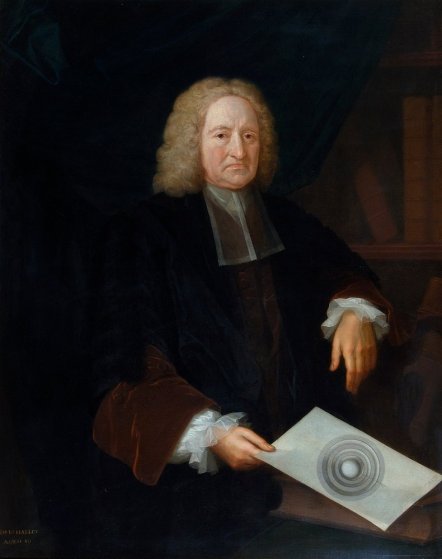
The idea that the earth has a hollow interior which might be inhabited was first proposed by Sir Edmond Halley in 1691. This idea has known several waves of success since then, among various utopian novelists and religious zealots.
Edmond Halley with a drawing of Earth’s interior spheres
The links woven by Frost to the mythology of the Hollow Earth function in a syncretic manner. They take elements from a variety of sources – from classical mythology to contemporary conspiracy theories – to create a network of associations that keep the mystery wide open. There are references to Lemuria and Richard Sharpe Shaver novels, with their Ancient Aliens connecting what’s above (UFOs) and what’s below (underground realms); links to Agartha and Tibetan underworlds; connections to Hinduism too, especially with the notion of Patala (in Twin Peaks: Fire Walk With Me); as well as many other links to Hollow Earth literature, from Edgar Allan Poe to Jules Verne, from Alice in Wonderland to Under Pike’s Peaks, from Etidorhpa to the books written by Rampa.
Beyond this, it is also important to understand the Hollow Earth symbolically from a psychoanalytical point of view. “Be a Columbus to whole new continents and worlds within you, opening new channels, not of trade, but of thought” (Henry David Thoreau, Walden). This idea that one needs to dive within in order to access unexplored realms is deeply ingrained in Twin Peaks, right from the moment Dale Cooper appeared onscreen, with his premonitions and Red Room dreams.
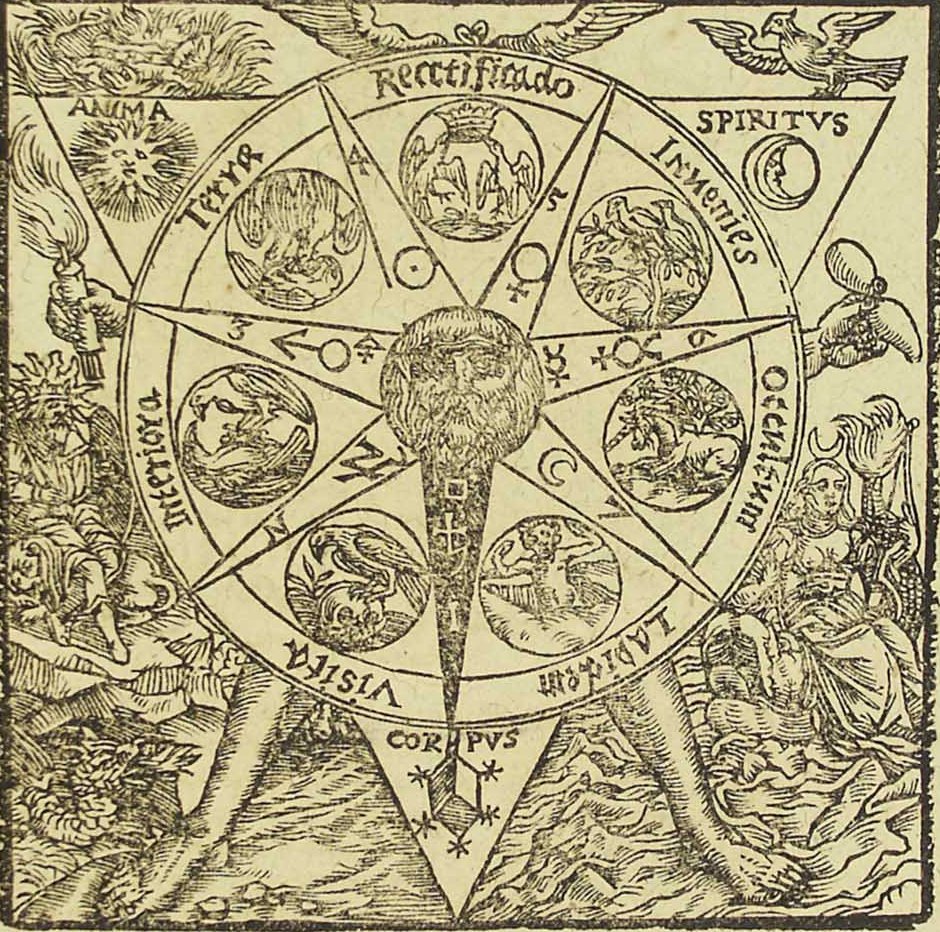
As always with Mark Frost, the Freemasons are not far, and neither is their link to alchemy. Here is their motto: “V.I.T.R.I.O.L. = Visita Interiora Terrae. Rectificando Invenies Occultum Lapidem”, which can be translated as “Visit the interior of the earth and rectifying (i.e. purifying) you will find the hidden/secret stone”. The Earth must be understood both as a physical realm and as a psychological one. Contrary to Mulder’s motto in the X-Files, we could say: “The Truth is in here”. More than astronauts, it does seem that Frost and Lynch might really be psychonauts and that the final frontier, according to them, lies within, not without.
V.I.T.R.I.O.L. – Alchemical diagram from Daniel Stolz von Stolzenberg, Theatrum Chymicum, 1614
During the next several weeks, I will explore the various elements listed above in relationship with Hollow Earth Theories, so as to see to what extent they can be connected to the mysteries of Twin Peaks.
This post is not about the (excellent) Adrian Lyne movie of the same name from 1990, but about the recurring masonic symbolism of the ladder one can find in Twin Peaks (and more precisely in The Secret History of Twin Peaks).
Beyond the reference to the Book of Genesis and its ladder from Earth to Heaven (Jacob’s Ladder), this device is to be understood as a symbol of moral and intellectual progress, a succession of steps and degrees to reach perfection (a stairway to Heaven). Climbing the ladder leads from unconsciousness to the collective unconscious, from Earth to light, from lead to gold, and from the body to Nirvana. A ladder with three rounds, as the one seen on Lewis’s apron, is usually associated with copper (or is it Cooper?) and Venus (as one can easily see in the Red Room).
In my book Twin Peaks: Unwrapping the Plastic, I argue that “Twin Peaks is fundamentally about one thing: the ‘process of individuation’ described by Carl Gustav Jung, that is to say, the integration by the various characters of the unconscious elements of their personalities in order to evolve as individuals“. The ladder is a visual materialization of the progress achieved by the characters throughout this process.
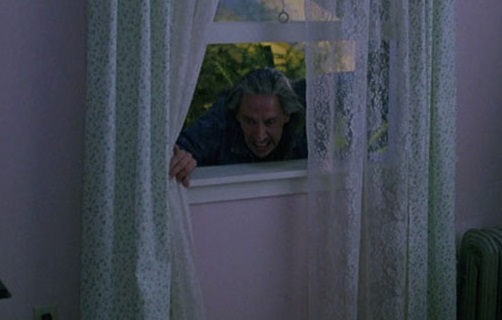
The image of the ladder already played a crucial role in Dreams That Money Can Buy (1947), a film that had an important influence on the creation of Twin Peaks. Hans Richter’s “blue man” uses the ladder to reach a window near the end of the film, while its rungs disappear one by one in front and behind him. His intrusion through the building’s window is highly reminiscent of (blue) BOB’s appearance at Laura’s bedroom window in Twin Peaks (question: why does BOB need to penetrate her bedroom via her window if he indeed possesses Leland, whose bedroom in on the same floor as Laura’s?). BOB probably uses a tree to reach that window, a good substitute for a ladder (made from the same wood, as the tree Yggrasil in Scandinavian mysteries, a cosmic tree = an axis mundi).
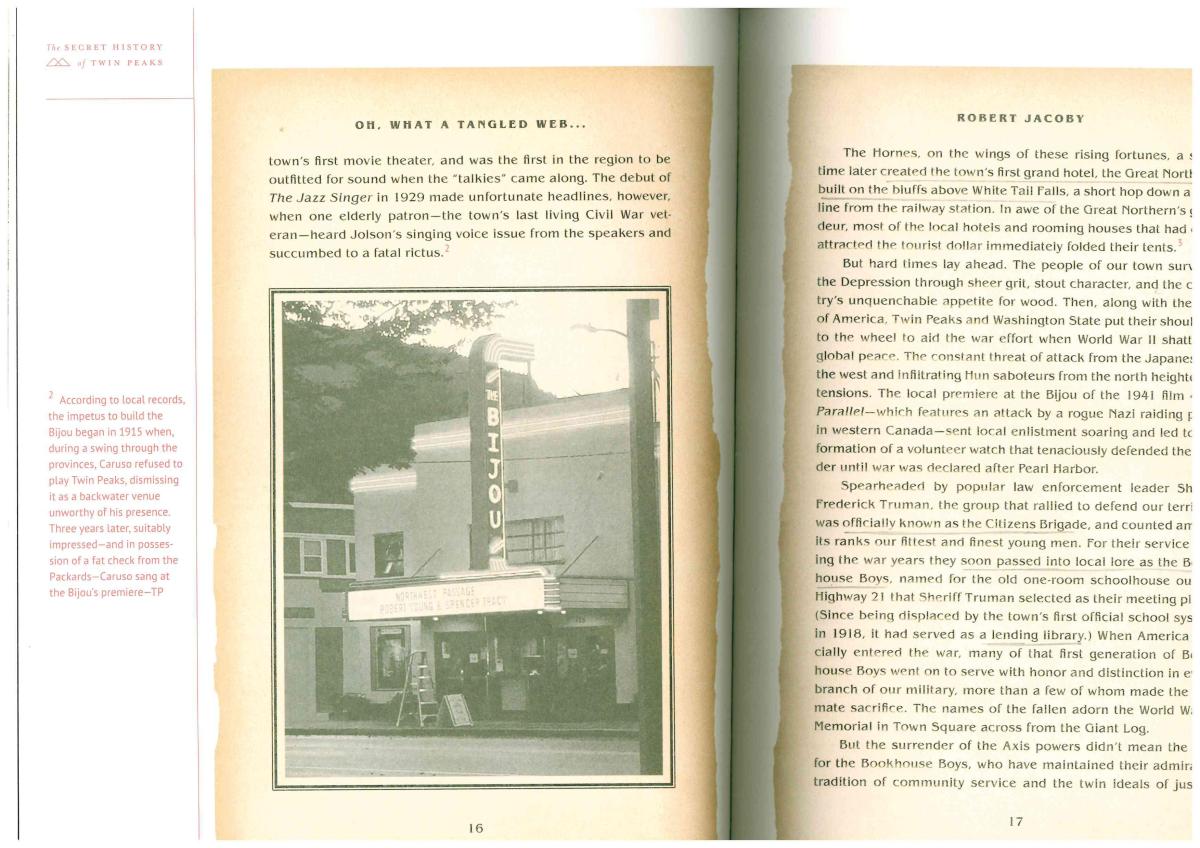
The image of the ladder also appears several times in The Secret History of Twin Peaks, a book highly influenced by Freemasonry, associated with a positive force in the history of the United-States. One can find it on Meriwether Lewis’s apron (as noted in my previous post), but also on the picture of the Bijou Opera House, under the sign announcing the screening of the 1940 Northwest Passage film with Spencer Tracy, Twin Peaks’ original title. This ladder reaches towards the passage (not to the Pacific ocean but to the ocean of consciousness?) that is implied to be in Twin Peaks. It might very well be the one in the Owl Cave and its labyrinth of volcanic tunnels leading to… the Hollow Earth? (more about that soon, in an upcoming post).
Even more interesting, one can see the first man on the Moon climbing down a ladder on the stamp found on Norma Jennings’ postcard to her mother. This ladder is inverted compared to the one found on Lewis’s apron. In this image, it literally gains back its status of “stairway to heaven”, taking us humans to our planet’s satellite – actually, two globes (one terrestrial and one celestial) are drawn on the apron, on the pillars of the Temple of Solomon, towards the top of the ladder. As a result, setting foot on the Moon is directly linked to Lewis’s colonization of the West – it is the new frontier of the American dream.
This slideshow requires JavaScript.
Last but not least, let us take a look at one of David Lynch’s paintings below. Once more, we find the connection between the ladder and the tree. Every episode of Twin Peaks starts on top of a tree, remember? (opening credits) In this painting, the blurred figures of the dancing couple become inseparable, they become “one”. It is as if this dance was supposed to continue by climbing on top of that branch thanks to the ladder, and from there, towards the Eye in the Sky…
Two figures Dance by a tree with Ladder (David Lynch)


























 TWIN PEAKS - Unwrapping the Plastic