Episode 9 takes us to the halfway point of the new Twin Peaks season, the point of perfect balance (an important concept in David Lynch’s vision of the world). We are now about to traverse the mirror into the second half of the mystery, the one which should hopefully tie some of the threads developed together. It makes sense that this is the moment, diving into the second half of the show, when we are introduced to the Zone. The privileged path to this realm is indeed through mirrors.
The Blood of a Poet (Jean Cocteau – 1932)
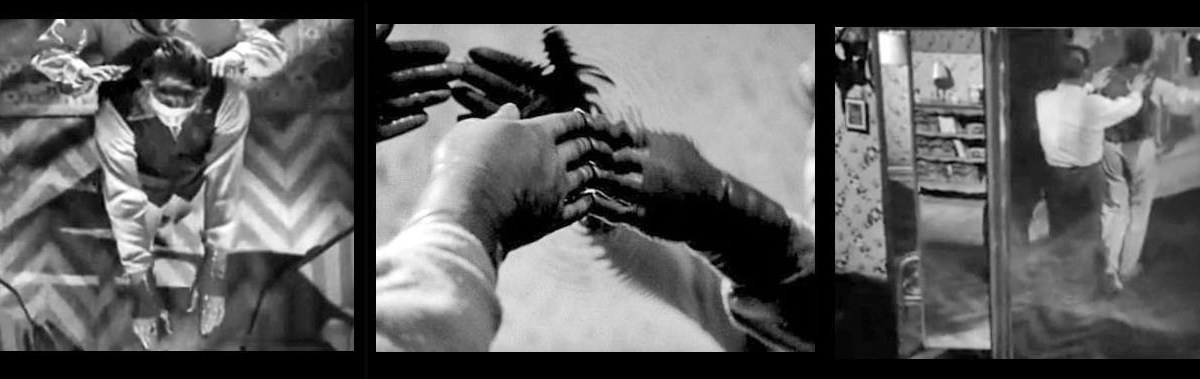
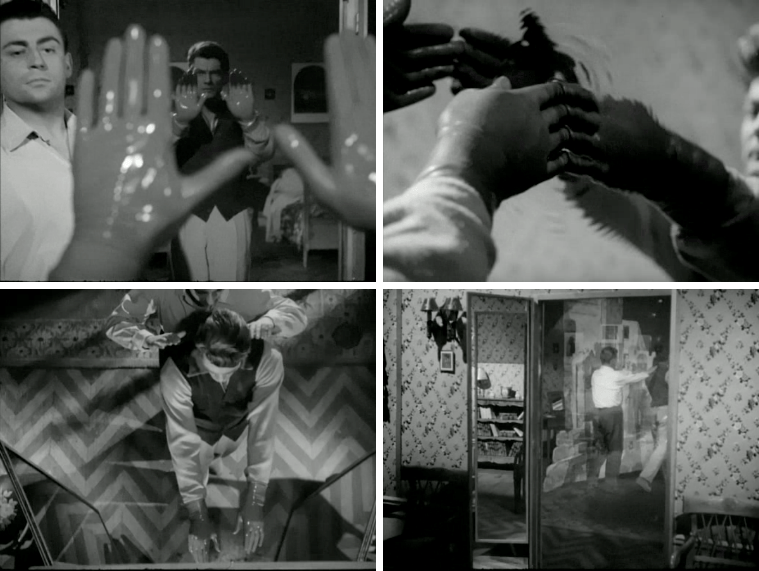
What is the Zone? I believe the answer to this question lies in the work of Jean Cocteau, the French surrealist artist who was a major influence on David Lynch. To be more precise, the concept of the Zone was developed in his film Orpheus (1950) and its mythological story that merges levels of reality, Greco-Roman divinities and passageways through mirrors. If one looks at the banner for this post and examines the scene when Orpheus (Jean Marais) crosses over to the other side of the mirror, one element should stand out to any Twin Peaks aficionado: the black and white chevron motif on his bedroom floor!
Once inside the mirror, within the Zone that is depicted as a ruined city, Orpheus travels with great difficulty because the laws of time and space are different here.
In Twin Peaks, Orpheus is of course Dale Cooper, the hero who travels to the other side of the mirror, to the realm of the dead, in order to bring back his beloved Annie.
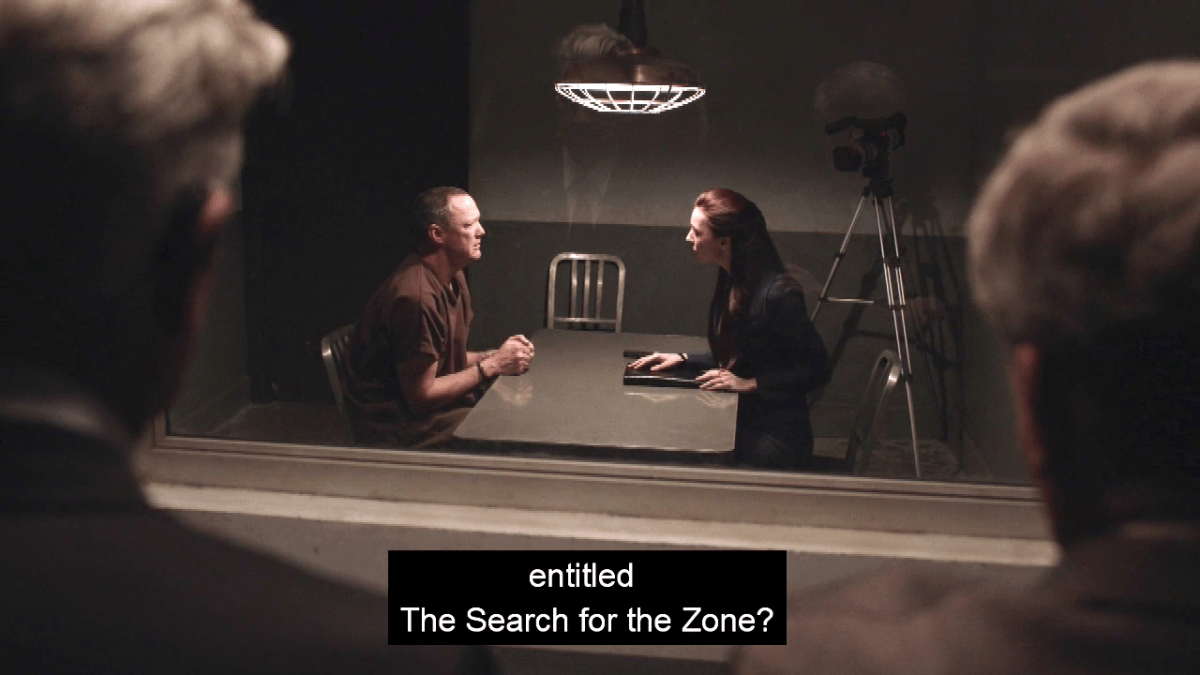
Reading the following page taken from one of the links found on The Search for the Zone blog (link) concerning the visualization of higher dimensions and the way higher dimensional beings might interact with us, is very close to what I wrote in my book Twin Peaks: Unwrapping the Plastic and on this blog.
Vibrations are the key to higher dimensions
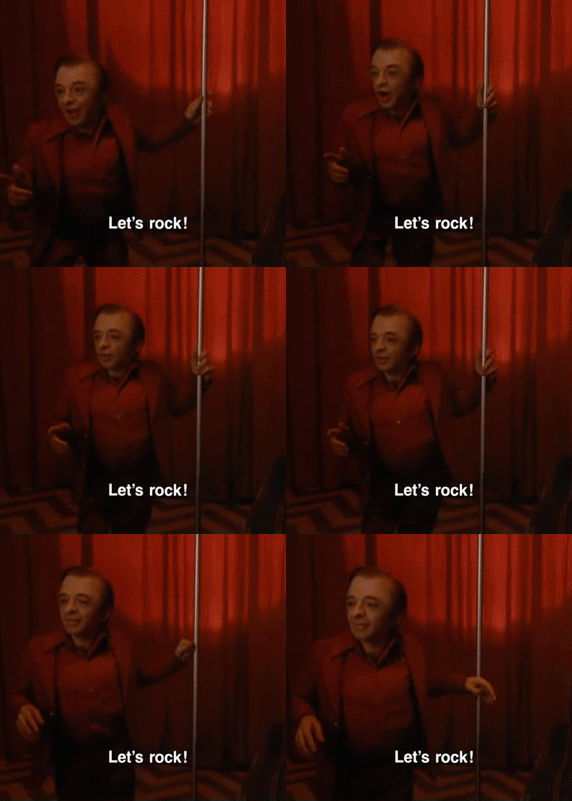
When they mention the importance of vibrations to access higher dimensions, for instance, this connects to what I wrote about vibrations as the source of movement in Twin Peaks that follow the teachings of the Maharishi Mahesh yogi of which Lynch is a devotee, echoed in the first appearance of The Man From Another Place (seen shaking from the back before he turns around and declares the now famous “Let’s rock!”, another form of (audio) vibration, mirrored in the chevron motif on the Red Room floor).
As a reminder, here’s what I wrote in my book about the Zone: “In 1950, Cocteau shot another film directly based on a Greek myth: Orpheus. In this film, spirits travel from their world to ours through an area called ‘the Zone’. As Heurtebise (François Perrier) leads Orpheus (Jean Marais) into the underworld, he tells him: ‘This is the Zone. It is made of men’s memories and the ruins of their habits’. This Zone is a sort of no-man’s-land between life and death, where time seems to flow differently than in the normal world. One cannot help but notice a certain resemblance between this Zone and the Lodges in Twin Peaks. The two concepts appear indeed very similar, especially when we learn that the way to enter the famous Zone is through mirrors.” (p.23-24).
And here’s an example of what I wrote about the Fourth Dimension and higher dimensional beings: “As discussed in the first chapter, the waterfall can be understood from the point of view of the mysterious Fourth Dimension of the esoteric tradition. The intersection of the water’s three-dimensional fall with the two-dimensional plane of the lake is meant to assist the viewer’s understanding that the three-dimensional world can also be similarly crossed by a superior reality. The two dimensionality of the plane thus becomes infused with elements leading to a higher dimension; it reflects elements from another world, just as the viewer’s first glimpses of the true reality behind the mask worn by BOB, i.e. the three-dimensional people that his four-dimensional entity possesses during the series and film, are revealed via various two-dimensional mirrors used to study their reflections“. (p. 53-54).
From Wikipedia: “New possibilities opened up by the concept of four-dimensional space (and difficulties involved in trying to visualize it) helped inspire many modern artists in the first half of the twentieth century. Early Cubists, Surrealists, Futurists, and abstract artists took ideas from higher-dimensional mathematics and used them to radically advance their work“. Marcel Duchamp, another major influence on David Lynch, was also very interested in the possibilities that higher dimensions and non-euclidean geometries offer to artists (link).
Besides the Zone, this episode features another important moment, the one when the FBI officials enter the morgue to examine the body of Garland Briggs. Actually, it’s the moment right before that is of interest, the moment when they enter “the waiting room”. Though the two room don’t appear at first to have anything in common, this earthly waiting room is indeed depicted as a double to the Red Room.
First, in both rooms one can find the chairs and sofas that are typical of such rooms, positioned at a right angle from each other. Both rooms are also rectangular and very bare. They both have geometric patterns on the floor and are connected to nature thanks to the plants and paintings in the morgue and to the curtains in the Red Room (which I link to the idea of a secret garden). Both are also antechambers to realms that take one beyond life, the Lodges and the morgue.
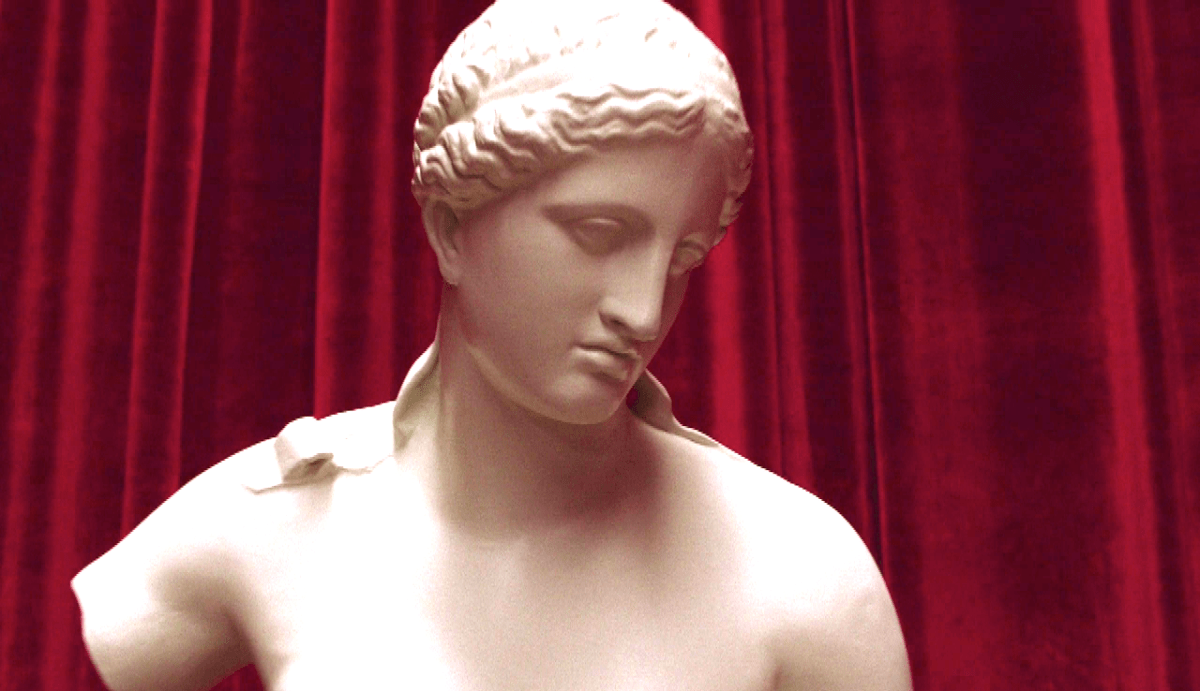
But the obvious link in my opinion is Diane. She appears in both universes, as a human being in the morgue waiting room, and as the statue of a goddess in the Red Room. The Diane impersonated by Laura Dern is a statue come to life. People used to believe that she was not alive, that she was a figment of Dale Cooper’s imagination, and there she is, walking side by side with Gordon Cole and Albert Rosenfield.
In episode 9, we learn about a mysterious transdimensional place called ‘The Zone’. Though this might have reminded some viewers of Andrei Tarkovsky‘s Stalker (1979), I believe this is likely a reference to Jean Cocteau’s Orpheus (1950). It is important to remember that David Lynch referenced Cocteau in the 1987 BBC documentary about Surrealist cinema: “In my opinion, Cocteau is the heavyweight of surrealism”.
Here’s what I wrote about Orpheus in my book Twin Peaks: Unwrapping the Plastic (published at the beginning of 2017, but written in 2015): “In 1950, Cocteau shot another film directly based on a Greek myth: Orpheus. In this film, spirits travel from their world to ours through an area called ‘the Zone’. As Heurtebise (François Perrier) leads Orpheus (Jean Marais) into the underworld, he tells him: ‘This is the Zone. It is made of men’s memories and the ruins of their habits’. This Zone is a sort of no-man’s-land between life and death, where time seems to flow differently than in the normal world. One cannot help but notice a certain resemblance between this Zone and the Lodges in Twin Peaks. The two concepts appear indeed very similar, especially when we learn that the way to enter the famous Zone is through mirrors.” (p.23-24)
Another element of Orpheus that I noted in my book is depicted below: the floor in Orpheus’ bedroom of black and white chevrons!
My book contains much more information about the links between David Lynch and Jean Cocteau, especially in relationship with his 1930 film The Blood of a Poet.
TP:FWWM establishes that the Lodge entities can travel via telephone wires as they are associated with electricity. It is also evident that the Man From Another Place’s war whoop (“I sound like this”) is connected to this mode of transportation. Beyond the reference to the Indian American whoop in Twin Peaks, this might very well be a hint regarding the telegraphic, wave-like pattern of his voice (see the Red Room floor, with its chevron motif).
There is indeed little difference between the telephone wires of today and the telegraph wires of old, which were often connected to the development of the rail road. The telegraph used to be known as the “Singing Wire”. This refers both to “singing” of wires (caused by vortex shedding), and the transmission of communication (later voice) across electric cables
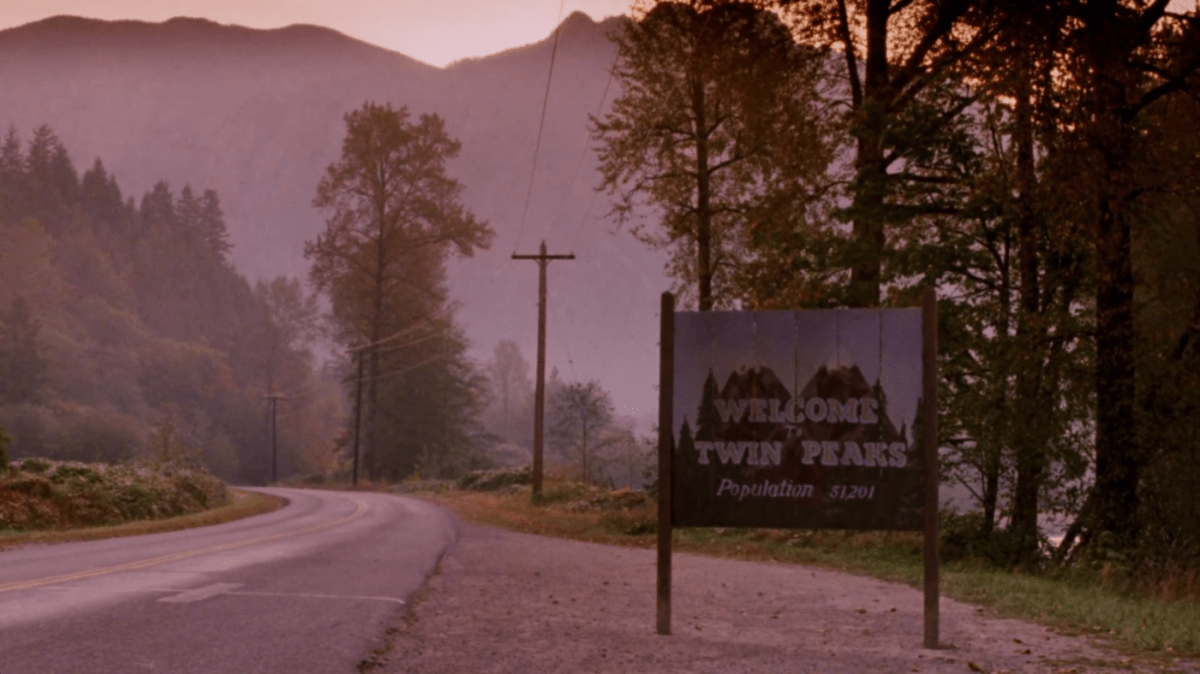
The well known image of the Twin Peaks sign, with the road on the left side, the river on the right side, the mountains in the background… and singing wires in the middle.
Here’s a very Lynchian documentary from 1951 about the arrival of electricity in rural farms, during which Bob (BOB?) and Judy (!) tell us everything about the advantages of the singing wires: Singing Wires – 1951
(The story of a 1950’s farm family whose work and play are transformed when their rural property is hooked up to the electricity grid)
Correspondences (Charles Baudelaire) Nature is a temple where living pillars
Let escape sometimes confused words;
Man traverses it through forests of symbols
That observe him with familiar glances.
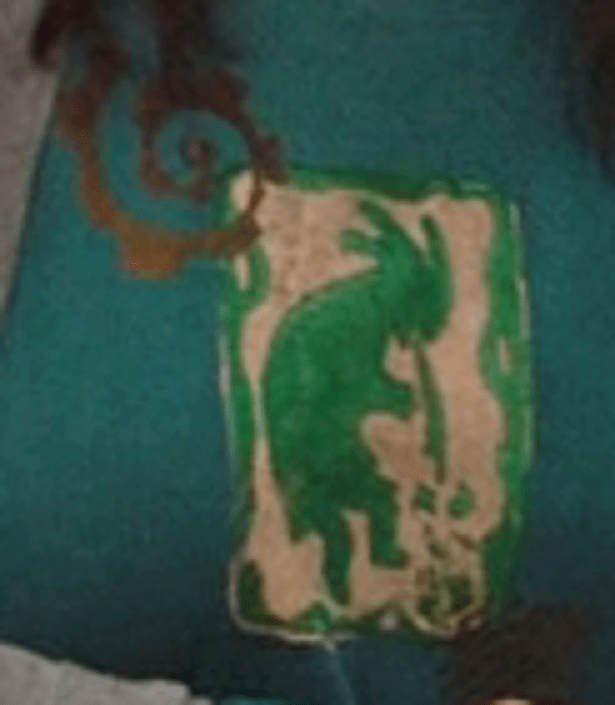
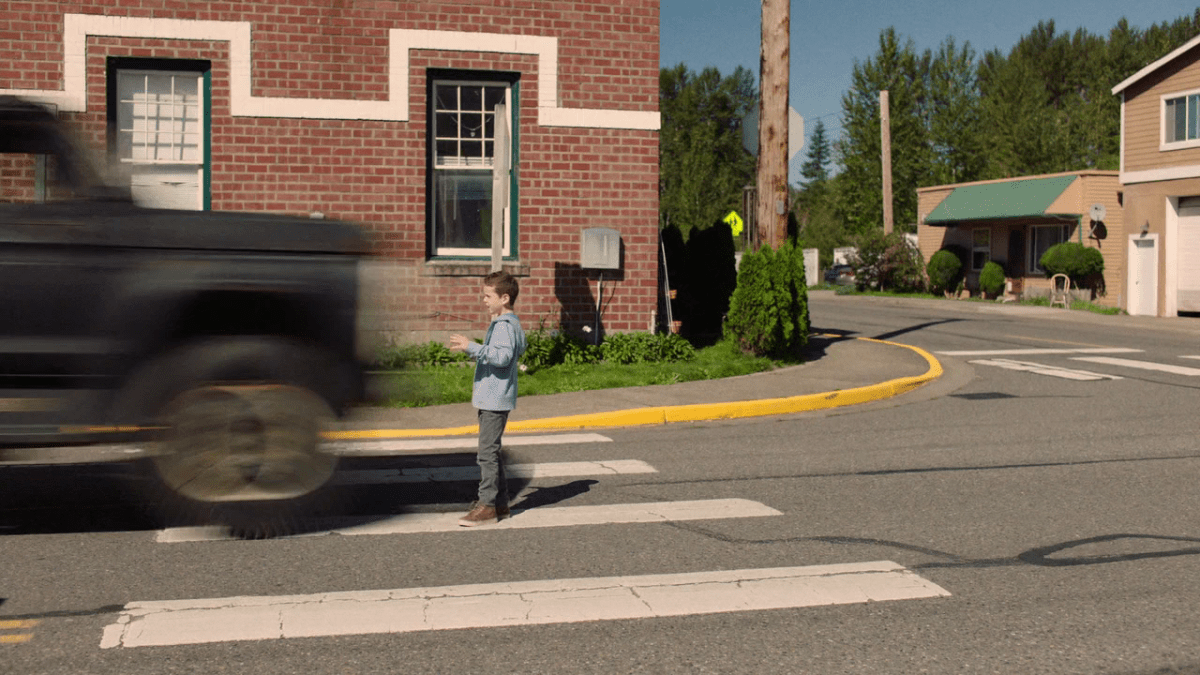
The latest episode of Twin Peaks reminded me of the moment in the sixth episode when a little boy gets hit by Richard’s pickup truck. As I have explained in a former blog post (here), I noticed a woman standing in the crowd of passers-by. She was wearing a top with a pattern of Kokopelli, the fertility god of Native American mythology, playing the flute.
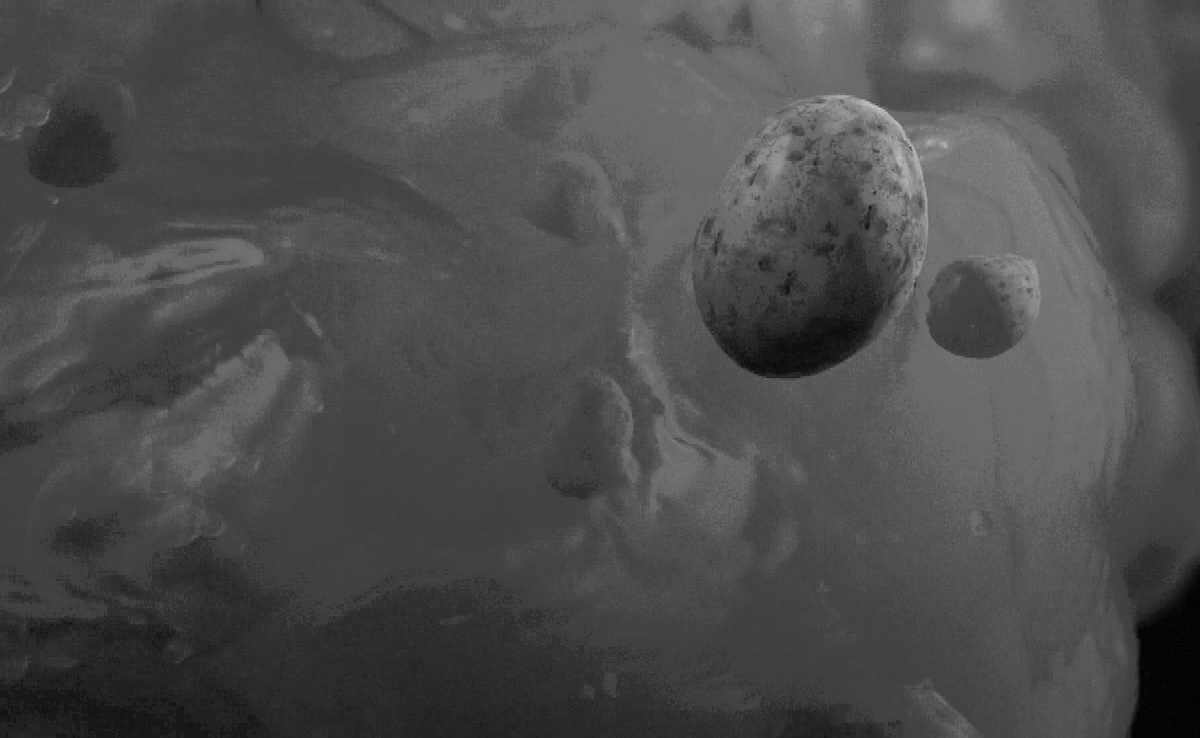
My first reaction, though, was that the character on the woman’s top was regurgitating something, as one can see a variety of shapes on the bottom right of the image. I am now wondering if this was not the case, after all, a kind of subliminal image meant to prefigure the cosmic entity whom we saw vomiting a series of eggs caught in a stream of gelatinous substance…
The eighth episode of Twin Peaks: The Return takes us closer than ever before in the series or the film to the realm of video art. There is hardly any dialogue in this episode and most of the action operates on a purely audiovisual level, underlined by a mythological/metaphysical framework that gives structure and meaning to the whole. As we will see, some of the elements I have pointed out in my previous posts (the importance of the Manhattan Project, the symbolic role of the egg, etc.) start to come together to give a cohesive vision of what to expect next in the series.
This slideshow requires JavaScript.
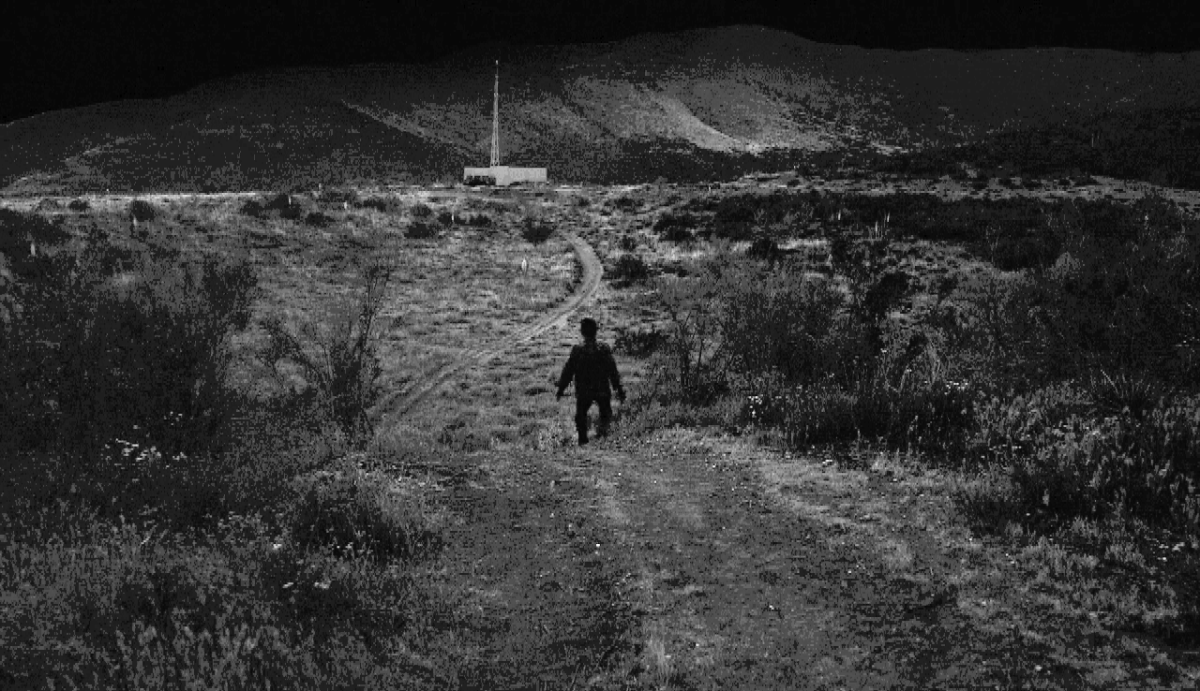
Apparently, everything starts in 1945, in New Mexico, with the explosion of a nuclear weapon in the middle of the desert. The camera flies directly towards the cloud of the atomic mushroom and gives us a look at the chain reactions happening inside, tearing apart the very structure of matter and producing explosion after explosion in what looks very much like a star cradle within a cosmic nebula.
Here is what David Lynch has to say about ‘worlds within worlds’: “What is kind of incredible is that there are, like quantum physics now says, ten dimensions of space and one dimension of time – that’s what they’ve come up with. Ten dimensions of space – what does that mean? There’s a field of relativity, it has a surface, and it has depths. There are, like they say, worlds within worlds within worlds, just unbelievable stuff going on in the field of relativity. And that’s all real interesting, but as Maharishi says, that’s only the ‘market-place’. You go through the market-place, and it’s real interesting, but there are lots and lots of chances to get waylaid and even go backwards and get lost, get in trouble. Maharishi always says, capture the fort, and then all the territories are yours – so get to the palace, get to the palace – and then you own all that you survey. ‘Get to the palace’ means transcend, get to the deepest level“. (in David Lynch: Interviews).
Quantum physics and the General Theory of Relativity are at the root of mankind’s mastery of nuclear energy. Without these developments in contemporary physics, we would never have been able to master the generating powers of the sun down here on earth – we would not have been able, like Prometheus in Greek mythology, to steal fire from the gods in order to use it for our own goals.
“Prometheus Brings Fire”, by Heinrich Friedrich Füger
In episode 6 Sonny Jim Jones was seen reading the Hardy Boys book The Secret of the Old Mill perhaps because of the role of Elekton Controls, a missile-development company in the narrative. The company is under threat from foreign powers that wish to stop United States missile development. Was this a subtle way to introduce us to the theme of nuclear weapons?
Whatever the reason, it does seem though that this “theft of fire” has had dire consequences for us: it has triggered a chain reaction of its own in the Convenience Store (the place above which the Lodge entities had their meeting in the film), with a growing agitation of a group of “woodsmen” who look like they are made of coal; it has also triggered a vomiting reaction in a cosmic deity that regurgitated a gelatinous thread of matter replete with eggs as well as a placenta-looking envelope containing the face of BOB.
This in turn triggered an alarm in a citadel (or is it the ‘palace’ mentioned by Lynch above?) that stands above an ocean (of consciousness, according to the Maharishi) in which the Giant and a lady called Dido live. The bell-looking piece of machinery from which the alarm comes is highly reminiscent of the one seen on the top of the cosmic raft on which Dale Cooper has to climb during episode 3. Dido’s name might once more be a reference to Greco-Roman mythology and to the queen of Carthago, famous for her love affair with the Trojan general Aenas (remember that Troy was the name of Laura Palmer’s horse).
This slideshow requires JavaScript.
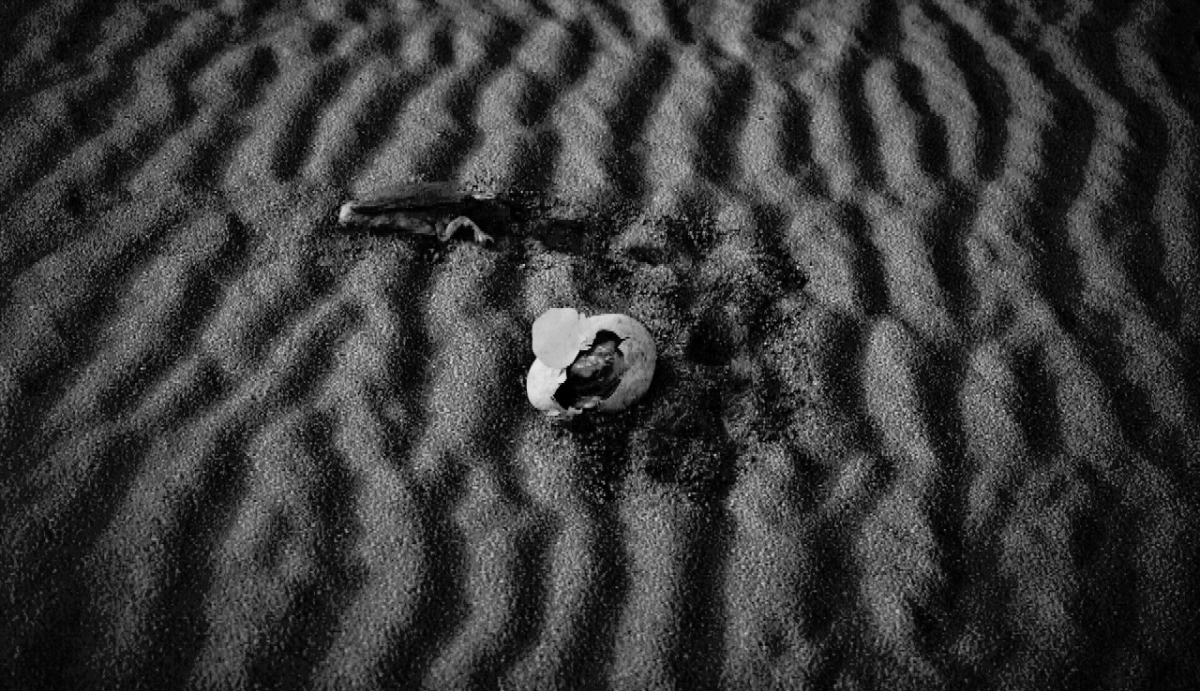
It is hard not to read the nuclear explosion as a creation myth of sorts, one that explains the interest shown by the various otherworldly entities depicted above in the affairs of our planet. The actual regurgitation by the oviparous and amphibian looking white skin entity of something akin to “frogspawn” (a gelatinous mass of frogs’ eggs) is reminiscent of a birth sequence. This progeny appears to be sent into space (inner or outer) at random, in the hope that one at least of the many eggs will survive the trip. This is indeed what happens a few years later when one of the eggs finally hatches in the desert and gives birth to a hybrid creature mixing amphibian and insectoid elements.
A few weeks ago, I dedicated a post to the question of eggs in Twin Peaks (here). I also wrote an article about the Manhattan Project (here). It is interesting to see the two notions brought together with this episode, the laying of the eggs resulting directly from the detonation of an atomic bomb – this bringing together of creation and destruction is reminiscent of the role of Shiva, the “destroyer and transformer” within the Trimurti, the Hindu trinity that includes Brahma and Vishnu. It seems to me that this all relates to the notion in Vedic philosophy of Hiraṇyagarbha, the ‘golden womb’ or ‘golden egg’. This egg is supposed to be the source of the creation of the universe: “After Mahāprālaya, the great dissolution of the Universe, there was darkness everywhere. Everything was in a state of sleep. There was nothing, either moving or static. Then Svayambhu, self-manifested Being arose, which is a form beyond senses. It created the primordial waters first and established the seed of creation into it. The seed turned into a golden womb, Hiraṇyagarbha“. (Wikipedia)
The idea of the golden egg is also related to alchemy, of course, and its quest for the transmutation of base metals into gold as well as the Philosopher’s Stone and the Elixir of Life. The ‘world within a world’ that contains the transcendental ocean of consciousness and the Giant in his palace appears to exist inside a golden egg/pearl connected to the many fires resulting from the nuclear blast.
The Giant and Dido seem to be monitoring the situation of the universe from their “palace”, while listening to slow atmospheric music from the same gramophone seen at the beginning of the first episode (the one with the sounds that Dale Cooper heard, which I argued could be the quacking of a duck – the laying of a new cosmic egg, giving birth to a new universe, seems to support my theory about the provenance of the sounds). The electromagnetic detector bell resonates when it senses the nuclear blast on planet earth and the Giant immediately examines the situation on a cinema screen, watching a film (‘a film within a film’) that depicts the very same images we have just seen during the episode.
This somehow connects us once again to the theme of surveillance that is so prevalent in this new season of Twin Peaks and to the thinning of the various membranes between levels of reality. I recently pointed out the reflection of a video camera from David Lynch’s team in a mirror, in a scene when Sarah Palmer is seen watching television at her place (here). This situation brought elements from our world into the fictional realm. Here, in this episode, one could argue that it’s the other way around: the Giant actually breaks the fourth wall, the performance convention in which an invisible, imagined wall separates actors from the audience. He stares in the direction of the camera for an extended amount of time, behaving as if he can see us viewers in front of our TV screens, examining us one by one. It’s difficult to know where fiction ends and where reality begins in this universe.
After having watched the “newsreel” on the cinema screen, the Giant rises up in the air, defying gravity, and opens up a golden orifice with his mind (reminiscent of a seashell or a vulva) from which exits a golden/amber globe with the image of Laura Palmer inside. If the seashell connection is correct, this could be a reference to the famous painting The Birth of Venus by Sandro Botticelli (in this painting, Venus is depicted as the pearl of a giant seashell) – in my book Twin Peaks: Unwrapping the Plastic and on this blog, I have repeatedly underlined the links between Laura and Venus in the Red Room.
Dido sends this globe to our planet via a golden device attached to the ceiling of the theater room in which the action takes place. This process is reminiscent of an insemination of sorts, our planet resembling a giant egg on the screen, fertilized by the globe sent from the golden device.
This slideshow requires JavaScript.
This globe should be considered in the context of various crystal balls seen in The Wizard of Oz. Lynch’s appreciation for this film is well established and is regularly referenced in his own work.
It seems that the process of sending the Laura Palmer globe to our planet was something of a counter measure, a response to the nuclear detonation in New Mexico that liberated the various woodsmen/coal miners from the Convenience Store as well as the eggs & BOB from the cosmic entity. The Giant and Dido appear as positive forces trying to right the wrong with this action, to somehow “own” again all what they survey from the palace, to use Lynch’s image featured above.
Could these eggs be linked to what Mr C wants so badly? Is it possible that they are indeed connected to the Egyptian idea of a winged egg named Kneph, as I argued in my post about ducks? What is certain for the time being is the fact that the egg that hatched in New Mexico contained a winged creature, one that parasited/fertilized a young woman fallen in a deep artificial sleep.
In passing, I cannot help noticing a certain similarity between the back paw of the creature and the tiny hand used by Dr. Amp/Jacoby during his podcast…
As far as the woodsmen/coal miners are concerned, the episode seems to connect them to the Convenience Store, around which they gravitate as electrons in fury. If this store is our world, where they feed and get their energy from, the fire within resulting from the nuclear explosion (see the smoke coming out of the store) might be understood as a light attracting such parasites.
Their look, that gives the feeling that they are made of coal or of dust, connects them both to the inside of the planet (and possibly to the various hollow earth theories I have listed previously) and to the nuclear fallout from the explosion, to the dust produced by such blasts.
As a consequence, they might very well be radio/active (as Dr. Amp/Jacoby?) and this might be why they seem to parasite both consciousness and sound when they appear. This might also be why the coal miner fallen from the sky (a fallen angel of sorts, connected to the moment when Gordon Cole whistles Rammstein in front of a nuclear mushroom in his office?) goes straight to a radio station to broadcast his mind altering lullaby.
It is important to notice that this sequence is yet another cryptic reference to alchemy. The four elements are indeed clearly present at this moment in order to create the hypnotic influence from the (literally) radioactive coal miner: air (“on air”), fire (“got a light?”), earth (the coal miner himself) and water (airwaves).
In 1992, Mark Frost and David Lynch created On the Air, a short lived TV series that also had to do with electromagnetic waves, those of television.
The cyclical and hypnotic radioactive poem recited by the coal miner is likely connected to the “ocean” of the collective unconscious (akin to the “oceanic feeling” described by Romain Rolland in 1927) in which he drowns his listeners, electromagnetic wave after electromagnetic wave, untill they fall asleep. He speaks to their unconscious because he himself appears to be coming from this part of our psyche, the one we normally repress when we are awake. The role of the white horse in this context is related to the fact that the animal is regularly attached to the role of a psychopomp, a guide for souls from our reality to other worlds (generally the afterlife). It seems that in Greek mythology, it has a close link with water, understood as the border between the world of the living and the great beyond.
This slideshow requires JavaScript.
Many more things could be said about this fascinating episode, notably about Mr C and what happens to him at the hands of Ray, but I have to close this post for now. Let’s hope that the rest of Twin Peaks: The Return proves to be as challenging as what we have just experienced.
Episode 7 gives Gordon Cole the opportunity to explain the reversed use by Mr C of the word “VERY” to his team (which becomes “YREV” ) and to link this to his disturbing set of fingerprints, which should probably be linked to those of Douglas Milford in Mark Frost’s The Secret History of Twin Peaks, with lines in the shape of a spiral.
The book describes a subterranean trip (both physical and mental) of a man who has been abducted to a cave in Kentucky, where he discovers a vast underground realm below the surface of the planet. With elements connected to Freemasonry, Etidorhpa is a book whose title when read backwards results in “Aphrodite”, the Greek name of the goddess “Venus” (of Red Room fame).
Etidorhpa / Aphrodite
During his underground journey, the main protagonist of the story comes into contact with creatures from the hollow earth. A look at some of the illustrations below should convince anyone of the similarity between these “monsters” and the evil creature that briefly becomes trapped in the New York glass cube at the beginning of this new season of Twin Peaks.
Since Mark Frost regularly references ideas connected to the hollow earth in his latest book – from Lemuria to Richard Sharpe Shaver – it does not seem far-fetched to consider that Etidorhpa may have been a source of inspiration for the author and Lynch. Additionally, the idea of a “trip” linked to the process of individuation and to Freemasonry is also clearly ingrained in Twin Peaks, just as it was in this early science-fiction novel, reminiscent, among others, of Jules Verne’s Journey to the Center of the Earth (1864).
Another interesting moment in episode 7 is linked to the picture of Dale’s doppelgänger in front of his Brazilian home, shown to Tamara Preston.
First, notice the obvious presence of palm trees behind him. As explained in my book Twin Peaks: Unwrapping the Plastic, Laura Palmer’s family name is directly connected to palm trees and their symbolism of eternal life. Interestingly enough, Tamara is a given name most commonly derived from the Biblical name “Tamar”, meaning date palm tree.
It’s clear that the picture also underlines the importance of reflection as linked to water (the house reflected in the pool). The house is located outside of Rio, “river” in Spanish and Portuguese. The person who takes over the house as soon as the FBI shows an interest in Dale’s ownership hails from Ipanema, a place name that means “stinky lake” (in the Tupi language). No surprises there, since the house belonged to Mr C.
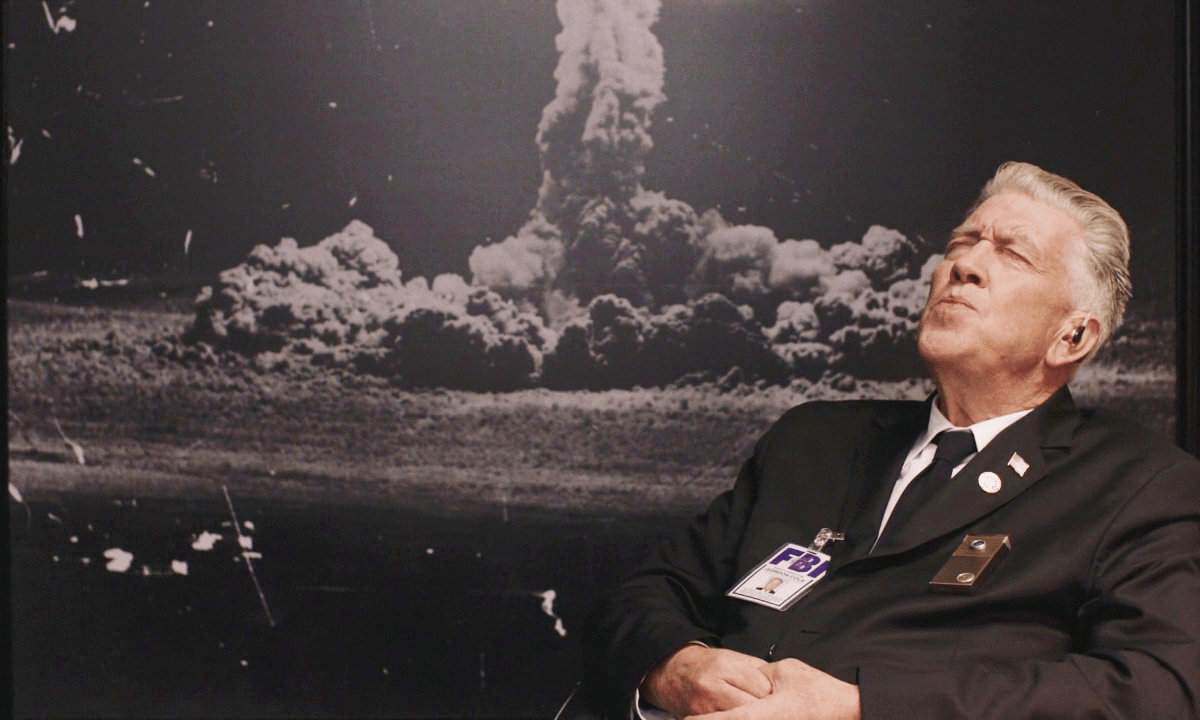
One may wonder why we regularly see Gordon Cole in his office seated in front of a mushroom cloud poster of an atomic explosion? In episode 7, after revealing a corn cob painting on one of his office walls, the camera pans to frame Gordon whistling bird calls from the beginning of Rammstein’s song Engel (German for Angel– not all the angels have disappeared from Twin Peaks, after all) eyes closed, seated below that very poster of total annihilation.
What could be the meaning of this? Why choose such a background image?
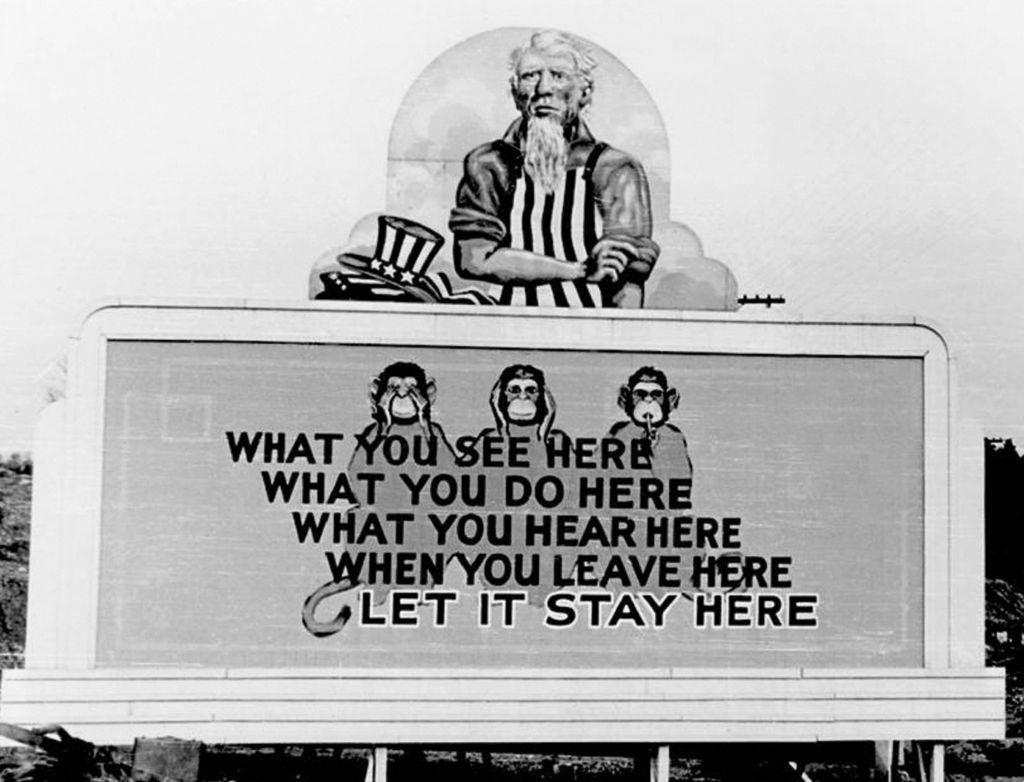
I believe this scene should be linked to Dale Cooper’s transdimensional fall to the electromagnetic tower beacon above the ocean of consciousness, where he meets the mysterious woman with her eyes sewn shut, as well as to Mark Frost’s The Secret History of Twin Peaks. All of this should in turn be connected to the following picture from the Manhattan Project’s propaganda billboard depicting the Three Wise Monkeys
The research and development realized under the name “Manhattan Project” is what led to the conception of the first nuclear weapon in the United-State during World War II. Mark Frost makes it clear in his book that Douglas Milford, Twin Peaks’ town mayor’s brother, was “assigned to various hazardous duties around the Manhattan Project, bearing the risk of possible radiation exposure”.
Is this the reason why his right thumb print shows an atypical finger print with lines in the shape of a spiral? (I’ve regularly discussed the importance of the spiral motif in David Lynch’s work and in Twin Peaks – see my book Twin Peaks: Unwrapping the Plastic for more details).
Douglas became one of the notorious “men in black” whose role it was to make sure that nothing related to this project and what followed – including Roswell and technology transfer from “aliens” to the American government (these aliens being either Nordic, grays, Lemurians from the Hollow Earth, or transdimensional beings) – leaked to the general public. Here is what Douglas wrote in his journal in 1958: “One source says Ike rejected ‘offer’ – these ‘Nordic types’ apparently made their offer contingent on U.S. giving up nukes. Second meeting – time and location unspecified – followed with ‘grays’, who made no such demands and offered their tech in exchange for access to ‘genetic material’. That source says second offer accepted“.
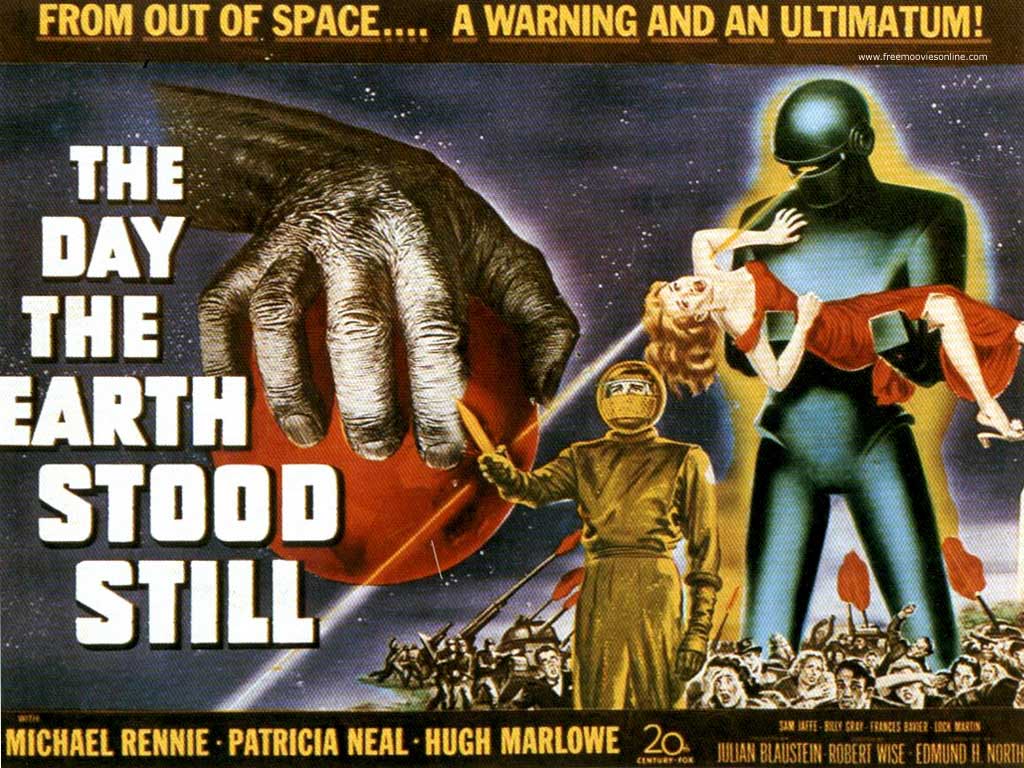
All of this is of course highly reminiscent of both the X-Files and The Day the Earth Stood Still (Robert Wise, 1951). In the latter, an alien comes to Earth because of the invention of rockets and atomic power, to warn us that the planet will be destroyed if we do not give up our drive to wage war. (in the film, a famous command to stop Gort, the robot accompanying the alien is “Klaatu barada nikto”; no such thing in Twin Peaks, though, but there’s “Garmonbozia…”). Interestingly, besides the Mahnattan project and the development of the atom bomb, Frost’s book also focuses for a while on Marvel John Whiteside Parsons, the co-founder of Jet Propulsion Laboratory, creator of “alchemic elixirs” (fuels) for rockets. Parsons declares at one point: “you can create an elixir that will call forth… call them what you will… messengers of the gods…”. Since angels are supposed to be the messengers of the gods, this can be connected to Cole’s whistling in his office.
The three monkeys billboard embodies the need for secrecy surrounding the Manhattan project with the proverbial “see no evil, hear no evil, speak no evil”. This idea of turning a blind eye resonates strongly with the ongoing theme of surveillance in the new season of Twin Peaks. It is also a direct visual connection to at least two moments in the series: Gordon Cole’s whistling session mentioned above (eyes closes, deaf as a post, whistling instead of talking) but also the mysterious woman in the purple tower (eyelids sewn shut, asking for silence because of her “mother”, her mumbled speech reminiscent of the sounds made by the deaf).
Is it possible that the many alchemical references spread throughout the series are there to remind viewers of what was at stake in Los Alamos, i.e. the creation of the first atom bomb? Is this the sort of “metamorphosis” hinted at by the presence of Franz Kafka’s portrait in Gordon Cole’s office, facing a nuclear mushroom behind his desk? The ability that humans have developed through science to “transmute” metals into energy might account for a growing alien interest in humans (coming from the Lodges or elsewhere) in our collective destiny.
Behind Dale Cooper’s personal quest then, it might very well be our future as a species that’s at stake here (though Garland Briggs explains that “our limited, linear sense of time means nothing to them”).
In its first six episodes, the new season of Twin Peaks lays a strong emphasis on watching, video and surveillance. Screens are everywhere, people keep each other constantly in sight and electronic images seem omnipresent.
This slideshow requires JavaScript.
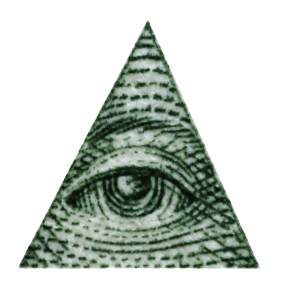
This constant “game” of preying on other people’s intimacy is of course highly reminiscent of BOB’s attitude towards Laura and her secret diary, raped of its inviolability by this otherworldly parasite. It is also possible that this has something to do with the Illuminati, which Mark Frost discusses in his book The Secret History of Twin Peaks. The secret society uses the Eye of Providence as one of its main symbols, as do the Freemasons. But since Frost clearly associates the former with the idea of evil and describes the latter as a force for good, it makes sense to link all the surveillance in Twin Peaks to the Illuminati.
It is a well known fact that Frank Silva was chosen by David Lynch to play the role of BOB in the original series due to his accidental appearance in a mirror, at the end of the pilot, after Sarah Palmer’s “vision” .
So far, we have only seen Laura’s mother once in the new season, for several minutes. She is pictured seated on her sofa at home, chain smoking as always, while watching a nature program on television about… animals preying on each other. Behind her, as in the original Twin Peaks, one sees mirrors that reflect the images from the television screen. As the camera reveals her intense viewing of the violent program, briefly, on the top of the left mirror, an image similar to BOB’s apparition appears: the sight of the camera operator’s hand and his camera.
This slideshow requires JavaScript.
Was this the result of a mistake on the part of David Lynch’s team? A mistake highly reminiscent of BOB’s first appearance on our screens? An appearance that took place above the very same character? One can doubt the accidental nature of this moment and possibly read it as an artist’s statement. Of course, it’s impossible to say if that’s indeed the case. But since surveillance plays such a central role in the new Twin Peaks, let’s bet that this might prove a worthwhile path for further reflection concerning the series.
Episode 6 moves the story forward without bringing any shattering developements to the narrative, aside from a few clues (such as the papers found by Hawk), which will likely prove important in the coming weeks. The good Dale (as Dougie) continues his slow quest to find out who he truly is/was, while we learn more about some of the new characters in Twin Peaks – especially about the lone wolf Richard Horne and his shady connections. Although Richard etymologically means “brave, hardy”, his flight after the hit and run with the little boy was anything but that.
Nevertheless, in spite of its slow nature, this episode brings forward several visual clues that should prove helpful for further understanding of the show’s symbolic aspects. Here are the main visual motifs analyzed below.
During the accident scene mentioned above, when the little boy gets run over by Richard’s pickup truck, a crowd gathers around the victim, sharing the pain (and sorrow) felt by the mother. At that moment, it appears worthwhile to note a piece of clothing worn by one of the women standing at the crossroads. Lost in the crowd, she might pass unnoticed, but I think that her top is quite important. It is composed of several patterns: from top left to bottom right: a spiral, a green Kokopelli (fertility god of Native American mythology who plays a flute and may be surrounded by agricultural goods on the bottom right and is known for his appearance on ancient petroglyphs), a chevron motif, and a winding pattern that ends in a mass of matter.
Green man & spiral
Green man 2
Green man 3
Chevron
I have already discussed the importance of spirals in the works of David Lynch in general, and in Twin Peaks in particular, both in my book (Twin Peaks: Unwrapping the Plastic) and on this blog (here, for example). This cyclical motif that draws the viewer in can be found in Lynch’s interest for Marcel Duchamp’s Rotoreliefs, and it frequently recurs in his creations (think of the spirals on the Owl Cave petroglyph, or of the 6 associated with Mr. C).
The 6 spiral
The idea of harvest (for Garmonbozia) is a recurring one in Twin Peaks. In a way, it can be argued that the young boy got harvested by Richard’s car/reaper in this episode.
This episode’s most central sequence features Sonny Jim Jones. When the good Dale goes to tuck him in for the night, the scene reveals much concerning the place where the good Dale currently finds himself. The room’s decor is a mix of retro astronaut (drawings, toys, bedspread) and Wild West images (cowboys and Indians everywhere). The room is partly linked to the mythological past of the US, with all the 1950s imagery of cowboy life (the boy’s pyjamas, with their 4 wheel car design, is suggestive of the American West’s desert nature). But one could also claim that the room is linked to a past vision of the country’s future via a vision of the new frontier symbolized by space conquest from the same decade, which has hardly anything to do with current space stations and shuttles. It’s closer to the science fiction one sees in the Twilight Zone, made of space rockets and lunar modules. Dale/Dougie himself can be described as an alien of sorts, lost on planet Earth, entirely unaware of human conventions and of what is expected from him (a bit like John Carpenter’s Starman, perhaps).
The patchwork design on his bed cover, situated between a cluster of stars and a green surface at the bottom, that may symbolize a planet or mountains, looks like a construction of some sort – a space station? – with a violet and blue figure in the middle, twisting its shape between the rigid blocks of white design. Hard to say what it represents precisely, but it’s probably not meaningless. Is it some sort of alien life form? Is this the “mother” of the lady with sewn eyelids in the electromagnetic space beacon seen in episode 3?
This slideshow requires JavaScript.
Then there is the top half of the bed cover with its various depicted stars. I’m not entirely sure, but the design of this constellation resembles the one of the Pleiades, also referneced in Mark Frost’s The Secret History of Twin Peaks (first on the picture of Lewis’ Freemason apron & again mentioned in relationship with Lemurians). Here’s what one reads in The Secret History of Twin Peaks when Frost discusses Richard Sharpe Shaver’s Lemurian stories: “The stories also claimed that the Lemurians had forever been opposed by a second race of peaceful aliens –called ‘teros’– with whom they were locked in eternal battle. Hailing from somewhere in the distant constellation of the Pleiades, these ‘teros’ individuals were allegedly human-like enough in appearance to live unnoticed among the human race. He wrote that they would occasionally reveal themselves and confide in humans in order to enlist help in the battle“.
This slideshow requires JavaScript.
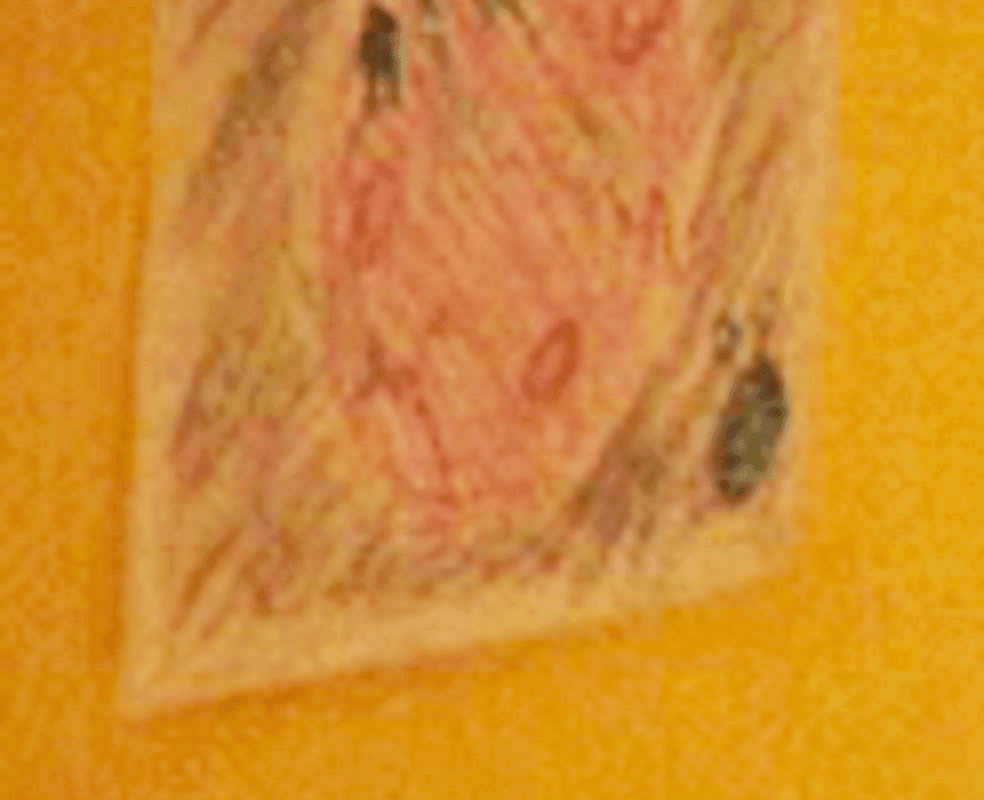
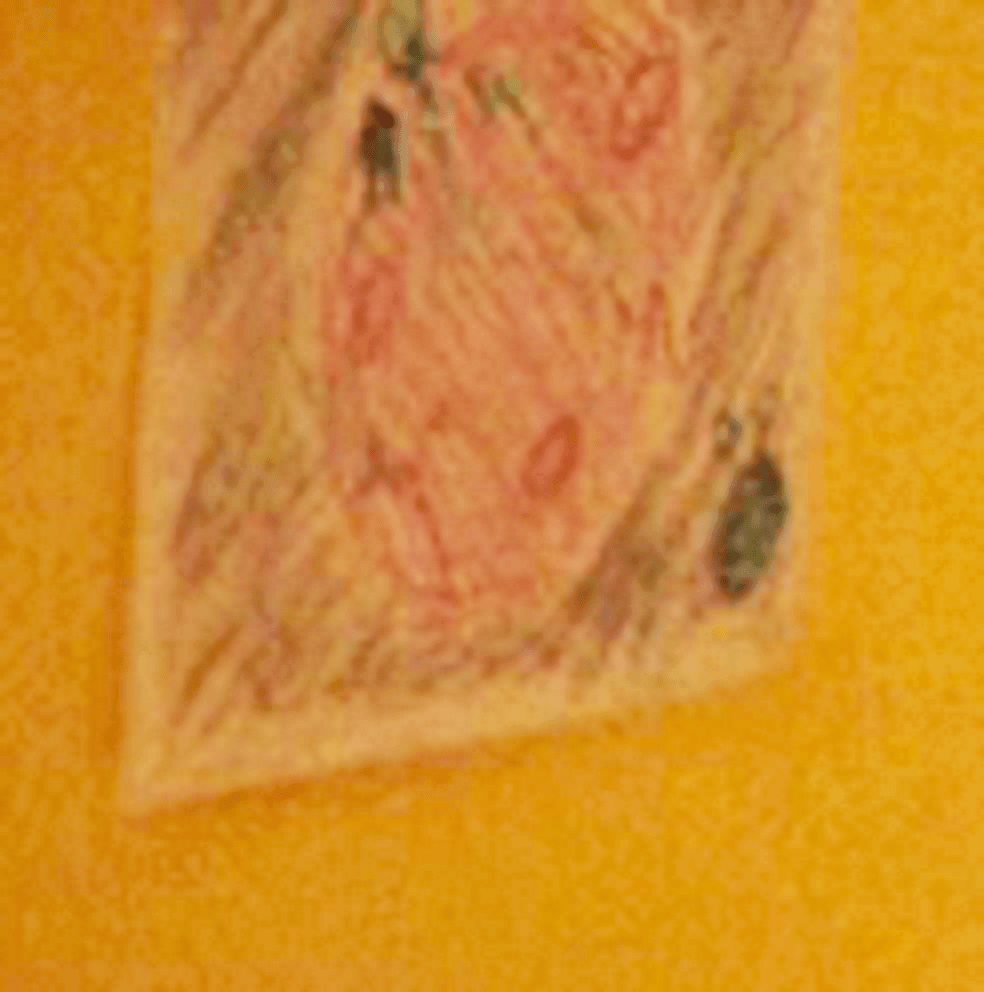
Finally, even more interesting than all of this, is the drawing seen on the wall behind the top of Sonny Jim’s bed: a pink ring/planet on which stands a lone human figure, next to a smaller blue ring/planet. The resolution of the image doesn’t allow me to examine the drawing in greater detail, but it looks like there is a tree / cactus / greenish shape next to the human figure, on both rings/planets.
Planet Rancho Rosa?
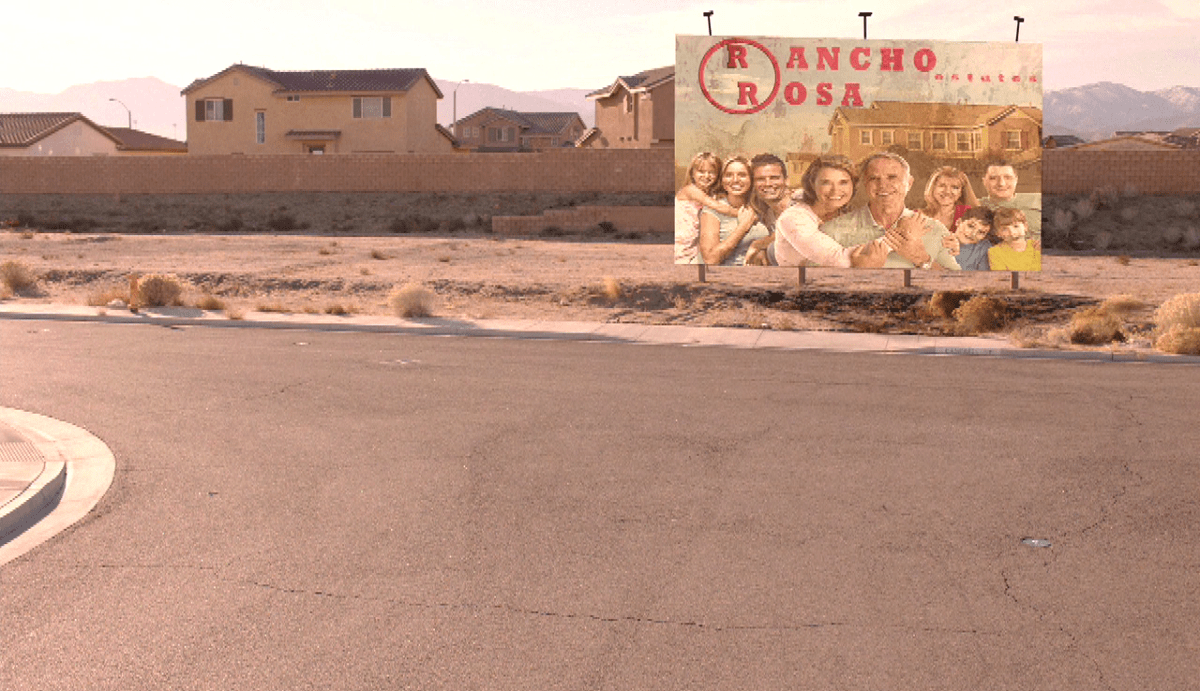
I believe this drawing is a metaphoric representation of Rancho Rosa – which can be read as “pink ring”. This circle is either the geographic and desert expanse where Dale/Dougie is currently trapped and/or an alien planet on which he has been exiled. It could very well be both at the same time, since things don’t necessarily have to be either/or. It could also be Sonny Jim’s creative interpretation of what he sees around him, transposed into a mythological “space western”. But since Dale replaced Dougie coming directly from an electromagnetic beacon in outer space, the Rancho Rosa planet option appears logical of course. This would explain many things concerning the relatively accepting response of his unusual behavior, one that ‘teros’ would not necessarily find odd.
Could Rancho Rosa be an alien zoo/prison for humans, far into “non-existence”, away from the watery source of Being to be found in the Red Room?
One could even argue that the desert and mineral-rich Rancho Rosa is an inverted version of the Venusian Red Room built on water – it is as far away from the Ocean of Consciousness as can be. I mention this about the Red Room because I recently found the following quote while perusing Wikipedia: “The Theosophical guru Benjamin Creme… subscribes to the view that Nordic aliens from Venus pilot flying saucers from a civilization on Venus hundreds of millions of years in advance of ours that exists on the etheric plane of Venus. These flying saucers are capable of stepping down the level of vibration of themselves and their craft to the slower level of vibration of the atoms of the physical plane… According to Creme, the Venusians have mother ships up to four miles long. It is also believed by the Theosophists in general as well as Creme in particular that the governing deity of Earth, Sanat Kumara (who is believed to live in a city called Shamballa located above the Gobi desert on the etheric plane of Earth), is a Nordic alien who originally came from Venus 18,500,000 years ago. The followers of Benjamin Creme believe there is regular flying saucer traffic between Venus and Shamballah and that crop circles are mostly caused by flying saucers… It is maintained in most of these versions of Theosophy that Venus, the ‘Planet of Love’, is the most spiritually advanced planet of our solar system. The beings living on the etheric plane of Venus are said to be hundreds of millions of years ahead of us in their spiritual evolution. It is said that the governing council of Venus – the Seven Holy Kumars – sent one of themselves, Sanat Kumara, here to guide us“.
Venus, the Ancient “Nordic” Alien?
Returning to the subject of Sonny Jim’s drawing, the green shape next to the man on the planet could somehow be linked to the painting on Lorraine’s office wall, the one to which the arrows from the piece of cardboard hanging behind her desk point towards, taken from a box similar to the ones seen in the warehouse with the glass cube. This piece of cardboard, hung behind her desk with electrical tape, goes by quickly during the scene (the camera pans) and it’s easy to miss it. But when one zooms in on this portion of the image, it becomes clear that there’s a tube emerging from the wall through the cardboard – which is reminiscent of the glass box in New York City as well. Additionally, below the cardboard on the wall, one can see black that look like a burned scorch marks. Is this connected to Agent Jeffries’ disappearance in Buenos Aires? (that would not be surprising since Lorraine was in contact with the mysterious alchemical box in Argentina).
This slideshow requires JavaScript.
In my book, I discuss the various elements of Twin Peaks related to the world of circus. The sixth episode of the new season revisits this theme through several references, which are made to characters typical of the circus cast (the magician, the clown). Below the surface of reality, these are relationships that return frequently in the series.
This slideshow requires JavaScript.
Finally, here are a few images linked to the concept of duality / symmetry:
Lamps and bird
Diane
Two more days to go before we continue Dale/Dougie’s quest!




















 TWIN PEAKS - Unwrapping the Plastic