Mother Goose Tales

What is an egg? Here is Wikipedia’s answer to the question: “An egg is the organic vessel containing the zygote in which an animal embryo develops until it can survive on its own; at which point the animal hatches. An egg results from fertilization of an ovum. Most arthropods, vertebrates, and mollusks lay eggs, although some, such as scorpions and most mammals, do not”.
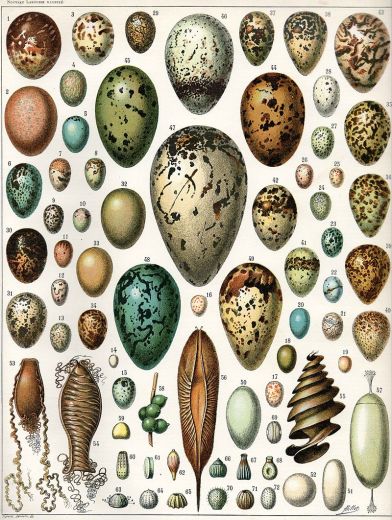
Adolphe_Millot_oeufs-fixed
Various eggs (Adolphe Millot – Nouveau Larousse Illustré, 1904)

The embryo, while in the protective shell of the egg, has access to food and warmth. Being inside an egg must feel like being in Heaven, a state to which those who have hatched might want to return. One could argue that David Lynch feels like he is inside an egg when he thinks about his youth of the 1950s (“everything is fine”).

It is also possible to view the egg as a sort of athanor – in alchemy, an athanor is a furnace used to provide a uniform and constant heat for alchemical digestion. Its aim is to make the philosopher’s stone (lapis philosophorum) – “a legendary alchemical substance capable of turning base metals such as mercury into gold or silver… Efforts to discover the philosopher’s stone were known as the Magnum Opus (“Great Work”)… Other mentioned properties: the creation of a clone or homunculus“. Inside the athanor, on finds an ovoid recipient (the philosopher’s egg) that contains the substance meant to change into the philosopher’s stone.

When discussing eggs in the context of Twin Peaks, one cannot ignore Humpty Dumpty from Alice Through the Looking Glass. It’s also tempting to think of her rabbit and link it to the Easter egg hunt (Jack Rabbit’s Palace, for instance). An image from David Lynch’s series of paintings Small Stories (see below) directly indicates just such a link.

It’s also difficult not to connect the creature that hatches at the end of episode 8 and Lynch’s painting below. Franz Kafka and Hieronymus Bosch are not far from these images.

This slideshow requires JavaScript.

As far as the yolk of the egg is concerned (the nutrient-bearing portion of the egg whose primary function is to supply food for the development of the embryo), it might very well be connected to the gold of alchemy.

The cosmic egg, born of primordial waters and linked to the genesis of the world, contains in germ the multiplicity of beings. According to Vedic spirituality, it was warmed by the goose Hamsa – the Spirit, the divine Breath (the hamsa, or the swan, is often identified with the Supreme Spirit, Ultimate Reality or Brahman in Hinduism).

Helen Valborg, a Theosophist, wrote about eggs in HERMES Magazine: “In Hindu tradition, the ‘Swan of Eternity’ lays a ‘Golden Egg’ at the beginning of each Mahamanvantara… One becomes the many… The very word Brahma comes from a Sanskrit root Brih, which means ‘to expand’. Within the Golden Womb of the Hiranyagharba, Brahma dwells for one Divine Year, at the end of which he divides the Egg into the upper heaven and the lower earth, with a sky of perpetual waters intervening“.
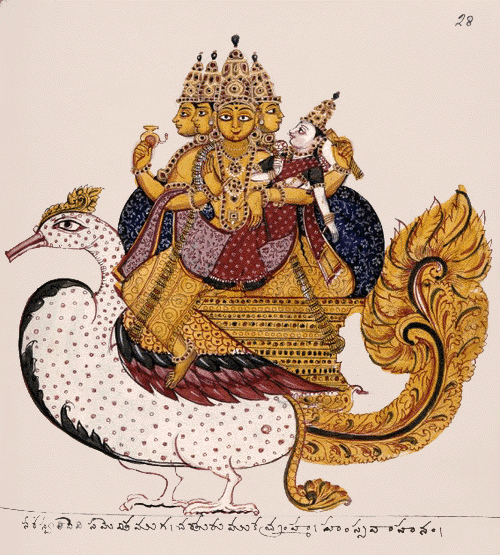
Hamsa.jpg
Lord Brahma on hamsa vahana -British Museum Collection

The omnipresence of the egg motif in Twin Peaks can probably be put into perspective through various works of art by David Lynch, such as the heads from his Small Stories series or his exhibition at Les Galeries Lafayettes in Paris (2009) (images: Roland Kermarec). The Freemasons Kneph (flying egg) can also be connected to Mark Frost’s The Secret History of Twin Peaks.

According to the cosmogony of Twin Peaks developed in episode 8 of The Return, the Trinity atomic explosion led to the release of various eggs (by a mysterious entity called Mother) that landed on Earth, where they imported a cosmic sort of evil. Lynch recently declared in an interview for Les Cahiers du Cinéma that the bomb created “a hole” – probably the one between the membranes of the universe(s) that led to such a contamination.

During the recent conference about David Lynch and the arts that took place at the University of Bordeaux (link), Diane Arnaud from the University of Paris Diderot talked about “troublants trous noirs” (troubling black holes, but also a pun on white holes/black holes). It seems to me that this idea of holes (whether they be white or black) is very similar to my concept about the role of sewing in Twin Peaks (a way to attach the various branes of the multiverse together or to mend possible holes in the fabric of spacetime).

The atom bomb from episode 8 generated a sort of “black hole” that broke the normal three-dimensionality of our reality and opened up the door to four-dimensional entities, such as BOB. Interestingly, a new theory in cosmology (see here) argues that our universe is not the result of a Big Bang, contrary to the general consensus within the scientific community, but of the collapse of a four-dimensional star, the implosion of which created a 4D black hole whose three-dimensional membrane would be our universe (according to the holographic principle).

In both cases, a cataclysmic explosion pierces through the barriers that normally separate dimensions.

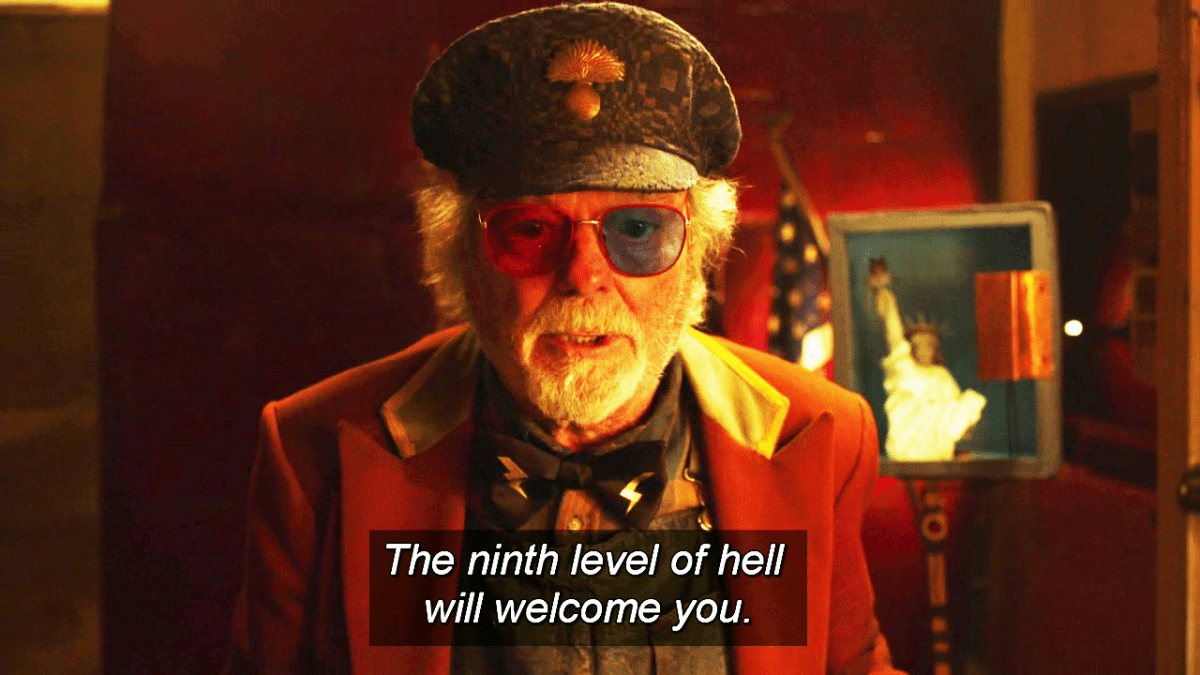
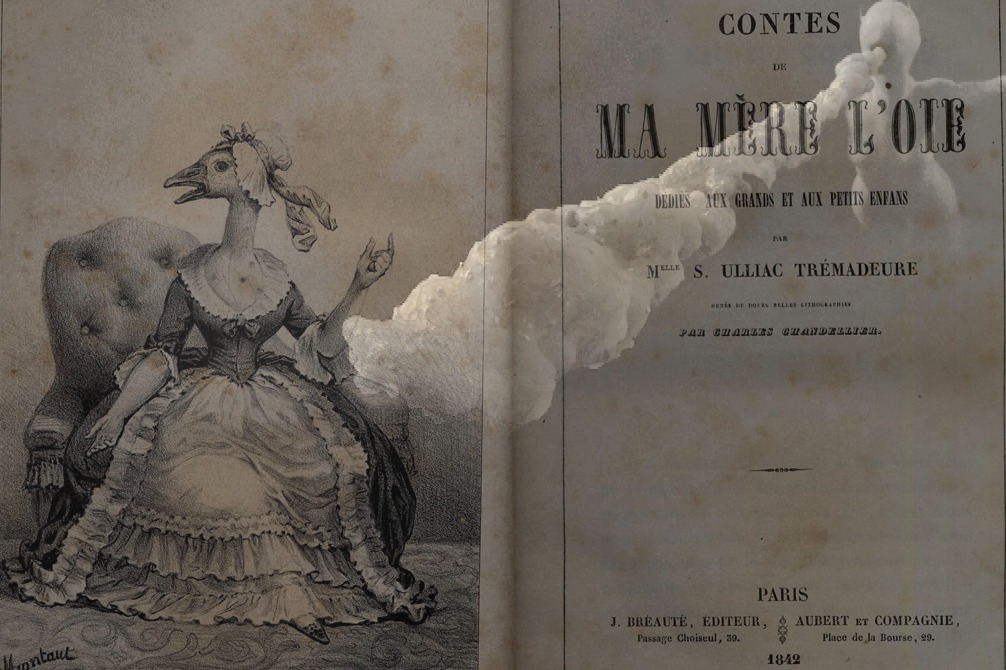
Moter Goose Tales (Les Contes de ma Mère l’Oye) is a collection of literary fairy tales written by Charles Perrault, published in Paris in 1697. Its typical characters: ogres, old witches, princes and princesses, wolves and fairy godmothers. In my book Twin Peaks: Unwrapping the Plastic, I wrote about the importance of fairy tale motifs in the series, from Sleeping Beauty to Beauty and the Beast. I now believe that this book by Charles Perrault might very well be the link between those various stories and that Mother is the Goose that lays the Golden Eggs, the ones that provide the philosopher’s stone of alchemy (see the sign above Big Ed’s Gas Farm, for instance).

“Listen to the sounds!”, says the Fireman at the beginning of The Return. We know the importance of soundscapes and music in the world of David Lynch, from the contemporary industrial music scene to the “heavenly” scene of the 1950s, that of his youth (without forgetting a zest of the 1930s, as I mentioned during the recent conference given by Emmanuelle Bobbee from the University of Rouen, an “archaic” influence from his parents’ generation that can be felt for instance during the sequence with the Fireman in episode 8). Nevertheless, the sounds in question, those mentioned by the Fireman, are not sounds from music pieces or background soudscapes – the gramophone in the purple Palace emits a scratching noise which, if slowed down, actually sounds very much like the shout of a goose (as I have already argued here: link). This would make perfect sense if it were the case, considering the importance of geese in this world.

P.S.: Thank you so much to Roland Kermarec from Lynchland for providing several of the images included in this blog post. If you don’t already, I strongly recommend hat you follow Lynchland on Facebook (here). It’s probably the best way to keep up to date on anything new concerning David Lynch!

P.P.S.: Could there be a link between The Return and the Game of the Goose (its spiral appears to be connected to the wheel of samsara in Hinduism, victory being synonymous with Nirvana –> 6= bridge / 19= hotel / 31= well / 42= maze / 52= prison / 58= skull)

Follow Unwrapping the Plastic: Facebook / Twitter

Cosmic Cinema

Episode 8 remains one of the main landmarks of The Return – it might be Lynch at his most experimental, flirting with non-narrative cinema as well as with complex metaphysical and esoteric issues. One of the most impressive moments of the episode is of course the one when the camera dives into the atomic mushroom over New Mexico, leading to cosmic imagery (and cosmic consciousness), worthy of the Stargate sequence in 2001: a Space Odyssey.

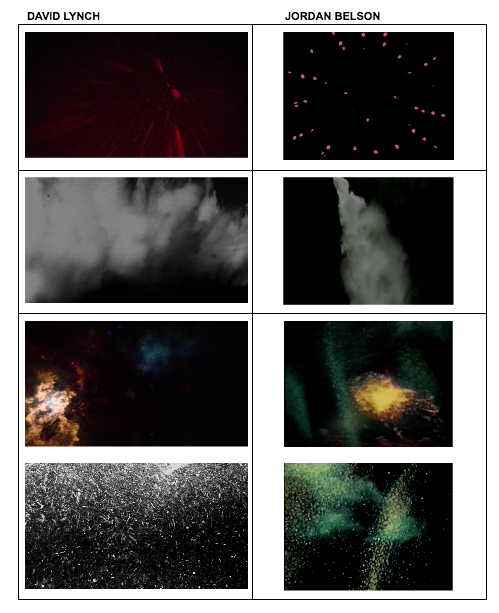
The reference to Stanley Kubrick, though pertinent to some extent, might nevertheless lead us to overlook another possible source for this sequence. I believe that the various (micro & macro)cosmic explosions we witness in this episode might have been influenced by the work of another American filmmaker: Jordan Belson (1926-2011), much of which predates Kubrick’s 1968 masterpiece.

From 1947 to 2005, Belson created a series of abstract and spiritually oriented films of extreme beauty. Like Lynch, he started as a painter before moving on to filmmaking, and he was also strongly influenced by Eastern theologies, notably by Buddhism and the Bardo Thodol (the Tibetan Book of the Dead).

Gene Youblood writes about Belson’s films in his book Expanded Cinema and says that “Belson’s work seems to reside equally in the physical and the metaphysical… He regards the films not as exterior entities, but literally as extensions of his own consciousness”, which is something one could also say about Lynch’s work. He goes on: “The films are litlerally superempirical – that is, actual experiences of a transcendental nature”. Also, like Lynch, he always maintained the illusion of his magic by not divulging his methods.

You can watch Belson’s film Samadhi (1967) – that state of consciousness in which the individual soul merges with the universal soul, when the physical world of sangsara and the spiritual world of nirvana become one -, a good starting base for his filmography, by clicking on the link below the image.

Samadhi.jpg

Samadhi

Interestingly when one discusses the similarities between Belson’s films and Lynch’s work on episode 8, Youngblood writes about his film Re-Entry (1964 – based on the Bardo Thodol’s intermediate state between death and rebirth): “The image in Belson’s film is somewhat like slow-motion movies of atomic blasts in Nevada with the desert floor swept across by a tremendous shock wave”. The cosmogonic experience of episode 8 finds a parallel in a quote by Belson himself who said of his film Momentum (1968): “I realized that the film doesn’t stop at the sun, it goes to the center of the sun and into the atom… The end shows the paradoxical realm in which subatomic phenomena and the cosmologically vast are identical”.

Screen Shot 2017-11-24 at 8.45.30 AMScreen Shot 2017-11-24 at 8.45.49 AMScreen Shot 2017-11-24 at 8.46.09 AM

Follow Unwrapping the Plastic: Facebook / Twitter

The Metaphysical Peaks

The world of Twin Peaks is of a metaphysical nature.

What does that mean? The word “metaphysics” derives from Greek and signifies “beyond physics”. In Twin Peaks, physical reality is not enough, there is also something “beyond” – another reality above, below, or behind the one in which we exist. A Fourth Dimension that “transcends” the limited traditional 3D reality of everyday life. Twin Peaks‘ physical world is nothing but a double, an image, a shadow of this other more fundamental reality.

Like Dale and Laura, some people are lucky enough to access this transcendental level of being beyond our own (via dreams, astral projection, etc.). Since time works differently there, they often become human oracles, as with the Log Lady. They receive glimpses of the future thanks to their connection to a realm where time works cyclically and not in a linear fashion as it does in our world. This advantage can sometimes become problematic, as it’s difficult for them to know precisely at which point in the river of time they will return when they exit the Lodges (as Dale Cooper learns in episode 18 of The Return).

On this other plane of reality, “I” is really someone else – a double who is both me and not me. Actually, in a sense, this double from the Fourth Dimension is more fundamentally me than I am. I am only its shadow (of flesh). It is closer to the bottom of the ocean of consciousness. It lives in Plato’s intelligible world, the world of pure Ideas.

In his book “Le réel et son double” (“The Real and Its Double”, 1976), French philosopher Clément Rosset writes:

The double that represents the subject is an immortal double, tasked with keeping the subject sheltered from his own death… But that which troubles the subject more than his own death, is first his non-reality, his non-existence… it’s no longer the other who is my double, it is I who am the double of the other.

If this essential other disappears, it’s our very existence that is called into question. This is why Dale Cooper’s plight is so terrible – beyond death, it’s his very existence that is at stake in The Return. He has to awaken from the dream into which he has been plunged  in order not to travel from being into nothingness.

Rosset then goes on:

Perhaps the foundation of anxiety, apparently linked here to the discovery that the visible other is not the real other, is to look to a more profound terror: to not be myself, that who I thought I was. And even deeper still, to suspect on this occasion that I am perhaps not something, but nothing.

Not me.png

How can we prove that we exist? To a certain extent, we can prove it to other people with our birth certificate, if we have one… but how can we prove our existence to ourselves? We have never even seen ourselves!

The true presence of one’s self to self  implies renouncing the spectacle of one’s own image. Because here the image kills the model… me, that I have never seen and never will see, even in a mirror… it doesn’t show me the inverse, but another; not my body, but a surface, a reflection.

This is likely why symmetry and mirrors play such a central role in Twin Peaks – they duplicate reality, but also invert it. It is not ourselves that we see in our mirrors, but our inverted selves, our doppelgängers.

Sartre would nevertheless argue that one possible way to prove our existence to ourselves might be through our actions. Audrey’s husband calls this “existentialism 101”. On the other hand, since it takes so long for Audrey to actually do anything, to act, she’s getting closer and closer to nothingness, to inexistence.

vlcsnap-2017-08-28-15h57m06s002

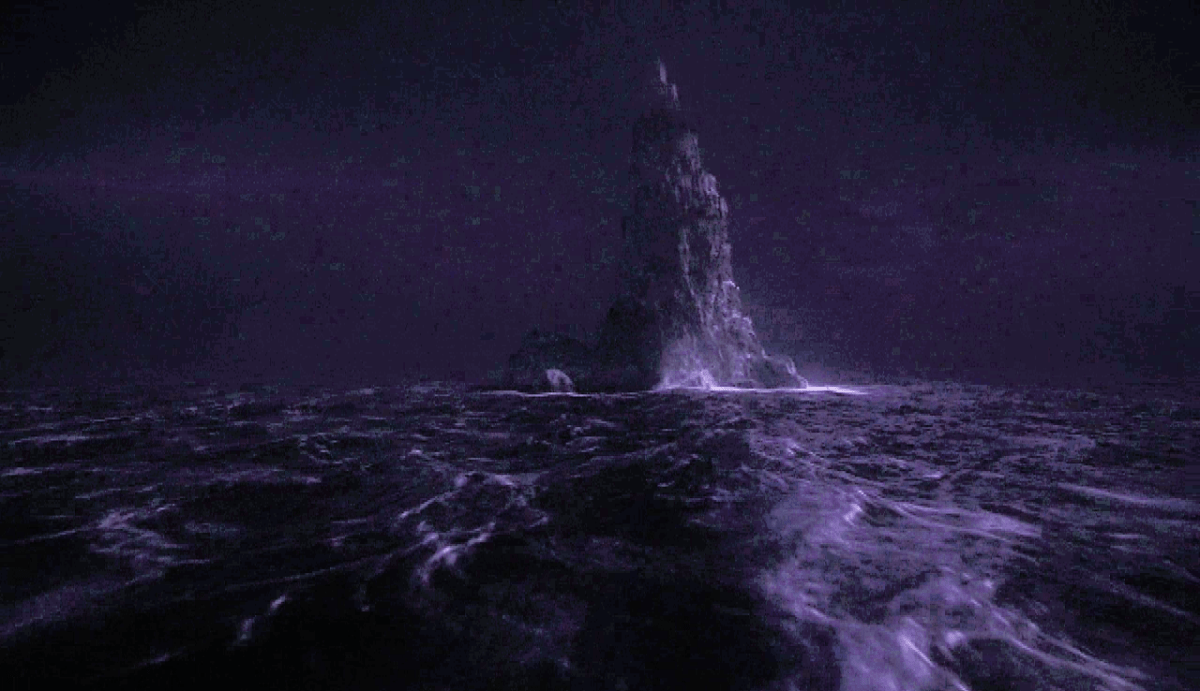
Let’s come back to the twin peaks mentioned in the title of this post. The purple ocean’s peak and Jack Rabbit’s Palace are, in spite of their differences, essentially the same. Finding the latter is actually described as a way to access the former – Andy and the Double get teleported to the Fireman’s place when they reach the grove close to Jack Rabbit’s Palace. Both layers of reality are superimposed at this precise location, as if they were pieces of cloth sewn together, over each other.

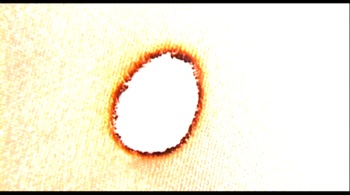
Images from various levels of reality transpire through the cloth and patchwork of the universe and some people are lucky enough to get glimpses of what lies behind. Holes (or vortexes) in the fabric of reality enable one to see and travel through those layers. In Lynch’s Inland Empire, for instance, one remembers the cigarette-burn hole in a piece of silk…

CigaretteBurn

The reason for the omnipresence of superimpositions of images in The Return is that the various cloth/universes are getting close together, masking each other. From the hidden layering of the opening credits (the plight of the three versions of Dale Cooper illustrates this tension between conflicting realities) to the superimposition of Cooper’s face in the sheriff’s station during episode 17, this is a recurring motif in the third season of Twin Peaks.

Gene Youngblood, the author of Expanded Cinema, would probably argue that The Return is a work of synaesthetic cinema, a cinema that “provides access to syncretistic content through the inarticulate conscious“. In his book, he writes:

Paul Klee, whose syncretistic paintings closely resemble certain works of synaesthetic cinema, spoke of the endotopic (inside) and exotopic (outside) areas of a picture plane, stressing their equal importance in the overall experience. Synaesthetic cinema, primarily through superimposition, fuses the endotopic and exotopic by reducing depth-of-field to a total field of nonfocused multiplicity.

Here, instead of “a total field”, David Lynch would probably say “a unified field”…

Youngblood goess on:

Moreover, it subsumes the conventional sense of time by interconnecting and interpenetrating the temporal dimension with images that exist outside of time.

It seems to me that this is a very good summary of what Lynch did with these various superimpositions, unifying different locations and times into the picture plane, where there is no more inside and outside.

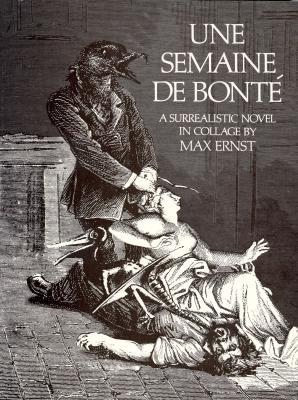
Youngblood concludes by saying that “synaesthetic syncretism replaces montage with collage“. I have stressed many times (in my book and on this blog) the links that exist between Twin Peaks and the works of Max Ernst, especially with his collage A Week of Kindness.

Ernst.jpg

Follow Unwrapping the Plastic: Facebook / Twitter

The Process of In/dividuation

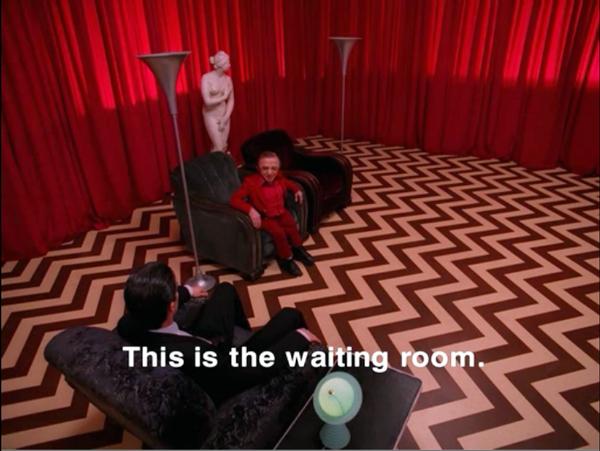
In my book Twin Peaks: Unwrapping the Plastic, one of my main claims is that “Twin Peaks is fundamentally about one thing: the “process of individuation” described by Carl Gustav Jung, that is to say, the integration by the various characters of the unconscious elements of their personalities in order to evolve as individuals“. I argued that the Red Room was a secret garden of sorts, a Temenos, which enabled those who visited it to proceed faster down the lane of this integration. It appears in The Return that this is also a place where the whole process can go horribly wrong, as we saw with the Double.

waiting

Before going any further, one must ask the following question: what is an “individual”? What do we mean when we say that someone is “an individual”?  An individual is literaly someone who cannot be divided (in/dividual, as in in/divisible). This claim is of course always something of a stretch – we are all, to some extent, a multiplicity. The person who goes to work in the morning is not exactly the same when meeting his or her parents later in the afternoon, who is also different from the person who spends time with his or her friends in the evening, etc. We are all legion. Nevertheless, the general idea is one of stability from day to day, that we are globally the same as yesterday and that tomorrow we will remain mostly the same as today.

When these various segments of our personality become separated, independant from each other, we are facing serious psychological disorders, shattering the notion of a balanced whole (balance being of course one of the central elements of Lynch’s view of the world). The Return is very much concerned with this idea, about the possibility of people with split personalities – even with the idea that some personalities might be so split from the original that they become “individuals” of their own. Dale Cooper and his polar opposites (the Double and Dougie) is of course the main example one finds in Twin Peaks. But Laura Palmer and her many incarnations, from Madeleine to Page, also fits this description. Interestingly enough, they both visited the Red Room, the place where this process of (dis)in/tegration seems to take place.

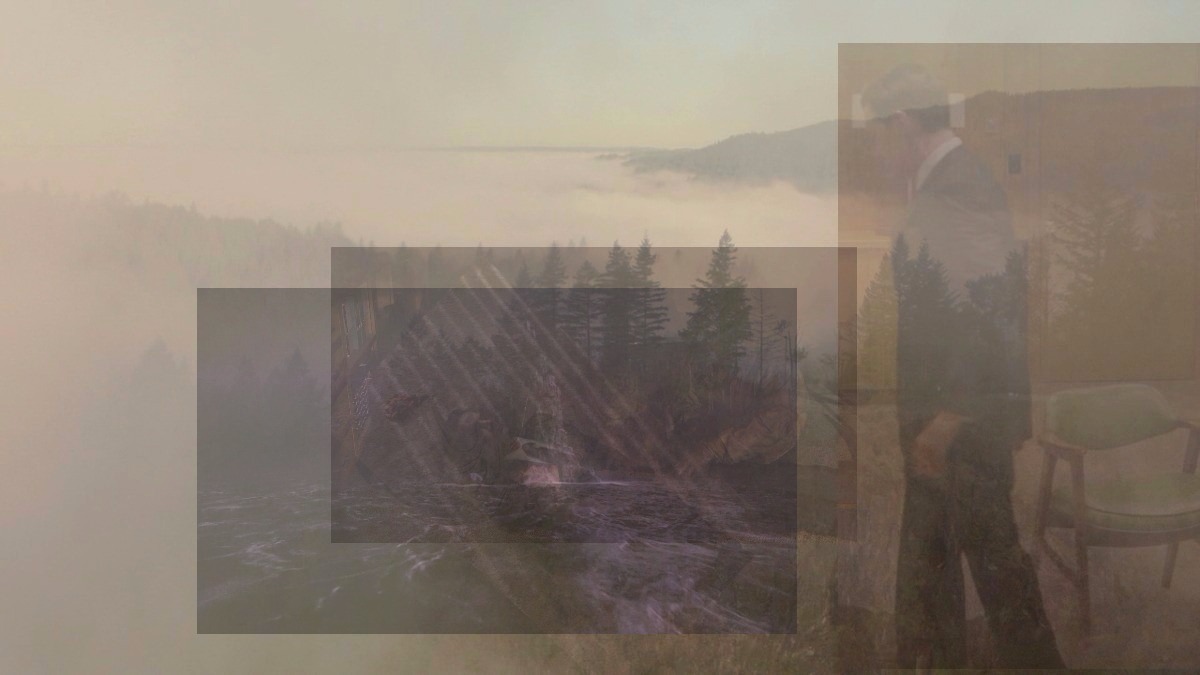
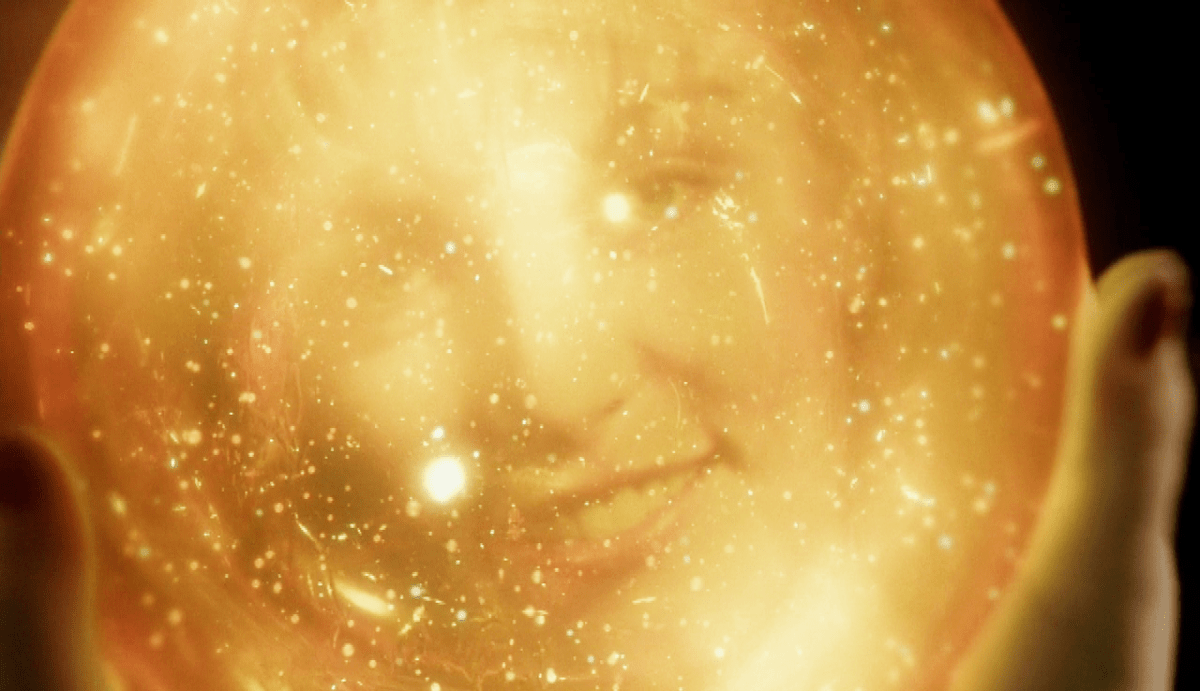
My personal reading of the opening credits of The Return, with its superimpositions, tends to give credit I believe to the idea that this process is at the core of the series’ mythology. I have already described and analyzed the various strata of images layered during the original fly over Twin Peaks (see here, for instance). What matters is the fact that right from its first image (besides Laura’s brief appearance in a globe), the series underlines the crucial role of the conflict between Cooper’s various persona.

image (5)

The Double and Dougie, polar opposites, cross each other while lying on the ground, under the eyes of Dale Cooper, observing his doppelgängers while it remains unclear which side will win. In order to become whole again, to become a true individual once more, one that has successfully integrated the unconscious elements of his personality, this multiplicity will need to cease (as it does in episode 17).

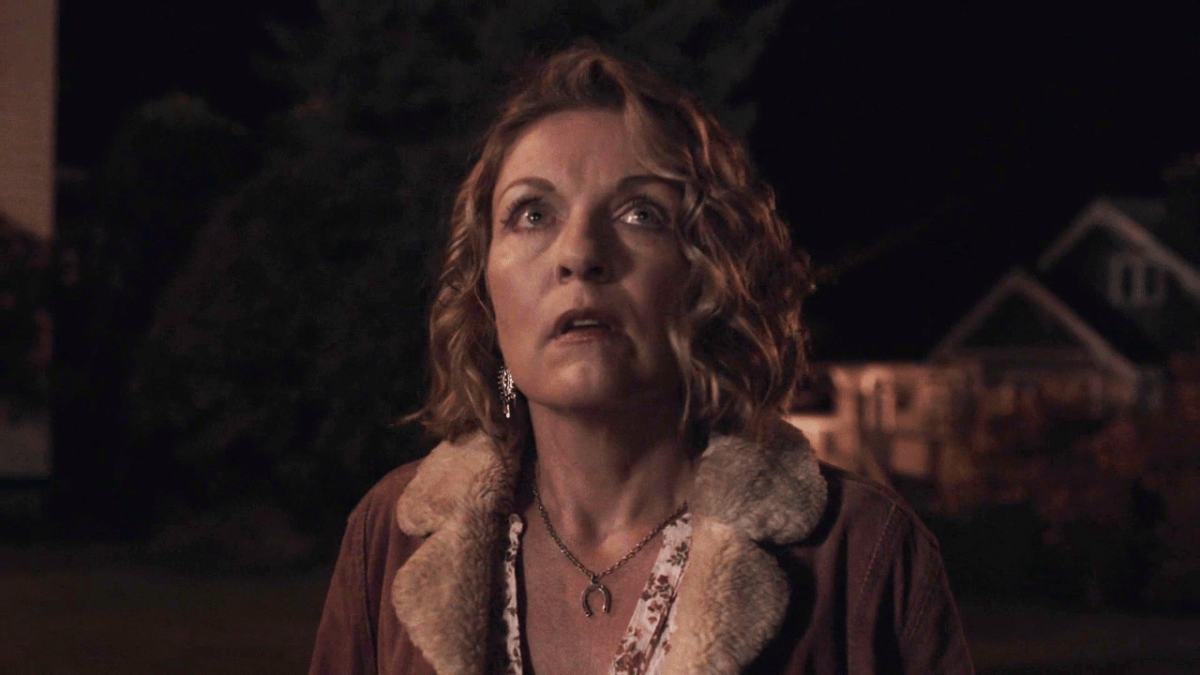
In Laura Palmer’s case, the final success is of course less obvious, as her Carrie Page double does not seem to remember who she really is (unless we consider the very last moment of the series, when she hears Sarah’s voice?). Something along the way appears to have blocked her process of individuation, her true personality has been veiled by a persona, a blank “Page” who has taken over. Does her final scream mean that she has finally torn the veil and seen through the curtain?

vlcsnap-2017-10-26-10h39m09s911

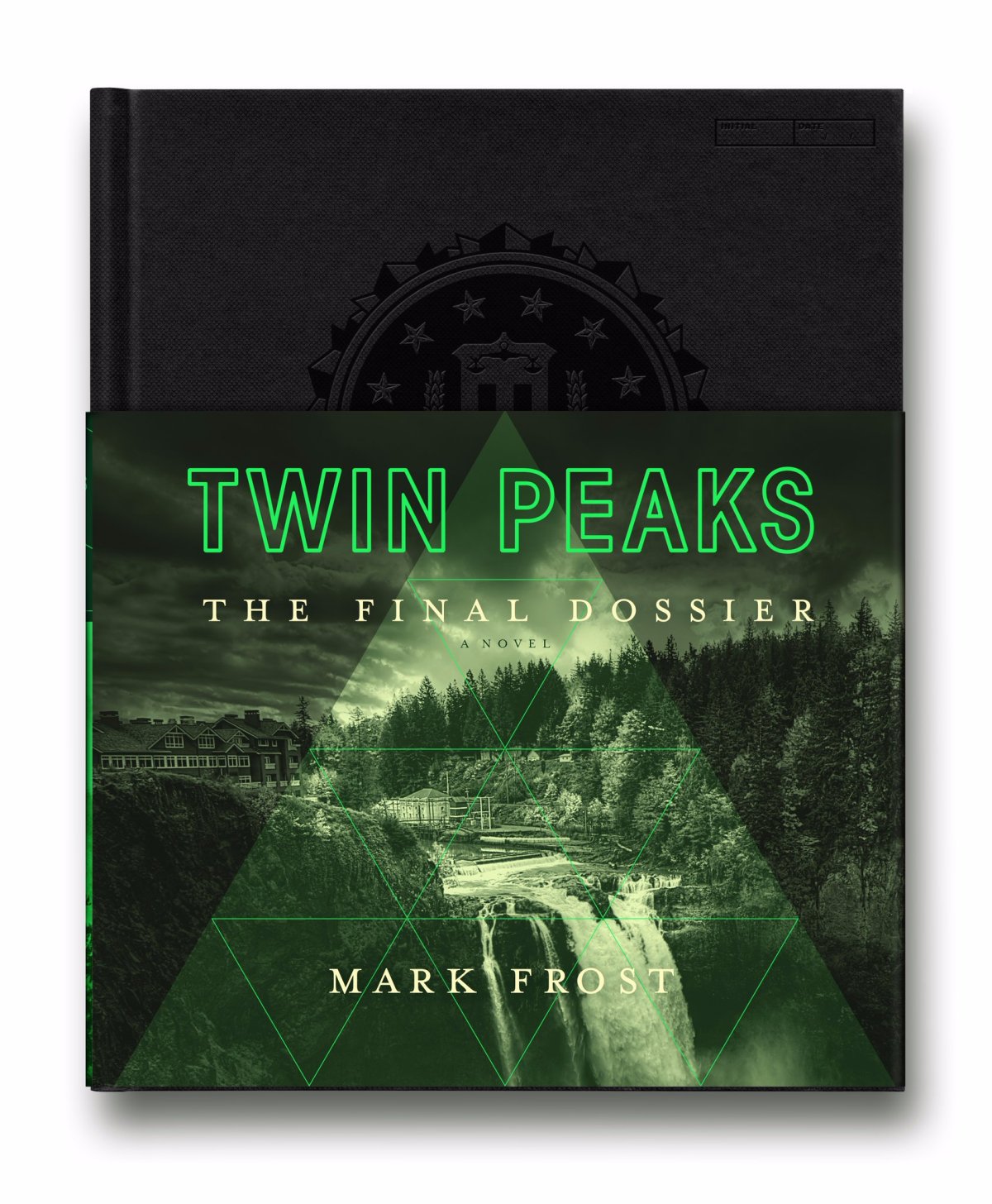
The Jungian process of individuation can be linked, to a certain extent, to what takes place in Alchemy when described as a way to proceed from mental lead to mental gold – a process of purification, of integration that leads to a better, more balanced whole. Tamara Preston makes this very clear in Mark Frost’s latest book, Twin Peaks: The Final Dossier, when she writes about Doctor Jacoby’s golden shovels: “The desired transformation through undertaking this assignment he described as a process of ‘intrapersonal alchemy,’ turning the lead of dull, everyday consciousness into the gold of an evolved human soul, the goal of what he described as a hallowed tradition in esoteric philosophy harking all the way back to the Middle Ages. This led to Jacoby offering literal golden shovels for sale“. She actually starts wondering if this quest for personal integration might not be what hides behind the Blue Rose task force itself: “Is that the secret at the heart of the Blue Rose and the work we do? To identify root causes of human misery and evil, do we first have to find them in ourselves?“.

To parody the motto from another famous TV series from the 1990s: “The Truth is IN here“. Could that truth be the quest for immortality?

twin-peaks-the-final-dossier (1).jpg

Paradoxically, even though we probably live in the most secure and prosperous era ever known by humanity (see Steven Pinker’s The Better Angels of our Nature), with a global and drastic decrease in violence on every front, the general feeling is nevertheless that we are currently experiencing troubled times (because of 9/11, Trump’s election, the war in Syria, etc.). The arts have relayed this opinion through the metaphor of the zombie, a nihilistic “no-future” character who has become omnipresent in fiction since the turn of the millenium.

The idea that we are currently experiencing a “dark age” is also present in The Return. Whether this reality is supposed to reflect our own or be independent from it (its dark age being the result of the Double’s influence, though the nuclear explosion in New Mexico might very well be the true root of the problem), one can nevertheless note that Mark Frost shows strong concerns regarding  the Trump administration (rightfully so!) and that David Lynch is very preoccupied by the omnipresence of violence and the necessity for world peace (as proven by his actions for the Transcendental Meditation movement).

Amp.png

Literary theorist Thomas Pavel argues in his 1986 book Fictional Worlds that during times of peace, fictional incompleteness tends to be reduced to a minimum, whereas it tends to be maximized during transitional and conflictual times. Fictional works created during the latter want to mirror the torn nature of reality itself. Strangely enough, although this beginning of the 21st Century is extremely safe overall, with peace, democracy, and the rule of law having reached their highest peaks in history, the general public consensus is the opposite (due to the media’s influence? because of dire threats that we face today, such as global warming or economic cycles?) and supports the idea of a time of crisis, reflected in The Return’s “dark age”.

As with Doctor Jacoby in Twin Peaks, a vast amount of people interpret “this as confirmation of his theory that the United States, and perhaps the world, might be entering into what he saw as a ‘Kali Yuga’—an ancient Hindu term for a ‘dark age.’” (from The Final Dossier). The very structure of The Return reflects this conviction in its strong fictional incompleteness, torn between multiple locations in space and in time, full of questions that remain unanswered, of characters who only appear once or twice before totally disappearing from the script, etc. Instead of the unified world that Twin Peaks once was, before the Double, season 3 depicts a patchwork reality made of various cloths, weaving together different dimensions/universes, always ready to be torn apart (as with Page’s shriek at the end of episode 18).

Beyond the interpersonal level, we are dealing here with the idea of a split in the fabric of things. Instead of torn personalities, the “dark age” theory claims that it’s the world itself that is torn apart, ready to crumble. From the point of view of the personal as well as of the collective unconscious, the process of individuation appears to currently run counter clockwise. Instead of integrating levels of personality and reality, it tears them into new segments. It divides instead of adding, it multiplies instead of simplifying. Lynch’s “unified field” appears unreachable in this universe devoid of unity.

Follow Unwrapping the Plastic: Facebook / Twitter

Alice and the Holmes Complex

One of the reasons why episode 18 creates such a feeling of the uncanny is linked to its ending, when Cooper and a sleepwalking Laura/Page meet Alice, the new owner of the Palmer house in Twin Peaks. All of a sudden, the barriers between universes  crumble as fiction and reality blend in a complex patchwork: Alice Tremond (Mary Reber) is indeed the person who owns this house in our reality (link).

Palmer's House.png

Where does fiction end and reality begin? Is it a dream? Where are the borders? Is this the past or the future? The world shakes under the feet of Dale and Laura as the ontological nature of their existence is suddenly called into question. Their very identities are even uncertain: is this really the Dale Cooper we used to know? and who is Page: a new avatar of Laura? Everything is torn apart. The fact that Twin Peaks references Alice’s Adventures in Wonderland is not new (a subject I discuss in my book Twin Peaks: Unwrapping the Plastic). But here, it’s not so much that Alice goes into Wonderland, rather all of a sudden Wonderland is brought to us. Even Alice is not totally herself, as mentioned above – she is also partly Mary, and also Tremond, who are very much the same thing as the Chalfonts.

The sequence with Monica Belluci in episode 14 was likely a forewarning concerning the uncertain nature of the fictional world of Twin Peaks. When Gordon Cole narrates his dream with the famous Franco-Italian actress, he suddenly mixes three different ontological realms: that of the fiction, of dreams, and of reality. The dream itself points towards the porous nature of the world(s) we inhabit, as Monica questions who the person is behind the dream/reality. One could even argue that Lynch also mixes different fictional realms and temporalities in this scene, as he summons images from Fire Walk With Me and edits then within the pattern woven here.

What is real and what is fiction, then? Has the fictional world crossed the looking glass to our reality or is it perhaps a part of our world that has traveled to the universe of Twin Peaks? Are we dealing here with Monica Belluci the actress or with one of her characters? Is she facing Gordon Cole or David Lynch? It seems that there is no easy answer to these questions except that they might all be true, to some extent. Dale Cooper and Laura Palmer have accessed, during the past 25 years, a certain degree of “reality” as they integrate the collective unconscious. Though fictional, they have become household names, models to be followed or avoided. Inversely, the presence of many real people in Twin Peaks (real in the sense that they keep their own names), contributes to the comings and goings across the fictional border.

In literature, there is a gap between the “segregationists” who want to keep the realms of fiction and reality mutually exclusive and the “integrationists” who, on the contrary, believe in the absence of true ontological difference between these worlds. David Lynch clearly appears to stand on the side of the second group. One reason for the integration of both realms given by the integrationists (see for instance Univers de la fiction, Thomas Pavel, 1988) is the concept in language of “mixed sentences” developed by John Woods, sentences in which fiction and reality are juxtaposed (as in “Sherlock Holmes lives on Baker Street”). This concept can easily be extended to film – when Monica Belluci meets Gordon Cole in a (real) café in Paris, she’s both inside fiction and in reality, and it’s pretty tricky to determine which is which based on the sequence alone.

Beyond the notion of “mixed sentences”, another point should be mentioned: that of the unconscious, which plays such a central role in the works of David Lynch. The unconscious does not discriminate between worlds according to their ontological level. Our psychological life is situated, in its depths, at the crossroads of reality and fiction. Our dreams constantly mix elements from the “real” world with fiction. To the unconscious, they are both real, it does not establish a hierarchy between them, or between the past and the future, or even between identities. Multilayers are possible when one is dreaming, that’s how the unconscious works (according to Freud and Jung, among others). It weaves together segments that belong to different worlds so as to create a new “reality”, one which does not function according to the laws of physics that we usually agree on.

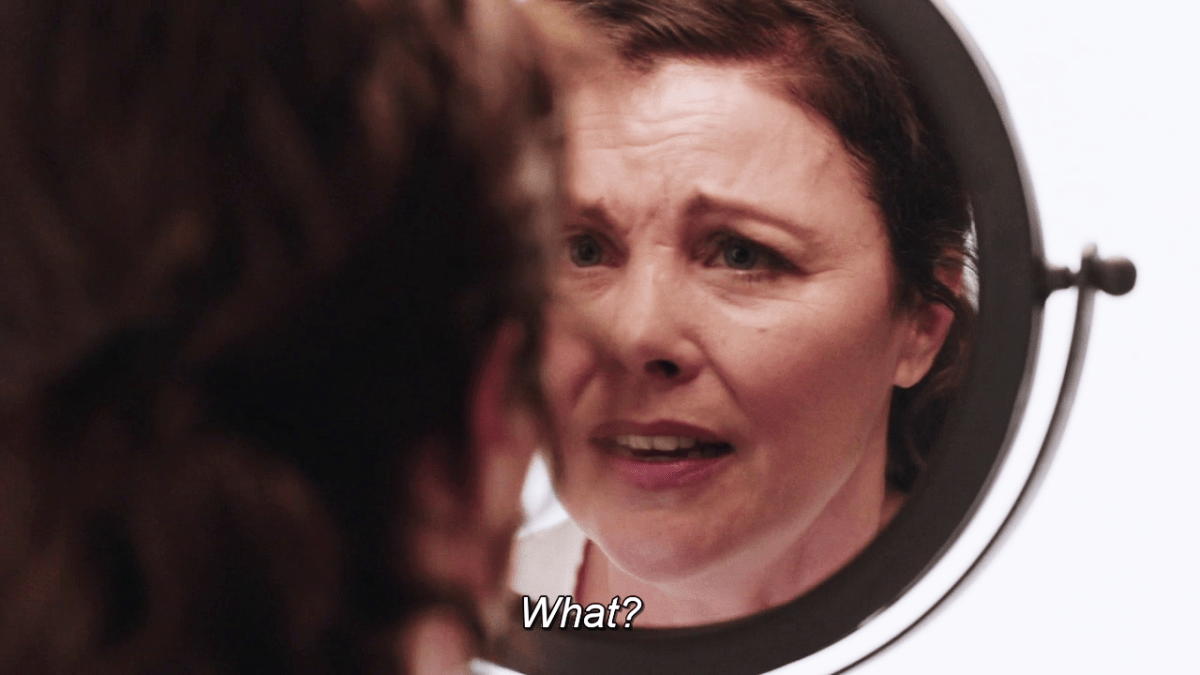
The fact that Page acts as a sleepwalker during the last sequence of episode 18, following Cooper dreamily, unable to focus on anything, points to such a layering of realities in her mind. In a way, she acts as Dougie Jones during most of the season, she needs to wake up.

vlcsnap-2017-10-26-10h38m59s426.png

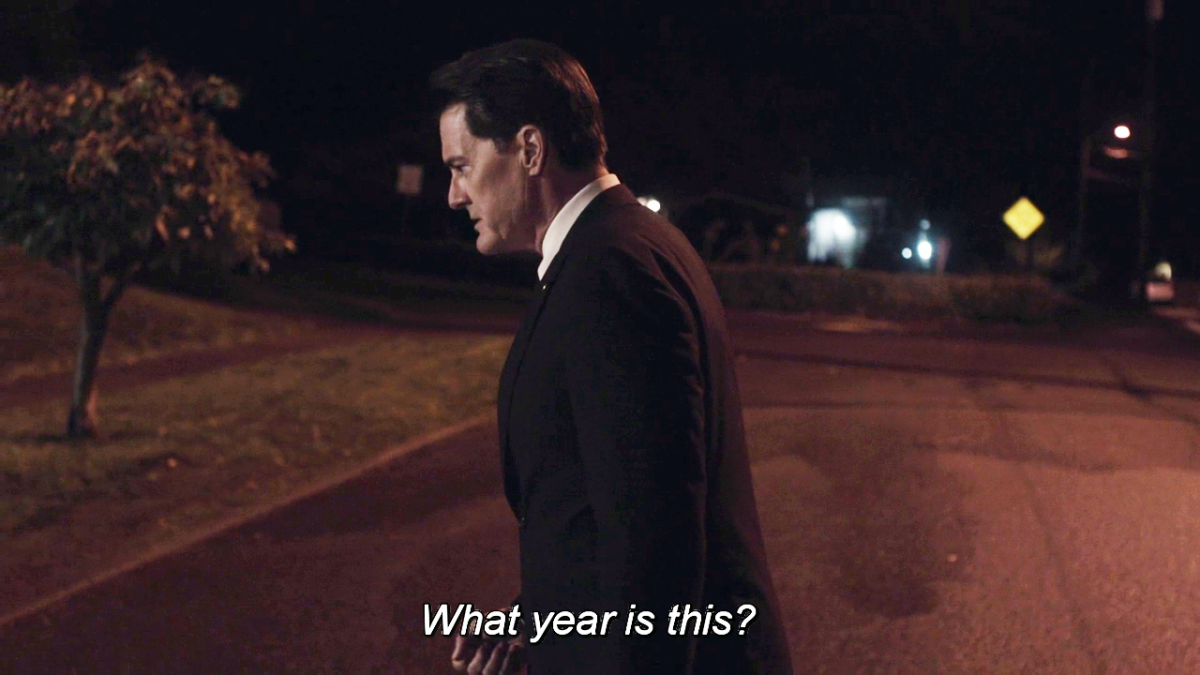
And then, when she moves back from the house and Cooper starts to wonder what year it is, a wind blows through her hair, she begins to shake and bursts into screams. The stuff of which her dream was made is suddenly torn apart by this shriek – she wakes up to the horror of her condition. What was sewn together gets ripped to pieces and the multiverse collapses (as does electricity, the force that binds it together).

The in-between world in which she finds herself (if one can claim that she still has something of a “self” at this point in the story) is one that welcomes beings from all sorts of realms, the fictional world as well as our reality. This Twin Peaks is a town that we can inhabit if we wish, at least mentally, and where we can meet the fictional characters whose stories we follow. But it is an unstable world, one that exists on the seam between universes. When she screams, Laura/Page rips apart this in-between world, in which a part of us also dwells. This is probably why this particular moment is so uncanny, because it calls her existence into question, but to a certain point, it also puts our own in jeopardy!

It is tempting with Twin Peaks to apply the concept of the “Holmes Complex” developed by the French psychoanalyst Pierre Bayard in his book Sherlock Holmes Was Wrong: Reopening the Case of the Hound of the Baskerville. This complex, he argues, is the one that inspires some authors and readers to give life to fictional characters and create  relationships with them based on love or hate. Bayard claims that this is what happened to Arthur Conan Doyle when he wrote The Hound of the Baskervilles due to his complex relationship with the character of Sherlock Holmes whom he had tried to kill several years earlier and without success following the collective outcry that ensued at the end of his adventures in The Strand. In his book, Bayard explains that Holmes, as a result of Doyle’s resentment towards him (he was not allowed to “kill” his fictional creation), accused the wrong culprit in the Baskerville case.

Mark Frost’s interest in the character of Sherlock Holmes is well documented. Two of his novels are centered around Doyle and the man he uses as a model for his famous detective (The List of 7 and The Six Messiahs). In the first episode of the second season of Twin Peaks, Truman and Cooper hold the following exchange: Truman: You know, I think I’d better start studying medicine. Dale Cooper: And why is that? Truman: Because I’m beginning to feel a bit like Dr. Watson“.

Cooper & Truman.jpg

In addition to Mark Frost’s fascination for Doyle and Holmes, it’s also interesting to note the extent to which the existence of Twin Peaks‘ fictional universe relies on elements coming from our reality. In the early 90s when the series was facing difficulty from ABC, pressure from the fan community played an important role in its continuation. When it was finally cancelled at the end of season 2, the fans kept the fictional universe alive, with the magazine Wrapped in Plastic for instance. And when David Lynch announced that he might not direct the third season, the same fan community also played a role in Showtime’s decision to continue negotiations with the director. For the various fans of Twin Peaks, the story has gained a certain degree of reality, at least in their unconscious – the continued existence of these characters appeared important enough to fans to cause them to act so that the series might come back to their screens. As a result, they have  partly contaminated the in-between reality that stretches between our world and the one of Twin Peaks, to the extent that some people from our reality have appeared in The Return.

Interestingly enough, the 25 year gap experienced between the end of season 2 and the beginning of season 3 also left a lot of latitude for the characters themselves to live their lives without the overbearing presence of a creator or of a reader/watcher. As with Holmes in The Hound of the Baskervilles, this unexpected freedom has led some of them in very surprising directions. They had to go on without us – they found jobs, had children, grew older or sometimes wiser… What they did, most of all, is gain a considerable amount of depth which brought them closer to the inhabitants of our reality. They too moved closer to the in-between world that separates, but also links us.

Until Laura/Page’s final shriek.

Follow Unwrapping the Plastic: Facebook / Twitter

The Logos Pervading All

This blog post is a continuation of sorts of the one dedicated to the colours of Diane’s nails. It goes deeper into the analysis of Besant and Leadbeater’s book Thought-Forms (1901), as it appears that the book bears many links to the third season of Twin Peaks, if not for anything else due to its title, which is of course connected to Tulpas.

The book is an analysis of the various images (obtained either via photography or painting) of subtle forms from the astral/mental planes surrounding people, that express their inner emotions: “emotional changes show their nature by changes of colours in the cloud-like ovoid, or aura, that encompasses all living beings“. The process is not easy because “there are some serious difficulties in our way, for our conception of space is limited to three dimensions, and when we attempt to make a drawing we practically limit ourselves to two“.

Since we are dealing with four-dimensional images in the case of thought-forms, reducing them to two dimensions is of course very limiting: “To paint in earth’s dull colours the forms clothed in the living light of other worlds is a hard and thankless task; so much the more gratitude is due to those who have attempted it. They needed coloured fire, and had only ground earths“. These are to be understood as “sections” of Thought-Forms.

These Thought-Forms are produced as follows: “Every thought gives rise to a set of correlated vibrations in the matter of this body, accompanied with a marvellous play of colour… We have then a thought-form pure and simple, and it is a living entity of intense activity animated by the one idea that generated it. If made of the finer kinds of matter, it will be of great power and energy, and may be used as a most potent agent when directed by a strong and steady will… Each definite thought produces a double effect, a radiating vibration and a floating form. The thought itself appears first to clairvoyant sight as a vibration in the mental body, and this may be either simple or complex. If the thought itself is absolutely simple, there is only the one rate of vibration, and only one type of mental matter will be strongly affected. The mental body is composed of matter of several degrees of density, which we commonly arrange in classes according to the sub-planes… this radiating vibration conveys the character of the thought, but not its subject… Such a thought or impulse becomes for the time a kind of living creature, the thought-force being the soul, and the vivified matter the body… they speak of the thought-form as “an elemental.”

The book then lists the general principles that underlie the production of all Thought-Forms:

1- Quality of thought determines colour.
2. Nature of thought determines form.
3. Definiteness of thought determines clearness of outline.

In the post dedicated to Diane’s nails, I included the table of colours used by the authors to describe the meaning attached to each of them. This is used for the analysis of a series of paintings representing various emotions, some of which bear striking links to The Return.

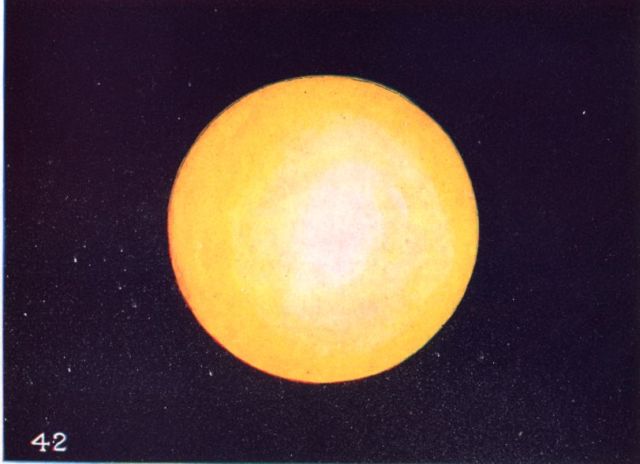
The image called “The Logos Pervading All” (Fig.42) is of course highly reminiscent of the various golden balls seen in the series, from the one that appears after the nuclear explosion in New Mexico to the seed used to create Tulpas.

Here’s what the book has to say about the use of yellow: “pale luminous primrose yellow is a sign of the highest and most unselfish use of intellectual power, the pure reason directed to spiritual ends”. It is clear in Twin Peaks that the golden ball born from the fire of atomic fission and the seed used to create new Tulpas are akin to the gold of alchemy, with its connection to immortality. Interestingly, gold is produced in the Universe by cosmic explosions such as Supernovae or, recently observed, star collisions (these explosions are to be linked to the nuclear blast from episode 8): “Researchers are witnessing a distant heavy-element factory synthesizing “maybe hundreds of Earth masses’ [worth] of gold” (link to an article about the collision of two neutron stars).

vlcsnap-2017-06-29-00h31m54s995.png

The antithesis of these golden balls can be found in the shape of BOB’s greyish placenta, itself reminiscent of the grey atomic mushroom depicted above.

The meaning of the colour grey fits perfectly with what BOB (and the woodsmen) represents in Twin Peaks: “hard dull brown-grey is a sign of selfishness, a colour which is indeed painfully common; deep heavy grey signifies depression, while a livid pale grey is associated with fear“. Selfishness, fear and depression – this is a pretty good summary of everything associated with these trans-dimensional beings.

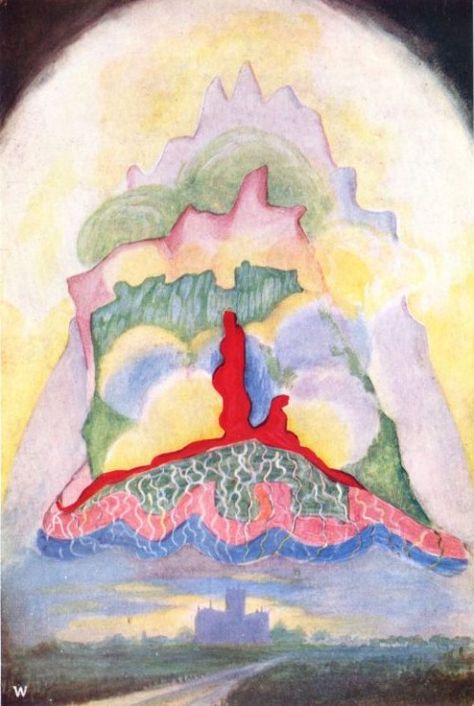
This fearful greyness can also be found in the next figure from the book (n°34) labelled “At a Funeral”, with two opposed thought-forms: a grey one expressing “profound depression, fear and selfishness” (the person who generated this thought-form did not know Theosophy and its promise of a “super-physical” life); the other, a colorful peak, with the pink of affection, the violet of a noble ideal and the blue of devotion, the golden stars symbolizing spiritual aspirations (this person was obviously familiar with the teachings of Theosophy). Difficult not to connect these images to the purple peak from The Return and to the creature that vomits the eggs in episode 8, both of which appear for the first time after the nuclear explosion which can be understood as a funeral of sorts, as a victory of death over life.

One can also wonder if some elements from the new season of Twin Peaks might not be linked to another book by Leadbeater entitled Man Visible and Invisible (1900) in which the author also describes the type of aura surrounding people depending on their emotions. The sequence in which we discover Diane’s true face, through the shell of Naido (which of course can be understood as a reference to eggs and golden geese, a constant theme in David Lynch’s universe), is also reminiscent of the ovoid shape which the aura is supposed to have according to the book.

Last but not least, the Fireman’s first warning to Cooper (“Listen to the sounds”) could also very well be connected to Thought-Forms. Indeed, the book claims that “many people are aware that sound is always associated with colour—that when, for example, a musical note is sounded, a flash of colour corresponding to it may be seen by those whose finer senses are already to some extent developed. It seems not to be so generally known that sound produces form as well as colour, and that every piece of music leaves behind it an impression of this nature, which persists for some considerable time, and is clearly visible and intelligible to those who have eyes to see. Such a shape is perhaps not technically a thought-form—unless indeed we take it, as we well may, as the result of the thought of the composer expressed by means of the skill of the musician through his instrument“.

Several examples of these sound-forms are then given. The drawing below, for example, is supposed to depict the forms created by the music of Wagner played on a church organ.

sound.jpg

Finally, one can wonder: what does Laura’s aura look like? Is she the Logos pervading all things in Twin Peaks?

vlcsnap-2017-06-29-00h40m40s157 (2)

Follow Unwrapping the Plastic: Facebook / Twitter

Thought-Forms – how Diane nailed it

Here’s a quote from my book Twin Peaks: Unwrapping the Plastic, which was published at the end of 2016, before the third season aired, and in which I discuss the opening credits of the original series: “The overall impression conveyed by the colours used in the opening credits is rather like a photo faded over time with several warm moments associated with the bird and the mill (reds and yellows). In contrast, the written text is a somewhat jarring neon green. This colour code can be linked to ideas found in Charles Webster Leadbeater and Annie Besant’s Thought-Forms (1901). Leadbeater and Besant were leading theosophists who endeavoured to give meaning to emotional dispositions based upon the colours present in a person’s aura, claimed to be seen by clairvoyants as an energetic field of light surrounding living things. The result of Leadbeater and Besant’s work was an ‘iconography of psychic conditions’ as described by Moffitt, who argues that perhaps Marcel Duchamp was influenced by this code in the creation of some of his paintings, as fellow artists Wassily Kandinsky and František Kupka certainly were” (p.44).

As we now know, the Thought-Forms in question have played a major role in The Return in the form of Tulpas.

vlcsnap-2017-08-16-09h50m13s192.png

Based on the concept that “thoughts are things”, the Though-Forms book presents a table of colours linked to certain feelings and emotions. Understanding these colours is necessary to properly read peoples’ auras. The book is replete with notions of vibrations, auras and radiations which, of course, make perfect sense in relationship to Twin Peaks.

Here’s the table of coulours included at the beginning of the book:

Thought-Forms.jpg

I believe this table becomes interesting in relationship to the colour of the nails of the main Tulpa of The Return, Diane. The importance of her nail polish is further underscored by the way she decorates her cell phone and also by Gordon Cole’s little game with Tamara’s nails in the plane. Is it possible  the choice of “the” Nine Inch Nails” in episode 8 was not totally was not entirely coincidental either?

This slideshow requires JavaScript.

Deciphering the meaning of Diane’s nails in relationship to this colour table is not a simple task, but the overall feel is nevertheless a negative one. The colours she wears don’t exactly stand for positive thoughts or emotions.

Nails.png

Thumb = Depression

Index = Selfish Action

Middle Finger = Deceit

Ring Finger = Pure Affection

Little Finger = Malice

This analysis is of course far from definitive as it would require much better quality images of both Diane’s nails and of the table of colours from Thought-Forms. Nevertheless, I believe it already points towards certain elements of Diane’s personality that sound rather in tune with her character in The Return.

I will continue this research in the coming weeks, taking the time to read Leadbeater and Besant’s book more thoroughly, but this first approach enables one to get a first hint of what Lynch and Frost were trying to do with Diane. Reading her aura, i.e. her nails, might have been a very helpful tool in order to understand her true deceitful nature.

ADDENDUM: During a chat dedicated to Twin Peaks, Jean-Sébastien Chauvin, who works for the French film magazine Les Cahiers du Cinéma, told me that David Lynch went as far as to create a colour specifically designed for Diane. This information supports my argument, given that her nail colours were anything but random and represented a carefully planned colour palette.

Follow Unwrapping the Plastic: Facebook / Twitter

At Land (Empire)

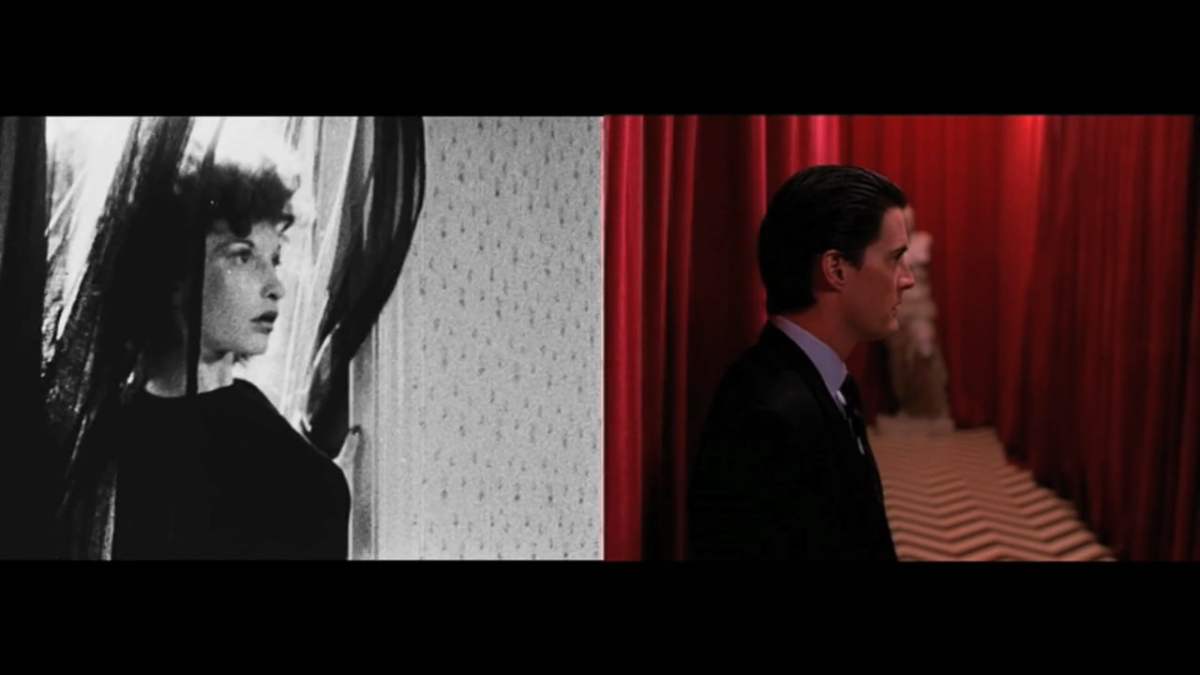
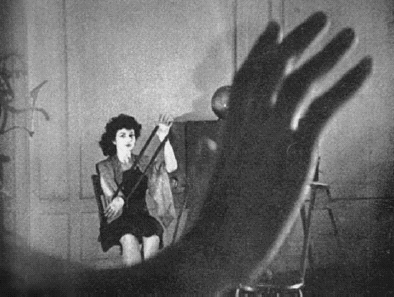
Maya Deren’s influence on the work of David Lynch is a well established fact. This is not surprising because both artists share the same appreciation for the experimental films of the early 20th century, especially those of the Surrealists (Richter, Cocteau, Duchamp), with which they have so much in common. Deren was a visionnary filmmaker who believed in the power of cinema as a true art form, something which connects her to David Lynch. His appreciation for her film Meshes of the Afternoon, for instance (among others), whose structure clearly impacted his Lost Highway, appears evident.

Meshes.jpg
Meshes of Lynch –> link

In addition to her work as a filmmaker, Deren was also a film theorist and some of her comments bear striking similarities to situations found in Twin Peaks: The Return. In her classic text, Cinematography: The Creative Use Of Reality, Deren wrote for instance: “In my At Land, it has been the technique by which the dynamic of the Odyssey is reversed and the protagonist, instead of undertaking the long voyage of search for adventure, finds instead that the universe itself has usurped the dynamic action which was once the prerogative of human will, and confronts her with a volatile and relentless metamorphosis in which her personal identity is the sole constancy.”

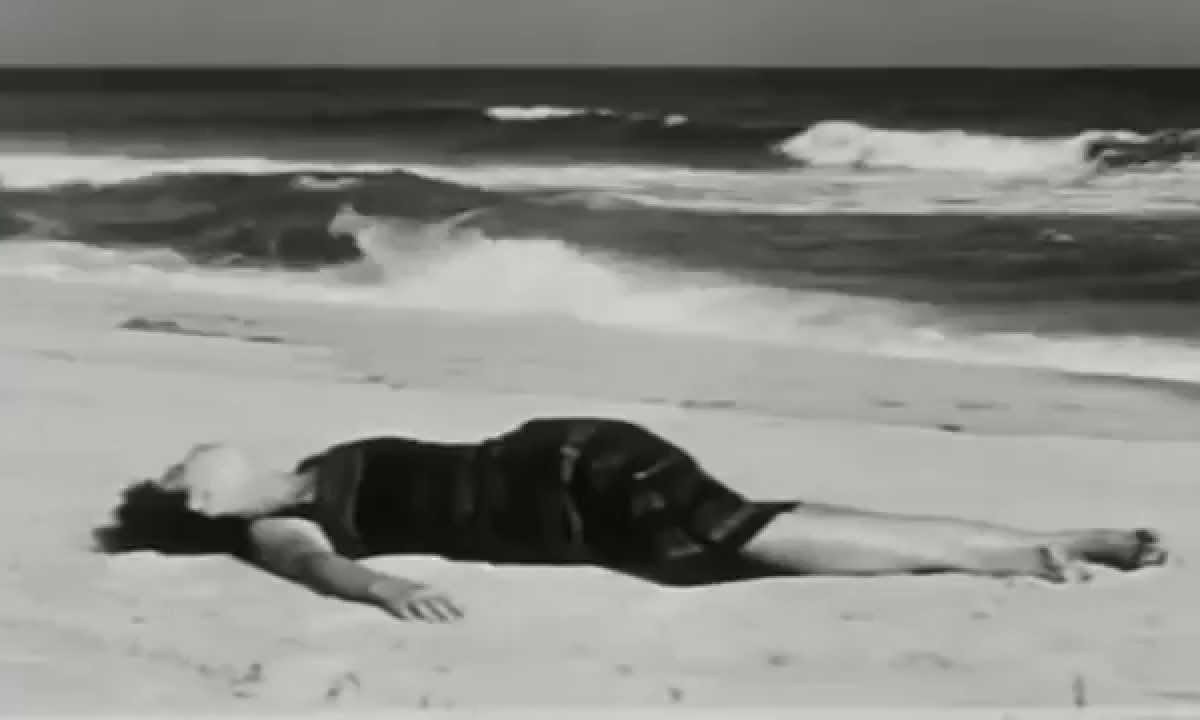
The opening situations of both works (At Land and Twin Peaks) are very similar: the body of a siren/woman (dead or unconscious) is washed ashore; this leads to an investigation into the notions of identity, doubles, and the unconscious. The way Maya Deren transcends the reality of the primodial beach by climbing a tree trunk reminiscent of Jack Rabbit’s Palace, takes her to a Palace of sorts, full of well dressed men and women, where she crawls across a table which becomes a dense jungle at moments (just as it’s necessary to cross a dark room which turns into a forest when one travels towards Phillip Jeffries in The Return)… The visual and thematic connections are numerous.

At Land (Maya Deren – 1944)

Beyond Laura Palmer’s case, what Deren writes in the text mentioned above describes Dale Cooper’s quest in The Return perfectly. In season 3,  somehow, he’s not totally in control of his own adventures anymore – the universe of the series has become the main protagonist while Cooper(s) drift(s) all over the USA, from Las Vegas to South Dakota, with no other guide in sight than his own (split) identit(ies). The “dark age” described by Janey-e is a world where “time is out of joint”, unhinged, as in Hamlet, and there might be no return possible to the former state of affairsto the safe and cozy world of Twin Peaks as we knew it.

In Homer’s Odyssey, Ulysses has to cross the Mediterranean sea in order to return to his kingdom of Ithaca. In Twin Peaks, it’s the “ocean of consciousness” that Cooper has to sail, the spiritual concept developed by the Maharishi Mahesh Yogi to describe the depths of one’s unconscious. In order to come back to himself (i.e. to wake up), Dale needs to dive first to the bottom of that ocean and manage to survive (below the waves of his own EEG and back towards consciousness).

WavesRR1RR2RR3

As we now know, Dale does manage to survive his exile and finally return to Twin Peaks with Laura (or a version of her). But as Maya Deren declared, “the universe itself has usurped the dynamic action” and the town to which he returns is not the one he left  (the one he was expelled from) twenty-five years ago.

Time is indeed out of joint.

vlcsnap-2017-09-06-12h01m36s689

All of this, Dale’s situation and more globally the one the world is facing, results from the atomic explosion of episode 8. This was the point of origin for the chaos that shook the universe. The fabric of space-time was torn apart by this “singularity” whose ripples can still be felt in the early 21st Century. Because of the central role played by the ocean of consciousness in the world of Twin Peaks, waves of all sorts seem to figure prominently – from water waves to time ripples, from radio waves to electrical ones.

vlcsnap-2017-06-29-00h36m36s803 (2)

The following quote from Maya Deren describes very well what we are facing in Twin Peaks: The Return: “The almost casual acceptance of the use of atomic energy is, if anything, testimony to man’s complete adjustment to science; for him, it is merely the most recent in a long series of achievements, some of which, like electricity and the radio, have had far more the quality of miracle” (An Anagram of Ideas on Art, Form and Film).

She then goes on to comment about the Surrealists: “Their ‘art’ is dedicated to the manifestation of an organism which antecedes all consciousness. It is not even merely primitive; it is primeval. But even in this effort, man the scientist has, through the exercice of rational faculties, become far more competent than the modern artist. That which the surrealist labor and sweat to achieve, and end by only simulating, can be accomplished in full reality, by the atom bomb“.

vlcsnap-2017-06-29-00h46m48s079 (2)

Extremely concerned with notions of space and time in her films, and with the possibility to play with them thanks to purely filmic tools, Deren’s thoughts apply perfectly to the world of Twin Peaks. Here too the nature of space and time gets distorted by the power of filmmaking. The very texture of this continuum gets modified – not so much by the use of slow-motion, for instance, but by the juxtaposition of distant actions thanks to editing so as to give the feeling that they influence each other at a distance; or by the clash of segments that take place at different times, as if they followed in close succession.

The stuff of which dreams are made of gets torn to pieces (the atomic explosion, Page’s shriek at the end of episode 18) and then rearranged, sewn together as a spacetime patchwork. Editing is akin to the art of sewing and that’s what David Lynch does when he juxtaposes scenes in The Return – he creates a patchwork that folds the structure of spacetime (the curtains of the Red Room, blowing in the wind as a watery element in the opening credits), even reusing segments from the first two seasons and Fire Walk With Me to create a new piece of art which defies linear time. One could argue that the various sub-stories of the Return (in Las Vegas, in South Dakota, in New York, in Twin Peaks, etc.) are sewn together by Lynch thanks to editing, creating thus the beautiful patchwork of the series as we know it (surprising at first in its diversity, and then slowly progressing towards unity).

Here’s what Maya Deren had to say about editing: “It must be obvious that a motion picture consists not of individual shots, however active, exciting or interesting they may be, but that, in the end, the attention is held by the way shots are put together, by the relationship established between them. If the function of the camera can be spoken of as the seeing, registering eye, then the function of cutting can be said to be that of the thinking, understanding mind.” (Creative Cutting)

21751653_10159429342345066_6714933939177110306_n.jpg
“The dress was altered to fit her. I noticed a different color of thread where the dress was taken in” (Sam Stanley ) Was Lil’s dress sewn from a piece of the Red Room’s curtains?
Module.png
Sonny Jim’s bed cover
Thread.gif
Ritual in Transfigured Time (1946), by Maya Deren

It’s interesting to note that the one thing that enabled the creation of the atom bomb (Einstein’s Theory of Relativity) is also the thing that explains the nature of the Universe, its curvature, in terms reminiscent of the influence of objects dropped on a cloth surface. Gravity curves space-time itself, changing the path that movements (in Space and Time) follow.

gravity.jpg

The one cosmic body that has the greatest influence on the nature of space-time is the Black Hole (where matter is compressed to a point, generating an enormous gravitational influence). Stephen Hawking actually named them “singularities”, locations in space-time where the gravitational field becomes infinite.

As we know, Lynch is very interested in the notion of a Unified Field – and interestingly, “the term was coined by Einstein, who attempted to unify his general theory of relativity with electromagnetism”. Electricity, magnetism, the curvature of spacetime all meet at the moment of the atomic explosion that takes place in episode 8.

To quote Maya Deren once more: “The theory of relativity can no longer be indulgently dismissed as an abstract statement, true or false, of a remote cosmography whose pragmatic action remains, in any case, constant. Since the 17th century the heavens – with God and His will – and the earth – with man and his desires – have rapidly approached each other. The phenomena which were once the manifestations of a transcendent deity are now the ordinary activities of man. A voice penetrates our midnight privacy over vast distance – via radio. The heavens are crowded with swift messengers. It is even possible to bring the world to an end. From the source of power must emanate also the morals and the mercies. And so, ready or not, willing or not, we must comprehend, with full responsibility, the world which we have now created

A fallen angel (messenger) – atomic fallout as a new source of (radio)activity

Follow Unwrapping the Plastic: Facebook / Twitter

Image

The Good, the Bad and the Dougie

The whole third season of Twin Peaks is summarized visually in its opening credits – with elements from episodes 3, 8 and 17.

The Bad (Mr. C) and the Dougie are laying down, helpless and stiff, somehow mixed together as if at a crossroads, while the Good (Dale, whose opposite sides of his personality they represent) watches over them from above… The Fireman’s peak appears to connect Mr. C and Dougie, floating on the ocean of consciousness…

image (4)

Superimposition Twin Peaks

17

image (3).jpg

image.png

17-2

Follow Unwrapping the Plastic: Facebook / Twitter