From the Rose Garden of Venus to Rancho Rosa: transmutations, numbers, shoes and faces of stone

HomThis week’s episode of Twin Peaks slowly builds on themes that were initiated during the first four episodes, introducing new characters as well as clarifying some of the major paths followed by the new season so far. It appears that alchemical thinking is steadily getting closer to the foreground of the narrative (I discussed the importance of the Great Art aka alchemy in my book Twin Peaks: Unwrapping the Plastic, 2016) and so is the underlying neo-Platonic structure of Twin Peaks’ mythology, inherited from Theosophy and the Vedas.

Concerning alchemy,  first, Doctor Jacoby with his golden shovels and the mysterious device in Buenos Aires suddenly turned into gold after Mr. C’s phone call are obvious references to the transmutation of lesser metals into pure gold. This process, both physical and spiritual, lies at the core of the series, centered around the process of individuation at play in its characters (Laura, Cooper, etc.), set on a path to purify their very souls.

Closely associated with the image of the Phoenix seen on the hood of Steven Burnett’s car (with such an emblem, it’s not surprising that his surname includes a reference to fire), the mythological reborn bird associated with cyclical regeneration, alchemy is also alluded to through references to silver one finds in the show – silver being the metal directly under gold in term of purity. For instance, the action with the good Dale takes place in Nevada, the Silver State. Moreover, when the mysterious Lorraine– a reference to Laura? or is it the “Lor” in her name, which reads as gold in French  (l’or)  that one should notice?– sends a text message to “Argent” (Argentina), the French word for silver (and money) appears on her Blackberry screen. Finally, she sends the number “2” of duality.

As far as numbers are concerned, they certainly play a central role in this new version of the series. They are everywhere and their meaning is revealed to us little by little. For instance, I have argued in a former post (link) that the mysterious clue given by the Giant at the very beginning of this season (430) is actually a reference to the Yankton State Prison, which happens to be built exactly at 43.0° North of the equator. The number given by the Arm (253) has also been explained as the time when the exchange between the two Coopers was to take place, the process being disrupted by Mr. C’s car crash and Dougie’s creation as a vessel for the good Dale (his license plate associates Dougie with the number 3 and when the good dale travels to Nevada via the electric device in episode 3, he waits for the same number to replace the foreboding 15 that precedes it).

Various associations with other numbers are omnipresent during the first five episodes. These numbers likely have  a symbolic meaning that should become more apparent the deeper we dive into the season. All of this is connected to the Pythagorean and Platonic ideas at the root of the mythological structure of the show. They are linked to the monistic ideas which I have described in detail in my book. The Platonic assertion at play here is that: reason is number and both exist prior to the visible world. “Listen, ye sons of the earth, to your instructors – the sons of the fire. Learn, there is neither first nor last, for all is one: number issued from no number” (Stanzas of Dzyan).

This slideshow requires JavaScript.

According to this vision, numbers constitute the primary substratum of the universe. Plato actually asserted that the origin of all things and the underlying harmony of the cosmos are numbers. Here’s what Helen Valborg, writing about Theosophy, had to say on the subject of numbers (from HERMES magazine): “For Pythagoras and Plato, numbers expressed not merely quantities but also idea-forces, each having a particular character of its own… The farther a number is from unity the greater its involvement with matter. Thus, the first ten numbers in the Greek system were treated as entities, archetypes and symbols of moving energy… Numbers lying beyond ten are basically products of combinations of these forces“. The meaning of the phenomenal world is therefore to be found in the noumenal world of numbers and ideas. Our world is just a shadow of the real world and it’s faster and more secure to look for answers in the latter than in the former. Empiricism is not the right way to proceed, neither is the inductive method.

rock.jpg

Agent Cooper, when he throws rocks at bottles to find a culprit or when he uses intuition to solve a murder, can be considered as a sort of anti Sherlock Holmes. He applies the deductive approach at least as much as the inductive method, contrary to the British detective who only functioned according to material evidence: “With the acceptance of irrational and negative numbers, the path to the development of modern ‘man-made’ mathematics was cleared. The immeasurable ‘sacred’, as it was understood, was considered measurable, and by the seventeenth century the deductive approach was no longer considered capable of standing alone. It had to be checked and revised against observation and experiment“. Theosophists and other esoterists wonder if this brought man closer to an understanding of his true nature. Twin Peaks seems to claim that that was not the case and that the true path to self understanding lies in the abstract world of ideas and numbers.

Valborg continues: “Meditating upon the fundamental character of these numbers, the Pythagoreans and followers of Plato perceived in them abstract qualities such as truth, beauty, goodness an justice. Thus the quaternary of justice added to the ternary of truth yielded beauty and goodness in the world, a manifestation of the fully formed human potential which combines eternity and time in a self-conscious transcendence of both“. In the new season of Twin Peaks, the good Dale is definitely associated with number 7 (Lucky 7 Insurance, the 777 of the slot machines at the casino, and he was also given the clue 430 which, when one adds the number’s figures, also gives a 7). It appears that his quest for his true identity should lead to a happy conclusion thanks to the positive omen signified by the number. It is also interesting to note that various numerology sites label the person associated with the number 7 as “the Seeker, the searcher of Truth”. This of course corresponds perfectly to the good Dale in his “quest” for home (he actually lives on Lancelot Court).

Dougie, before his transmutation into a pearl (which makes sense because it took place in the Red Room, the secret garden of Venus; she was depicted by Botticelli in his 1486 painting The Birth of Venus as a pearl emerging from a giant seashell), was associated with the number 3. This is the number that appears on his license plate. He was indeed the third Cooper, the unexpected one. Valborg: “It is a liberation to move on to the ternary formula for the creation of worlds and the solution of conflict posed by dualism“. The way out of the Manichean fight between the good Dale and his doppelgänger had to go through this liberating number which constitutes a way around the stalemate between opposing forces.

Cooper’s doppelgänger, Mr. C, has already been associated several times with number 6 (it’s the number that appears on his motel room, for instance). This number is associated with earthly matters, which makes perfect sense for a fallen angel like his character. Everyone knows that the false prophet, the Antichrist of the Apocalypse, is supposed to be marked with the number of the Beast: 666. In fairy tales, it is linked to the physical side of man, devoid of his spiritual part, and was connected in Antiquity to the goddess of physical love, Venus (remember the Red Room). Interestingly, the number at the top of the Blackberry device of Lorraine is 159, which also gives us a 6 (1+5+9 = 15 = 1+5 = 6).

The sum of money earned by the good Dale in the casino (435.000 $) gives us a 12, when one adds all the figures. Twelve is the number of space-time divisions (hours, Zodiac, months) and it’s also the number of knights around Arthur’s round table (remember that Dale/Dougie lives on Lancelot Court). It is considered to be the end of a cycle as the twelfth Tarot card, The Hanged Man, that symbolizes the end of the involutive cycle to be followed by the thirteenth’s card of Death, to be understood as a resurrection (Dale is indeed resurrected as Dougie). A numerology site on the Internet goes a bit further (The numbers and their meanings, on blogspot): “Number 12 represents the completed cycle of experience and when an individual reincarnates as the number 12, they have completed a full cycle of experience and learned of the possibility of regeneration toward a higher-consciousness. They belong to a group of developed souls who have accumulated an unusual inner-strength through many and varied lifetimes. They may still, however, be hindered by old habits that need to be changed“. Dale has reincarnated as Dougie and is moving toward a higher-consciousness. His prize earnings will help him on that path.

Concerning number 15: the one that appeared on the electrical device in the electromagnetic tower in episode 3, associated with death by the blind woman there, warning the good Dale to stay away from it . Encyclopedia Britannica explains that it was connected to the goddess Ishtar, of significance in Mark Frost’s latest book. This might be the reason why it was considered dangerous. One can also guess that the sum of its digits (1+5 = 6) would have directly led the good Dale to reincarnate as his doppelgänger, possibly killing them both in the process.

This relationship between numbers and the real world is one of dissimulation (or revelation, it depends). In order to understand what lies below the surface of reality, one needs to know the scaffolding of unchanging numbers and ideas which shape the world of appearances, always mutable. This is the reason why Gordon Cole, when he examines the picture of Mount Rushmore, is proud to claim: “Here they are, Albert: faces of stone!“. The various faces of presidents carved in the rocks there (Washington, Jefferson, Roosevelt and Lincoln) have achieved in Plato’s Sensible World the incorruptibility of ideas and numbers. The surface and the depth are in perfect synchronicity, there is no lie, no mask. This is to be understood in contrast to the various characters in the show whose faces become modified due to underlying tensions they inhabit. Dale and Laura both see their faces deformed by the influence of BOB, who lies beneath their respective masks. It appears impossible to read what truly lies behind these masks, to have access to the thoughts they hide away from us – except in the case, of course, of the granite faces of Mount Rushmore.

Before I close this post, I’d like to comment on two important motifs that I have noticed in the past several episodes. First, the good Dale continually longs after his own shoes (link). Returning to them appears to have become the symbol of his quest for self-discovery. Some heroes are on a quest to find something away from home while others are trapped in a distant land and need to find their way back. That is  Cooper’s current plight, being exiled as he is in a housing development (Rancho Rosa) in the middle of a desert. Though he lives in Las Vegas, he needs to find the exit from Rancho Rosa.

Shoes 2
Home

Etymologically, a ranch comes from the Proto-Germanic and means “circle, ring” – Rancho Rosa fundamentally means a pink ring / a ring of roses. In my book, I argued that the Red Room was a secret rose garden, so it seems that Cooper really has not gone far  from where he was originally trapped. Rancho Rosa is a desert, an empty place where thieves and hit men roam the streets, not unlike Hades from classical Greek mythology, where people are only the shadows of themselves. Contrary to the Temenos of the Red Room and all its Jungian symbolism, the housing development of Rancho Rosa feels like a dry dead end, a fake place for lost souls only.
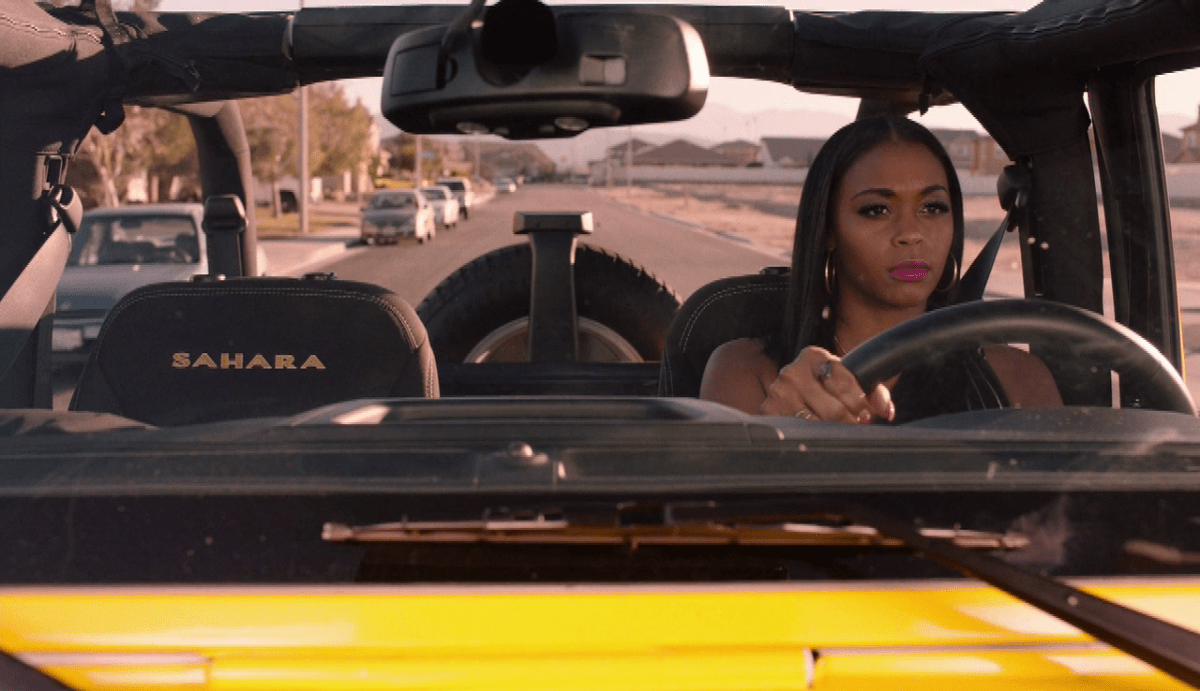
Sahara.png
Sahara desert

On the other hand, the logo for Rancho Rosa production is that of a light bulb – perhaps after all this, it is also a place of self discovery, a place where ideas come to light thanks to electricity (as they do in comic books). Its only fully conscious inhabitant, the junkie mother’s little boy with a red “1” on his tee-shirt, might be understood as a Jungian unifying symbol (similar to a mandala, or the squaring of the circle), able to bring contraries together, to realize a synthesis of the opposed. Let’s also remember that beyond the figure of the young boy, Laura Palmer “is the One”. What’s for sure, though, is that we are through the looking glass, as the call for help from the junkie mother in episode 3 is there to prove (she calls “119” instead of “911”).

This slideshow requires JavaScript.

The second recurring motif is that of food (link). There is apparently something about craving for the good food one finds in the town of Twin Peaks, a regressive fairy tale-like place where everything is so tasty. The good Dale wants to go back to his own pair of shoes, abandoned while escaping from the electromagnetic tower and the overbearing presence of the guardian mother’s knock on the door. But he also misses the sweet treats from Twin Peaks, a warm and cosy childhood of sorts he longs for amid the harsh reality of his present adult life in Nevada, in someone else’s shoes. Both this relationship to shoes and to food have been subliminally depicted in the Yankton Federal Prison scene when Dale’s doppelgänger manipulated the staff’s screens in order to call Argentina without being heard by surveillance: two of the screens briefly displayed images from a shoemaker workshop and from a cooking television program (where the food was bright yellow and red).

surveillance.png
Shoes and Food

Let’s wait for next week’s episode to learn more about the various elements listed in this post and follow the good Dale’s quest for his own pair of shoes.

Follow Unwrapping the Plastic: https://www.facebook.com/unwrappingtheplastic/
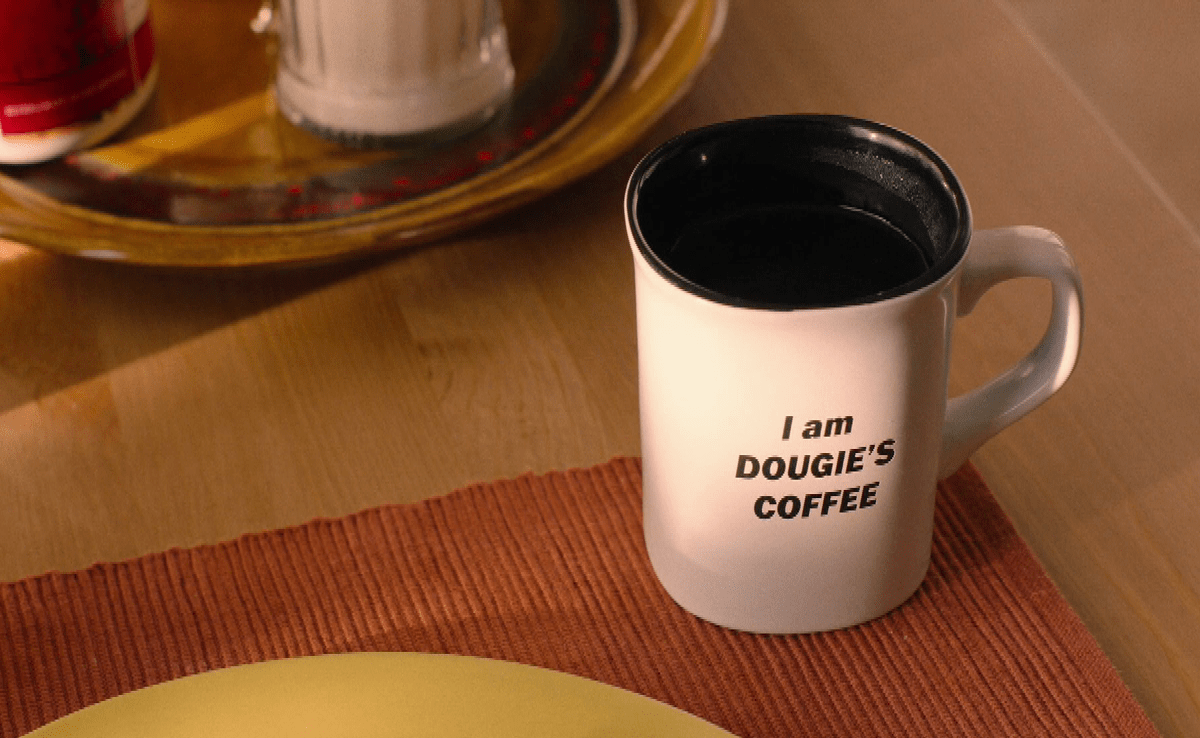
Food

Food has always played a central role in Twin Peaks (pies, coffee, donuts, Garmonbozia…). The new season makes an extensive use of this motif.

This slideshow requires JavaScript.

Follow Unwrapping the Plastic: https://www.facebook.com/unwrappingtheplastic/

Ducks on a Lake

The first image in the opening credits of Twin Peaks is a bird atop a tree. Everyone knows that, but what was the very first image in the series itself? Was it Pete Martell gone fishing? Or was it perhaps Josie Packard applying make-up in front of the mirror?

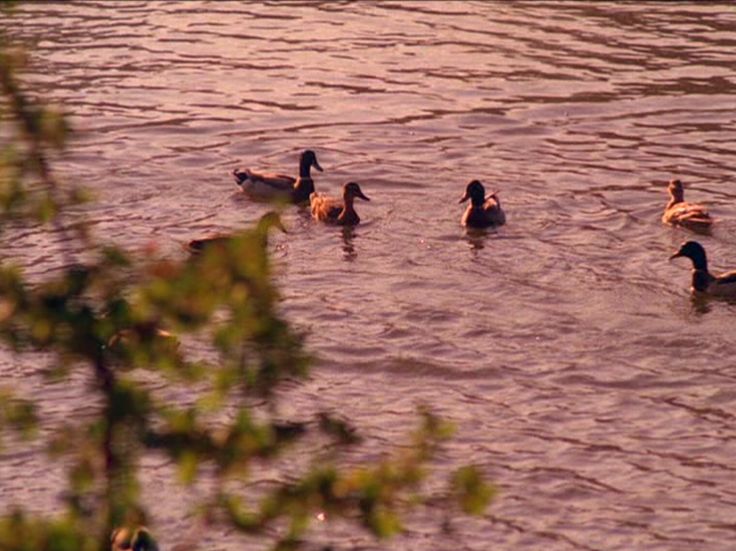
Not quite: it was another image of birds: ducks frolicking on a lake.

This slideshow requires JavaScript.

This was not, by far, the last appearance of the Anatidae family of birds (ducks, geese and swans) on the show. Twin Peaks is home to many species of animals, sometimes featured in stuffed form, from deer to rabbits, from owls to pine weasels. But in this open air menagerie, ducks hold a special place, as their appearance within the pilot’s very first image proves.

Before going any further, let’s read what David Lynch himself has to say about the question of ducks, and more specifically, the position of their eyes:

eye

When you start looking at a duck, you see your eyes moving in a certain way. You see textures, and colors, and shapes and you start wondering about a duck, about what it can teach us about any kind of abstract painting, or proportions, or even sequences. It’s always interesting that the eye is in the perfect place. If you move it to the body, it would get lost. If you move it to the leg or the beak, it’s two kinda of fast areas competing, even though the eye is the fastest, it’s the little jewel… I believe every film has ‘the eye of the duck scene’, but it can fool you which one it is

The Eye of the Duck

In a sense, Twin Peaks itself could be compared to a duck. I would argue that the eye of the duck would be the Red Room sequence(s) (Laura in her plastic bag is too close to the beginning and Dale’s possession by BOB, too close to the end, “fast areas” according to Lynch in the video linked above).

If the Red Room can be associated with Twin Peaks‘ eye of the duck, Lynch also claims that the mystery surrounding Laura’s murder was The Goose That Laid the Golden Egg (I go through some of the many references to fairy tales that one can find in the show in my book Unwrapping the Plastic). His creative differences with ABC led to the revelation of Laura’s killer, which was much too premature according to Lynch: “It’s a whole bunch of things that came together. I for sure was against it, and I always felt that it’s a story of the little goose that laid the golden eggs and you don’t want to kill that goose—not for a while, anyway”.

Interestingly enough, he had used such an image in the show itself. The idea of the golden egg is indeed what one finds on top of Big Ed’s Gas Farm:

This slideshow requires JavaScript.

This place is something between a gas station and a farm, i.e. something between nature and culture (very reminiscent in its design of the famous 1940 Edward Hopper painting entitled Gas and its clear demarcation between civilization and the forest). Energy radiates from the golden egg laid by the goose atop the sign just like it also emanates from the gas used by the cars that arrive to filltheir tanks.

Here is what Helen Valborg, a Theosophist, had to say about eggs (from HERMES Magazine): “To ancients in all lands, the egg was the symbol of generation and immortality … in Egypt by the winged egg floating above the mummy, carrying the soul to another birth … The alchemists spoke of the philosophical egg which combined all the elements of life, the container of thought and matter… the Cosmic Egg of Hindu tradition“. Inside the egg takes place “the necessary process whereby the One becomes the Many“. As such, it seems that one should not underestimate the importance of this symbol in Twin Peaks, a duck of sorts. Once again, as with so many elements of the show, this can also be read as something that explains the necessary mental evolution of its characters, their process of individuation. The egg/mind, like the alchemist’s athanor (furnace), is the place where lead is transmuted into gold.

This has been taken further by the Freemasons who adopted the Egyptian idea of a winged egg – named Kneph – and used it in their own collection of symbols. One wonders if this is not what the South Dakota version of Dale Cooper is looking for (what he ‘wants’). It would make sense that he would be trying to find a way to carry his soul “to another birth” and reach immortality, since he is afraid of going back to the Lodges.

This slideshow requires JavaScript.

The fact that his version of the egg is black and drawn on an Ace of Spades playing card also makes sense. First, this card is traditionally associated with death and the bad Cooper is not afraid to kill whenever he needs to (or is it whenever he wants to?). Additionally, beyond the egg, the question of the bird appears central: “Often connected with the Spiritual Egg is the idea of a sacred bird that drops the Egg into the waters of space or chaos… In Hindu tradition the ‘Swan of Eternity’ lays a ‘Golden Egg’ at the beginning of each Mahamanvantara (an astronomical period of time measured in Hindu mythology). This Swan is the sacred Kalahansa, the Word. Its egg is the Word made manifest“. According to another Theosophist writing for Hermes Magazine, Kalahansa is “the Dark Swan of Everlasting Duration which manifests as the White Swan of Eternity in Time… Kalahansa is black, representing Divine Darkness, the plenum of all potentiality. Imagine a mighty cosmic bird with black wings, which corresponds to infinity and eternity… The Great Bird of Life is the primordial sacred bridge between kala and khandakala, the unconditionally Timeless and conditioned Time“. Recall here the specificity of time in the Lodges.

A Sanskrit term meaning “Swan of Time”, Kalahansa is identified by ancient Hindus as the first cause of the universe by metaphorically laying a cosmic Egg in space. The Theosophist Helena Blavatsky states: “Kalahansa has a dual meaning. Exoterically it is Brahmā who is the Swan, the ‘Great Bird,’ the vehicle in which Darkness manifests itself to human comprehension as light, and this Universe. But esoterically, it is Darkness itself, the unknowable Absolute which is the Source, firstly of the radiation called the First Logos, then of its reflection, the Dawn, or the Second Logos, and finally of Brahmâ, the manifested Light, or the Third Logos”. Helen Vallborg adds: “We have two aspects of the swan: the dark swan whose wings appear at the head of the caduceus (the staff carried by Hermes in Greek Mythology) and the swan which becomes white when light is created… The first is Hansa-Vahana or ‘He who uses the swan as is His vehicle’. It is Darkness itself, the Unknowable. The second is Kalahansa, the vehicle of the One Ray”.

The following quote from Vallborg should be of special interest to Twin Peaks specialists: “Kalahansa, the initiator of cycles, the Swan of Eternity, lays the Golden Egg at the beginning of each manvantara. The Swan, spanning the elements of air, water and earth, ignites the fire of a new beginning and a proliferation of being“.

She continues: “Kalahansa, the Great Swan whose arched wing hovers over the illusion of manifestation… is an extremely complex symbol of transcendence, of spirit in the world, of cycles and of creation“. It is “a creature of  the air (“from pure air we have descended”) but obtains its sustenance on water and land… The white plumage of the swan bespeaks the milk of spirit and thought brought to earth, the swan can discriminate between it and the water upon which it floats… Before the world took form, the cosmic ocean was a sea of milk, but in manifestation the ocean became water, the lake and the pond”.

Another possibility, alongside Kneph, concerning what the bad Cooper wants can be found in the following quote regarding ants (the drawing could also be of such an insect): “The fourth principle, completing and dynamizing the triad of wisdom, compassion and sacrifice, is the principle of metaphysical continuity between the highest and the lowest. ‘The highest sees through the eyes of the lowest’ is an ancient Hermetic axiom. Therefore, God sees through an ant. The Divine Mind is related to the mind of an ant“.

This slideshow requires JavaScript.

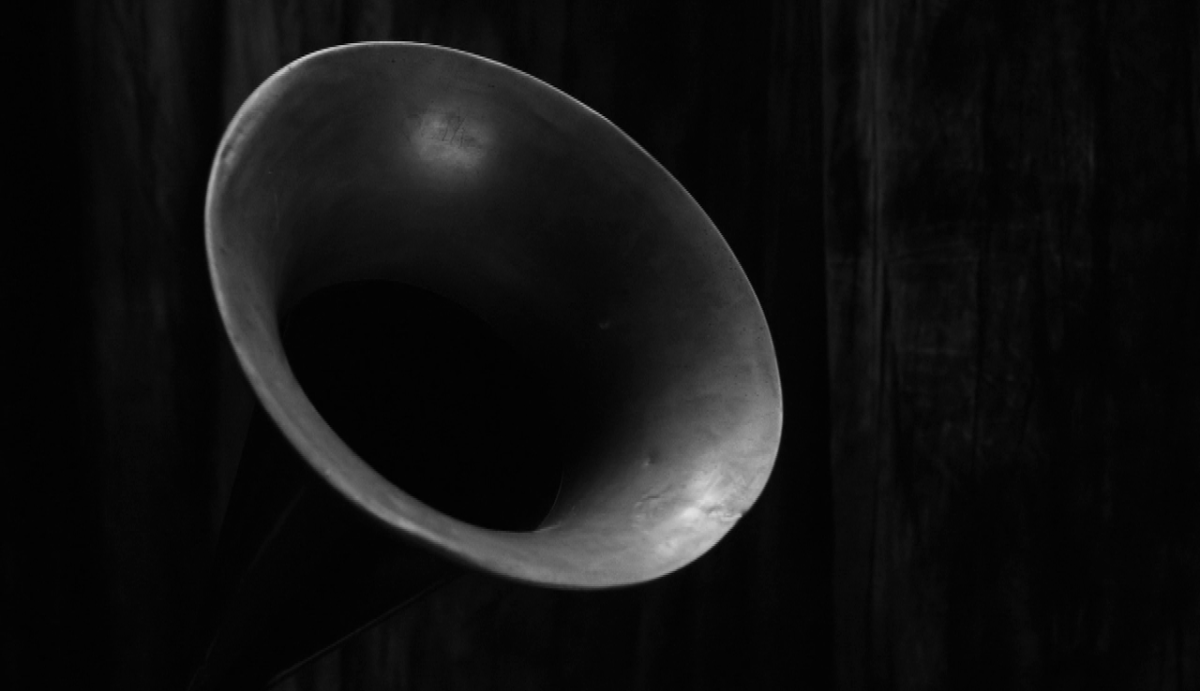
After 25 years, we now get a new season of Twin Peaks, which begins with strange advice from the Giant to the good Dale: “Listen to the sounds”. A weird series of sounds is played by a gramophone, sounds that might be produced by insects perhaps. Only, when one changes the speed of the recording (from 78 rpm to 33 1/3 rpm – the sequence, shot in black and white, might have taken place in the past, at the beginning of the 20th century,  when gramophones were still the main sound storage media), here is what one hears:

Listen to the sounds

Ducks 2

Ducks on a lake!

And here are the ducks heard in the sequence above, just before Cooper declares “Look at that! Ducks on a lake!”:

Ducks quacking

One cannot deny a strong similarity between the two types of sounds. It does seem that the gramophone plays the sounds of a duck quacking at a high speed (78 rpm) – perhaps because of the time distortion linked to life in the Lodges?

phonograph 1

Duck sounds? “There is a high noise to signal ration, and hence one cannot really listen to the deepest voice in oneself, the Voice of the Silence. One cannot listen to the music of the spheres. Occult healing of soul deafness can come through the Great Bird… The AUM, the Great Bird, represents that which is beyond all processes of change” (Hermes Magazine)

Is it possible that the archetypal sound would be that of a duck? The very same duck/goose/swan that laid the golden flying egg that the bad Cooper wants so badly? By playing the sounds for him on the gramophone, was the Giant trying to warn the good Dale about his doppelgänger’s evil plans? Is that the word “Quills” written at the top of the gramophone’s horn?

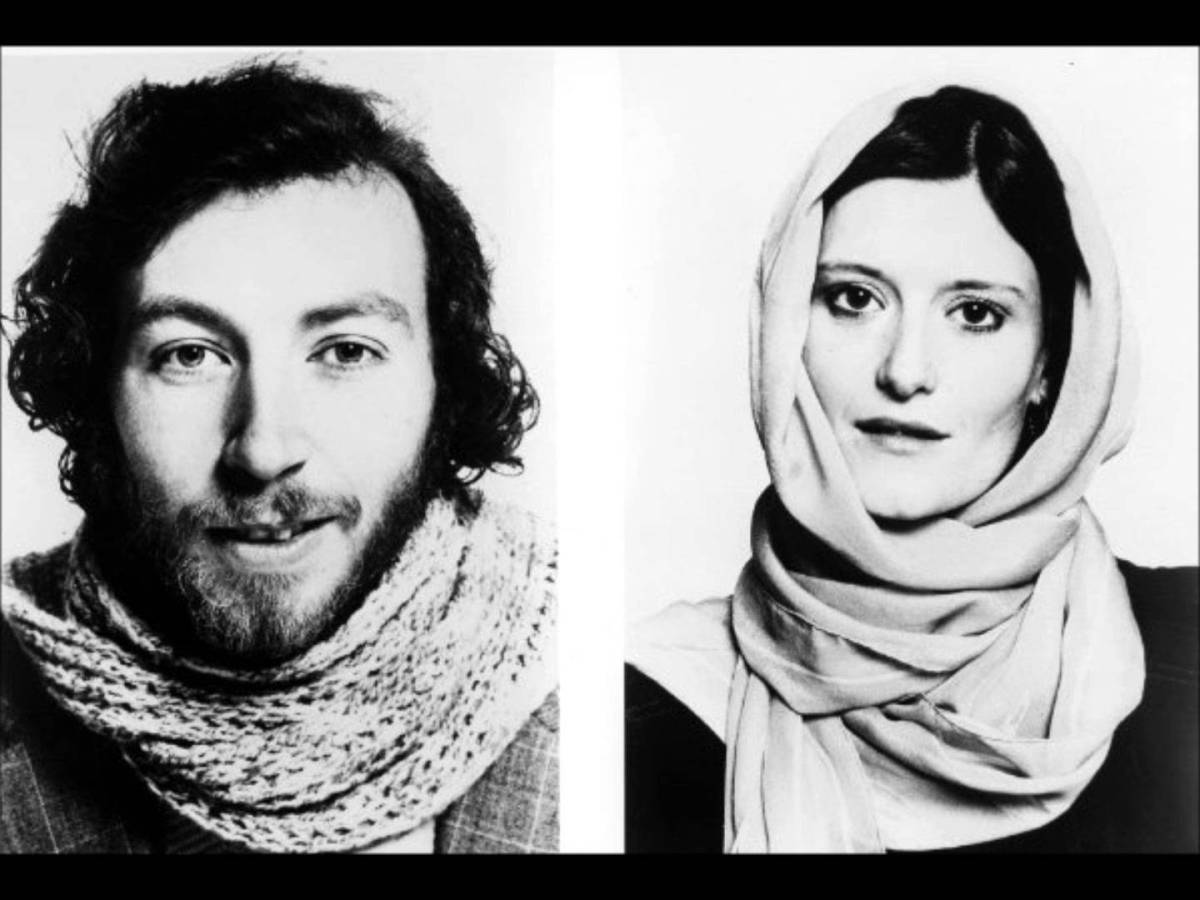
Finally, the Giant also says: “Richard and Linda. Two birds with one stone”. This is possibly a reference to the British folk duo Richard and Linda Thompson and their song “Bird in God’s Garden”. Those who have read my book are aware that I have long been convinced that the Red Room is a secret garden of sorts, a Temenos closely associated with the idea of Paradise (from Persian, meaning “walled enclosure”), one in which the bird-like entities of the Lodges dwell (“where we come from, the birds sing a pretty song and there’s always music in the air”).

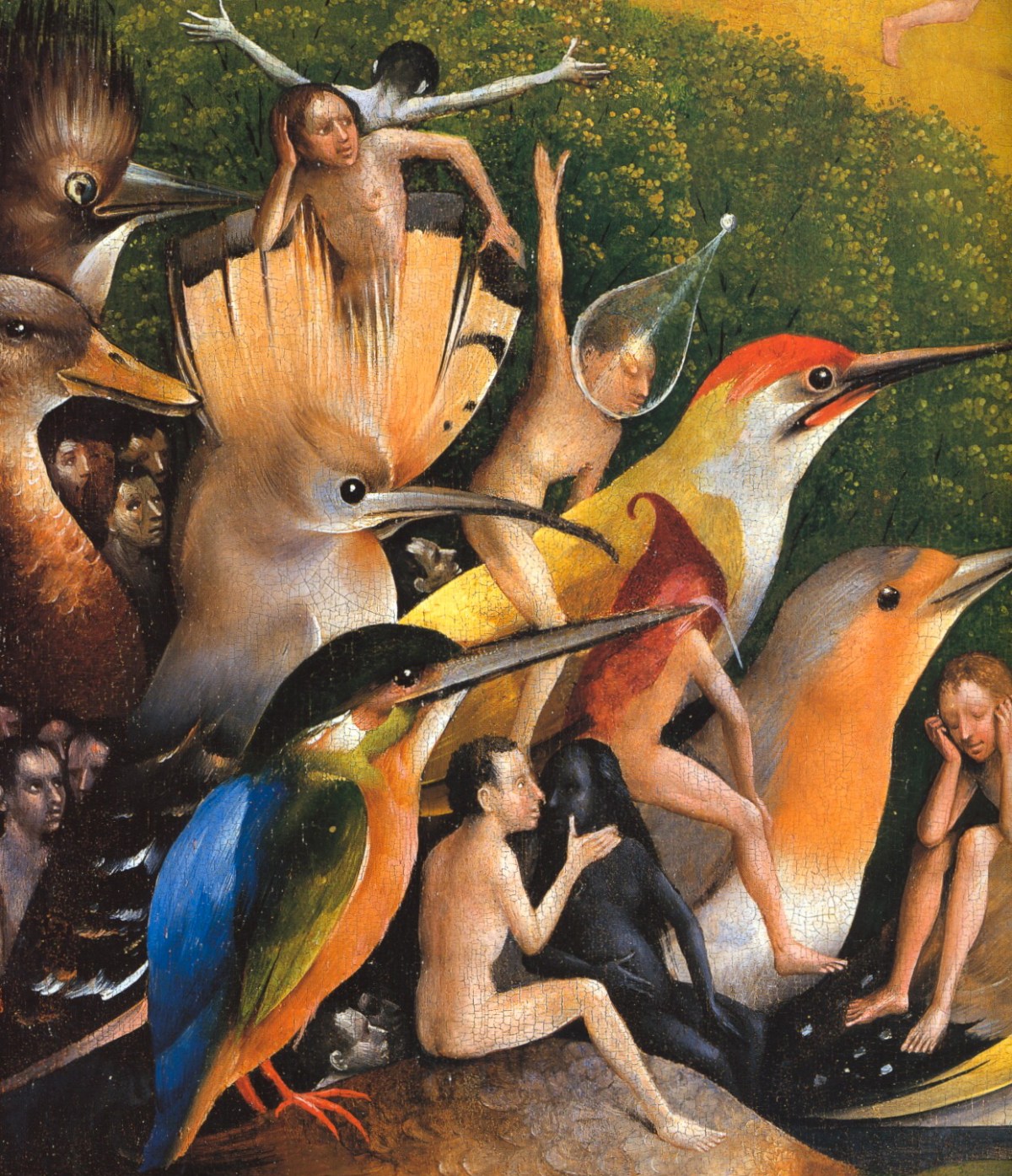
birdsbosch
Detail form Hieronymus Bosch, The Garden of Earthly Delights, a painting pinned next to David Lynch’s desk in the documentary The Art Life.

Reading the lyrics of the Thompsons’ song underlines what I asserted in my book. They also largely correspond to the good Dale Cooper’s situation, estranged from his own country, doing his best to return to Twin Peaks, the place that gives access to God’s Garden via Glastonbury Grove:

I am a bird of God’s Garden
I do not belong to this world

I am a bird of God’s Garden
I do not belong to this dusty world

For a day or two I have been locked up
in this cage of my own body

I did not come here of my own
How can I return of my own

He who brought me here can take me back again
He who brought me here will take me back again

to my own country

richard and linda.jpg

Richard and Linda Thompson – Bird in God’s Garden

Follow Unwrapping the Plastic: https://www.facebook.com/unwrappingtheplastic/
430 = 43.0° N = Yankton Federal Prison

At the beginning of the first episode of the new season of Twin Peaks, the Giant and the good Dale Cooper are seated in front of each other in a black and white world (the past?). The Giant communicates a series of clues to Cooper, including a number: “430”.

Later, in the second episode of the new season, the evil Dale Cooper (Mr. C) explains to Darya, his partner in crime (soon to be disposed of), that he’s supposed to be pulled back into the Black Lodge. Of course, he has no intention of letting this happen. This is why he asks Ray Monroe (as often occurs in the show, one can find clear links between a character’s name and water/streams/oceans: is it Ray as in a ray fish? Monroe comes from a Scottish surname meaning “from the mouth of the Roe”, a river in Ireland; and in modern Persia, Daria means “sea”) to get information from Bill Hastings’ secretary concerning certain geographical coordinates (numbers, letters).

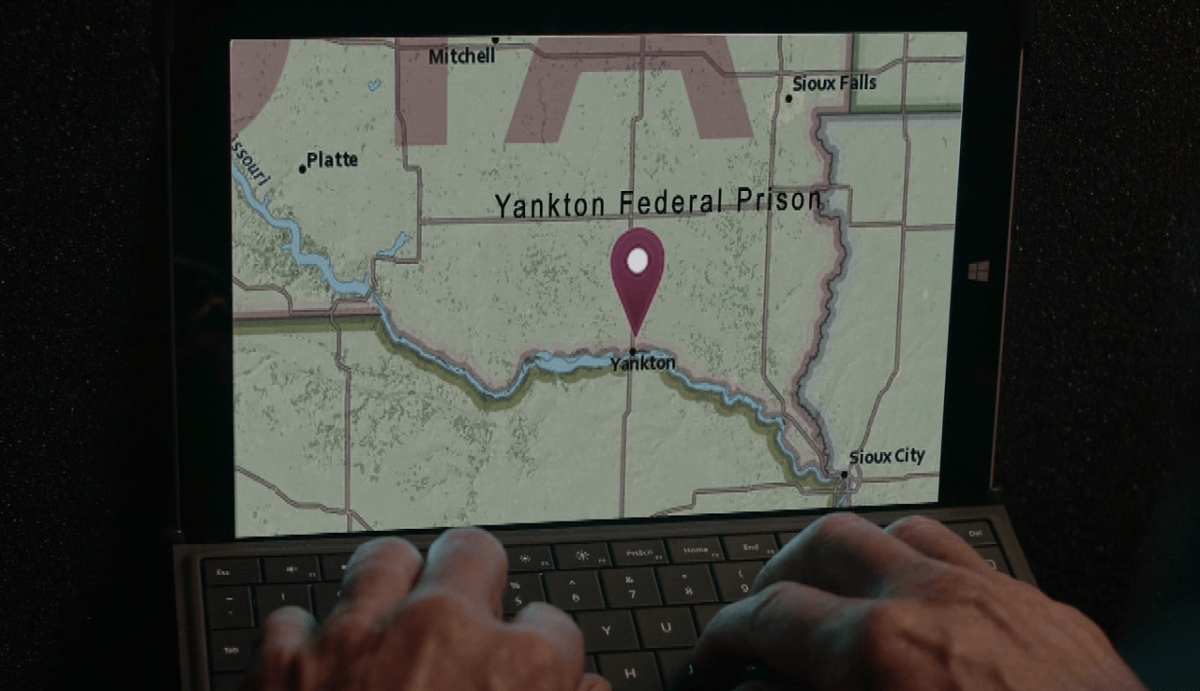
The evil Dale then brings up a map of South Dakota on his computer screen with the location of the Yankton Federal Prison in South Dakota, where Ray has supposedly been incarcerated for carrying guns over the state line.

Yankton.png

When one computes the geographic coordinates of the prison, it appears that it is situated at a latitude of precisely… 43.0° north of the equator (by roughly -97.3° west of the Greenwich meridian)! The Giant was informing the good Dale about the place to find his doppelgänger, soon to be incarcerated in that prison following his spectacular car crash.

doppel.jpg

As far as the clue given by the Arm (“253, time and time again”), it is now clear that this was meant to warn Cooper about the time when the exchange between Mr. C and himself would take place. The Arm was giving him time coordinates, the moment that directly led to the incarceration of the evil Dale at Yankton.

Space coordinates for the Giant, time coordinates for the Arm.

time.jpg

The Arm’s message implies that the event may take place several times. Will the location also change each time?

Follow Unwrapping the Plastic: https://www.facebook.com/unwrappingtheplastic/

Four Birds With One Stone

This time we are not dreaming anymore, the 25 year night has finally come to an end and “the sleeper has awakened”: Twin Peaks is really back on our screens and we have already been treated to four new episodes.

The first two, although interesting for widening the scope of the original series to include new places and characters, remain pretty much in tune with what we already knew about Twin Peaks (actually, the Red Room sequences are not as surprising as they used to be a quarter of a century ago). This likely served to bring us back into the narrative while introducing new threads, and the excellent third episode gives us a hint of the new mythology that is going to be developed within the new season, centered on Dale Cooper’s return to the town of Twin Peaks (home). The fourth installment is a continuation of the new ideas and situations established in its predecessor. All in all, one could say that the new Twin Peaks is very different (darker in tone, perhaps, and doing away with many of the melodrama and soap opera aspects), but fundamentally the same (the underlying themes remain stable).

vlcsnap-2017-05-26-09h59m24s927.png

Here are some transversal thoughts about the first four episodes, possible avenues for further examination during the next few months.

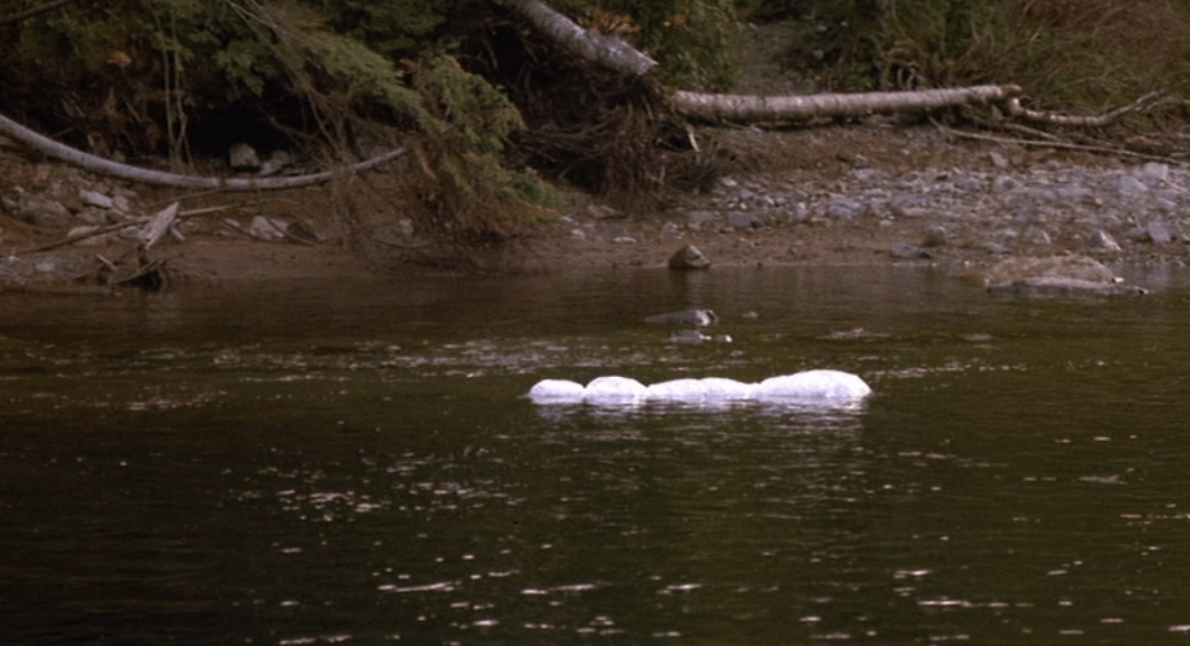
• First, the opening credits: They constitute an excellent example of the fact that this new season, while superficially different, retains at its core the exact same mythological roots as the original. Though the images appear different, the structure of the credits indeed remain stable. The only slight difference is the opening image of a rainbow bubble floating in front of Laura Palmer’s face.

vlcsnap-2017-05-27-14h44m42s358.png

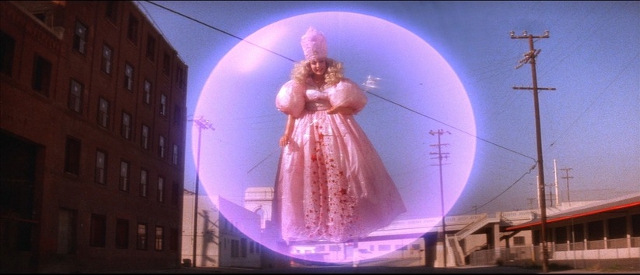
Although different from the bird that traditionally opened each episode of the 1990s series, one can argue that this rainbow is  not much of a change. It should be considered alongside the following image of Sheryl Lee as the Good Witch in Wild at Heart, floating in a similar bubble (the rainbow aspect of the bubble is surely not an accident in this context).

wild-at-heart18.jpg

In both cases, the bubble is associated with the air, with floating / flying, and as with the bird, one can guess that it is supposed to symbolize the “soul” of Laura Palmer “descending from pure air”, now that she has become a member of the Lodges.

After this initial image, the sequence follows a movement which, though slightly modified compared to the original opening credits, maintains the same relationship to the four elements. It begins with a bird’s eye view from the forest that has come to symbolize the town (air & earth); continuing with another eye bird’s view (!) from above the waterfall neat the Great Northern Hotel (water), creating a round shape in the middle of the screen. This shot transforms into a vision of the fiery red drapes of the Lodges, which feel like they have been set in motion by the impact of the water or by a breeze (air & water & fire); and the credits finally end with a tracking, swirling shot of the chevron motif on the floor of the Lodges, clearly associating it with the four elements mentioned above, and perhaps more precisely with water and to the mysterious quintessence of Alchemy (see my book for more details about the meaning of the floor).

Here are the sequences from the new Twin Peaks, the 1990’s version, and Ruth, Roses and Revolver (a sequence from the film Dreams That Money Can Buy–see my previous post for more on David Lynch’s admiration of this film) placed side by side, following the order of the new series to visualize the air / earth / water / fire components:

• What should one make of the observation room set in New York and its glass box, continually watched by various video cameras and a young man seated on a sofa? What is this box? And why is it so important to warrant constant surveillance?

Glass box.png

Once more, the answer to those questions may be related to The Great Art of Alchemy. When seen from the perspective of the young man, the box unites the various geometrical figures (circle, square, triangle) involved in “the squaring of the circle”, which was a process designed to created the philosopher’s stone.

The philosopher’s stone is described in such a way by one alchemist: [1.] Make of a man and woman a circle [2.] then a quadrangle [3.] out of this a triangle [4.] make again a circle, and you will have the Stone of the Wise. This was meant to symbolize the process followed by the Self through Matter towards Unity Enlightenment: 1) Self Area->Behavior Boundary 2) World Area->Law Boundary 3) Trinity Unity Area 4) Spirit Area.

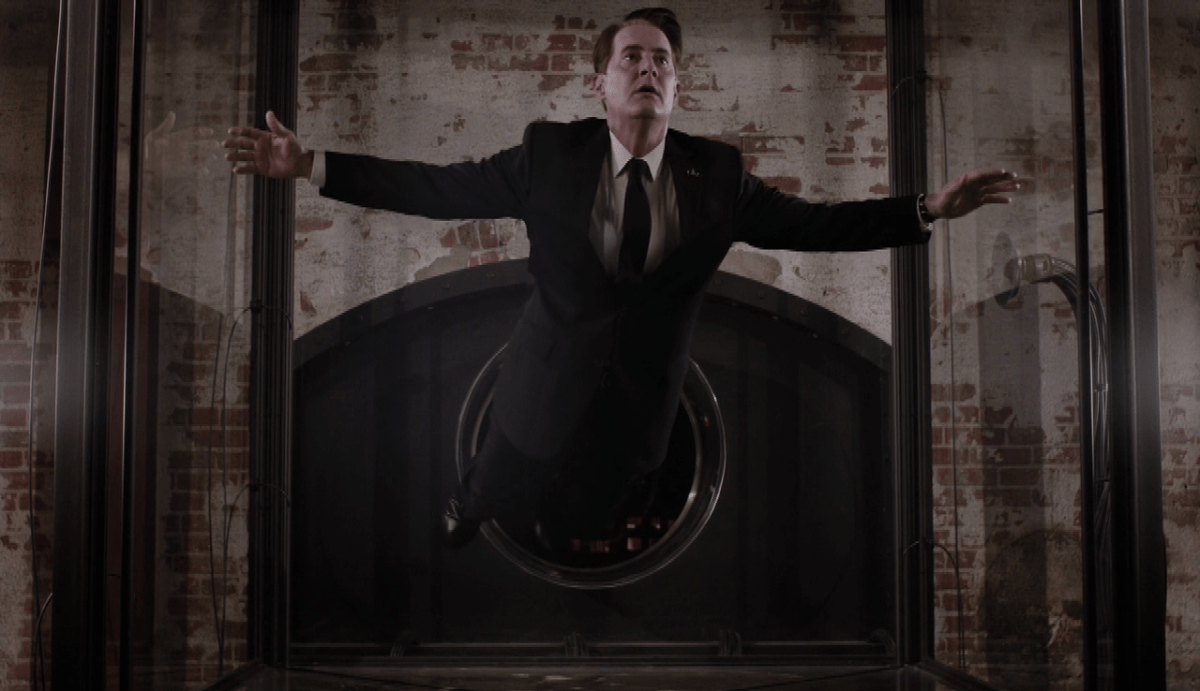
In the new Twin Peaks, it is made clear that man/woman/spirits enter the box via the circle (the image is highly reminiscent of HAL from 2001: a Space Odyssey and its final “trip” through space-time), and that they move on later to a different realm towards the Spirit Area. The connection to higher realms has to take place in a vertical city like New York, a vertical relationship underlined by the various cardboard boxes piled up in the room and the city’s skyline visible at the outset. The four triangles on the cube form an X (X marks the spot) that enables communication between our level of reality and the Fourth Dimension, that of the Lodge entities (that “target X” appears again on the boxes concerning to Agent Cooper held by Hawk following the telephone call from the Log Lady, connecting that case to the Lodges).

This slideshow requires JavaScript.

But why does the glass box need to be surveyed by someone constantly? It is interesting to note that the only moments that someone (or something) appears in the box are when the young man stops watching it, first when he goes to check on the guard at the entrance (Cooper “swims” in the box for a few seconds), and again when he makes out with Tracey (the demonic entity appears before killing them both). The answer to our question might lie within the realm of quantum physics and its notion of the observer effect. It refers to changes that the act of observation will make upon an observable phenomenon. It might be that the act of watching the box actually prevents entities from entering it, or traps them there.

This glass box is to be understood as a transdimensional aquarium in which entities from higher dimensions can transit. Caught outside the building by the X structure, thanks to the verticality of New York, brought inside the building with the help of the tube/circle, they can briefly be kept there to be examined by the cameras, as long as no one physically watches. Why would someone be asked to constantly watch the box, then? Perhaps to prevent the appearance of such entities in our world, using the box as a lightning rod (the electrical fire).

• The subject of electrical fire brings me to discuss the sequence in episode three during which the good Dale leaves the ocean’s “lighthouse” for Las Vegas. Set on the ocean of consciousness, this tower seems to be the equivalent of one of our lighthouses – except that it is manned by a blind woman (or rather, it seems that her eyelids have been sewn shut) and does not function with light, but with electromagnetism. This likely makes sense in the Fourth Dimension of the Lodge entities where everything is connected to electricity.

Inside the tower, in the room with the chimney and the blue rose, Dale finds a strange device on the wall. Numbers appear on its surface: first, 15, associated with danger by the tower’s blind resident who signals a cut throat when Dale approaches the device. This  number is followed by 3, once the electromagnetic beacon has been disconnected. Dale uses the device to leave the tower. It seems that he was destined to reach South Dakota and the car his doppelgänger was driving via the electric fire of the cigarette lighter, but due to an accident that disconnects the power of the car, he is sent instead to Las Vegas where he takes Dougie Jones’ place. Dougie is the first to vomit (Garmonbozia?), as the bad Cooper is able to hold it in long enough so that the exchange does not take place with him. The good Dale is then seen traveling as a tube of smoke towards Dougie’s vomit on the floor.

What about the numbers on the tower’s wall device? Could they be linked to the intensity of the current, 15 being much too dangerous for transportation? Since this location appears to be a transdimensional knot, my own take is that entities from the Fourth Dimension use it to travel to our 3 dimensional world. In order to reach the right destination, the electromagnetic power  first had to be disconnected, or at least diminished, which was done by lowering the handle on top of the tower.

• Another link to Alchemy might very well be found in the actions of Doctor Jacoby. He is basically turning the shovels he has ordered into gold. The reason why he is doing so remains unclear for the time being, but one can guess that he will try to unearth a treasure (perhaps one from the Treasure Island slot machine Dougie first sees when he enters the Casino in Las Vegas?).

• It is interesting to think about the tone of the new Twin Peaks and about the possible connections to be made with other filmmakers’ works. As far as I am concerned, without listing all the influences I observed during the first four episodes, two directors (as well as perhaps Guy Maddin for the third episode) came to my mind in relationship to the images and themes developed so far. Visually speaking, I was struck by a certain resemblance in the third episode to the films of Patrick Bokanowksi, a French experimental filmmaker, and especially to his movie L’Ange.

L’Ange (Patrick Bokanowksi – 1982)

From a thematic point of view, the links with the filmography of Tim Burton are strong, particularly in relationship to the character of Edward Scissorhands, whose childish behavior when confronted with everyday life is strongly reminiscent of Cooper as Dougie, who also behaves like a small child, an innocent newborn of sorts who needs to learn again how to dress himself, how to speak, how to eat, etc. The fact that he lives in Las Vegas, the most childish American city akin to a Disneyland for “adults”, is telling.

LV1.png
Searching for a tropical treasure in the adult Disneyland of Las Vegas

His quest for a home is very similar to Edward’s (but also to Ulysses, whose Odyssey might have a lot to do with Cooper’s). David Lynch’s cinema has always been slightly regressive in the sense that it is obsessed with a lost Golden Age (the 50s), with the mother’s womb (when Cooper enters the aquarium, he floats like a baby in the placenta), with what comes “before”. Dougie might not be his first infantile character (the Elephant Man also behaved in such a way), but he might be the most obvious so far. One could also say that the character is a nod to the past of Lynch’s own filmography, Dougie sharing much in common with Henry from Eraserhead.

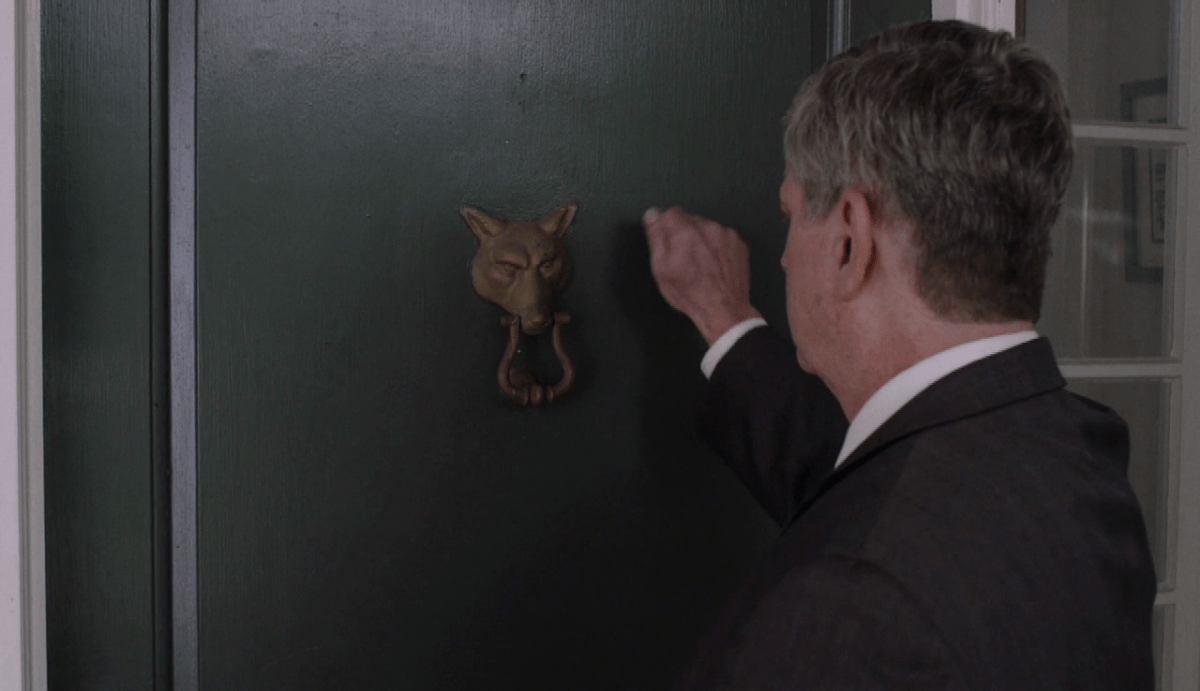
• The fairy tale elements that I have listed in my book are still present, perhaps even more obvious. In episode one when the police come to William Hasting’s home to arrest him, we find that this killer has a door knocker in the shape of a wolf. The big bad wolf is still hiding under a costume, wearing the mask of a respectable high school principal in order to collect its Garmonbozia.

Wolf.png

• Numerous moments found in the new Twin Peaks are reminiscent of images from the films of David Lynch, particularly Dune and Eraserhead. Some examples:

This slideshow requires JavaScript.

• Gordon Cole’s inability to hear properly, which causes him to change the meaning of what is being said reminds me of The Adventures of Tintin. Aside from the fact that one famous adventure of the Belgian reporter took place in Tibet, many parallels seem to exist between the two sets of main characters even if it’s unlikely that Frost/Lynch are familiar with the celebrated Belgian comic: Cole/Professor Calculus are both hard of hearing; Tintin/Dale are both innocent seekers of the truth; Albert/Captain Haddock tend to speak their mind loudly; Thomson and Thompson are a good example of the omnipresent theme of duality and dopplegängers in Twin Peaks

• By the way, what is Franz Kafka doing hanging in Gordon Cole’s office? Is Tamara Preston going to metamorphosize into something else? Or is it just a tribute to one of Lynch’s favorite authors?

Kafka.png

• Is it just me or is there something engraved inside the phonograph’s horn?

• Concerning aspects of the new series that I am less fond of, I can note at least two elements:

First, I tend to find the obligatory closing song at the Bang Bang Bar at the end of each episode a bit immature. Aside from the fact that one has the feeling that Lynch is simply providing a playlist of his favorite bands, and though the lyrics tend to echo what takes place in the series, the overall feel remains too MTV for my taste. These scenes are not filmed in a particularly creative manner and feel like a gimmick that the show could have done without. These moments are not unpleasant, but rather unsatisfactory.

My main problem with the new series is found in its depiction of women. The original series was already  a bit vain from this point of view, with (male heterosexual) fans debating endlessly about who might be the prettiest girl in Twin Peaks, as if they were in a candy store. One is totally free to have personal preferences, but this market of women approach has always seemed a bit objectifying to me. This time around, after four episodes, I have to say that I find the new series a bit disappointing from this point of view, especially after our TV screens have been graced with strong female characters such as Buffy, Carrie Mathison, Sarah Lund and countless others. I expect better of a 21st century series: not one single female character after four hours of viewing who contains much substance or embodies any central role, but several prostitutes of course and gratuitous stripping down (for women only). So far, Agent Tamara Preston has been very underwhelming as a character – the way she speaks and walks is more reminiscent of a playmate from Playboy than anything else.

Sadly enough, one could even argue that the most interesting female role so far has been the one of Denise Bryson… played by male actor, David Duchovny!

I hope that the upcoming episodes will provide more substance for the women of the cast.

Last but not least: only one single (live) owl in four episodes, that’s not enough!

OWL.png

Follow Unwrapping the Plastic: https://www.facebook.com/unwrappingtheplastic/
Song to the Siren

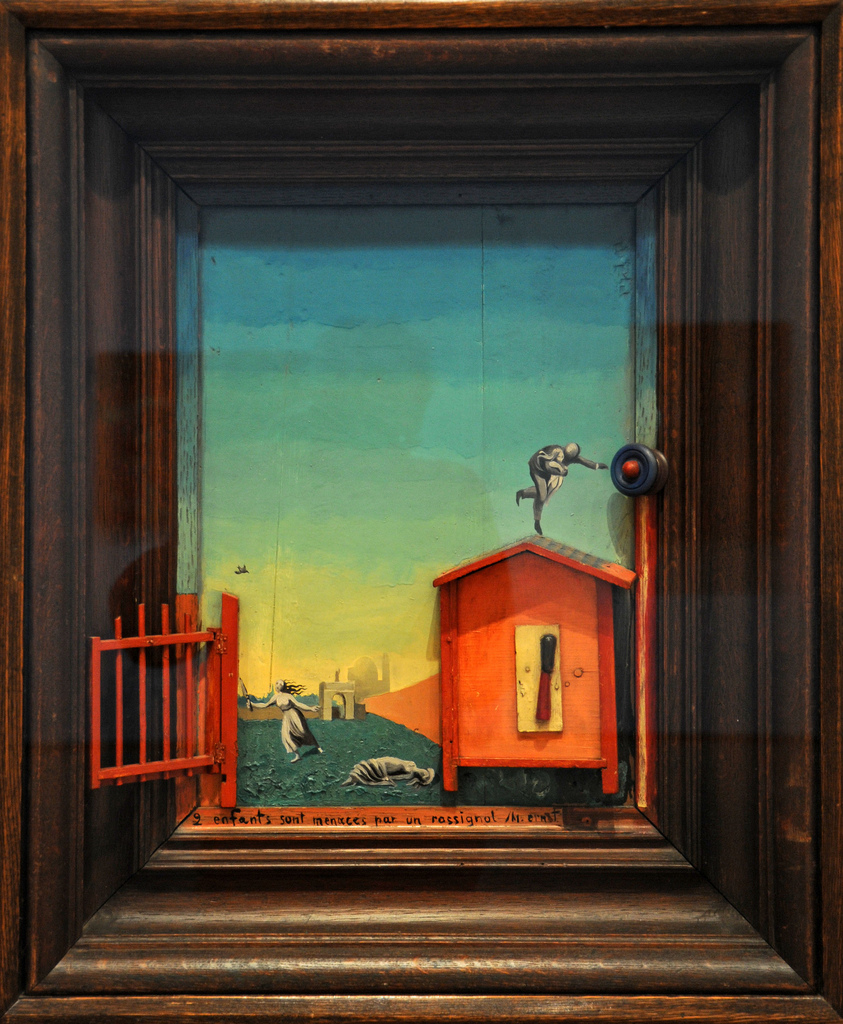
A river, a waterfall, a lake, an ocean of consciousness… Laura’s watery astrological sign (Cancer)… the chevron motif on the Lodge’s floor… the links to Max Ernst’s and his Une Semaine de Bonté

As much as fire and food, water is found everywhere in Twin Peaks.

It is even where one would least expect it – hidden in the names of the characters. But before analyzing this aspect of the show, first I’ll focus on other water motifs.

What is water? What does it do? “Scientists may call it an ‘essential substance’, which can be solid, liquid or gaseous, providing the main constituent of vegetable and animal cells as well as crystals and many minerals… all of the strange and important characteristics of water arise from the configuration of the three atoms in the molecule and the distribution of electrical  charge among them… enabling it to serve as an almost universal solvent” (all quotes by Helen Valborg, from HERMES Magazine).

Constantly moving, “it is an archetypal symbol for transmutation“.

With water, we are once more brought to the world of Alchemy. Water is the solvent which enables the transformation of (mental) lead into gold. “Water lubricates every aspect of the wheel of life“. The process of individuation needs it so as to reach its “golden” destination. Without water, there is no life possible (of the body and of the mind): “Water is always feminine, the ‘Mother’ out of which all life comes. She is Chaos, primordial substance, and Gangetic flood… The Secret Doctrine tells us that hydrogen was the earliest existing form of matter and, together with oxygen, it instills the fire of life into the Mother through the process of incubation… This echoes the occult teaching about ‘the Fiery Wind’ whose ‘fire’ may be traced on a more phenomenal plane in the combustion of hydrogen by oxygen”.

wind.jpg

Water, fire, wind… All of this should sound very familiar to any Twin Peaks fan. When BOB – often associated with the (fiery) wind in The Secret Diary of Laura Palmer – gives his victims to the river (a symbol of fertility and the irreversible passage of time: “the inexorable repetitiveness of the water’s movement imbues one with an impression of timelessness“), he might very well be “instilling the fire of life into the Mother”. The ritual sacrifice he commits in doing so is able to generate an offspring, a crop: Garmonbozia.

But where does water come from and where does it go? “We see the waters as they emerge but we are often ignorant of the unseen developments that engaged them when they first percolated into the earth’s rocky structure” (here, I’m tempted to add: “There was a fish in the percolator!“). In Twin Peaks, the waters might very well originate in the Lodges (at least from a symbolic/metaphysical/noumenal point of view). The Lodges appear to be closer to Unity, to that place at the roots of the Cosmic Tree from which the phenomenal world emanates. The floor of the Lodges with its chevron motifs is a visual reminder of their watery essence (this becomes even clearer in the new episodes we are seeing unfold in the third season) – they are the place of the “ocean of consciousness” dear to David Lynch and Transcendental Meditation. This can also be understood from a psychoanalytical point of view in that waters originate in the unconscious, at the root of the conscious mind, the place where archetypes – which can be associated with Lodges entities – reside.

As for the place where these waters flow now, first, they become a river that cascades downward near the Great Northern Hotel (in a process that reminds us of the collision between the Fourth Dimension and our reality – more on that in a future post: Cube falling through a plane) before ending their course in the Black Lake. “The name ‘river’ comes from rivus or rive, indicating ‘a splitting asunder’… the river literally divides the earth… symbolically it divides the world of the living from that of the dead“. A good example of this would be the River Styx, in Greco-Roman mythology. It is clear in Twin Peaks that once a body/log is fed to the river, that person never comes back to the world of the living. It enters a new dimension.

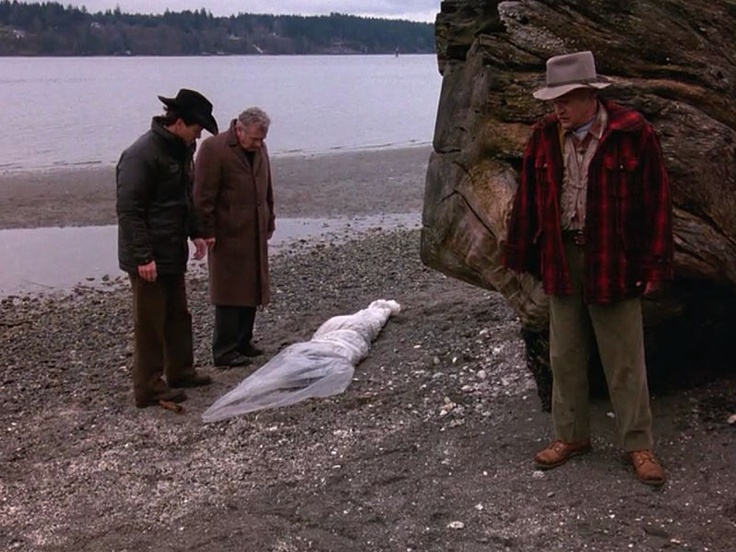
This is what happens to Laura Palmer. She is washed ashore on the banks of Black Lake, a Lady of the Lake of sorts – Arthurian mythology is not far below the surface of Twin Peaks. Links to Glastonbury are actually discussed in the last episode of season 2 and the Bookhouse Boys’ patch with its sword in a tree can also be read as a reference to Arthurian lore.

lady.jpg
The Lady of the Lake
bookhouse
Excalibur – the magic sword

Dale Cooper, knight to “Laura of the Lake”, follows her into the body of water towards the Red Room. “The critical factor distinguishing a lake is that it is completely surrounded by land, with no direct communication with the sea” (one could even say that it’s an “Inland Empire” of sorts…). In Twin Peaks the ocean (of consciousness) is where everything starts, where one catches “big fish”. Black Lake is downstream from that primordial ocean, down the path of duality. “For many people water has always suggested a connection between the superficial and the profound, a transparent, fluidic mass which conceals and yet reveals the way to another world. The lake embodies this in its fearful depths as well as on its glittering surface. It is profoundly feminine, being the humid spawning place of monsters and magical female power, and yet the image of self-contemplation, consciousness and revelation…. sometimes becoming the means of transition between life and oblivion, form and formlessness, solidity and fluidity“. In that sense, it can be understood as a mirror of the mind, as the reflections on its surface during the original opening credits of the series indicate: “It is a mirror into which the mind is readily drawn to receive a broader picture of reality. In its water the past lies alongside the present and the above is mirrored in below. Atomic particles float freely to shape images known only in other worlds, and long-forgotten memories surface to float for a moment beside embryos of ideation in their pre-natal state“. This special relationship to time is of course highly reminiscent of what happens in the Lodges.

figure-13

Not all rivers end up in a lake, though: “Some believe that the Ganges enters Patala, the nether world which is no end but only the other side of the cycle of life and death“. Interestingly enough, some argue that Patala (the subterranean realm situated under the earth in Indian religions) might be found somewhere… in South America, the continent where Buenos Aires is situated and where agent Phillip (friend of horses) Jeffries (territory/foreign/hostage – peace) mysteriously disappeared in 1987.

SevenTalas.png

This connection between water and what lies below the earth (usually associated to magma, or Hell) can further be explained by the fact that H2O is sometimes described as “liquid fire”: “Water quenches fire but we are taught that water is liquid fire. Light, flame, heat, cold, fire and water are the ‘progeny’ or correlations of electricity, the web of the One Life itself… The progeny of electricity are infinite. Foremost is fire as creator, preserver and destroyer, then light which is the essence of the divine ancestors, and flame, which is the soul. Light incubates water which fuses with earth, as Moses taught, to bring a living soul. Light and flame in and through fire and water receive, conduct and dissolve, at each stage of the manifesting triads“.

One can actually visualize the process of water being turned into fire (though, fundamentally, they are thought to be one and the same) in the new credits of Twin Peaks, all of this being the result of the (watery and fiery) electrical flow which then appears on the floor of the Lodges.

So, in a way, one could say that water, fire (should we say instead: the fiery wind?) and electricity are “one and the same” (remember that cryptic and famous line from the last episode of season 2?).

This slideshow requires JavaScript.

Here is another quote which sums up what one needs to keep in mind when water appears in Twin Peaks: “Water symbolizes transmutation, the ocean of the unconscious, the abyss of mystery and intuition. It is a veil of the One Fire of Atman, a mediator between life and death, with its positive and negative flow of creation and destruction. The entrance to the Spirit-world is typically described in terms of crossing a river or immersing oneself into a body of water“.

As always, when it comes to symbols associated with Alchemy, Transcendental Meditation or Theosophy, everything should also be understood in relationship to the mental development of human beings. These images are really images of the mind (of the characters) and of their progress along the path of individuation: “The microcosm of the macrocosm is man, and he contains, like the globe itself, his own ocean. In his body there are at least thirty quarts of water inside the cells, and these make up seven-tenth of his total weight… Life in the womb before birth is aquatic“. If the flow of consciousness is somehow blocked, one takes the following risk: “Water dammed up and hoarded will grow stagnant, but given freely will nourish, gain strength and purity in its onward rush

vlcsnap-2017-05-24-11h53m42s312.png
Cooper in the aquarium / womb / transdimensional & alchemical glass box

Once caught in a stream, one should be careful about the treacherous currents which could drag them under the water. In relationship to what was just said about Patala as the underworld / the southern hemisphere, it is interesting to read the following lines which connect the watery element to another recurring motif in the films of David Lynch, the spiral: “To its north (the belt of the earth) water drains in a spiral, moving counter-clockwise,  while to its south it does the opposite. The counter-clockwise motion signifies the fall of spirit into matter, whereas the opposite represents its ascendanceAs a river ceases its youthful rush downhill, drawn on by gravity, the combination of forward and sideward flow produces a spiral movement… the river’s current assumes the same serpentine pattern that describes the movement of all manifested energy“.

figure-18
The counter-clockwise spiral, or the fall of spirit into matter…

In David Lynch’s mind at least, it is likely that all these streams and rivers originate and eventually lead to what the Maharishi Mahesh Yogi, the founder of Transcendental Meditation, calls “the ocean of consciousness”: “The reality of the universe is one unbounded ocean of consciousness in motion“. It is probably that reality that Cooper visualizes when he falls from the Lodges to a realm situated inside a milky cloud. The ocean he then discovers appears directly related to consciousness, the underlying reality of the universe. When he climbs to the top of the building via a ladder, he appears to be sailing on a small raft on an endless cosmic sea, with a rocking motion…

Returning to the idea of water hidden in the very name of the characters in Twin Peaks: the names there are not chosen randomly, they are vectors of meaning (just like water, in a sense). An etymological approach to these names is enlightening concerning what they are supposed to represent in the show, beginning with Laura Palmer’s name, analyzed earlier on this blog and in my book as well.

How about Annie Blackburn? Annie stands for “grace”, but Blackburn means “dark-colored stream“. Then we have Norma Jenning’s new father (featured in Mark Frost’s book, not the same one as in the original series, which might explain the absence of Annie): Marty is derived from “Mars”, the god of war) and Lindstrom from “linden stream“. Beverley Paige, Ben Horne’s new assistant, means “beaver stream” and “young helper”. One can also list Ruth (“sorrowful”, which might explain why she was killed) Davenport (“harbor on a trickling stream“); Douglas Milford’s given name stands for “dark water” (this might also explain Agent Cooper’s interest in Douglas firs); and of course there is Dougie Jones (“John’s child”, with another slang-like meaning linking it to addiction –> Cooper indeed becomes a child again when he becomes Jones).

I’ll conclude by quickly mentioning another sort of water, tears: “May the disciple who would seek Nirvina light within himself the golden flame of Akashic Fire…. May he build high the fire of tapas within him until his pain and longing are converted into sweet and compassionate tears that may flow in abundance for all humanity“.

This slideshow requires JavaScript.

Follow Unwrapping the Plastic: https://www.facebook.com/unwrappingtheplastic/