You can read my article about Sephiroth and Qliphoth on the site Lapsus Lima by following this LINK.
Trees of Life and Death in “Twin Peaks: The Return
TWIN PEAKS – Unwrapping the Plastic
My blog has something to tell you
You can read my article about Sephiroth and Qliphoth on the site Lapsus Lima by following this LINK.

riverrun, past Eve and Adam’s, from swerve of shore to bend of bay, brings us by a commodious vicus of recirculation back to Howth Castle and Environs.
(beginning of Finnegans Wake, by James Joyce)
It began 30 years ago with a river carrying the corpse of a young woman wrapped in plastic to the shores of a lake in the town of Twin Peaks. Or did it? This journey, which ostensibly began in the 1990s and continued again in the 2010s, might reveal only the tip of a vast iceberg. What if the bulk of Twin Peaks’ mythological body lies dormant under the surface, displacing a large portion of the space/time ocean? Dreams of many sorts have nourished this quest, re-envisioning our reality through a lens of mystery, romanticism, and surreal occurrences. Various literary works have helped to form its path, from Homer’s Odyssey to Dante’s Divine Comedy and Valmiki’s Ramayana, among others.
In Twin Peaks’ most recent incarnation, the writings of the modern author, James Joyce, have been elevated to a similar mythological level as those of the aforementioned works. Ulysses, Joyce’s retelling of the Odyssey in the context of early 20th century Dublin, bears striking similarities to the narrative design of The Return (discussed in my forthcoming book). Upon closer scrutiny, Finnegans Wake (1939), Joyce’s final novel, is equally worthy of consideration in this regard.

Known as an intimidating, impenetrable, and almost unintelligible web, Joyce’s dream-saga “is a mighty allegory of the fall and resurrection of mankind” whose “mechanics resemble those of a dream” in which “all time occurs simultaneously” (A Skeleton Key to Finnegans Wake, Joseph Campbell). The links one can establish between Finnegans Wake and The Return are numerous, and it may be argued that Joyce’s work served a major role in providing the scaffolding for the story contained in The Return. The complex manner in which the plot of Finnegans Wake unfolds, at times tending towards narrative rupture, mirrors the intricate structure of season 3. Both works require an active reader/viewer ready to put the scrambled pieces of the puzzle together in order to fully appreciate the message. The philosopher Schopenhauer’s image of the world resonates with this: “It is a vast dream, dreamed by a single being, but in such a way that all the dream characters dream too. Thus everything interlocks and harmonizes with everything else.” (On an Apparent Intention in the Fate of the Individual).
The prologue of Joyce’s tale describes Tim Finnegan, an Irish hod carrier, a free mason, really, who when drunk falls off a ladder to his death (echoing Adam’s fall from grace, Humpty Dumpty, or the Cosmic Egg). During the wake, Finnegan is revived by a splash of whiskey and returns to life. He thus becomes a hero-god of sorts, an omnipresence that symbolizes the entirety of humankind. Reality is the return of his sleep, and if he wakes, “the stage is overturned and doomsday arrives.” (Campbell). Echoing this tale of origins, it is important to note the recurrence of the ladder motif in both The Return and Mark Frost’s The Secret History of Twin Peaks.


Finnegans Wake takes place within the confines of enlightenment thinker Giambattista Vico’s cyclical concept in which history passes through four phases, the latter phase of which, much like current times, is characterized by chaos, individualism, and sterility. This is reminiscent of David Lynch’s belief in the “Kali Yuga” age, a concept found in Hindu philosophy, and in which Lynch believes we currently live. It is a dark period of evil, as described by Janey-E in part 5 of The Return.

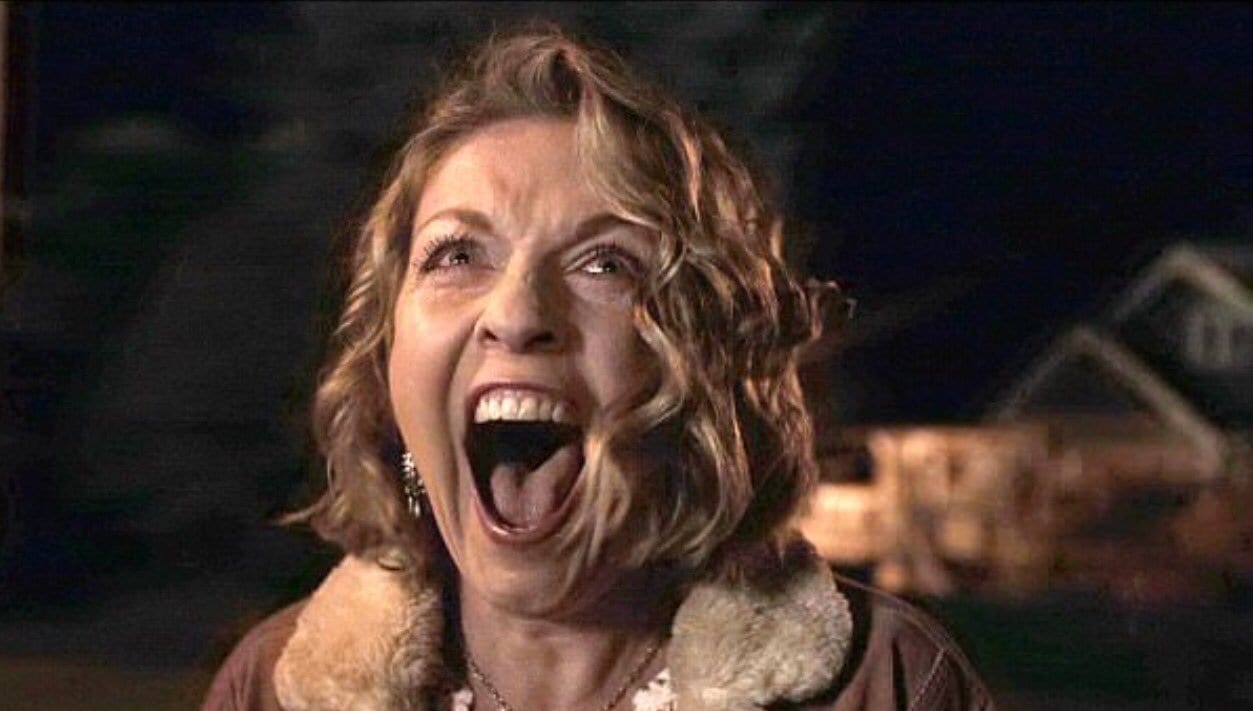
According to Vico, this age “is terminated by a thunderclap, which terrifies and reawakens mankind to the claims of the supernatural, and thus starts the cycle rolling again with a return to primeval theocracy.” (Campbell). The cyclical aspect of The Return issues in part from this philosophical idea, and the thunderclap in question might well be Carrie’s shriek at the end of part 18, which blows the electrical circuits in the Palmer household.
There are echoes of The Egyptian Book of the Dead throughout Finnegans Wake, and the potential influence of this book on The Return (along with its Asian counterpart, The Bardo Thodol, or The Tibetan Book of the Dead) seems apparent. In it, “One follows the journey of a soul through a dreamlike landscape to the Throne of the Lord of the Dead.” (Campbell). It is difficult to overlook the similarities in that description with the focus in season 3, the entire story of which “may be regarded as something drawn out of the subsoil of the soul.” (Campbell).

Parallels between Finnegans Wake and The Return continue in the character of Humphrey Chimpden Earwicker (HCE), Finnegan’s successor, who dominates the rest of the novel. A tavern keeper in Dublin, Earwicker has been caught peeping at or exhibiting himself to girls in Phoenix Park, Dublin’s equivalent of the Garden of Eden. This original sin led to disgrace, creating HCE’s own version of the Fall. Earwicker is also troubled by desires for his daughter Isabel, who is a reincarnation of his wife. At one point, HCE declares: “I reveal thus my deep-sea daughter which was borne up proudly out of my dreams, unclothed, when I was pillowed in my prime”. One can read both a reference relating to Venus/Aphrodite emerging from the waves (note the various statues of Venus in the Lodges), and to the naked Laura wrapped in plastic.
Anna Livia Plurabelle/ALP, Earwicker/HCE’s wife, is a manifestation of the fruitful principle in the world. She is symbolic of Eve, Isis, Iseult, a river, and a mother hen. Their twin sons, “called in their symbolic aspect Shem and Shaun, and in the domestic aspect Jerry and Kevin” (Campbell), represent a battle polarity present throughout history. Shem, the introverted poet, is associated with the biblical Cain, and Shaun, the policeman of the planet, with brother Abel. Shaun, “while winning of the skirmishes” with his brother, “loses the eternal city.” (Campbell). “HCE, the father of the pair, represents the unity from which their polarity springs.” (Campbell).
Earwicker’s equivalent in Twin Peaks is Dale Cooper, trapped in the Red Room (the Garden of Eden, the Temenos I’ve described in my book Unwrapping the Plastic), whose fall through water/space in part 2 (“non-exist-ent!”) leads to his “descent” into the material world[1], in which he becomes split into polar opposites: his sons Shem (Mr. C, the mother’s pet) and Shaun (Dougie, the father’s pet).

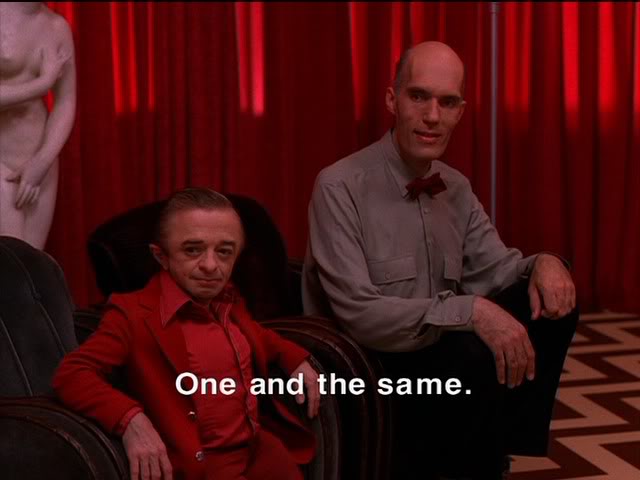
Beyond Earwicker, it could be argued that Cooper is also a manifestation of Finnegan (fine-again) himself, the All-Father. Joyce explains that “It is all one and the same. Finnegan’s form is that of the landscape”.
Just as Finnegan’s story is the prologue to the book, the opening credits of The Return hide Cooper’s form (the archetypal Form of all forms) in the very landscape of Twin Peaks. He too is a gigantic presence beneath and within reality (the mountains) which, mixed with the movement of the river (a manifestation of his wife, ALP), sets the world in motion, towards Howth Castle (by the River Liffey, in Dublin). And where does The Return begin? In the Fireman’s palace/castle, with an exchange between the Fireman and Cooper.

Cooper is the equivalent of HCE/Earwicker, and Dougie corresponds to Shaun, while Mr. C is a match for Shem. Who, then represents ALP and daughter Isabel? Concerning ALP, Cooper’s is not the only form discernible behind the reality of a landscape. When Albert hands a picture of Mount Rushmore to Gordon Cole, one can recognize Cooper’s face in the clouds, as well as that of Diane. She is meant to represent Cooper’s version of Eve in the story, and their sexual relations in part 18 resonate with the notion of original sin. This moment echoes the intercourse between HCE and ALP that takes place near the end of Finnegans Wake, before the cycle ends and a new one begins, the Rise after the Fall, the phoenix from the ashes.

Interestingly, Diane disappears right after her night with Cooper. This is a clue to the fact that she has returned to Cooper, her point of origin, as Eve came from a rib taken from Adam. This process mirrors the move towards unity, towards the One, that underlies The Return as a whole. This One is none other than Dale and Diane’s child, Laura/Carrie, Isabel’s equivalent in the series. As mentioned above, HCE, the All-father, manifested a desire for his daughter, something highly reminiscent of Laura’s story. Cooper and Carrie holding hands, climbing the steps to the Palmer house in part 18, is akin to an incestuous but failed alchemical wedding, repeating the pattern of Laura/Carrie’s destiny, prior to her thunderclap[2] scream that reboots the world, the mahamanvantara (the world cycle or aeon in Sanskrit), “the universal nightmare from which the sublime dreamer of cosmic history will awaken, only to dream once more.” (Campbell).

The first four chapters of Finnegans Wake are dedicated to the figure of the father. The next four chapters of Joyce’s work then focus on ALP, the figure of the mother. Together, these eight chapters constitute Book 1 of Finnegans Wake, or what Campbell refers to as “The Book of the Parents”. Similarly, many early episodes of The Return, depict the various versions of Cooper, setting the scene for what is to come. Following this view of the Father, Diane makes her appearance, and this is also when we discover the cosmic Experiment in part 8 laying/vomiting its eggs. While the negative version of Cooper, Mr. C, raped Diane and created her Tulpa, the positive Cooper from part 18 has consensual, although awkward, sex with her, which results in the birth/resurrection of Laura as Carrie (my reading), their child and Isabel’s equivalent.
In chapter eight of Finnegans Wake the following passage concerns ALP: “How many young fishies had she at all? I can’t rightly tell you that. Some say it was 111. She can’t remember half the names she gave them. They did well to rechristen her Plurabelle”. Campbell tells us that 111 is the number of plenitude, which can be associated with the scene in The Return part 8 when the cosmic Experiment, the link between eons, vomits its many eggs, among which BOB’s rock appears. Later in his book, Joyce adds: “Where now are all her children? Some here, more no more. I’ve heard tell of one married into a family in Spain. Some in America, one in the gutter, some broke”. Perhaps one in White Sands?
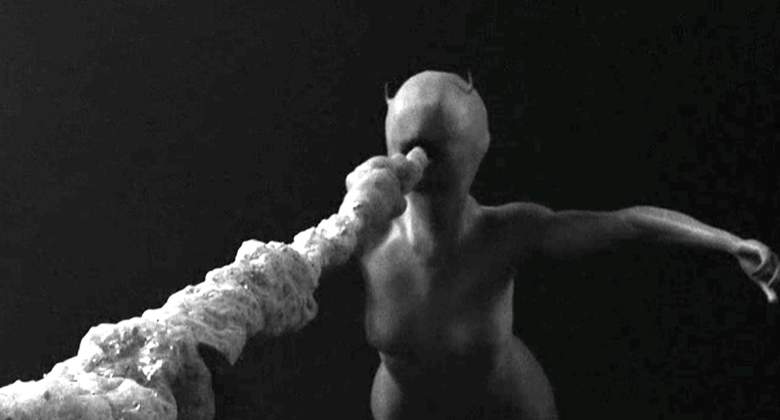
While the first book of Finnegans Wake is primarily concerned with the past, the second belongs to the present and follows the battle between Shem and Shaun, the sons, who may be related to the long-distance struggle between Mr. C and Dougie. This contesting between Shem and Shaun is characterized as a boxing match, with actual rounds depicted in chapter 11. Here elements from the esoteric doctrines of the Kabbala come into play, especially the role played by Ain Soph[3], the Creator, the Eternal Spirit, in his descent into phenomenal manifestation towards Queen Zero, his bride. He is number 1 and she is number 0, and their union generates the number 10 (“the number of completion”, to quote Cooper). It can be argued that the Creator/Fireman/Cooper (the archetypal man) from part 8 meets his Queen Zero in Diane (the archetypal woman) in part 17, thus recreating the archetypal couple and leading to a new decade.

The battle between Shem and Shaun also concerns the secrets of the mother (earth mother), depicted by Shem as a triangle and a vortex, linked to the image of a forest, and in reality, a picture of his mother’s genitals. Given the importance of the triangle motif in Twin Peaks and the role played by the woods, as well as the several vortices that appear in the sky during the season, one can conclude that the feminine aspect is highly powerful in the locale of this small Washington state town, only counterbalanced by the veiled presence of the gigantic Finnegan/Cooper presence in the nearby hills, hermetically depicted in the opening credits of the episodes.
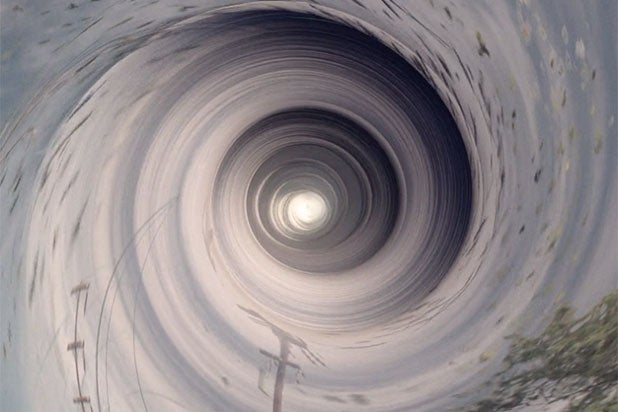
HCE’s work as a tavern keeper might explain why the Bang Bang Bar plays such a central role in The Return, with various concerts closing most of the episodes. It is within this tavern– where the dream atmosphere is dense with characters constantly morphing into other characters and where past, present, and future collide–that the role of the radio emerges as nearly omnipresent in the narrative. Radio programs and advertisements interrupt the flow of the story at regular intervals, creating an electromagnetic environment reminiscent of the Woodsman’s litany in part 8. The programs are themselves broken by interference from spiritualist seances, a clue to the fact that it is all a dream and beyond death itself. It is also in the tavern, that the role of the atom appears, with statements such as: “the widower, so help me God, is consistently blown to Adams!”, which Campbell translates as “to atoms! Back to Adam and Eve!”. The tavern’s “rounds” of drinks constantly remind us of the struggle between Shem and Shaun, as well as of Bushnell Mullins’ past as a boxer, and of the boxing match watched by Sarah Palmer on her giant TV screen. The figure of the Flying Dutchman appears repeatedly during the tavern scene, echoed in The Return by the Dutchman’s, the place where Agent Jeffries goes on living as a mysterious machine/tea kettle of sorts.
At the end of chapter 12 in Finnegans Wake, HCE falls on the floor of his tavern, dead drunk, and “his mind sails forth, like a sea-wanderer returning to the bounding deep, on a sea of dreams” (Maharishi Mahesh Yogi’s ocean of consciousness?). This is followed by his later dream that takes place in bed in Book 3. While Book 1 represents the book of the past and the dark energies of the unconscious and Book 2 is dedicated to the present of HCE’s tavern, then Book 3 represents the desired future, an idealized future built around the figure of Shaun that will disappear as the day rises. There is a sense that the end of times is near, and while Shaun appears to triumph in his struggle against his brother, he “repeats in grotesque parody the patterns established long ago by the father. Shaun is not creative. He is the end, not the beginning of a mighty destiny.” (Campbell). This might be the hubris Mark Frost has mentioned several times in relation to the character of Cooper, who seems unable to avoid the mistakes he has made in the past, and continues trying to rescue damsels in distress, always generating catastrophe as a result.

By chapter 15, Shem and Shaun, equals of opposite, essentially one, vanish like a dream, and only the primordial presence of HCE and ALP remains, in the midst of radio interference. This is very much akin to what takes place in part 17, when Cooper, who has finally awakened, returns to Twin Peaks to watch Mr. C disappear in front of him. Both Dougie and his twin brother have vanished by this point of the story, and Cooper is whole again (except for his rib, Diane, which he will integrate in part 18). “The realities of the waking world begin to break through the tissues of dream.” notes Campbell. HCE and ALP can finally have their sexual union, the triumph of wakefulness over deep mythological dream, the merging of Time and Space, World Father and World Mother. The dream of a future in which Shaun/Dougie/Cooper would triumph has dissipated. “Noctambulant, we have wandered through the nonexistent waters of the night-Nile”.

Book 4 of Finnegans Wake mixes elements from Ireland and India: the West is equated with falling asleep and the East with awakening. The Sanskrit language plays an important role in this chapter as well as do the Hindu and Buddhist notions of cosmic cycles of unending time. The sleeping god Vishnu also surfaces.
One could argue that Cooper’s mistake in part 18 consists of driving Laura/Carrie home, towards the West, i.e. towards sleep. While he had managed to fully awaken from his dream thanks to his intercourse with Diane, this choice to return to Twin Peaks appears to contradict the general movement towards the East that had been his since the beginning of the episode (Las Vegas – White Sands- Odessa). While “The individual who emerges out of the pits of sleep and drinks the waking-up drink of his morning coffee will open his eyes to a world of old, old friends… The morning paper will rehearse the ancient story…ham and eggs for all” reminiscent of what Cooper enacts at Judy’s diner, his decision to drive Laura back to Twin Peaks leads them into the middle of the night, outside of time, back into dream logic. The only reason why all is not finally lost is due to Laura’s shriek, the renovating impulse, the thunderclap that reboots the world, “time and time again”.

There is a recurring sound, a “tip”, that occurs sporadically throughout Finnegans Wake. It is finally revealed that this is the dream transformation of the sound made by a branch knocking against HCE’s window as he sleeps. The Fireman’s “listen to the sounds” might echo this incident, as the phonograph sound[4] is similar to the sound emitted by the Log Lady’s phone when she puts it on speaker in part 16. It is the sound heard by Cooper when he loses Laura to the forest of time in part 17, the moment when his (tele)communication with her becomes brutally interrupted. Beyond this level of reality, this moment might be a hint to the dream transformation of their split in the realm of the Red Room, the energetic umbilical cord connecting them (he is her father, after all) being ripped apart.

If indeed Frost and Lynch drew on Finnegans Wake, it must have been a tremendous task to integrate these elements so beautifully into the texture of The Return, particularly as the season is woven from the narrative threads of so many other mythological sources (Ulysses, the Odyssey). Campbell, in his “skeleton key” to Finnegans Wake explains that “The complexity of Joyce’s imagery… results from his titanic fusion of all mythologies; and his genius shows itself in his application of these to the special traits of the modern day.” He continues “Joyce actually plunges into a region where myth and dream coalesce to form the amniotic fluid of Finnegans Wake… he chose night logic, expressed in dream language, as his method of communication.” The same can certainly be said of Twin Peaks: The Return, a masterpiece that plays with many levels of reality, while interweaving mythological tales from around the globe. Campbell adds something that is relevant to both Finnegans Wake and Twin Peaks: “We are convinced that this saga of man’s tragicomic destiny is not a symbol of disintegration, but a powerful act of reintegration, yielding more for the present, and promising more for the future, than any work of our time.”
End here. – Us then, Finn, again! Take. The keys to. Given! A way a lone a last a loved a long the
(ending of Finnegans Wake, by James Joyce)
[1].The glass cube in New York was perhaps a trap designed by Mr. C to catch Cooper after his expulsion from the Red Room Garden. This is evocative of the following passage in Finnegans Wake: “Let it not be thought that the Prisoner of the Vatican was at best but a one-stone parable, a rude breathing on the void of to be, or the clue-key to a Reality beyond the space world; for scarce one of his twelve companions cared to doubt the canonicity of his existence as a tesseract” (a four-dimensional cube).
[2] .Because of the many references to Ireland, her scream can be linked to that of the Banshees, Celtic spirits whose cries warn of death or, like the Valkyries, carrying slain heroes from the battlefields. Ireland is very much depicted as the land of dreams in Finnegans Wake. “Did this ancestor of yours live in a paradisal early Ireland, where death entered not, or during prehistoric times, before the days of modern whoredom? / – It is all a dream. On a nonday I sleep. I dream of a someday. OF a wonday I shall wake. / – I understand your runic verse. The same thing recurs three different times, descending from the abstract to the concrete”.
[3]. Also known as Makroprosopos, “the Great Face”, always represented in profile, reminiscent of Cooper’s giant face in the clouds over Mount Rushmore.
[4] In Finnegans Wake, one reads in chapter 1: “The scene comes to us converted into sound by an optophone”. (an instrument that converts images into sounds). Interestingly, this passage is followed by the description of The Blue Book of our local Herodotus, Mammon Lujius, a dream guidebook of sorts…

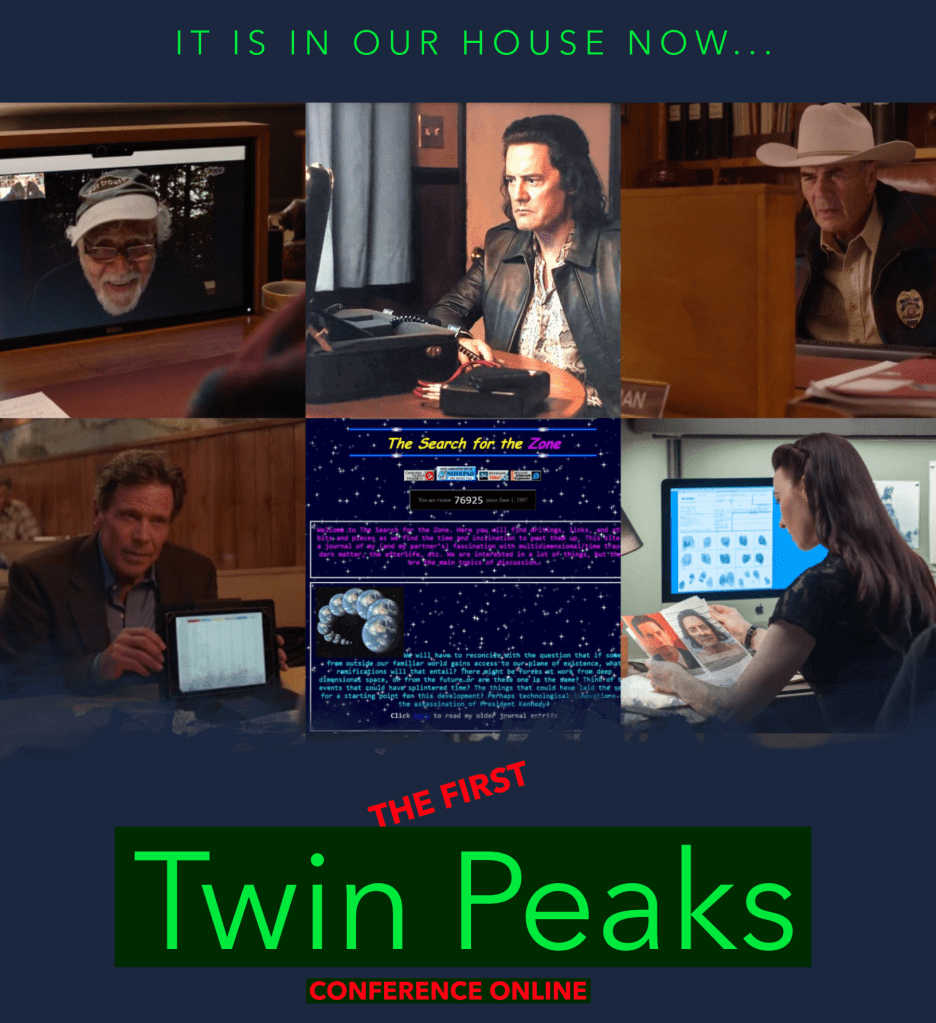
(EN FRANCAIS CI-DESSOUS)
CALL FOR PAPERS
Twin Peaks Season 3 Conference
“It is in Our House Now”
Organized in partnership with Lynchland (https://www.facebook.com/Lynchland), Cork University (Ireland), Université Bordeaux Montaigne (France) & Université de Liège (Belgium), the Supernatural Studies Association, and the film magazine La Septième Obsession (France).
This international online conference will focus on the third season of Mark Frost and David Lynch’s acclaimed television series Twin Peaks, an eighteen-part event that premiered on Showtime in May 2017. While the original two seasons of Twin Peaks (1990-91) and Lynch’s feature-length film Twin Peaks: Fire Walk with Me (1992) have been the subject of numerous academic and critical studies, season 3 returned to television over 25 years later. The season has yet to benefit from an international conference that is interdisciplinary in scope. We are excited about the conference’s accessible online format and its potential to engage with international colleagues in diverse fields of research.
Suggested topics of exploration include, but are not limited to:
• the role of time in season 3
• expanded space and geography in season 3
• aesthetics of season 3
• the use of special effects in season 3
• the relationship between season 3 and earlier seasons of Twin Peaks (1990-91), as well as the film Twin Peaks: Fire Walk with Me (1992)
• the relationship between the 3rd season and Mark Frost’s The Secret History of Twin Peaks (2016) and Twin Peaks: The Final Dossier (2017)
• Homer’s Odyssey
• electromagnetism
• the American West and/or Western films
• the 2008 economic crisis
• parallel universes
• doppelgangers and avatars
• the atomic bomb
• the supernatural
• mythology & spirituality
• representations of gender and race in season 3
We welcome papers from the fields of television and film studies, art history, literature, sociology, psychology, gender studies, religious studies and fields in the arts, humanities, and sciences. Panels in both English and French will be organized during the conference weekend, June 19-20, 2021.
While it is expected that papers will reference earlier seasons of Twin Peaks and/or David Lynch’s filmography, please keep in mind that the focus of this conference is the third season of Twin Peaks. Therefore, papers dedicated exclusively to the first two seasons of the series or the film Twin Peaks: Fire Walk with Me will not be accepted.
Abstracts (in English or French) of 300-500 words, accompanied by a C.V. will be accepted until December 1, 2020 at: TwinPeaksConference@gmail.com
Notification of the conference program will be sent by January 15, 2021.
Conferences will be limited to 20-minute presentations.
Conference organizers: Franck Boulègue (Associated Scholar – University of Liège & author of Twin Peaks: Unwrapping the Plastic), Marisa C. Hayes (Sorbonne Nouvelle – Université Paris 3, film & co-editor, Fan Phenomena: Twin Peaks), and Roland Kermarec (founder & curator of Lynchland (https://www.facebook.com/Lynchland), with additional assistance from Matt Zoller Seitz.
Institutional support:

Let’s Rock!
APPEL A COMMUNICATION
Colloque en ligne – 19-20 Juin 2021
Twin Peaks Saison 3 (The Return)
“It is in Our House Now”
Organisé en partenariat avec Lynchland (https://www.facebook.com/Lynchland), l’Université de Cork (Irlande), l’Université Bordeaux Montaigne (France) & l’Université de Liège (Belgique), la Supernatural Studies Association, et le magazine de cinéma La Septième Obsession.
Cette conférence en ligne portera essentiellement sur les 18 épisodes de la troisième saison de la série télévisée de Mark Frost et David Lynch, diffusée par Showtime au mois de mai 2017. Il sera toutefois possible de faire référence aux deux premières saisons de Twin Peaks, au film Twin Peaks: Fire Walk with Me, aux Missing Pieces, ainsi qu’aux divers ouvrages en lien avec cet univers publiés par Mark Frost, Jennifer Lynch et Scott Frost.
Twin Peaks : The Return n’ayant pas encore bénéficié d’un colloque interdisciplinaire international, nous sommes ravis de pouvoir utiliser les possibilités de l’Internet à cet effet et d’engager la discussion avec nos collègues internationaux au sein de divers champs de recherche.
Souvent décrite comme à l’origine de l’âge d’or contemporain de la télévision d’auteurs, régulièrement citée comme une influence majeure par de nombreux artistes, la version originelle de Twin Peaks, celle des années 1990, a nourri le besoin d’exégèse des fans et des chercheurs depuis sa diffusion. Son avatar de 2017 a tout à la fois poursuivi et réinventé cet univers, après un hiatus de 25 années durant lequel on a cru la série morte et enterrée. La nouvelle saison a porté Twin Peaks à de nouveaux sommets artistiques et narratifs, générant ainsi de nouveaux standards pour l’ensemble du monde de la télévision.
Trois ans après sa diffusion, il semble évident que la saison va nécessiter le même type d’analyse approfondie que celui généré par sa version des années 90. Les chemins à emprunter pour une pareille exégèse sont nombreux :
Nous acceptons les communications dans les domaines des études cinématographiques et télévisuelles, de l’histoire de l’art, de la littérature, de la sociologie, de la psychologie, des études de genres, des études religieuses, de la philosophie, ainsi que d’autres champs artistiques et scientifiques.
Les propositions d’intervention (en anglais ou en français), accompagnées d’un résumé de 300-500 mots et d’un C.V., devront nous être transmises avant le 1er décembre 2020 à l’adresse suivante : TwinPeaksConference@gmail.com
Une notification relative au programme du colloque sera transmise avant le 15 janvier 2021.
Les conférences seront limitées à 20 minutes maximum.
Des panels en anglais et en français seront organisés au cours du week-end retenu pour le colloque (samedi 19 & dimanche 20 Juin 2021).
Une fois que le colloque aura eu lieu, les organisateurs choisiront une sélection d’interventions, qui seront publiées dans un livre et / ou dans un magazine.
Organisateurs :
Avec le concours et le soutien de Matt Zoller Seitz
(New York Magazine/Vulture, RogerEbert.com).
Comité scientifique :
– Dr. Lindsay Hallam (Université d’East London)
– Dr. Miranda Corcoran (Université de Cork)
– Dr. Adam Daniel (Western Sydney University)
– Dr. Dick Tomasovic (Université de Liège)
– Dr. Jean Foubert (Université de Caen)
– Dr. Emmanuel Plasseraud (Université Bordeaux Montaigne)
Partenariats :

Let’s Rock!
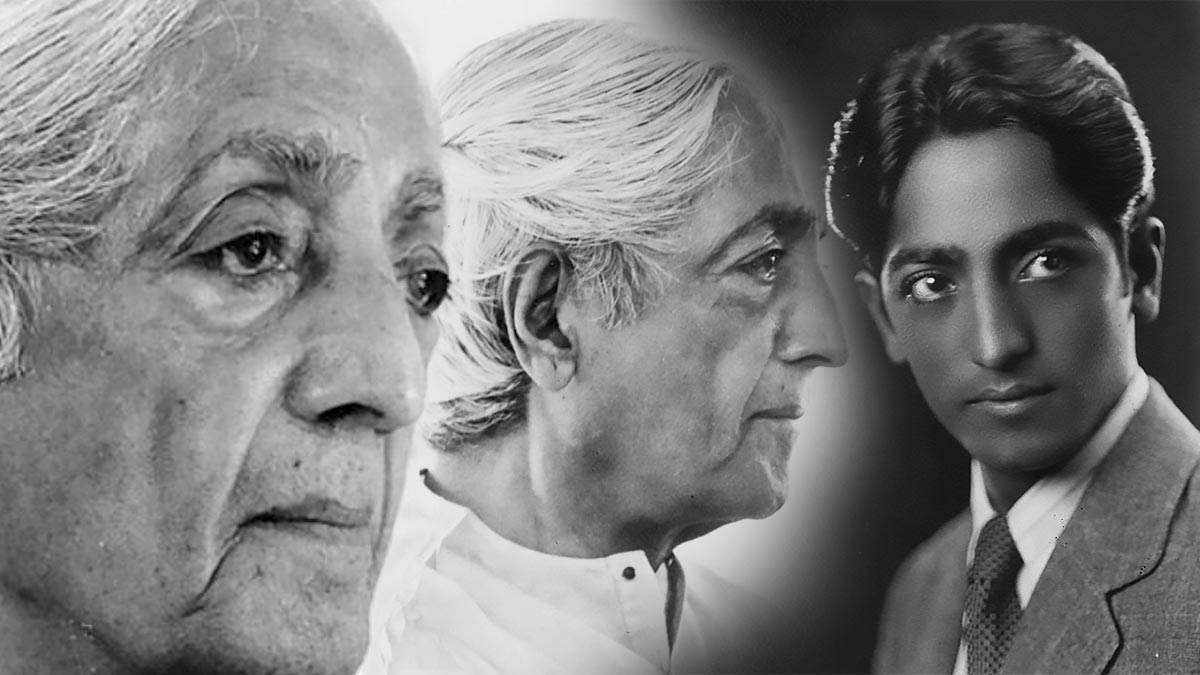
Jiddu Krishnamurti (1895-1986) is the subject of the book that Mark Frost is currently writing. This post investigates the Indian spiritual teacher’s possible connections to and influences on the third season of Twin Peaks.

In 1911, Theosophist Annie Besant–then President of the Theosophical Society–appoined Krishnamurti Head of the Order of the Star in the East, an organization funded to promote the coming of the World Teacher (a messianic entity, the Maitreya). But Krishnamurti dissolved the Order in 1929, convinced that people do not need guidance but awakening. He argued that “truth is a pathless land” and that “it cannot be brought down”, therefore, one does not need a spiritual authority to reach it.
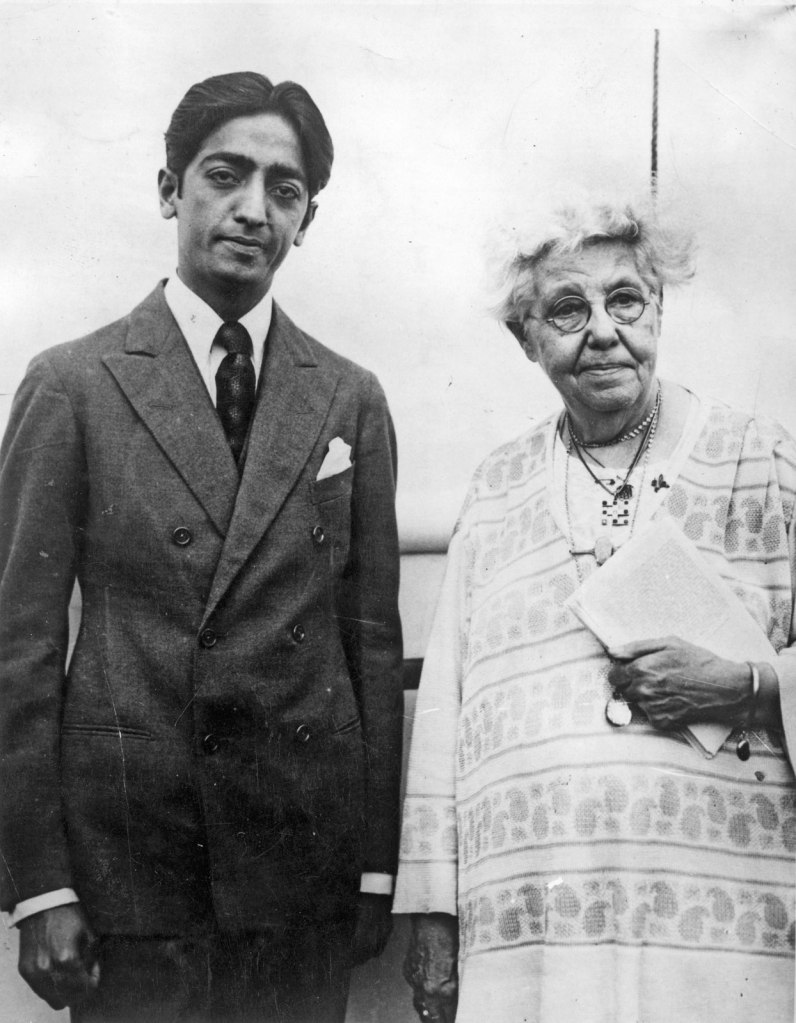
In order to become free, man only needs to devote attention to “what is” in order to awaken intelligent thought and dissolve the net of illusions (which Hindus would call Maya): “Understanding comes through being aware of what is”. This attention to what is, of consciousness, should be unencumbered by the past (memories, knowledge) or the future (goals). In other words, karma: “you have a burden in the present, the burden of the past in the present… you bring with you the environment of the past into the present, and because of that burden, you control the future, you shape the future”. This burden traps one in a vicious circle, a prison for the mind, because “reaction to the past may impede my full comprehension in the present”. All this is reminiscent of the words uttered by Dale Cooper in part 17 of The Return: “The past dictates the future”.
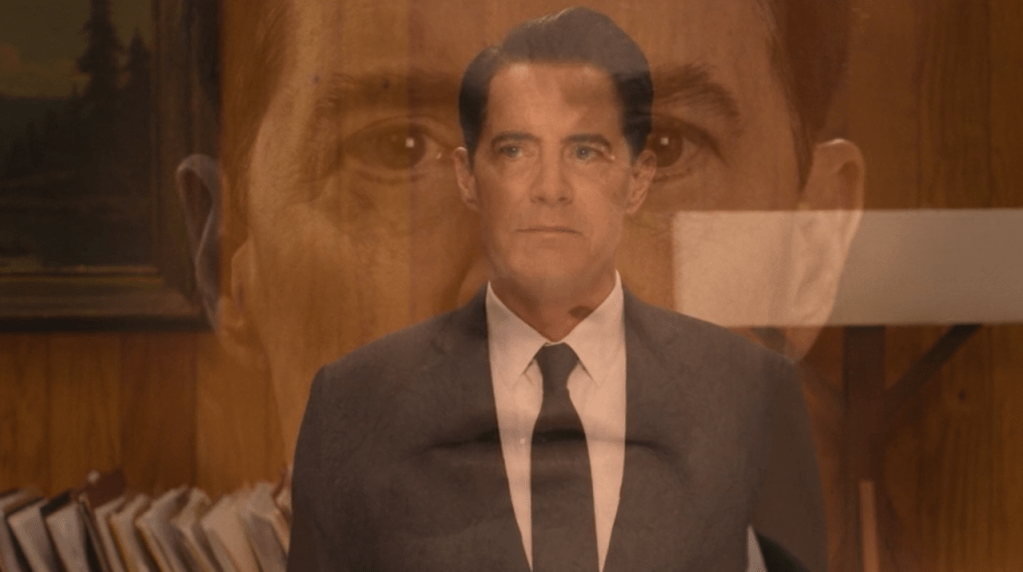
The awareness to what is (as opposed to what could or ought to be) shouldn’t be affected by “the stream of pain and sorrow” caused by “loneliness, shallowness, emptiness, insufficiency”. To achieve this, Krishnamurti claimed that we need to reach the unity that hides behind all dualities (“when the mind is trying to overcome, it must create duality, and that very duality negates understanding and creates the distinctions”) and conflicts of the world: conflict between the “I” (the self) and its environment, between individuals, religions, nations, etc. One needs to transcend duality so as to reach unity, to reassemble the pieces of the puzzle into the coherent whole it has always been. There should be no fear of what is, just awareness. As long as there isn’t, the fear will subsist, which blocks the intelligent understanding of life.
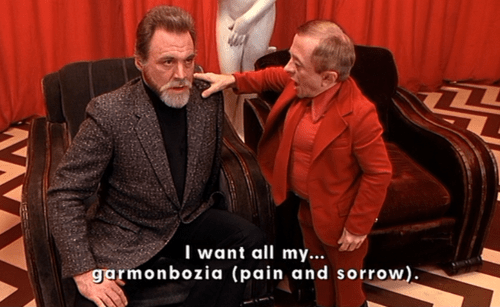
To do this, the mind needs to become aware of its own conditioning (by the State, the family, etc.), an obstacle to free thought. Krihnamurti stressed the unity of human existence and rejected divisions of all sorts. This is similar to what the Log Lady said in her introduction to episode 15 about “The pros and cons of division”.

The following description of Krishnamurti’s vision of how a true artist should exist matches what David Lynch says about the Art Life he pursues, a lifestyle revolving around creativity and the arts: “To me, the true artist is one who lives completely, harmoniously, who does not divide his art from living, whose very life is that expression… this demands that exquisite poise, that intensity of awareness and, therefore, his expression is not divorced from the daily continuing of living”.
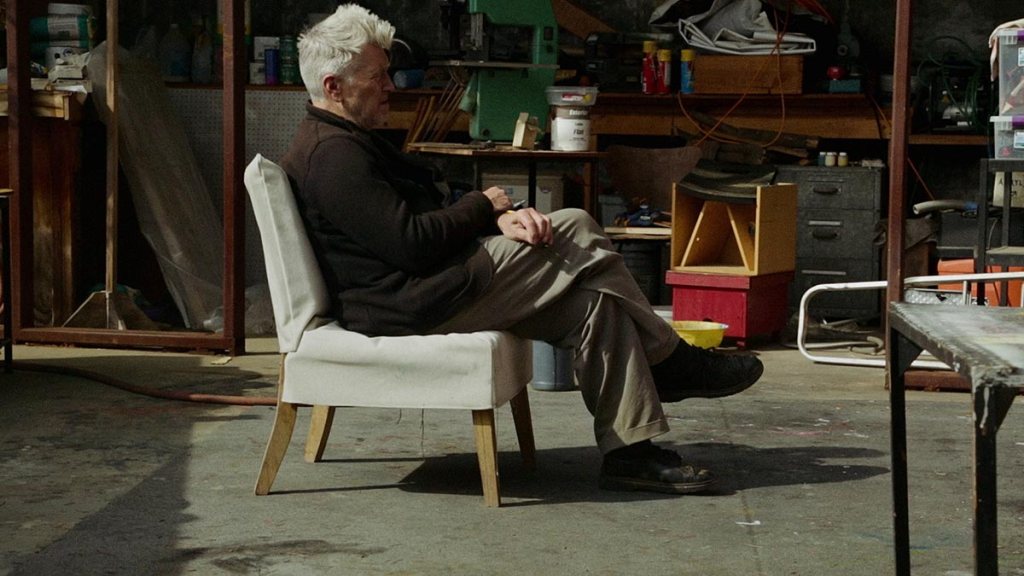
I have argued elsewhere (in French film magazine La Septième Obsession) that the original opening credits of Twin Peaks were about a process of division (the original world tree being sliced up into logs in the sawmill), whereas the new credits for season 3 mirror the overall move of the season towards integration, towards unity… towards the One (i.e. Laura). In that sense, The Return (to unity) closely follows the message of Krishnamurti.

Awakening is a constant motif in The Return, a season during which the cosmic dream is all-encompassing. Krishnamurti would certainly have agreed with the message. Awakening of intelligence is necessary to attain freedom. It could be argued that Cooper did not entirely awaken because he was not able to release the burden of the past – his actions in part 17 and 18 to save Laura show an attachment that leads to disaster
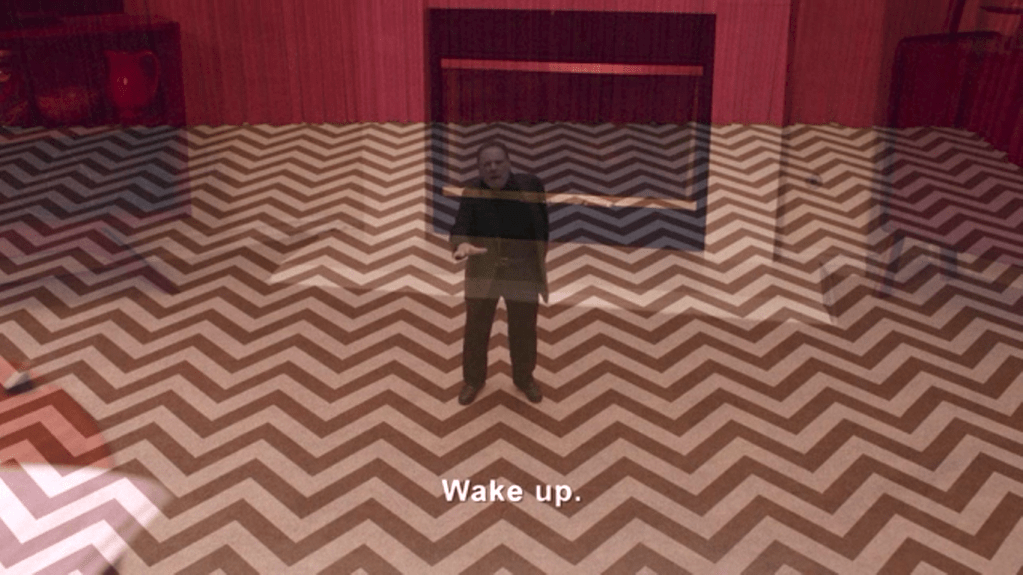

Here are some of my notes concerning the influence on season 3 of the films released in 1956. The Return of Twin Peaks: Squaring the Circle will also analyse books and music from that same year and include detailled analysis of the major films that influenced the season: The Ten Commandments, The Searchers, Gunslinger, Meet Me In Las Vegas, Moby Dick, and several others. The following text will not appear in the book itself.
Several Westerns are echoed in The Return. For instance, Frank Truman’s light-coloured cowboy hat and attitude resembles Randolf Scott’s character, a righteous sheriff in Seven Men From Now (Bud Boetticher).


The 1956 film Dakota Incident (Lewis R. Foster), like The Return is partially set in South Dakota. Containing scenes of a bank robber who is shot and left for dead in the desert, he appears in town shortly afterward, obviously mirrored by Mr. C’s arrival at the farm guarded by Hutch and Chantal, after having been “killed” by Ray in a desolate place.


Other examples include parallels to the following films: Tribute to a Bad Man (Robert Wise) or The Beast of Hollow Mountain (Edward Nassour).


Frontier Gambler (Sam Newfield) is an ingenious transposition of Otto Preminger’s Laura to the Wild West, the story of an orphan girl who is turned by a Pygmalion of sorts into his image of the perfect woman until she starts rebelling, is left for dead, and reappears midway through the narrative very much alive. These Freudian questions of paternity, identity and memory are reminiscent of the plot of The Return and of Laura’s disappearance in part 17 and reappearance in part 18 as Carrie Page. Laura’s equivalent in the film is nicknamed “The Princess”, which also echoes her iconic homecoming queen picture in the series. In Frontier Gambler, the father figure asks: “Do you think it’s possible to go back in time, forget all the intervening years, start over again fresh, and pretend that I’d found you here again today?”. The female protagonist answers, “That’s impossible, Roger. We’re what we are now because of those years. All the things that have happened to us, we can’t ignore them”. In other words, according to Twin Peaks: the past dictates the future. “I wonder what I’ll be without him?”, finally asks The Princess to the man who’s saved her from her murderous father figure. He answers:, “You’ll probably be yourself”, something Laura Palmer was never truly allowed to be.
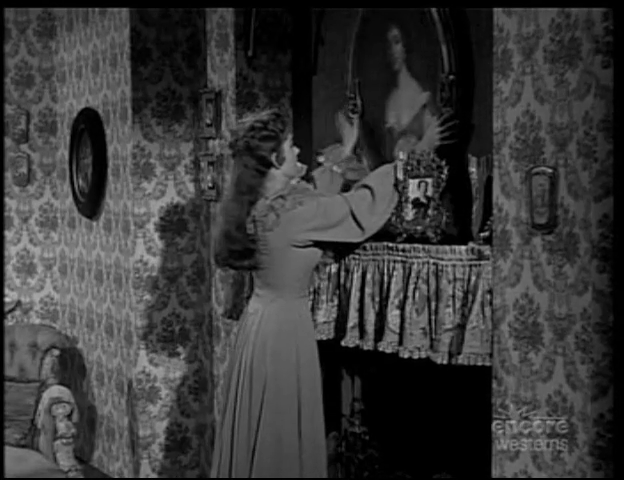
A comedy from the same year, Crashing Las Vegas (Jean Yarbrough), also outlines similarities to The Return. A character earns the ability to successfully predict numbers thanks to a freak accident with electricity. Thanks to this newfound good fortune, the heroes of the film earn a trip to one of Las Vegas’ snazziest casino hotels where they able to win big. Supernatural luck, electricity and gambling in Las Vegas are prominent features of 1956 films set in the same city where Dougie encounters similar luck.

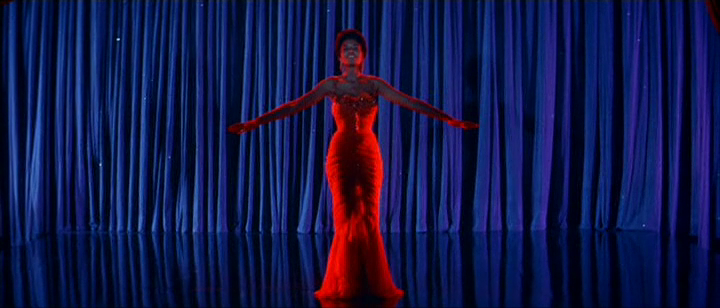
Frank Tashlin’s The Girl Can’t Help It (1956) is another strong example. Abbey Lincoln’s performance, lit in red in front of blue drapes, bears a striking resemblance to the aesthetics of Twin Peaks. The film also includes a song by The Platters, so prominent in The Return.
The poster for Jean-Pierre Melville’s Bob the Gambler (1956) on which the eponymous character holds an ace of spades, may also be linked to Mr. C (BOB) showing the card of what he wants to Darya in part 2.


Although it’s not exactly a film noir, but rather a suspense thriller, Alfred Hitchcock’s The Man Who Knew Too Much (1956) includes a famous scene in which a dying man whispers something mysterious into another man’s ear, a moment much like the one when Laura whispers into Cooper’s ear. The film also centres around the search for the hero’s missing son, who has been abducted.


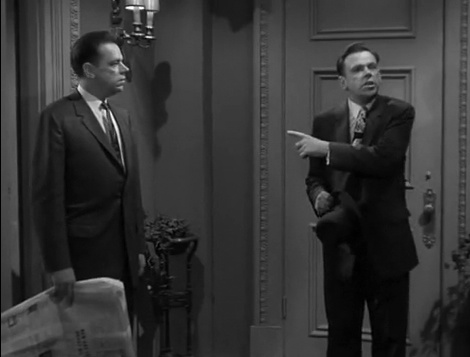
Although not technically from 1956 with its original airdate of December 1955, the episode of Alfred Hitchcock Presents entitled The Case of Mr. Pelham mirrors the story of The Return. It concerns the case of a man convinced that he has a double who is slowly taking over his life. Mr. C ends up taking Pelham’s place while the latter has a breakdown and is interned in the hospital.
Godzilla, King of the Monsters! (Ishiro Honda & Terry Morse), the 1956 American adaptation of the 1954 Japanese film, presents a giant reptilian monster directly linked to the pain and sorrow generated by the Hiroshima bombing. This holocaust could well be the result of a teenage girl’s nightmare in cyclic time, as the Frogmoth incident in New Mexico takes place exactly 11 years after the atomic bombing of Hiroshima. The original Trinity Test explosion sequence is set by Lynch to the music of the Threnody to the Victims of Hiroshima by Krzysztof Penderecki. The traditional dance sequence in the Godzilla film, which features long nosed masks as part of the costuming, is also highly reminiscent of Twin Peaks’ Jumping Man.


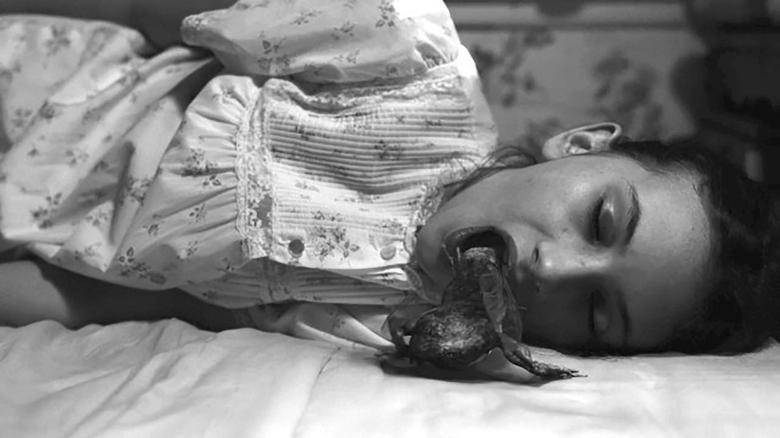
Mervyn LeRoy’s film The Bad Seed (1956) displays a similar obsession with motherhood and evil genetics, as seen in The Return. A woman is convinced that her murderous mother may have transmitted her psychopathic impulses to her own daughter. She blames “that awful place and that evil woman”, a thought that Laura Palmer might experience with regards to her own home and background. At one point in the film, the building’s handyman says, in reference to the young girl, “Swallow me a frog, but she’s smart, huh?” – an expression literally observed in part 8, when the teenager swallows the Frogmoth creature.


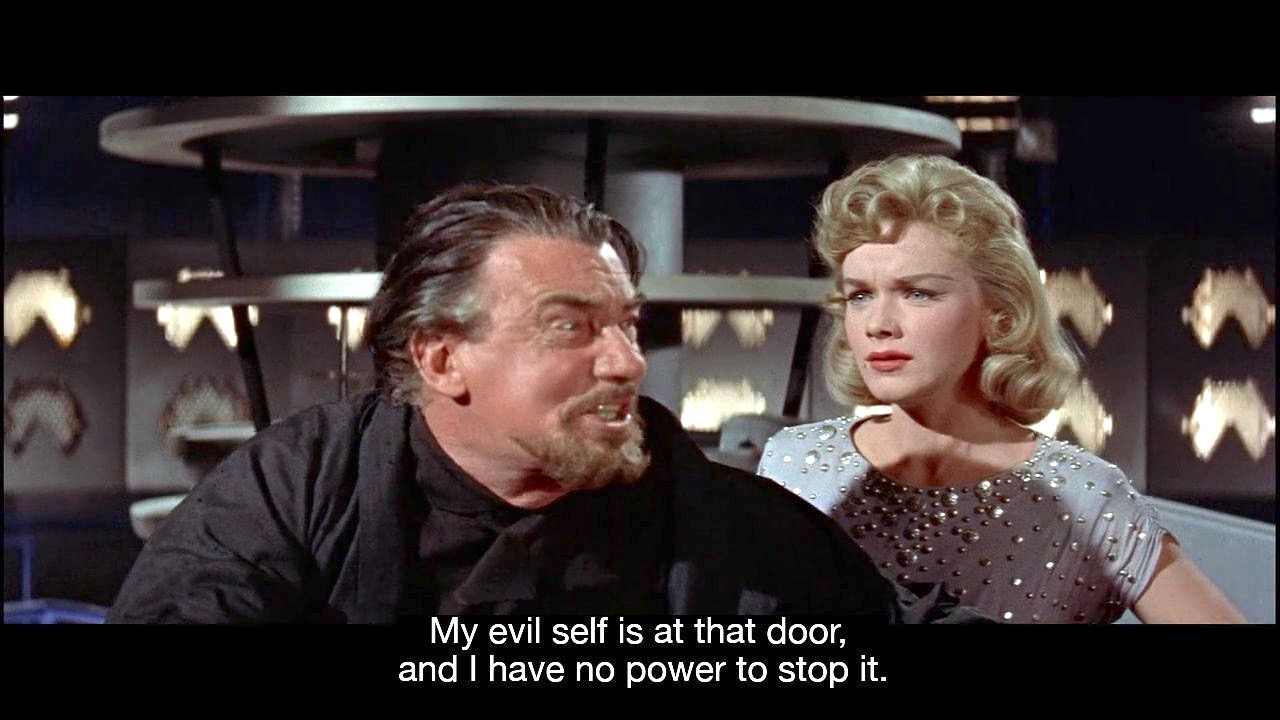
The theme of the power of the mind to create monsters in the film Forbidden Planet (Fred M. Wilcox), with its subterranean civilization and nightmarish return of the repressed, is notable. The planet’s landscape, with its peaks and torn mountains, also resonates with the Fireman’s abode in part 8.
Run for the Sun (Roy Boulting), a loose remake of The Most Dangerous Game, includes a plane very much like the one by which Lil stands in FWWM, as well as a church with architecture that bears many similarities to the Fireman’s Palace.


The Werewolf (Fred F. Sears) takes place in a little town with a diner called “Chad’s Place”, reminiscent of the name of one of the sheriff’s deputies in The Return. The film also includes a scene where the monster, who spends most of his time roaming in the forest, gets his foot caught in a bear trap set by the authorities. This scene resembles Jerry Horne’s fate in season 3, including his foot problem.


A few other films from 1956 are noteworthy, including an animated British short (screened in the US) entitled A Short Vision (Joan and Peter Foldes), which depicts a nuclear explosion over a city and the destruction it generates. The black dot in the sky, meant to represent the plane dropping the bomb, echoes the black figure on Mr. C’s ace of spades card and is also present on the map drawn by Hawk, where it is pictured in the sky above the mountains of Twin Peaks. The explosion itself ends in a whirlpool of particles similar to the one depicted in part 8, when the camera penetrates the mushroom cloud.


As for the various circus influences found in Twin Peaks, they may originate in Trapeze, a 1956 film set in Paris and directed by Carol Reed. The film echoes the circus motifs discussed in the context of Lynch’s oeuvre earlier in this chapter.


The character played by James Mason in Bigger Than Life (1956) is subject to mood swings and psychotic episodes reminiscent of Leland Palmer in their unpredictability and violence. The depiction of a family unit under such threat is evocative of TP:FWWM. In contrast, his foolishness, witnessed by his wife and son, can also be connected to what happens under the Jones’ roof with Sonny Jim and Janey-E. When Mason’s character finally recovers from his drug induced sickness, he describes a dream in which he was walking with Lincoln, the latter a recurring figure in The Return: on the penny found by Sarah in part 8, in the Mount Rushmore image, and in the form of Robert Broski, an actor who has portrayed both Lincoln in films and who plays the chief “Gotta light?” Woodsman in part 8.

The opening credits of the film Storm Center (Daniel Taradash, 1956), include the image of a whirlpool reminiscent of the vortex in the Buckhorn sky. On the film’s poster a pair of eyes are superimposed on the image of book pages, evocative of the sequence in part 17 when Cooper’s face is superimposed over what is taking place at the Twin Peaks’ sheriff’s office. When the librarian at the heart of Storm Center picks lint off a man’s suit, it may be mirrored in Dougie obsessing over the dandruff on Anthony’s collar.


Finally, Jean Delannoy’s 1956 adaptation of The Hunchback of Notre Dame, however surprising a choice, is also noteworthy. The bells of Notre Dame, activated by a half blind Quasimodo, are similar to the bell manipulated by Naido in part 3, and the Fireman’s Palace is something of a cathedral itself.


This is a post linked to my forthcoming book The Return of Twin Peaks: Squaring the Circle, designed to function in the same transmedia manner that the series adopts with the books by Mark Frost, Scott Frost, Jennifer Lynch, and others. This text will not appear in the book itself.
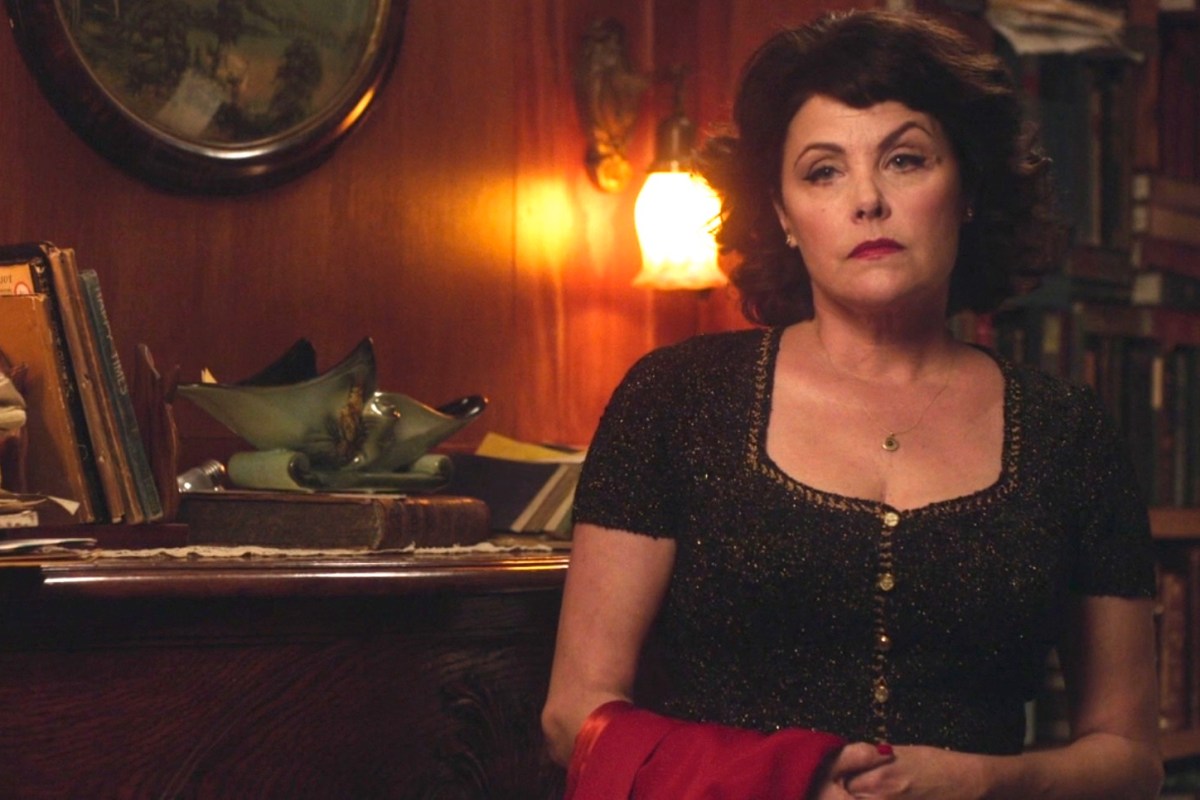
T.S. Eliot’s book Four Quartets appears visible above the fireplace during Audrey Horne’s first scene in The Return.
The first poem, Burnt Norton, begins in a rose garden reminiscent of Eliot’s childhood and the Garden of Eden, adorned with a pool and the sound of birds, just as the season begins with Cooper in the Red Room. This accompanies my interpretation in UTP of the Red Room as a Temenos, a secret rose garden containing water, where the process of individuation takes place. The first section of the poem opens with the following strophe, which resonates with MIKE’s question to Cooper “Is it future or is it past?”:
The second section of Burnt Norton continues with a description that might very well apply to the Evolution of the Arm:
The tree becomes a manifestation of the axle tree (axis of the world or Tree of Life), at the still point of the turning world. The fact that Cooper is somehow split between the Red Room and his avatar in the Twin Peaks world (see the superimposition that takes place in the Sheriff’s office in part 17) echoes a process of self-examination (individuation) that is externalized outside the body. Kenneth Paul Kramer describes this in Eliot:
Since Kramer explains that “the third and central movement of each quartet evokes a descending-ascending spiritual practice, oriented toward redeeming moments of time” (Redeeming Time, p.52), it makes sense that Cooper’s fall through the liquid space below the Red Room evokes the following passage:
Kramer argues that “the central meaning of the poem is the idea that the way out is down and through” (p.53), towards an underground world. When Eliot describes the place in question
one is reminded of the Las Vegas Silver Mustang Casino where Cooper arrives at the end of part 3. Kramer goes on: “For Eliot, the soul’s descent into darkness, like Christ’s descent into the dark night of the tomb, unites the way up and the way down” (p.94).
Part 4 of The Return includes the image of a clematis flower that hangs on the wall beside Dougie’s head when he examines himself in his bedroom’s mirror. Burnt Norton’s fourth section includes the following question:
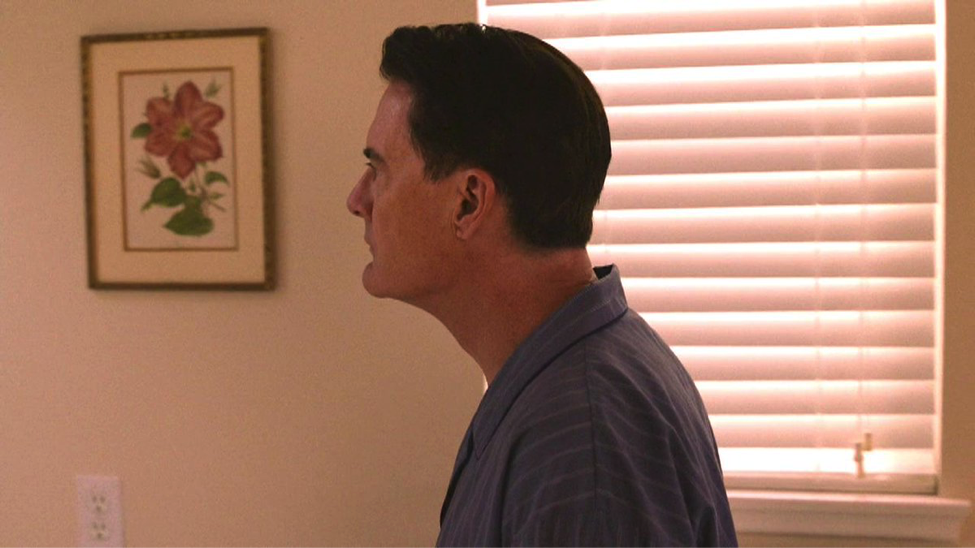
Will the clematis stray down?
The statement in the fifth movement of Burnt Norton that
is evocative of the way the young boy of the drugged-out mother peers through the blinds after Dougie’s car explodes.
In East Coker, the second poem of Four Quartets, Eliot returns to his ancestral home in England. He wrote the poem during a “truly dark age”, to quote Janey-E, in England during World War II. According to Kramer, whereas Burnt Norton focused on “the simultaneity of timelessness and the flux of time, here the poet turns his attention to the seemingly purposeless, repetitive cycle of birth and death, creation and destruction. Nothing endures; everything changes “ (p.70). Part 6 of The Return certainly focuses on death, as it is the moment when Richard runs over a young boy at a crosswalk while Carl Rodd relaxes on a nearby park bench, echoing the first movement of the poem:
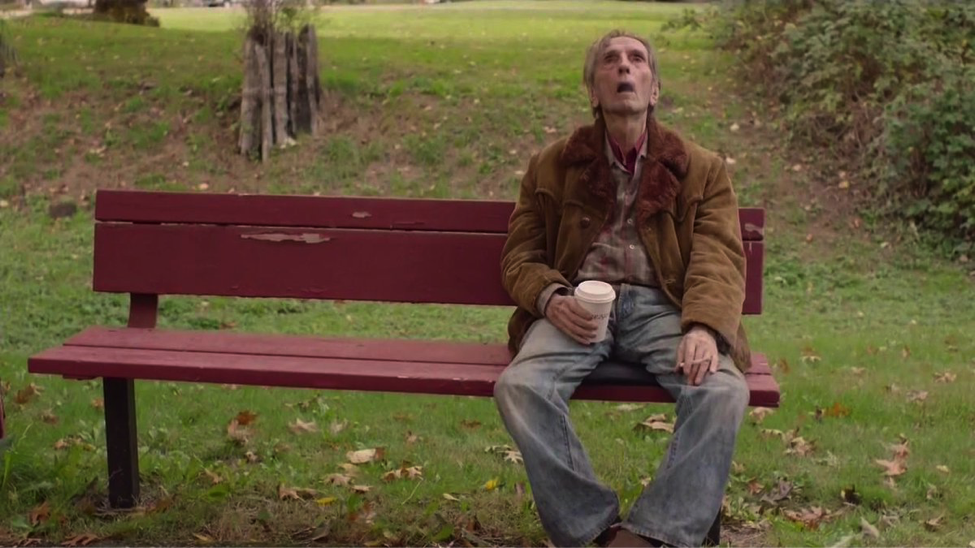
“You lean against a bank while a van passes”
Part 7 then brings us to the second movement of East Coker, and the lines
Besides their association with Dante’s Divine Comedy[2], these verses recall the situation in Twin Peaks, when Andy tries his best to move the investigation forward. It almost goes without saying that the apocalyptic visions of part 8 resonate powerfully with the beginning of the poem’s third movement:
This darkness is associated “with possibilities leading to moments of illumination” (p.86), which is indeed what takes place in The Return, as it is in part 8 that Laura makes her entrance into the world: “So the darkness shall be the light, and the stillness the dancing” (p. 26). The next movement similarly argues that “Our only health is the disease If we obey the dying nurse Whose constant care is not to please… to be restored, our sickness must grow worse” (p. 27) a statement somehow confirmed by Chantal’s nursing of the resurrected, blood-covered Double in part 9. Finally, the fifth movement reconciles the tensions developed during the quartet and argues that “There is a time for the evening under starlight” (p. 28), while Rebekah Del Rio sings in part 10 about being “under the starry night”.
The Dry Salvages, Eliot’s third quartet, takes the reader to landscapes from the poet’s childhood, along the Mississippi River and the coast of Massachusetts (the theme of this quartet is clearly water). The chronological flux of the river leads to a more primordial type of time, that of the ocean, akin to timelessness: “And under the oppression of the silent fog The tolling bell Measures time not our time… a time Older than the time of chronometers” (p. 34). The first movement’s description of the sea
resonates with the first appearance in The Return of the sky vortex (part 11), this abyssal maelstrom ready to swallow everyone into the sky ocean. When the quartet continues in its second movement with the following strophe
It is echoed by Diane’s statement that she likes her drink “on the rocks”, in part 12. Krishna’s teachings about liberation in and from time follows in the third movement of the poem, and are mirrored in the 13th part of The Return when the Mitchum Brothers enter the Lucky 7 Insurance office mimicking a train, a scene corresponding to the following statement:
Once again, via non-attached action, “our ‘destination’ is not a place toward which we travel but a transformation of awareness occurring in the traveling itself” (p.123). In its constant inter-religiousness, this movement forward brings the poem from Krishna to the Virgin Mary: “Lady, whose shrine stands on the promontory… Figlia del tuo figlio, Queen of Heaven” (p. 39-40). Part 14 sees Sarah order a Bloody Mary in the bar before ripping the throat of a truck driver to pieces. She is associated with Mary as the mother who received the seed from the Fireman, the godlike entity in charge of the multiverse, leading to Laura’s birth. The Christ-like journey of her daughter[3] confirms her role as a corrupted Mary in The Return. The fifth and final movement of The Dry Salvages opens with the following words: “To communicate with Mars” (p. 40), something echoed by Chantal’s pointing at the night sky towards the glow of the solar system’s fourth planet.
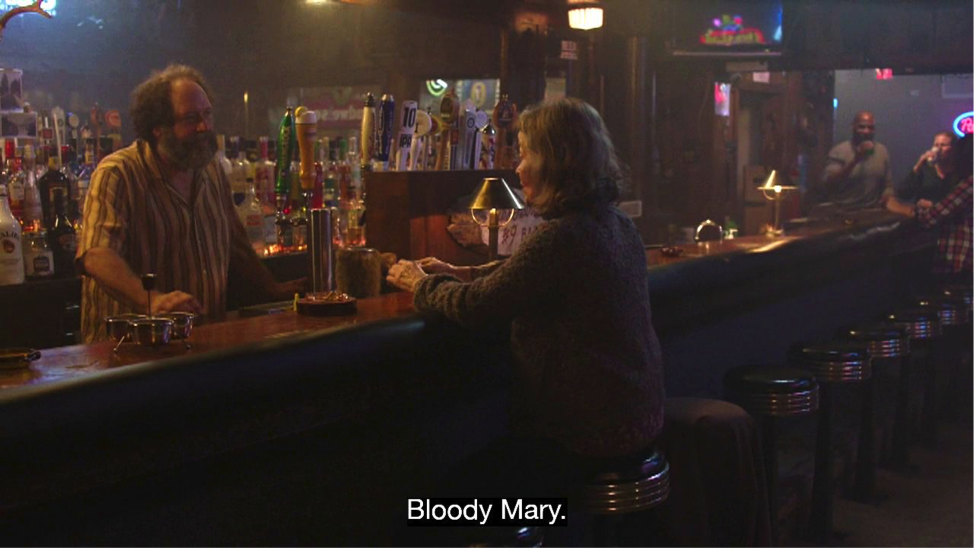
Figlia del tuo figlio
The fourth and last quartet in Eliot’s book is entitled Little Gidding, a place of spiritual pilgrimage, and revolves around the fire element. There is something of a return to Heaven in the journey that drives the poet back to this church, a “dying to one’s time-conditioned identity” (p.147). It doesn’t take long for Richard to die in part 16, while in the first movement of the poem: “It would be the same at the end of the journey, If you came at night like a broken king… It would be the same, when you leave the rough road”. (p. 45-46). Mr. C then goes to Twin Peaks, where he meets his end, and can be associated with the “compound ghost” described by Eliot in the poem’s second movement. In Redeeming Time, Kramer states:
In Little Gidding’s second movement one passage reads: “So I assumed a double part… I was still the same, Knowing myself yet being someone other” (p. 48). This confrontation leads to peregrine “between two worlds become much like each other”, as the passage now presents no hindrance To the spirit unappeased”, (p. 49) and Cooper can travel freely to the day of Laura’s death, between the worlds of life and death, a timeless moment. The series’ final episode corresponds to a movement of Eliot’s poem focusing on the right form of action, and follows Krishna’s viewpoint that “the key to actionless action lies in throwing off the delusion of an imaginary ‘ego’, of an ‘I’ who acts or does not act” (p.160). Although Cooper manages to summon a new version of the world where “they vanish, The faces and places, with the self which, as it could, loved them, To become renewed, transfigured, in another pattern” (Laura’s transfiguration as Carrie, for instance), he nonetheless remains attached to his desire to bring Laura back to her old self and her home (p. 51). The purification does not totally take place, blocked by Cooper’s hubris and attachment to the self (“You are Laura Palmer”). He doesn’t manage to be at home in the universe due to his lack of humility and his attachment to desires and sufferings. They remain trapped in the no man’s land between worlds that Twin Peaks has become.

When the night has come, and the way is dark
And the moon, is the only light you see
I won’t be afraid, lala nomie, I won’t be afraid
Not as long, not as long as you stand by me.
(Stand by me – Ben E. King)
Without a doubt, the book from the Bookhouse Boys reading list included in The Secret History of Twin Peaks by Mark Frost that bears the largest amount of similarities with The Return is Stephen King’s 1978 novel The Stand (Lucy’s favourite book).
 Not just the novel, but also the television mini-series adaptation from 1994 by Mick Garris: Mark Frost’s father Warren – otherwise known as Doctor Hayward in Twin Peaks – plays the role of George Richardson. Miguel Ferrer (Albert Rosenfield) also plays a role in the mini-series (Lloyd), and his first appearance during the narrative is accompanied by the 1983 ZZ Top song Sharp Dressed Man, heard at the Roadhouse in episode 15).


One could even go as far as claiming that this apocalyptic tale almost constitutes the intertextual framework for the new season of Twin Peaks. Some might say that this amounts to plagiarism, but what it truly is, as with sampling in music, is an exchange of sorts between works that are part of the global intertextual web. The Return is now as much part of The Stand as the opposite is true, and the dialogue between the two fictional universes gives depth and perspective to both of them. Besides, the fact that Mark Frost includes King’s book in the Bookhouse Boys reading list is a clear indication that he acknowledges the importance it played in his creative process.
So, in what way can The Stand be understood as a source (among others) of what happens in The Return?
First, the overall subject of both is very similar: these are both stories about the End of Time. The Stand is set in a plague-decimated USA, the result of a military experiment with chemical weapons gone wrong. Though this is perhaps less obvious at first in the new season of Twin Peaks, episode 18 clearly take us to a nightly realm devoid of people, situated at the source where (and when) reality crumbles. The Palmer house is depicted as the root of all evil and Laura/Carrie’s return home leads to the extinction of all (electrical) fires.


The geography of both also has a lot in common. Las Vegas, for instance, plays a central role in the two universes. This is the city where Randall Flagg, the ruthless drifter and supernatural madman who embodies evil in the book, “a negative man with no face” (p.1192), gathers his troops (similar to the Dark Lord of the land of Mordor, in Tolkien’s The Lord of the Rings). The Nevada metropolis is also described as Cibola by one of the characters (“Cibola, fabled City, Seven-in-One” p.711) – Cibola was one of the Seven Cities of Gold according to a Spanish legend. The mystical call of the city is reflected in its architecture: “A tall white building stretched up to the desert sky, a monolith in the desert, a needle, a monument, every bit as magnificent as the Sphinx or the Great Pyramid. The windows of its eastern face gave off the fire of the rising sun like an omen. In front of this bonewhite desert edifice, flanking its entranceway, were two huge gold pyramids. Over the canopy was a great bronze medallion, and carved on it in bas-relief was the snarling head of a lion. Above this, also in bronze, the simple but mighty legend: MGM GRAND HOTEL” (p.731-732). Gold, Silver and Alchemy playing such an important role in The Return, this does not come as a surprise, and Las Vegas is definitely portrayed by Lynch as a fabled place out of time, stretching between antiquity on the one hand (see for instance the beetle that appears on a slot machine, in episode 16) and the present on the other.


On top of this, the city (the largest one within the greater Mojave Desert) is blown to ashes by an atomic explosion (“The A-bomb, the Big One, the big fire, my life for you!… “Silent white light filled the world. And the righteous and unrighteous alike were consumed in that holy fire” p.1353-1354) highly reminiscent of the one that takes place in another desert, in episode 8 of The Return. In a way, one could argue that atomic bombs created holes into both texts, one leaking into the other and vice versa. This might be the reason why Dale and Diane drive the 430 miles from Las Vegas to Jornada del Muerto (Journey of the Dead Man) in episode 18, the spot close to which the first detonation of an atomic weapon occurred at the Trinity nuclear test site, on July 16, 1945.


The car they drive (a 1970 Belvedere?) might be the same model Stu Redman and Tom Cullen drive on their way back from Las Vegas (“maybe God had left this battered ‘70 Plymouth here for them, like manna in the desert” p.1374), a car they abandon in front of a motel reminiscent of the one in The Return, episode 18 (“The motel with the star on it was the Grand Junction Holiday Inn… He pulled in and killed the Plymouth’s engine, and so far as either of them knew, it never ran again” p.1384).


But the similarities do not end here, by far. Beyond this, the United States as a whole appears to be the stage on which both dramas take place. Randall Flagg (otherwise known as the Dark Man, the Walkin’ Dude, the Tall Man, or the Man of the West – Tom Cullen, under hypnosis, goes further: “His name is Legion. He is the king of nowhere” p.1019; Glen Bateman even adds: “Call him Beelzebub, because that’s his name too. Call him Nyarlathotep and Ahaz and Astaroth” p.1326 – in The Final Dossier, Mark Frost via Tamara Preston explains that BOB is really Beelzebub, formerly Ba’al, and the links to Lovecraft are made clear when one reads Kenneth Grant’s Beyond the Mauve Zone) is described as a “tall man of no age” in old blue jeans, denim jacket and old cowboy boots. His silhouette, as portrayed in the television mini-series, recalls that of Mr. C in The Return (when Flagg conceives a child with Nadine, his chosen bride, she thinks: “You become a stranger to yourself, an olive-skinned Doppelgänger, a psychotic Vampira with pale skin and fishslit eyes” p.1088). His clothes and eternal smile (“There was a dark hilarity in his face, and perhaps in his heart, too, you would think” p.214-215; “No soul, but a sense of humor. There was that; a kind of dancing, lunatic glee” p.425) are very similar to those of BOB (“their real faces, their underneath-faces, were monster faces… That kind of monster was called a werewolf” p.1243).


The following description of his eyes recalls the woodsman’s litany about the well, the water, and the white of the eyes on the radio: “His eyes seemed to grow larger and darker. Looking into them was like looking into wells that were very old and very deep” p1199). A couple of pages later, we actually read: “Sparks began to jump from his hair, as if somewhere inside him a cyclotron had hummed into life, building up an electrical field and turning him into a battery. His eyes blazed with dark fire” (p.1202). It’s worth remembering that in episode 11, Hawk speaks of a black fire related to black corn.
The motif of the all seeing eye in relationship to Flagg (“He had developed a sort of third eye… He was able to send it out, to see… almost always” p.1221), besides its association with Mr. C. and the Illuminati (of importance in The Secret History of Twin Peaks) is to be linked to the omnipresence of surveillance in The Return (cameras everywhere, people spying on others). He is a nightmarish presence that haunts the book (“It would be funny if he was just a mirage, wouldn’t it? Nothing but a bad dream in our collective consciousness” p.1323).


Flagg was briefly in touch with a certain Mr. Oswald in 1962 (p.218), an interesting fact when considering the role of the Kennedy assassination in the series. His magic trick besides Lloyd’s cell, when he turns a black stone into a key and vice versa, is reminiscent of Red’s sleight of hand with a penny during his meeting with Richard Horn.


He has the ability to shapeshift, as BOB when he turns into an owl: “for behold he comes in more forms this his own… the wolf… the crow… the snake” p.815; “He never dies… He’s in the wolves, laws yes. The crows. The rattlesnake. The shadow of the owl at midnight and the scorpion at high noon. He roosts upside down with the bats. He’s blind like them” p.1403). His link to technology is stressed several times, as is Mr. C’s – see for instance all the tech equipment that surrounds the glass cube set in the New York loft (“Maybe he’s just the last magician of rational thought, gathering the tools of technology against us” p.922).

Randall’s main rival – the 108 years old Mother Abagail, a prophet from Nebraska not unlike the Log Lady (“In my dreams I saw myself going west. At first with just a few people, then a few more, then a few more. West, always west, until I could see the Rocky Mountains” p.632), who establishes a much more liberal society around herself on the other side of the Rockies, in the Boulder Free Zone, thanks to powerful dream messages (“she has a… a kind of aura about her” p.803) – lives in a farmhouse surrounded by corn fields, reminiscent of Garmonbozia: “the mystic corn that was rooted shallow in the earth but wide” (p.603); “He did sleep a little, and the dream that came was one he had had before recently: the cornfield, the smell of warm growing things, the feel that something – or someone – very good and safe was close. A sense of home” (p. 239).


Interesting “coincidences” occur throughout the novel, such as on page 138: “Past Silver City and roaring through Cliff, the road now bending west again, just the direction they didn’t want to take. Through Buckhorn and then they were back in the country God forgot”. The covert countermeasures by the Government to stop the spread of Blue (not “rose”, but the code name for the mutated superflu virus that decimates the world) are activated by the word “Troy”. In addition to the fact that Laura’s horse was also named Troy (see her diary), the famous city from The Iliad plays a role in episode 18, associated with the Palmer house. More on the subjects of Laura and the Trojan Horse here.
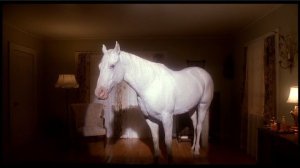
The West certainly plays a major role in both The Stand and The Return. Besides Flagg’s cowboy look, many references to the West are planted throughout the novel (as in Wallace Stegner’s 1971 Angle of Repose, another Bookhouse Boys choice), such as: “They all believe in the Code of the West – a quick trial and then up the rope. It was the way out here until 1950 or so. When it came to multiple murderers, it was the only way” (p.227) or “I don’t think any of us want a frontier society here in Boulder” (p.982).


The barge-trains towed out and dumped into the Pacific, full of the dead bodies of the plague victims (p.258), might be connected somehow to the many intermodal containers seen throughout the series – first on a train, then in Buckhorn, and finally behind Judy’s diner (episode 18). Are we witnessing a hidden apocalypse in The Return? Or could these intermodal containers be used to carry huge quantities of Garmonbozia to Judy’s? It is worth noticing the presence on some of those of the Maersk star, which catches the eye of Dale/Richard in episode 18. The Danish firm has been the largest container ship and supply vessel operator in the world since 1996. The founder of the Maersk corporation was a devout Christian who attached a blue banner with a white seven pointed star on both sides of the black chimney on the steamship “SS Laura” (built in 1875) when his wife recovered from illness. The heptagram is a traditional symbol for warding off evil – but more interestingly, in the context of The Return, it is used in the symbol for Babalon in Thelema.


Furthering the intertextuality elements from The Return, The Stand actually mentions Charlotte’s Web (p.396), Richard Nixon (“We used to watch Presidents decay before our eyes from month to month and even week to week on national TV – except for Nixon, of course, who thrived on power the way that a vampire bat thrives on blood” p.780), The World According To Garp (“The world, he thought, not according to Garp but according to the superflu. This brave new world” p.830), The Wonderful Wizard of Oz (“the Wicked Witch of the West, or some Pentagon assholes, visited the country with a great plague” p.836), Alice in Wonderland (“she was… afraid that she might see Harold’s grin hanging over her shoulder like the grin of the Cheshire cat in Alice” p.876), the Robert M. Pirsig’s book (“Beside the drink was an ashtray with five pipes in it, copies of Zen and the Art of Motorcycle Maintenance” p.926), the Kennedys (“facing a 3-D picture of John and Robert Kennedy against a background of gold-edged clouds. The legend beneath proclaimed BROTHERS TOGETHER IN HEAVEN” p.1016)… all titles and themes featured on the Bookhouse Boy’s reading shelf and in The Return.
The mixing of levels of reality is also stressed in the book, as in the following sentence: “At first Nick was able to divide this fantasy from reality, but as time passed, he became more and more sure that the fantasy was the reality” (p.503).
The twister Nick and Tom encounter in the book can be linked to the various sky vortexes from The Return, which in turn relate to the one from The Wonderful Wizard of Oz, as well as to Marcel Duchamp’s Rotoreliefs.


The quest on which the four main male characters from The Stand go (“You are to go west… you are to go on foot… he is in Las Vegas, and you must go there, and it is there that you will make your stand” p.1144), during the last third of the book, is not unlike Dale’s journey, always followed by Arthurian references (Merlin market, Lancelot Court, the Excalibur, etc.), white knight at the service of princess Laura against the fire dragons BOB and Judy. One could argue that it’s in the west, in Twin Peaks, that Laura as Carrie makes her stand (the shriek) in front of her family house, this nexus of evil. Is she the sacrificial lamb slaughtered to save the rest of us? (“God always asks for a sacrifice. His hands are bloody with it” p.1422). Unless this is a reference to Asian mythology (Journey to the West, by Wu Cheng’en).
Interestingly enough, the hike to Las Vegas (“a purging process” p.1299 – this is actually associated with electricity in the novel: “think of yourself as a battery… Your brain runs on chemically converted electrical current… what we’ve done is to strip off the accessories. We’re on charge” p.1300-1301) taken by the four men from the Boulder Free Zone via Grand Junction follows exactly the line drawn between Las Vegas and Yankton, where Mr. C. is imprisoned (Las Vegas can also be understood as a prison of sorts for Dougie). Also, Stu and Tom’s trip back to Boulder is of course a return.

The dreams everyone have in this post-apocalyptic USA are interpreted as follows by one of the main protagonists: “they seem to presage some future struggle… We’re being given the means to shape our own futures, perhaps. A kind of fourth-dimensional free will: the chance to choose in advance of events” (p.678). This of course resembles a lot what happens in The Return, especially the sequence when Andy is teleported to the Fireman’s place and gets to see a few images from the future. Some end up being slightly different when the time comes, especially the way Lucy deals with Mr. C in the sheriff’s office. “There are all sorts of dream interpretations, Freud’s being the most notorious, but I have always believed they served a simple eliminatory function, and not much more – that dreams are the psyche’s way of taking a good dump every now and then… But lately, I’ve had an extremely bad dream… It’s like no other dream I’ve ever had, but somehow it’s like all of them. As if… as if it were the sum of all bad dreams. And I wake up feeling bad, as if it wasn’t a dream after all, but a vision” (p.421) Besides, notions of a Fourth Dimension are omnipresent in Twin Peaks, as I discuss in my book Twin Peaks: Unwrapping the Plastic (2016).
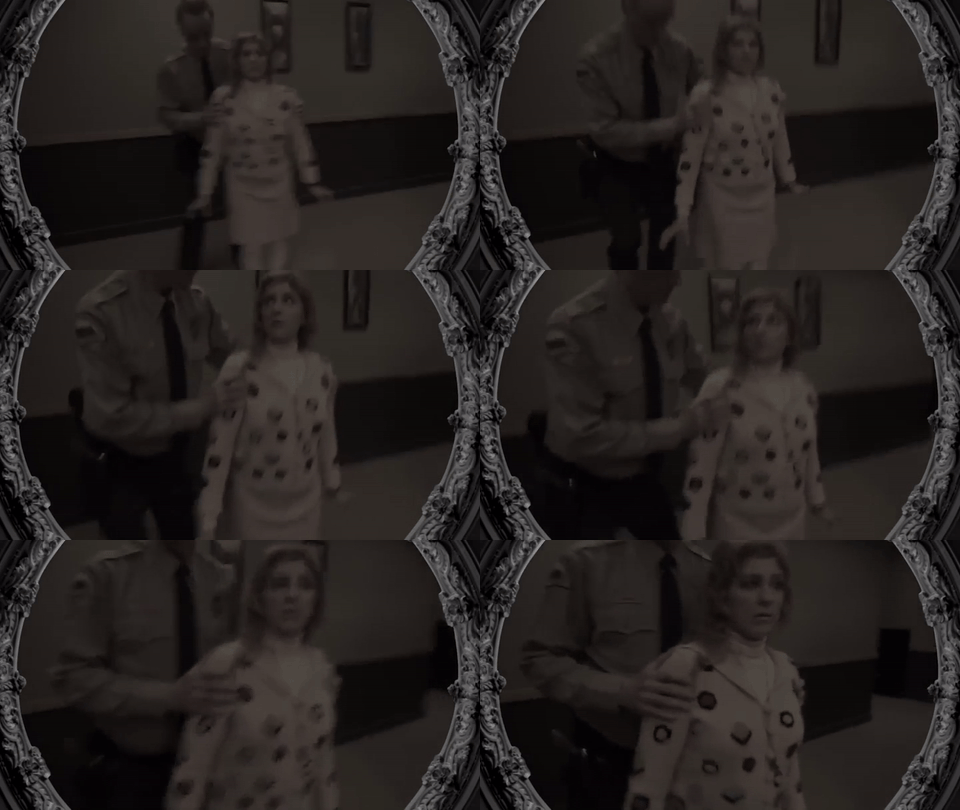
I also regularly mention the importance of sewing in The Return, in relationship to intertextuality of course, but also to Penelope’s role in The Odyssey. The Stand has something to say on the subject: “He suddenly felt that he had joined some bizarre sewing circle of the human spirit… or perhaps they had only, after a brief pause, begun once again to make a large shroud for the human race” (p.831).


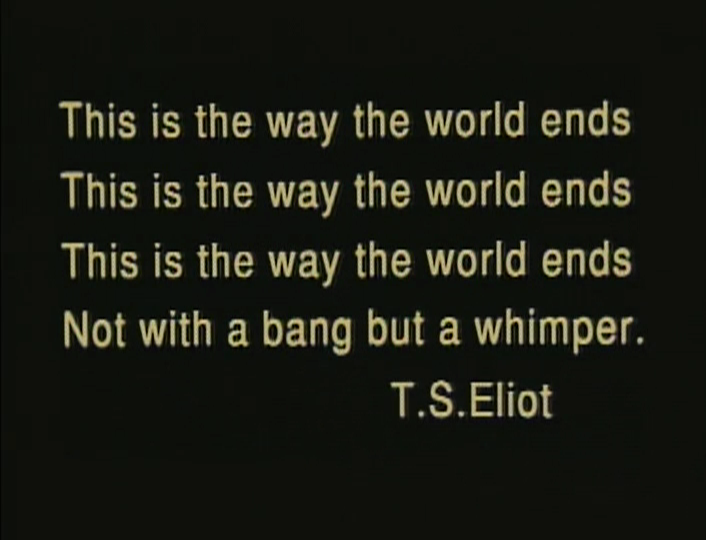
When Harold Lauder thinks about his work as a writer, he suddenly sounds very similar to Mr. C: “it was the best writing he had ever done in his life and the deciding factor was his want – no, his need. His need to have someone else read, experience, his good work” (p.1010). Let’s not forget that the television mini-series (for which King wrote the teleplay) opens with another quote by T.S. Elliot’s The Hollow Men (see Fear and Loathing on the Campaign Trail ‘72): “This is the way the world ends. This is the way the world ends. This is the way the world ends. Not with a bang but a whimper”.
Once again, as contemporary doomsday preppers would argue, “the shit hit the fan” and the world is about to end. Dale and Laura’s trip to the end of the night in episode 18 leads the series to its logical eschatological conclusion, one in which the only thing that remains is life in the Lodges, above phenomenal reality. In a sense, Carrie’s shriek is akin to the atomic explosion in Las Vegas from The Stand – it consumes the righteous and the unrighteous alike, in order to reset the world. The in-between reality of Richard and Linda disappears and the one from season 3 is slowly rewritten to follow a new course in which Laura Palmer never died, as proven by Tamara Preston’s report (The Final Dossier).

More about this subject, about the other books from the Bookhouse Boys reading list, and about The Return in general in my upcoming book Twin Peaks: Squaring the Circle, to be published in 2019!
Follow Unwrapping the Plastic: https://www.facebook.com/unwrappingtheplastic/

French traditionalist René Guénon wrote several books related to esotericism at the beginning of the 20th Century, strongly influenced by Hindu doctrines. Among these, The Reign of Quantity and the Signs of the Times (1945), is notable in that it is a work that focuses on the cyclical conditions that led to the modern world in general and to the Second World War in particular.
Here’s what Charles Upton had to say about the book: “in the Reign of Quantity, Guénon sees history in terms of the Hindu concept of the manvatara, the cycle of manifestation composed of Golden, Silver, Bronze and Iron ages; […] This cycle is an inevitable descent from the pole of Essence (or forma) toward the pole of Substance (or materia). […] Essence is qualitative while substance is quantitative; As the cycle progresses or descends, the very nature of time and space changes.[…] In earlier stages, time is relatively eternal, as the cycle moves on, however, time begins to take over and accelerate, but this constant acceleration of time can’t go on forever. Time, the “devourer” ends by devouring itself. At the end of time, Time will be changed into space again. […] This ultimate timeless point is simultaneously the end of the cycle of manifestation and the beginning of the next“.
Guénon writes: “The descending cyclic movement must therefore be considered as taking place between these two poles (essence and substance), starting from unity… and gradually tending toward multiplicity“.

I believe this description applies perfectly to what we witness in Twin Peaks, especially in the first two seasons. I now believe that The Return is less about “fission” (as with the atomic blast) than about “fusion” (as with Carrie’s “implosion”), back to the original unity, the last phase of the end of time devouring itself. In one of her introductions to the series, the Log Lady actually said the following: “Seven is difficult to balance, but not impossible – we are able to divide. There are, of course, the pros and cons of division“. The fission of the atom might very well have been one of these cons she was talking about, whereas the multiplicity resulting from the descending cycle could be understood as one of the pros (necessary for manifestation).


In The Ramayana, one actually finds the following quote: “The night which had come to claim the monkeys and rakshasas seemed determined to destroy everything, like the night at the end of time“. In the Reign of Quantity, Guénon agues that “there is also a symbolic geography… there is a significant correspondence between the domination of the West and the end of a cycle, for the West is the place where the sun sets, that is to say where it arrives at the end of its daily journey“. This is pretty much what Richard and Carrie’s road trip in episode 18 is all about, going to the place where the sun sets (Twin Peaks), proceeding to the final extinction of all fires.


In a sense, to quote Guénon further, “it is also a RETURN to the ‘center of the world’- at either end of the cycle, of the ‘Terrestrial Paradise’ and the ‘Heavenly Jerusalem’ respectively, with the ‘axial’ tree growing in the middle of both the one and the other“. Note that the original opening credits of the series started atop a tree, which I described as a Cosmic (World) Tree in my book Twin Peaks: Unwrapping the Plastic. Interestingly, the ‘Terrestrial Paradise” is described as circular by Guénon, the ‘Heavenly Jerusalem’ is supposed to be squarish. Could this be why The Return ends with a vision of an unreachable Palmer house?


Guénon also underlines the similarities between the Christ of the Apocalypse and Kalki, Vishnu’s 10th avatar in Hinduism – especially their common use of a white horse. This of course needs to be connected to Carrie’s association with the horse of Troy, discussed in my previous post. In both cases, it is about a siege of sorts, aimed at entering within the walls of an impregnable fortress.


Laura’s fate should perhaps be linked to an Ashvamedha, a horse sacrifice from the Vedic period. This sacrifice was used by ancient Indian kings to prove their imperial sovereignty. In this tradition, the horse is associated with the yearly course of the Sun and the primal waters are considered its stable and birthplace. Interestingly, before the sacrifice, the horse was sprinkled with water, and the priest used to whisper mantras into its ear. Though Laura is the one who whispers something into Dale’s ear, the similarity is striking. As soon as she’s done whispering in his ear, she’s ripped aways (she becomes “a” Page) from the Red Room and transported elsewhere.


The fact that we have arrived at the end of a cycle (TEOTWASKI: The End Of The World As We Know It) is exemplified by the clock in the Sheriff’s office, oscillating between 2:52 and 2:53. Cooper explains that “it is 2:53 in Las Vegas, and that adds up to a ten, the number of completion”. One should also note that in Hinduism, the four Yugas (eras) of the universe are composed of 4, 3, 2 and 1 charanas (periods), which also add up to a 10 when the world reaches the end of its final age. But since there are several ways to get a 10 with a clock, this precise choice should be linked to the Fireman’s clue from episode 1: “Remember 430”. If one splits the portions of the clock as indicated below, it becomes clear that 2:53 separates two sections worth 430 (4 hours and 3 minutes).

The clock is of course highly reminiscent of a doomsday clock, pointing at the small amount of minutes that separate us from the midnight of the end of the world – the middle of the night symbolised by Carrie’s shriek. On a more positive note, it is also possible to read the design on the clock as a peace sign, pointing towards the solution to end this dark age. In fact, David Lynch himself regularly advocates for world peace through his Transcendental Meditation foundation: The David Lynch Foundation for Consciousness-Based Education and World Peace.


In The Mystery of Electricity, Manly Palmer Hall argues the following: “As the first world was destroyed by the earth, the second consumed by fire (Lemuria), the third swallowed up by the waters (Atlantis), so the fourth shall be swept away by the spirits which dwell in the air“. In The Secret Doctrine, Helena P. Blavatsky writes: “They descended from the pure air to be chained to bodies… The air is full of Souls… they descend to be tied to mortal bodies, being desirous to live in them“. All of this should of course be connected to what The Arm says in Fire Walk With Me: “From pure air we have descended“.
According to these quotes, the spirits that dwell in the air (i.e. the Lodge Entities) might very well be the reason why the world of Twin Peaks is coming to a close in The Return.


Magicians and clairvoyants are people who claim to be able to escape above the linear flow of Time. “If with electricity as our ally, it is possible to see the events of yesterday, why should we deny the possibility of predicting the events of tomorrow… Is it safe, then, for us to deny the realities of these well attested miracles or ignore these so-called magicians and sorcerers as the first scientists and masters of electrical phenomena?“.


The link between electricity and time travel he operates makes a lot of sense in the context of Twin Peaks. It is thanks to its power that the Lodge Entities are able to travel and watch over the world “through the darkness of future past”. Are they magicians or scientists? Perhaps a bit of both. As Arthur C. Clarke used to say, “Any sufficiently advanced technology is indistinguishable from magic“.
While discussing the link between science and magic, it might be interesting to come back once more to the giant black metallic cones seen in the Fireman’s palace. Reminiscent of bells and of thimbles (“thimbells”?), they are also very similar to Lingams. Lingams are column-like or oval symbols of Shiva, the Formless All-pervasive Reality. They are made of stone, metal, or clay, and they symbolise the beginning-less and endless cosmic pillar of fire, the cause of all causes. In a sense, they hold the universe together, making sure that no reap appears in its texture – which brings us, once more, to the art of sewing.


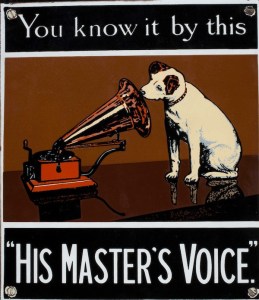
Besides the Fireman, there is a character who is constantly sewing things back together, who is doing her best to extinguish all the wild fires she meets. The Log Lady, thanks to her direct link to the Cosmic Tree (her log), had this ability to see beyond the veil of reality into the hidden layers of the cosmos. She was an earthly messenger for the positive influences coming from the supernatural world, “the voice of her master” (to quote a famous ad by Marconi).
The close-up of the phonograph’s horn in episode 1 reveals a strange inscription on its inner top surface. I wondered at first if this was not some kind of writing, a cryptic message left for us to decipher by Lynch and Frost. The way the light highlights it does not seem to be random.


I now believe these are not letters which are scratched in the horn, but a very primitive rendering of the image of the Log Lady’s house in the forest, connected to the Fireman’s phonograph via the tall tree seen right in front of it.
One should note that Thomas Edison, the man who developed the phonograph technology, also wanted to create a sort of “spirit phone” that recorded the utterances of departed souls: “there’s ample proof that Edison was interested in speaking to the dead using technology. In 1920, the inventor shocked the public when he told American Magazine: ‘I have been at work for some time, building an apparatus to see if it is possible for personalities which have left this earth to communicate with us.'”.
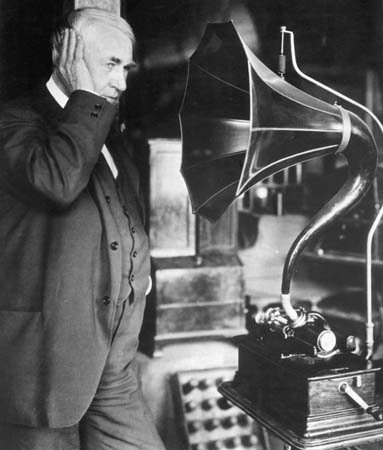
This was a time when spiritualism was still very strong and when people still believed in the existence of an ether in which spirits floated around us.
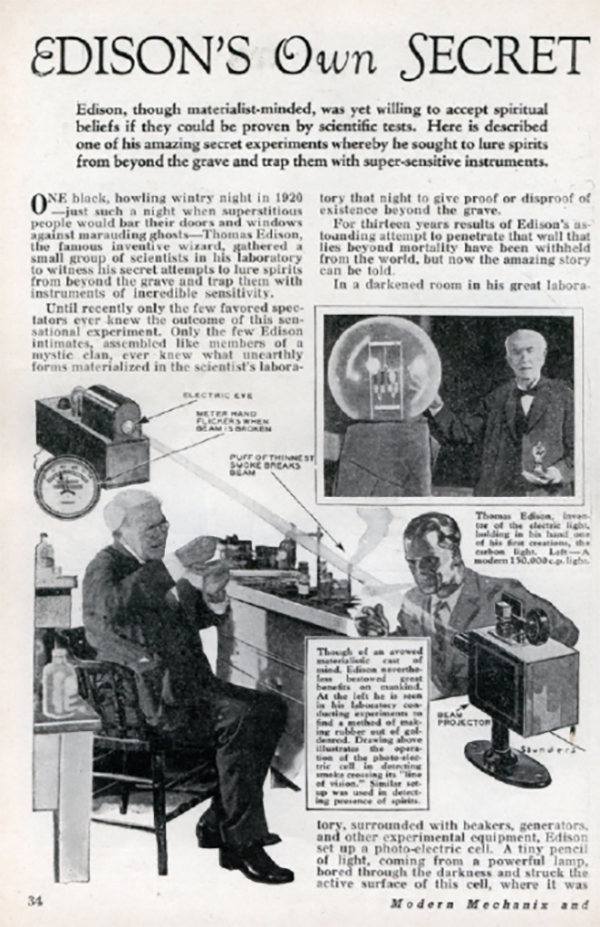
Is there a link with the phonograph from The Return? Are the famous “sounds” transmissions from “the great beyond”, phone calls of sorts from spirits? Could the sounds themselves have been made using a rotary dial telephone? Also: is there a link with the notion of Akasha, the basis and essence of all things in the material world according to the Vedas? Akasha is supposed to be the fifth element, this aether in which spirits dwell – the substratum of the quality of sound, the One, Eternal, and All Pervading physical substance, which is imperceptible. In Sant Mat (a group of spiritual leaders from India), the raison d’être for the human form is to meditate on the sound current, and in so doing merge with it until one’s own divinity is ultimately realised.

Many open questions yet to find an answer.
Finally, before closing this post, I’d like to say a word about Laura’s orb from episode 8. Conjured up by the Fireman (who represents a mix of Indra and Vishnu), it appears to be his 10th Avatar Kalki (Carrie), the one designed to fight demon Kali (i.e. Joudy) at the end of the Kali Yuga. Here is what René Guénon had to say about the sphere: “it is intrinsically the primordial form, the least ‘specified’ of all… the Egg of the world.. the cube is opposed to the sphere… the most ‘arrested’ form of all, end of the cycle of manifestation, ‘stopping-point’ of the cyclical movement“. I have already discussed the squarish form of the Heavenly Jerusalem above – it therefore makes sense that the spheric Laura/Carrie ends up fighting the squarish Palmer house in episode 18.


The fact that Laura’s orb appears to be made of amber is no accident. The classical names for amber (Latin electrum and Ancient Greek ēlektron) are indeed connected to a term meaning ‘beaming Sun'”. It is also worth noting that yellow amber entered Arabic as kahraba = electricity. Laura’s orb is an electrical orb made from fossilised tree resin coming from the world tree supporting the heavens, and connecting them to the terrestrial world, and, through its roots, to the underworld.
The orb actually appears again in episode 18 when Dale/Richard leaves his motel. Positioned in front of an electric line, it has turned into a spheric light bulb, waiting to be lit. Next to it, a tree with branches reminiscent of antlers – the fight between evil and light is on.
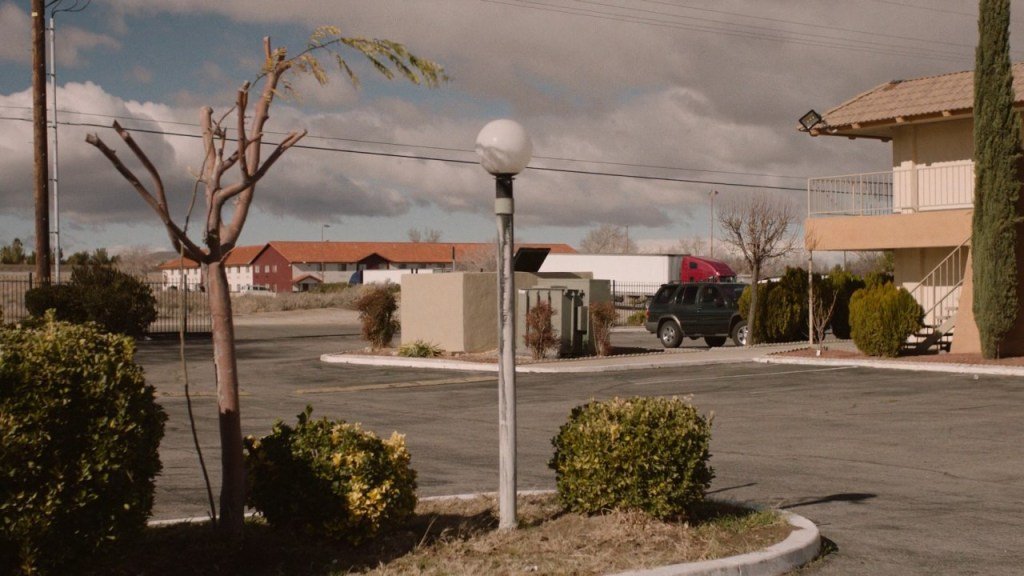
Follow Unwrapping the Plastic: https://www.facebook.com/unwrappingtheplastic/
 TWIN PEAKS - Unwrapping the Plastic